
Life for Women and Children
Daily life in ancient Egypt cannot be understood if we only follow men into fields, workshops, or administrative offices. Much of the civilization’s real continuity happened inside homes, courtyards, kitchens, and local markets. Women were central to that world. They prepared food, managed household resources, cared for children, worked in textile production, participated in agriculture, sold goods, and in some cases held property or acted with notable legal independence compared with many other ancient societies.
This does not mean life was equal in a modern sense. Ancient Egypt was still shaped by hierarchy, gender expectations, family duty, and social class. But women were not invisible. They appear in legal documents, tomb scenes, religious roles, household evidence, and economic activity. A woman’s day could involve grinding grain, baking, brewing, weaving, managing stores, helping in fields, visiting markets, caring for relatives, and participating in family rituals.
Children lived close to adult work. Childhood was real, but it was not separated from responsibility in the way many modern childhoods are. Young children played, learned, copied adults, and moved through the village world with curiosity. Older children might help with animals, water, food preparation, craft tasks, or fieldwork. In elite or scribal families, boys especially might receive formal education to prepare for administrative careers. Most children, however, learned by watching and doing.
Ancient toys and games remind us that children were not simply small workers. Dolls, balls, animal figures, board games, and playful objects show a human side of Egypt that feels surprisingly close. A child in ancient Egypt could laugh, compete, imitate adults, fear punishment, enjoy stories, and fall asleep while the household continued working around them.
The family was also connected to the dead. Ancestors mattered. Tomb offerings, names, memory, and household devotion created a bridge between generations. To live in ancient Egypt was to belong not only to the living family around you, but also to those who came before and those who would remember you after death.
Markets, Crafts, and Local Communities
As the morning grew hotter, villages and towns became more active. People moved through streets with baskets, jars, tools, animals, and goods. Markets were not always permanent places in the modern sense. Exchange could happen in local spaces, near riverbanks, around workshops, or wherever people gathered to trade what they had for what they needed.
Ancient Egypt had a strong redistributive economy, especially around temples and the state, but everyday exchange still mattered. A person might trade grain, fish, vegetables, cloth, pottery, oil, sandals, or labor. Value was often measured through goods rather than coins. This made daily economic life physical and practical. Wealth was not only an abstract number. It was stored in jars, animals, textiles, tools, land access, and social connections.
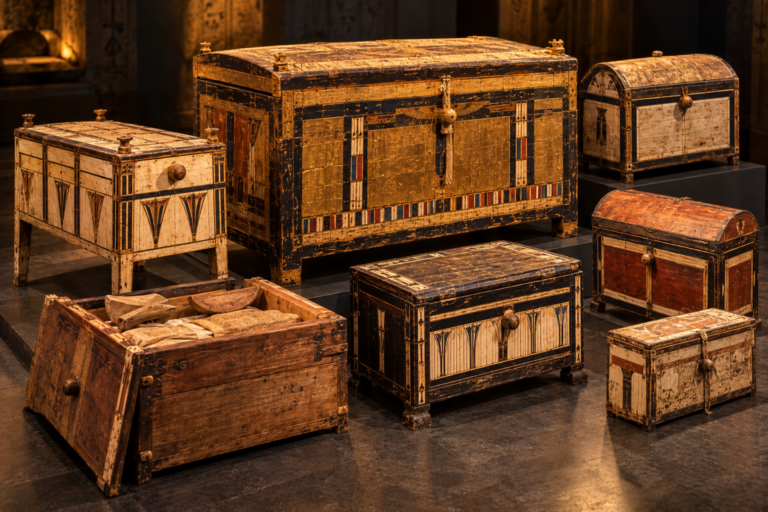
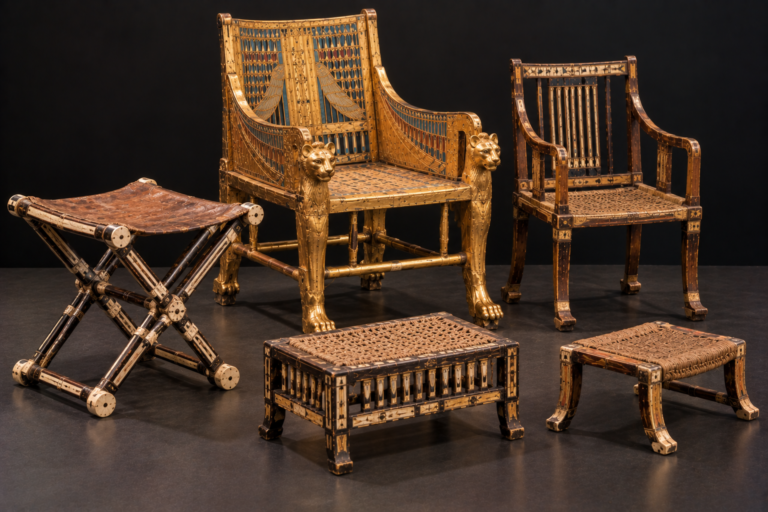
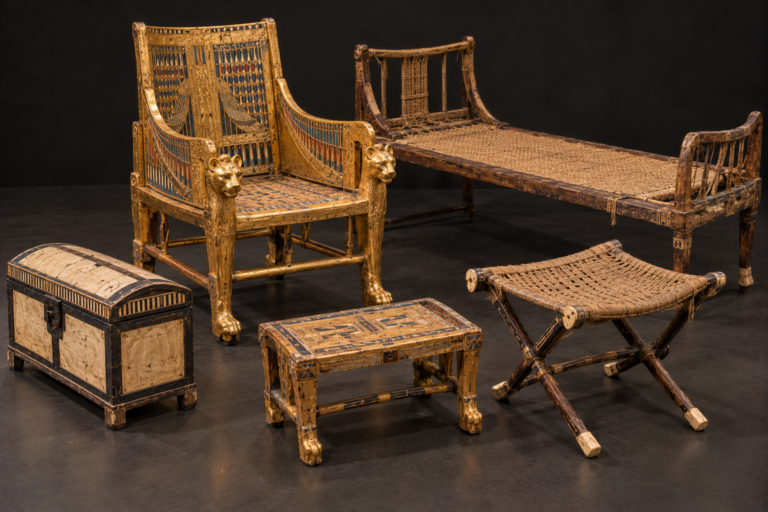
Craftsmen gave Egyptian life much of its texture. Pottery held food and drink. Baskets carried goods. Linen clothed bodies. Wood became beds, boxes, stools, doors, and tools. Stone could become a statue, a vessel, a grinding surface, or a monument. Even ordinary objects required skill. The beauty of ancient Egypt did not only belong to royal art. It also lived in the repeated perfection of useful things.
Community life could be supportive, but also tense. People borrowed, argued, complained, married, inherited, worked, missed duties, praised gods, and accused neighbors. Written records from places such as Deir el-Medina show us a society full of human concerns. Absences from work, disputes, deliveries, payments, prayers, and personal letters reveal people who were not frozen in museum silence. They were busy, emotional, practical, and sometimes difficult.
This is why daily life is one of the most powerful ways to study ancient Egypt. It removes the distance. A royal statue can impress us, but a note about missing work, a worn sandal, or a child’s toy can make the ancient world suddenly feel inhabited.
Faith in Everyday Life
Religion in ancient Egypt was not limited to temples. It lived in homes, names, amulets, festivals, prayers, protective images, and daily gestures. The gods were not distant ideas. They were part of the structure of reality. A family could honor household deities, ask for protection in childbirth, seek healing, fear dangerous forces, and participate in local religious life without ever entering the grandest temple spaces.
For ordinary people, religion was often practical. They wanted safety, fertility, food, health, successful work, protection from snakes or illness, and peace for the dead. Great gods such as Amun, Osiris, Isis, Hathor, Ptah, and Ra belonged to large religious traditions, but local and household devotion could feel more immediate. Protective deities connected to childbirth, the home, or personal safety mattered deeply.
The daily path of the sun itself carried religious meaning. Sunrise was not only light returning. It echoed creation, renewal, and divine order. Sunset was not only the end of work. It marked transition, danger, rest, and the unseen journey of the sun through night. Even if an ordinary farmer was not thinking in theological language, the culture around him gave cosmic meaning to natural rhythms.
This is one reason ancient Egyptian life can feel so layered. A loaf of bread could be breakfast, wages, and an offering. Water could be practical and sacred. A house could be shelter and a place of protection. A name could be identity and survival. A tomb could be architecture and memory. The sacred and the ordinary constantly touched.
The strongest way to write about ancient Egypt is not to separate “religion” from “daily life.” For ancient Egyptians, the two were often connected. The same world that demanded labor also demanded ritual attention, protection, and respect for divine order.
When the Sun Began to Fall
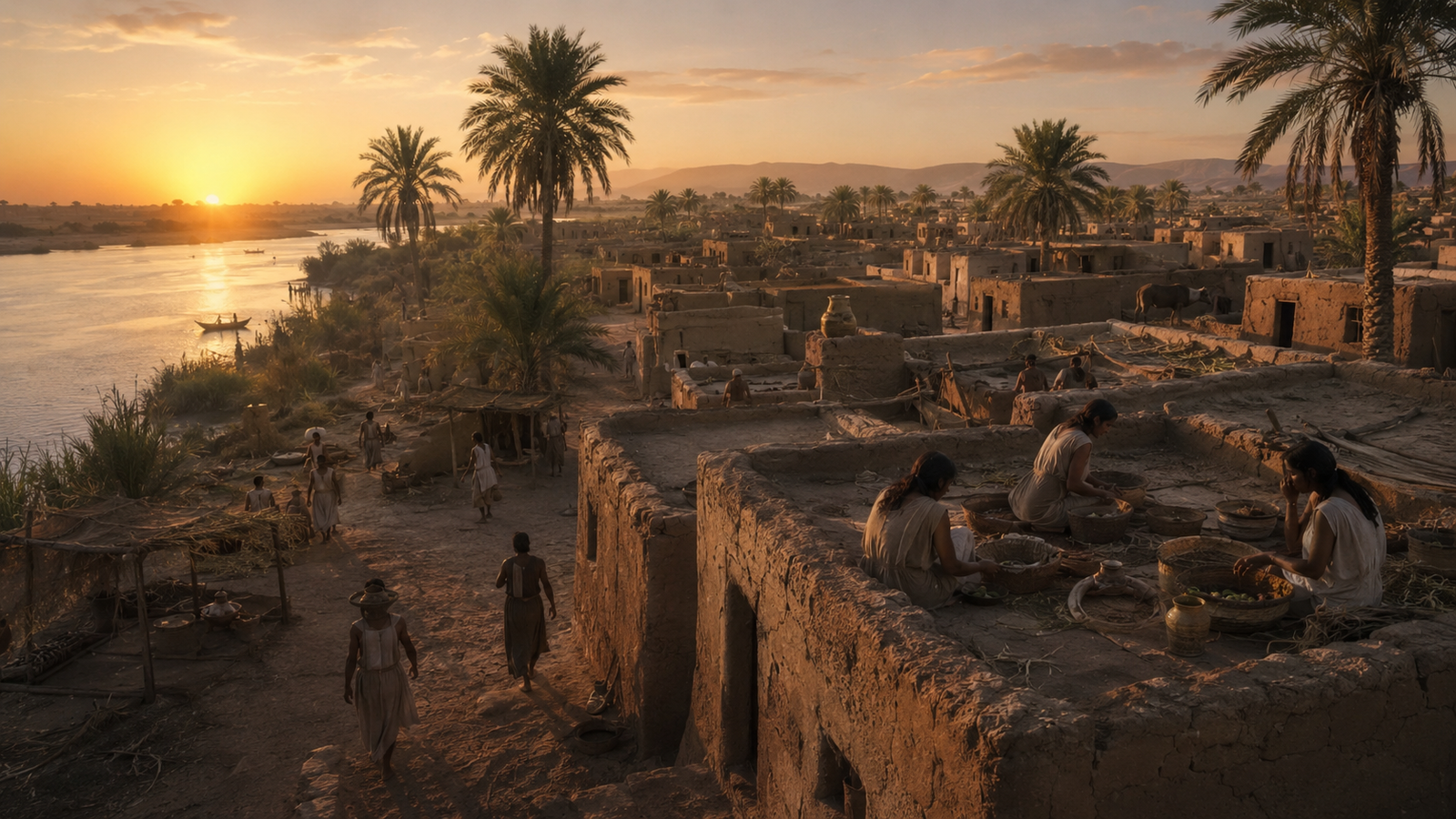
By late afternoon, the hard edge of the day began to soften. The heat lost some of its power. Shadows grew longer along walls and fields. People returned from work, gathered tools, checked animals, carried water, prepared food, and moved back toward the household world. If morning belonged to urgency, evening belonged to return.
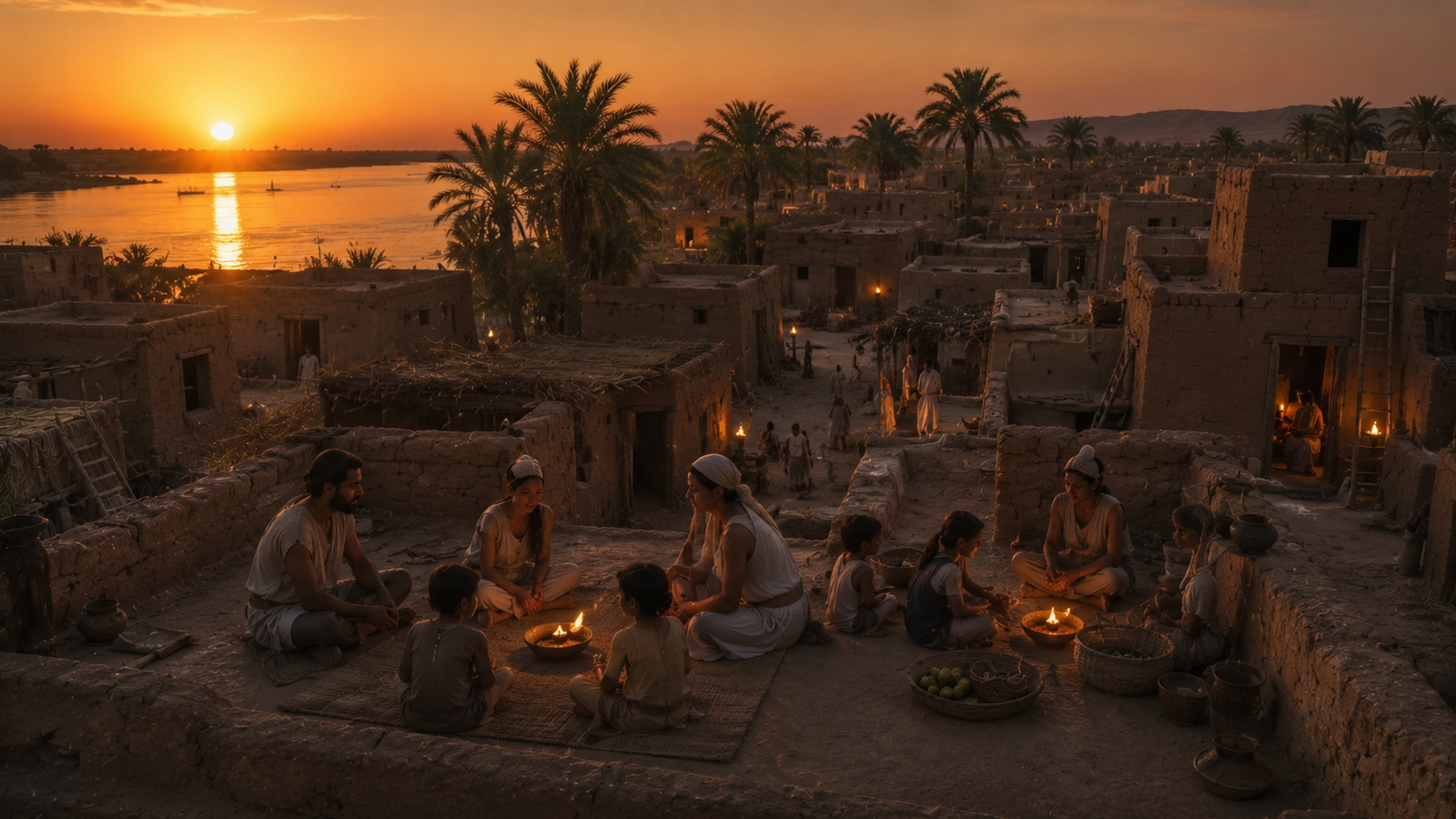
In the evening, food mattered again. Bread, beer, vegetables, fish, and whatever the household could provide became part of the shared rhythm. People talked. Children stayed close. Neighbors might gather. Work did not completely stop, because grinding, mending, storing, cleaning, and preparing for tomorrow still had to happen. But the emotional tone of the day changed.
Rooftops and courtyards became important spaces as the air cooled. A family might sit together under fading light. Lamps might be lit. Stories could be told. A worker might complain about a foreman. A mother might check a child’s hair or clothing. Someone might count supplies. Someone else might speak a small prayer for protection through the night.
There was beauty in this hour, but not the polished beauty of museum gold. It was the beauty of survival repeated so many times that it became culture. The same gestures performed by thousands of families over thousands of mornings and evenings created the human foundation of ancient Egypt.
The Night Before Another Dawn
Night in ancient Egypt changed the world. The river darkened. The desert cooled. Sounds carried differently. The house became a more protective space. Lamps gave limited light. People slept on mats, beds, or rooftops depending on season, comfort, and status. The body rested, but the imagination did not necessarily become calm.
Darkness had meaning. The night could be peaceful, but also uncertain. In Egyptian religious thought, the sun’s night journey was full of danger and renewal. In ordinary life, night brought practical concerns too: animals, insects, illness, thieves, bad dreams, and the vulnerability of children. Protective amulets and household beliefs helped people feel surrounded by forces of care.
Sleep ended the visible day, but it did not end responsibility. Tomorrow would bring more work. The fields would still need water. Bread would still need grain. Children would still need care. Officials might still demand labor or supplies. The gods would still need honor. The dead would still need remembrance.
This repetition is not boring. It is the deepest structure of civilization. Ancient Egypt lasted not because every day was extraordinary, but because millions of ordinary days held together. The monuments survived because the routines behind them were strong enough to support ambition on a massive scale.
What Archaeology Reveals About Daily Life
How do we know any of this? Not from imagination alone. The daily life of ancient Egyptians comes to us through many kinds of evidence. Tomb paintings show food, farming, craftwork, music, servants, banquets, boats, animals, and family scenes. Settlement archaeology reveals houses, streets, storage spaces, ovens, tools, and traces of domestic routines. Written documents record wages, complaints, work attendance, legal matters, deliveries, and letters. Objects such as sandals, combs, baskets, jars, toys, and textiles bring us closer to the body and hand.
Deir el-Medina is especially valuable because it preserves an unusually detailed view of a working community. The people there were connected to royal tomb construction, but their records expose much more than official labor. They show family life, religion, disputes, payments, health issues, and the emotional texture of a real village. It is one of the places where ancient Egypt stops being only monumental and becomes personal.
Archaeology also teaches caution. We do not know every detail of every Egyptian life. Evidence survives unevenly. Elite tombs often preserve more art than poor houses. Dry conditions protect some materials while other traces disappear. A painting may show an ideal world, not an exact photograph of ordinary reality. A worker village may not represent every village in Egypt. Good history does not pretend the evidence is perfect.
But even with those limits, the picture is rich. Ancient Egyptian daily life was organized by work, family, food, water, religion, class, and season. It was both practical and symbolic. It was full of hardship, but also skill, humor, beauty, and continuity. The people who lived before sunrise were not background figures in someone else’s story. They were the civilization.
Before sunrise, ancient Egypt was not a land of silent monuments. It was a living place. Fires were stirred, bread was prepared, water was carried, children woke, farmers moved toward fields, and families faced another day beside the Nile. The temples and tombs may have preserved Egypt’s grandest dreams, but daily life preserved its heartbeat. To understand ancient Egypt fully, we must look not only at kings, but at the ordinary people who made the kingdom possible.
FAQ
What was daily life like in ancient Egypt?
Daily life in ancient Egypt depended on social class, location, and occupation. Most people lived around family, work, food production, religion, and the Nile’s seasonal rhythms. Farmers, craftsmen, women, children, scribes, and laborers all experienced Egypt differently, but their lives were connected by the same environment and economy.
What did ordinary Egyptians do for work?
Many ordinary Egyptians worked in agriculture, but daily work also included baking, brewing, fishing, weaving, pottery, carpentry, building, transporting goods, and serving temples or state projects. Skilled workers and scribes had more specialized roles.
What did ancient Egyptian families eat?
Bread and beer were central staples. Many families also ate vegetables such as onions and garlic, along with dates, figs, fish, and other foods depending on region, season, and wealth. Meat was less common for ordinary people and was often linked to status or special occasions.
Did ancient Egyptian children go to school?
Some children, especially boys from scribal or elite families, received formal education. Most children learned through family life, household tasks, farming, craftwork, and observation of adults.
What were ancient Egyptian homes made from?
Most ordinary homes were made from sun-dried mud brick. This material was practical in the Nile Valley and helped create houses suited to Egypt’s dry and hot climate.
How do archaeologists know about daily life in ancient Egypt?
Archaeologists use tomb paintings, settlement remains, household objects, tools, written records, food remains, pottery, textiles, and sites such as Deir el-Medina to reconstruct daily life. Each type of evidence gives part of the picture.