
Estimated reading time: 13 minutes
Most people meet ancient Egypt through stone. They see pyramids, temples, obelisks, statues, and tomb walls carved for eternity. But the ancient Egyptians themselves did not spend most of their lives inside monuments. They lived in houses made of mud brick, beside narrow streets, near fields, courtyards, ovens, storage jars, sleeping mats, children, animals, and the ordinary noise of family life.
To step inside an ancient Egyptian home is to see Egypt from the ground level. Not the Egypt of kings posing for eternity, but the Egypt of mornings, meals, heat, dust, work, sleep, and survival. This was the space where bread was prepared, children were raised, tools were repaired, stories were told, and families returned after long days beside the Nile. If Before Sunrise followed the rhythm of a day, and Bread and Dust explored the food that sustained it, this article opens the door to the place where much of that life actually happened.
Ancient Egyptian homes were usually built from sun-dried mud brick, not stone. Their size and layout depended on wealth, location, and period, but many ordinary houses included storage spaces, work areas, cooking zones, courtyards, and rooftops. These homes were practical responses to climate, family needs, food storage, and daily labor.
- Entering an Ancient Egyptian Home
- Built From the River
- Why Mud Brick Changed Everything
- Inside the House
- Life Around the Courtyard
- The Kitchen and Daily Food
- Where Did People Sleep?
- Sleeping Above the Heat
- Children Inside the Home
- A House Full of Work
- Rich Homes and Poor Homes
- What Archaeologists Found Inside Ancient Houses
- Final Thoughts
- Frequently Asked Questions
Entering an Ancient Egyptian Home
Imagine walking through a village street in ancient Egypt. The ground beneath your feet is dry and dusty. The air carries the smell of clay, smoke, grain, animals, and river mud. Houses stand close together, their walls made from bricks dried under the same sun that hardens the fields after floodwater retreats. There is no marble entrance, no grand staircase, no polished palace floor. The doorway is modest, practical, and familiar to the people who pass through it every day.
Inside, the first impression is not luxury. It is usefulness. Ancient Egyptian houses were not designed to impress strangers. They were designed to help families live. A home had to protect people from heat, store food, support cooking, provide space for work, and hold the possessions that mattered most. Every corner had a function.
For ordinary Egyptians, the home was not only a private place. It was part of an active household economy. Food preparation happened there. Textile work could happen there. Tools were stored there. Children learned there. Religious gestures and family rituals could take place there. The house was shelter, workplace, storeroom, kitchen, sleeping space, and family archive all at once.
This is why ancient Egyptian homes are so important for understanding daily life. Temples tell us how Egyptians imagined the divine. Tombs tell us how they prepared for eternity. Houses tell us how they lived before the next sunrise.
Built From the River
The most ordinary material in ancient Egyptian architecture was also one of the most important: mud. The Nile did not only water fields. It helped build homes. River mud mixed with straw could be shaped into bricks and left to dry in the sun. Once hardened, these mud bricks became the walls of villages, towns, workshops, storage areas, and countless family houses.
Stone was available in Egypt, but it was not the normal material for ordinary homes. Stone belonged more naturally to temples, tombs, royal buildings, and monuments meant to last for eternity. Mud brick, by contrast, belonged to living communities. It was accessible, practical, and well suited to the Egyptian environment.
The process was simple in concept but important in practice. Mud was gathered, mixed with plant material, pressed into molds, dried, stacked, and used. The resulting bricks were not eternal like limestone or granite, but they were effective. They could be made locally, repaired when damaged, and used to create walls thick enough to offer some protection from heat.
There is a beautiful irony here. The temples that survive today often make ancient Egypt look like a stone civilization. But much of everyday Egypt was actually a mud-brick world. The houses where people cooked, slept, argued, laughed, worked, and raised children were built from the river’s own earth.
Why Mud Brick Changed Everything
Mud brick was not a poor substitute for stone. It was the right material for a living house. In a hot climate, thick mud-brick walls could help moderate temperature. They absorbed and released heat differently from thin modern materials, helping create cooler interior spaces during parts of the day.
Mud brick also allowed communities to build quickly using local resources. A village did not need expensive quarrying or long-distance transport to create homes. The material came from the same environment that supported agriculture. In this sense, the house, the field, and the river belonged to one system.
Of course, mud brick had weaknesses. Rain, flooding, neglect, and time could damage it. This is one reason ordinary Egyptian houses rarely survive as dramatically as temples. Many homes disappeared, collapsed, or were built over. What archaeologists find today is often partial: foundations, wall lines, storage pits, ovens, floors, and objects left behind.
But those remains are powerful. A broken wall can reveal the size of a room. An oven can reveal where cooking happened. A jar can suggest storage. A worn floor can show movement. Archaeology does not need a perfect house to tell a human story.
Ancient Egypt can look like a civilization of stone because stone survives. But daily life was often lived in mud-brick spaces that were more fragile, more ordinary, and much closer to the real rhythm of Egyptian families.
Inside the House
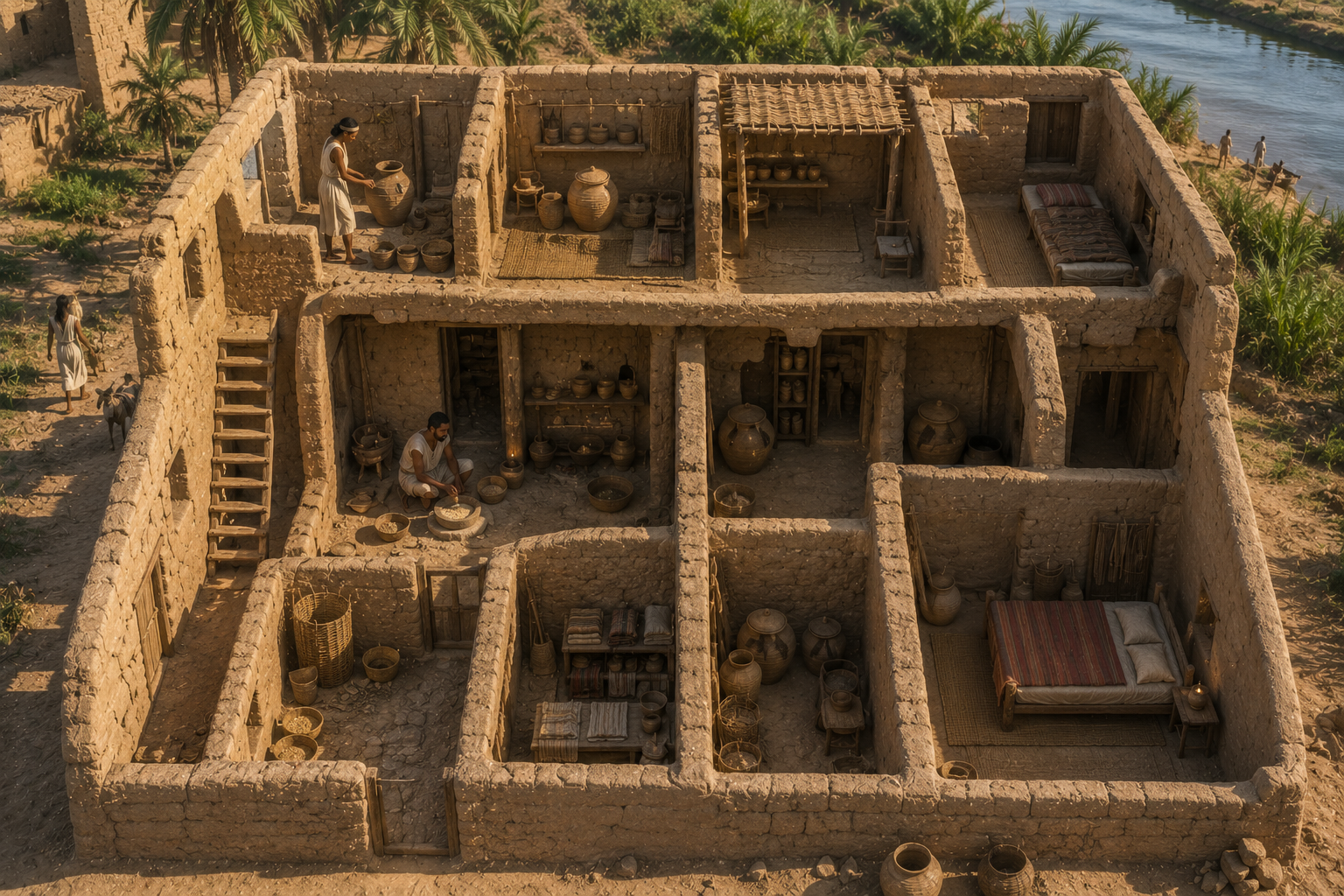
The layout of an ancient Egyptian house varied widely. A modest village home was not the same as a large elite residence. A worker’s house in a planned settlement was not identical to a rural farmhouse. Still, many homes shared certain practical concerns: storage, food preparation, work, sleep, and protection from the climate.
Some houses had a front area that separated the street from the private interior. Others opened more directly into domestic space. Rooms could be small by modern standards. Storage was essential because grain, oil, beer ingredients, tools, textiles, and household goods needed protection. A family’s security often depended on what it could store.
The house might include a main room, side rooms, a kitchen or cooking area, storage spaces, and access to a roof. Wealthier homes could include more rooms, larger courtyards, decorative features, gardens, or separate service areas. Poorer houses were simpler, but even the simplest household required organization.
Furniture was usually practical. Mats, low stools, chests, beds, headrests, baskets, pottery vessels, lamps, and wooden boxes could appear depending on wealth. Many daily objects were made from organic materials that do not always survive well, which means ancient homes may have been more furnished and textured than the archaeological record first suggests.
Inside the home, light and shade mattered. Small openings helped reduce heat. Thick walls provided some insulation. The roof offered another living surface. Courtyards allowed work and cooking to happen in more open air. Egyptian domestic architecture was not random. It responded to a real climate.
Life Around the Courtyard
For many households, the courtyard was one of the most important parts of the home. It was not merely an empty space. It was where domestic life breathed. In a climate where indoor rooms could become hot and dark, a courtyard offered light, air, and room to work.
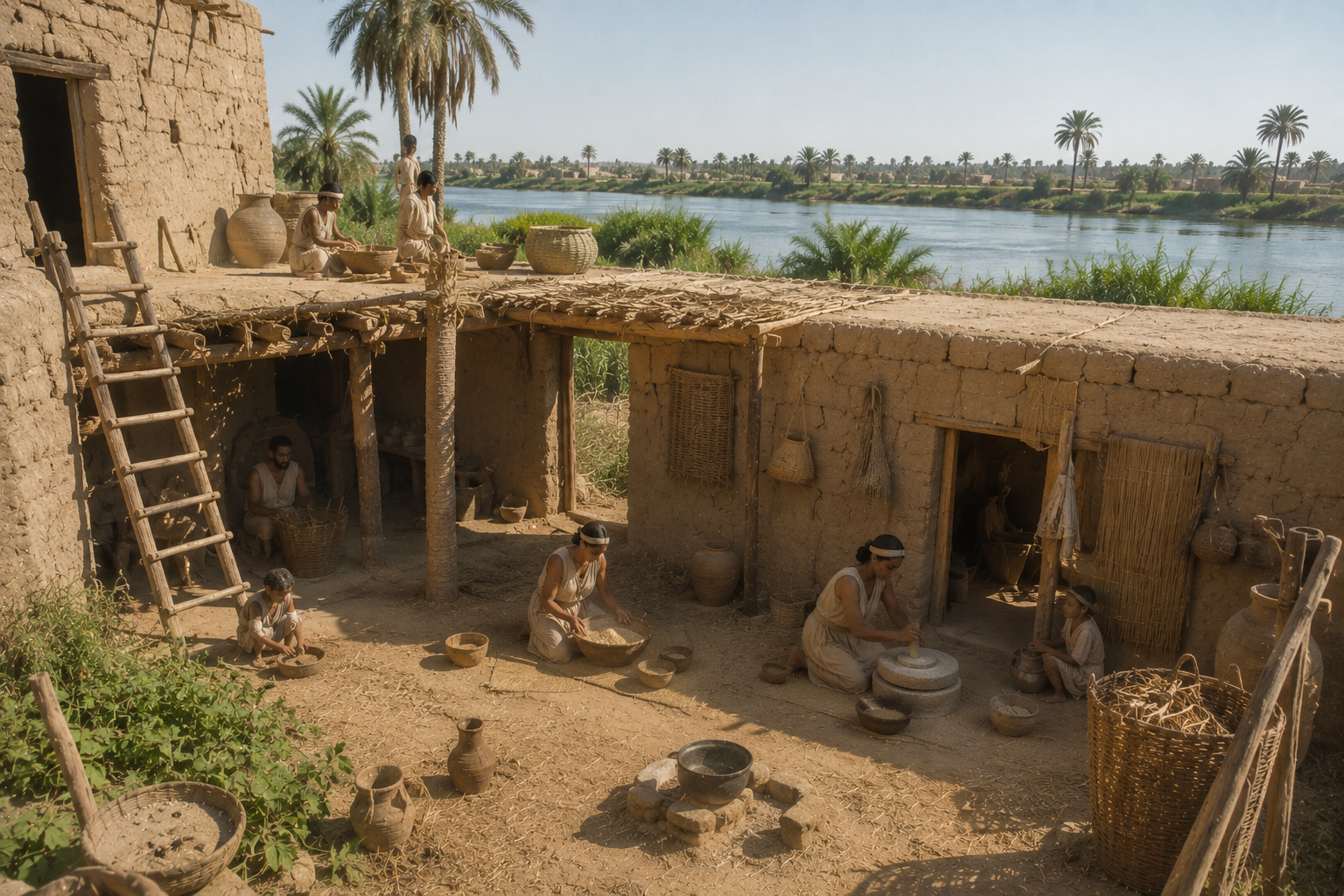
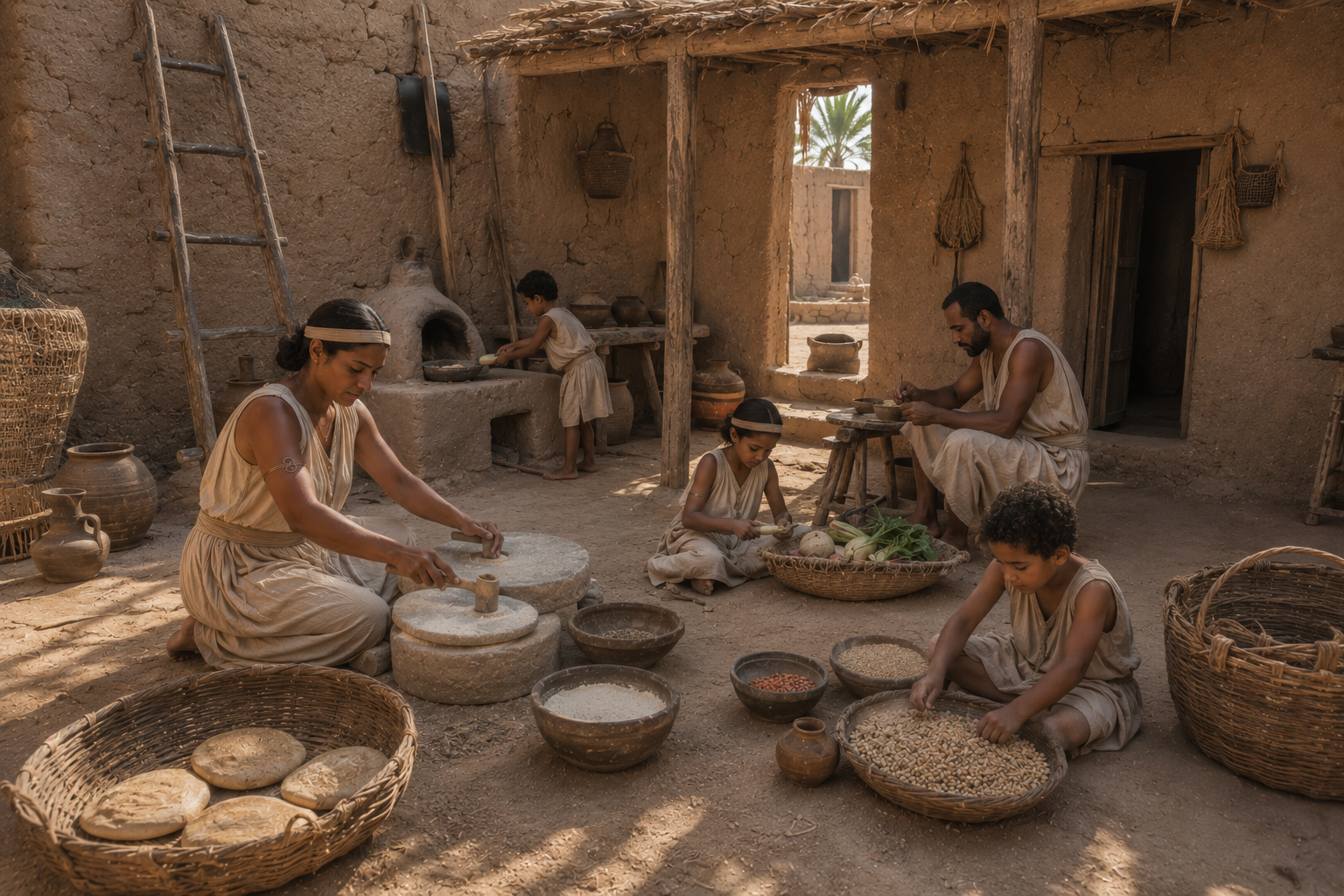
Here, grain could be prepared. Food could be sorted. Children could play near adults. Tools could be cleaned. Animals might be kept nearby depending on the house and community. Neighbors could be heard. Smoke could rise from cooking. The courtyard connected the private household to the larger world without fully exposing it.
Courtyard life also reminds us that ancient Egyptian homes were active spaces. A modern person might separate home, workplace, school, kitchen, and storage into different buildings or systems. Ancient households often brought these functions together. The home was where life happened in layers.
In this space, the article Bread and Dust becomes visible again. Food was not an abstract part of the diet. It was prepared by hands, in household spaces, through repeated work. Bread began as grain, passed through grinding stones, became dough, and reached the family through the labor of people inside and around the home.
The Kitchen and Daily Food
The kitchen was not always a separate room in the modern sense. Cooking could happen in designated areas, courtyards, or spaces arranged around ovens, hearths, jars, grinding stones, and fuel. What mattered was not the label of the room, but the repeated work that took place there.
Ancient Egyptian food required preparation long before eating. Grain had to be ground. Dough had to be shaped. Beer had to be produced. Vegetables had to be cleaned. Fish might be cooked or preserved. Jars had to be filled, sealed, opened, and reused. A household kitchen was therefore a center of movement.
Bread dominated daily meals for many families. Beer, vegetables, fish, dates, figs, and seasonal foods completed the picture. As explained in Bread and Dust: What Ancient Egyptians Ate Every Day, food was not simply nutrition. It was labor, economy, family, and survival.
Cooking also shaped time. Morning preparation began early. Evening meals marked return from work. The smell of bread or smoke could define the atmosphere of the home. Children grew up learning these rhythms naturally because food production happened around them.
If we want to understand an ancient Egyptian house, we cannot imagine it as a quiet empty structure. It was full of sound: grinding, pouring, sweeping, speaking, children moving, jars shifting, fire crackling, and perhaps animals outside the door. The house was alive because food kept it alive.
Where Did People Sleep?
Modern homes often dedicate specific rooms to sleeping, but ancient Egyptian households used space more flexibly. The number of rooms available depended heavily on wealth, location, and family size. A large household might have several distinct areas, while a smaller home required family members to share limited space.
Sleeping arrangements reflected practicality rather than luxury. Beds existed, especially among wealthier Egyptians, but many people also used mats, simple wooden frames, or other modest sleeping surfaces. Archaeological discoveries have revealed beds, headrests, and household furniture that help us understand how people rested after long days of labor.
Ancient Egyptian headrests often surprise modern visitors. Rather than soft pillows, many Egyptians used curved supports designed to elevate the head while sleeping. These objects appear strange to modern eyes, yet they served practical purposes and became common features of Egyptian domestic life.
Sleep was not simply the end of the day. It was recovery. Farmers needed rest before returning to fields. Craftsmen needed energy for skilled labor. Women responsible for household management faced another demanding day ahead. Every member of the household depended on sleep to maintain the rhythm of daily life.
The home therefore functioned as a place of restoration. After the noise of work, markets, and agriculture, families returned to spaces designed to support another sunrise.
Sleeping Above the Heat
One of the most fascinating aspects of ancient Egyptian domestic life involved the roof. Modern readers often imagine rooftops as unused architectural features, but in ancient Egypt they could become valuable living spaces.
During warmer months, rooftops offered cooler sleeping conditions than enclosed rooms below. After sunset, heat trapped within walls slowly escaped, while breezes moving across the roof created a more comfortable environment. Families sometimes spent evenings there before settling down for the night.
The roof could also serve other purposes. Storage, household work, food preparation, drying materials, and social interaction might all take place there depending on the needs of the family.
This use of rooftops highlights an important principle of Egyptian architecture. Homes were designed around climate. Every part of the structure had potential value. Walls, courtyards, roofs, and interior rooms worked together to help families adapt to environmental conditions.
In a future Daily Life article, The Last Lamp at Dusk, we will follow the transition from evening activities into nighttime routines, exploring how Egyptians experienced darkness, rest, and the final hours before another dawn.
Ancient Egyptian houses were not used in the same way modern homes are used. Courtyards, rooftops, workspaces, and storage areas often served multiple purposes throughout the day, changing according to season, weather, and household needs.
Children Inside the Home
The home was where children experienced most of their early life. Long before they understood farming, administration, religion, or trade, they understood the household. It was their first school, workplace, playground, and social environment.
Children watched adults prepare food, repair tools, manage animals, weave textiles, organize storage, and carry out countless everyday tasks. Knowledge was not always transmitted through formal lessons. Much of it came through observation and participation.
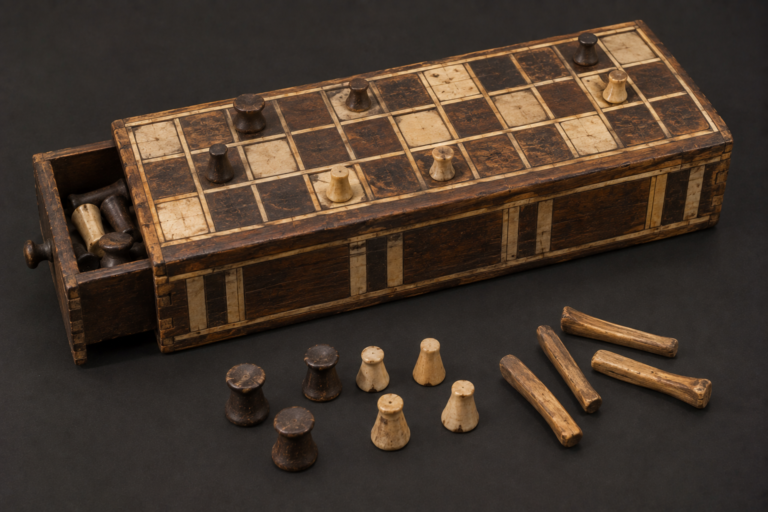
Archaeological discoveries have revealed toys, dolls, miniature objects, and gaming pieces that remind us childhood existed in ancient Egypt just as it does today. Children laughed, played, explored, and learned. They were not simply miniature adults.
Family relationships shaped identity. Grandparents, parents, siblings, and extended relatives often influenced daily life. The home created continuity between generations and helped preserve traditions, skills, and values.
This subject deserves a deeper exploration of its own, which is why the future article Born Beside the River will focus entirely on childhood, family life, and growing up in ancient Egypt.
For now, it is enough to recognize that the home stood at the center of childhood experience. Every room, courtyard, rooftop, and storage jar formed part of the world children learned to navigate.
A House Full of Work
Ancient Egyptian homes were rarely quiet. Work happened everywhere. The idea of separating professional life from domestic life would have felt unfamiliar to many households.
Women prepared food, managed supplies, produced textiles, cared for children, and handled numerous household responsibilities. Men returned from fields, workshops, river activities, or administrative duties. Children assisted where they could. Elder family members contributed knowledge and experience.
Storage demanded constant attention. Grain had to remain protected. Food supplies required monitoring. Water needed replenishment. Household objects needed maintenance and repair. The home was a working system that depended on continual effort.
Many productive activities took place directly inside domestic spaces. Textile production, food preparation, tool maintenance, basket making, and other tasks often occurred within the household itself rather than in separate commercial facilities.
This reality helps explain why ancient Egyptian homes appear so practical in archaeological evidence. Their design reflected everyday requirements rather than decorative ambitions.
A house was successful not because it looked impressive, but because it allowed a family to function efficiently.
Rich Homes and Poor Homes
Not all Egyptians lived the same way. Social class influenced the size, complexity, and comfort of domestic spaces. Wealthier households enjoyed advantages unavailable to ordinary families.
Larger homes could include multiple reception rooms, private areas, gardens, storage facilities, and more elaborate furnishings. Better-quality furniture, decorative elements, and specialized workspaces reflected higher social status.
Elite residences sometimes contained features that distinguished them clearly from village homes. Yet even the richest Egyptians still relied on many of the same principles seen throughout society. Food storage remained important. Climate remained important. Family life remained important.
Poorer households operated on a smaller scale. Rooms were fewer. Possessions were more limited. Resources had to be managed carefully. Yet these homes still fulfilled the same essential functions.
What is remarkable is how much ancient Egyptian society shared despite differences in wealth. Bread still mattered. Family still mattered. Shelter still mattered. The Nile still shaped everyday existence.
Whether a person lived in a modest mud-brick dwelling or a spacious elite residence, daily life remained connected to the same environment and many of the same practical concerns.
What Archaeologists Found Inside Ancient Houses
Much of what we know about ancient Egyptian domestic life comes from archaeology rather than written descriptions. Excavated settlements provide a direct window into spaces where ordinary people actually lived.
Sites such as Deir el-Medina are especially valuable because they preserve evidence from a community whose residents left behind both physical remains and written records. Houses, storage areas, tools, furniture fragments, ovens, religious objects, and personal items reveal details that monuments rarely provide.
Archaeologists study floor plans, wall remains, cooking installations, pottery assemblages, and wear patterns to reconstruct how rooms were used. A cluster of jars may indicate storage. Grinding stones suggest food preparation. Ovens reveal cooking locations. Small objects can identify sleeping spaces, work areas, or household rituals.
These discoveries allow historians to move beyond broad generalizations. Instead of imagining an anonymous ancient population, we begin to see real households. Families organized supplies. Children played. Meals were prepared. Repairs were made. Life unfolded within walls built from mud and sunlight.
The archaeological record is incomplete, but it remains remarkably powerful. Every excavated house reminds us that ancient Egypt was not only a civilization of kings. It was also a civilization of families.
The pyramids may dominate the modern image of ancient Egypt, but most Egyptians never lived among monumental stone structures. They lived in homes built from the Nile itself. Within mud-brick walls, families prepared meals, raised children, stored grain, repaired tools, shared stories, and rested after long days of work. These houses rarely survive as dramatically as temples or tombs, yet they preserve something equally valuable: evidence of ordinary life. They remind us that civilizations are not sustained by monuments alone. They are sustained by homes. If Before Sunrise showed how the day began, and Bread and Dust revealed the food that sustained it, then The House Beside the Nile reveals where much of that life actually happened. Behind every great achievement of ancient Egypt stood families living inside houses like these.
Frequently Asked Questions
What were ancient Egyptian houses made of?
Most ancient Egyptian houses were built from sun-dried mud bricks made from Nile mud mixed with straw. Stone was generally reserved for temples, tombs, and major public structures.
Why did Egyptians use mud bricks?
Mud bricks were inexpensive, widely available, easy to produce locally, and well suited to Egypt’s hot climate. They provided practical building material for everyday homes.
Did ancient Egyptians have bedrooms?
Some larger homes contained designated sleeping areas, but many households used rooms flexibly. Sleeping arrangements often depended on family size, wealth, and available space.
What did the inside of an ancient Egyptian house look like?
Typical homes included storage spaces, work areas, cooking zones, living rooms, and access to rooftops. Furnishings were usually practical and designed to support daily family life.
Did ancient Egyptians sleep on rooftops?
Yes. During hot weather, rooftops often provided cooler sleeping conditions and became important living spaces during evenings and nights.
How do archaeologists know what ancient Egyptian homes looked like?
Archaeologists study excavated settlements, house foundations, room layouts, ovens, storage facilities, furniture remains, household objects, and written records to reconstruct domestic life.