
Tutankhamun was buried with more than one way to sit.
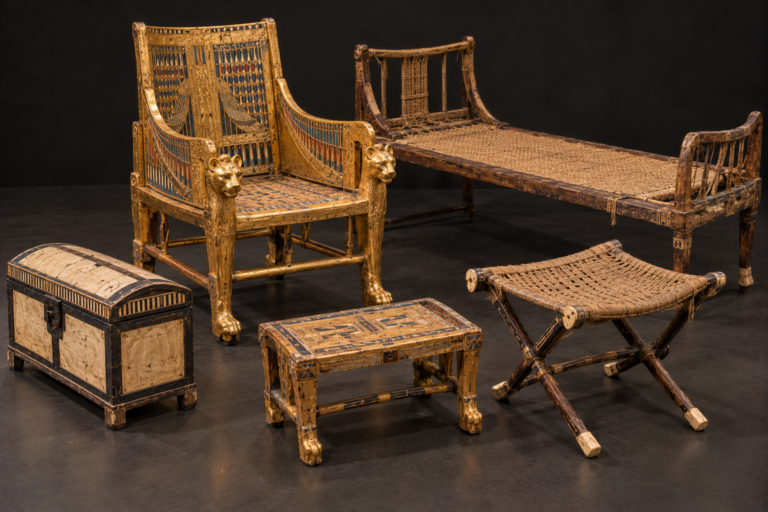
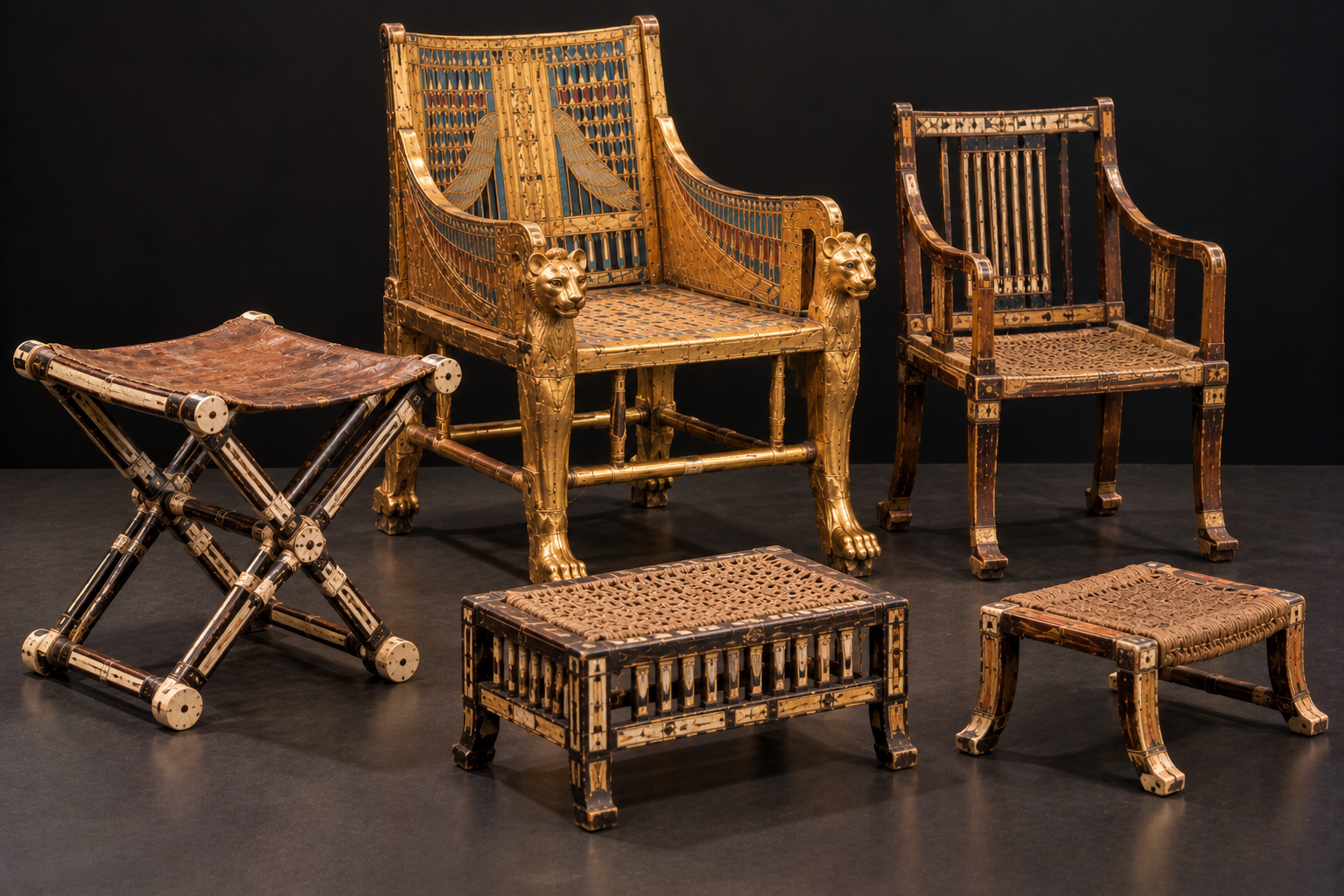
Inside his tomb were elaborate royal chairs, lightweight stools, folding seats, footstools and the spectacular object now commonly known as his Golden Throne. Howard Carter’s records even distinguish a chair associated with the king as a small child from another object simply described as the King’s Chair.
Together, these objects reveal something easily missed when attention focuses only on gold. A seat in ancient Egypt could be practical furniture, portable equipment, a demonstration of extraordinary craftsmanship and a visual statement about kingship at the same time.
Quick Context
- King: Tutankhamun
- Dynasty: Eighteenth Dynasty
- Period: New Kingdom
- Tomb: KV62, Valley of the Kings
- Seating found: Chairs, elaborate ceremonial seats, stools, folding stools and footstools
- Famous royal seat: The object commonly known as Tutankhamun’s Golden Throne
- Carter number of the famous Golden Throne: 91
- Museum numbers: Cairo JE 62028; GEM 4573
- Portable seating: Folding stools were included in the burial
- Materials: Different pieces combined wood, leather, ivory, ebony, gold, gesso, glass or other inlays, and woven plant materials
- Key caution: Not every chair was a throne, and not every surviving seat can be proven to have been personally used by Tutankhamun
More Than a Golden Throne
Modern presentations of Tutankhamun’s furniture often revolve around one magnificent object: the Golden Throne.
But KV62 preserved a much broader collection of seating.
Carter’s records distinguish between the King’s Chair, a chair he associated with Tutankhamun as a small child, the famous throne, folding stools, ordinary stools, footstools and other specialized forms of seating.
This variety changes the story.
Instead of asking only what Tutankhamun’s throne looked like, we can ask how many different problems ancient Egyptian furniture makers were solving.
How could a chair remain strong while supporting the sitter?
How could a stool be made portable?
How could leather or woven plant material be incorporated into a seat?
How could a functional object also communicate royal status?
And why would some pieces be lavishly covered with gold and inlay while others relied on relatively modest materials?
These questions make the chairs and stools an important part of the larger collection of furniture found inside Tutankhamun’s tomb.
Tutankhamun’s tomb preserved more than a throne. It preserved an entire vocabulary of royal seating.
Where Were the Chairs Found?
The chairs were not discovered together in a neatly arranged royal sitting room.
They formed part of the crowded archaeological environment of KV62.
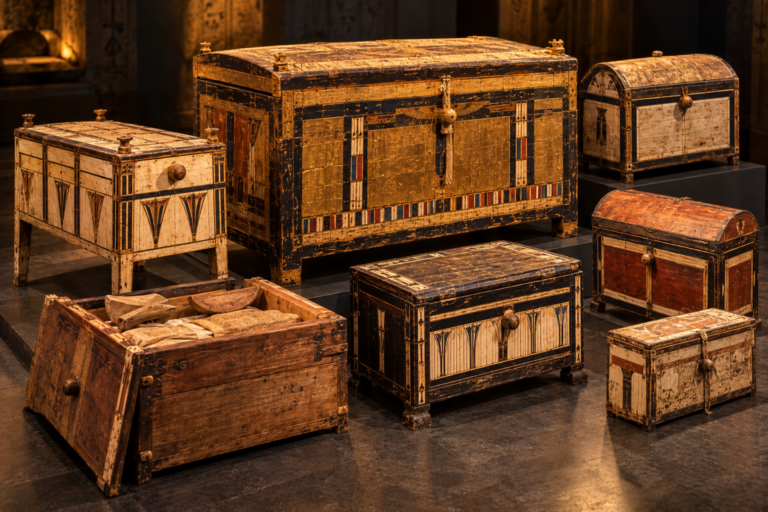
The Antechamber contained some of the most famous pieces, surrounded by couches, chariots, boxes and many other objects. The Annexe contained additional furniture in much greater disorder.
This matters because the position in which Carter encountered a seat does not always tell us exactly where it had originally been placed when the tomb was first closed.
Ancient robbers disturbed parts of the burial, and officials subsequently reorganized at least some objects before resealing the tomb.
One archaeological diary entry is particularly revealing. Arthur Mace noted that the position of a stool helped demonstrate that officials had placed chariot wheels in their recorded position after the plundering.
A seemingly ordinary stool could therefore contribute to reconstructing the history of disturbance inside the tomb.
This is why Carter’s documentation of Tutankhamun’s tomb is so important. Archaeological information comes not only from individual objects but also from their positions and relationships.
Chair, Throne or Ceremonial Seat?
Calling every elaborate royal chair a throne creates a problem.
Ancient furniture does not always fit comfortably into modern categories, and even the terminology used by the excavators could express uncertainty.
Carter object 91, the famous Golden Throne, is catalogued in the Tutankhamun archive as a “Throne (or ceremonial chair).”
That small qualification is important.
A chair describes the physical form of an object.
A throne adds ideas of royal authority, status and ceremonial function.
A ceremonial chair may look throne-like while its precise ancient use remains difficult to reconstruct.
The safest approach is therefore to examine each piece individually rather than assuming that decoration alone determines function.
Not every royal chair was necessarily a throne. Elaborate materials can demonstrate status and craftsmanship without revealing the exact ceremony or setting in which a particular seat was used.
Tutankhamun’s Golden Throne
Carter object 91 is one of the most recognizable pieces of furniture from the tomb.
Its fame comes from more than the amount of gold visible on its surface.
The chair combines architecture, woodworking, precious materials, colored inlay and figurative decoration into a single functional form.
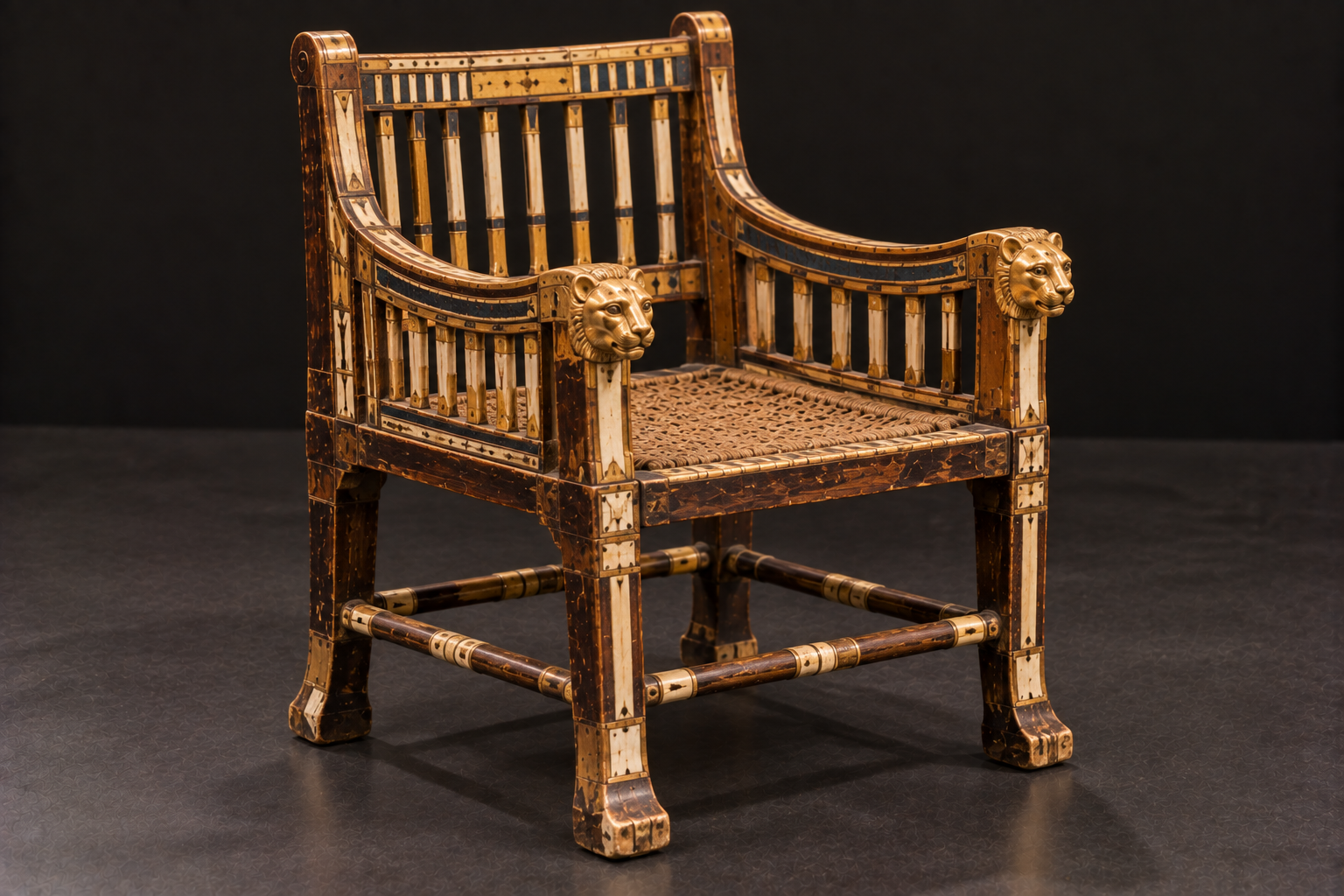
Conservation records for object 91 describe areas covered with thin gold plate as well as areas where gesso was gilded. The decoration also incorporated colored stones and colored glass.
This gives us a much more accurate picture than the popular phrase “gold chair.”
Underneath the brilliance was a carefully constructed piece of furniture.
The wood had to support the sitter.
The joints had to remain stable.
The decorative layers had to conform to the underlying structure.
The inlays had to be prepared and positioned.
Its appearance depended on several crafts working together.
Was the Golden Throne Made of Solid Gold?
No.
The Golden Throne should not be imagined as an enormous mass of solid gold shaped into a chair.
Its structure depended on wood, while gold was used on its surfaces along with gesso and colored inlays.
This construction makes practical sense.
Wood provides the structural properties needed for legs, rails, supports, arms and other components. Gold can then transform the visible surface without requiring the entire piece to be made from a dense precious metal.
The distinction also helps us understand ancient Egyptian luxury more accurately.
Luxury was not simply a question of using the largest possible quantity of gold.
It could come from combining materials with exceptional precision.
The Scene on the Back of the Throne
The back panel is one reason the chair became so famous.
It shows Tutankhamun seated while his wife, Ankhesenamun, stands before him.
The composition feels unusually intimate compared with scenes of the king hunting, fighting or dominating enemies.
But it is important not to turn the scene into a photograph.
It belongs to the visual culture of Egyptian kingship and was created according to artistic conventions.
It can tell us how the royal couple was represented.
It can show clothing, jewelry, posture and the visual language chosen for the king and queen.
It cannot prove that the artist recorded one particular private event exactly as it occurred.
Why Put This Scene on a Chair?
Because elite furniture could become a surface for royal imagery.
The chair was not simply something hidden beneath the king when he sat down.
Its back, arms, legs and other visible surfaces offered opportunities for decoration.
That means the object could perform several functions simultaneously.
It supported the body.
It displayed expensive craftsmanship.
And it communicated an image of royal identity.
The throne scene is evidence for royal representation, not a private photograph. It can help us understand how Tutankhamun and Ankhesenamun were presented visually without proving the details of a specific moment in their personal lives.
The King’s Chair
The Golden Throne was not the only elaborate chair important enough for Carter to highlight.
His lecture notes separately identify Carter object 148 as “The King’s Chair” and include another image showing details of its back.
This distinction is useful because it prevents the Golden Throne from swallowing the rest of the furniture collection.
Tutankhamun’s burial contained multiple forms of high-status seating.
They differed in design, decoration and construction.
That diversity suggests that the royal environment required different types of seats rather than one universal chair for every occasion.
However, assigning each surviving chair to a specific palace room or ceremony would go beyond the evidence.
The objects show diversity more securely than they show a precise schedule of use.
Tutankhamun’s Childhood Chair
One of the most intriguing entries in Carter’s records has nothing like the visual fame of the Golden Throne.
It is Carter object 143.
In his lecture notes, Carter called it “The King’s Chair When a Small Child.”
That description immediately changes the scale of the story.
Instead of looking only at the public image of an Egyptian king, we encounter a piece interpreted by the excavator as furniture associated with an earlier stage of Tutankhamun’s life.
Tutankhamun became king while still young, so the possibility that objects associated with childhood survived among his possessions is entirely plausible.
But caution is necessary.
Carter’s description should not be expanded into claims the chair itself cannot establish.
It does not tell us the exact age at which Tutankhamun supposedly used it.
It does not tell us where it originally stood.
And it does not record how frequently he sat in it.
What it does provide is evidence for furniture at a smaller scale within the royal collection.
The smallest chair associated with Tutankhamun can be historically important for a completely different reason from the most spectacular golden one.
Could It Have Survived From Before He Became King?
That is an attractive possibility, especially because Tutankhamun came to the throne at a young age.
But the distinction between possibility and proof matters.
A small chair interpreted as a child’s chair may preserve an object associated with his earlier years. It does not by itself provide a complete ownership history.
The broader lesson is stronger.
Objects entering KV62 did not necessarily begin their histories with Tutankhamun’s funeral.
Some of Tutankhamun’s everyday possessions may already have been used, stored or moved before being selected for burial.
Folding Stools and Portable Seating
At the opposite end of the spectrum from a massive ceremonial chair was furniture designed to move.
Folding stools demonstrate that Egyptian craftspeople understood the advantages of portable seating.
The concept sounds simple until we consider the engineering.
A rigid stool only needs to remain stable.
A folding stool must move deliberately when being opened or closed and then resist movement when someone sits on it.
The crossed frame must handle weight.
The seat must distribute tension.
The joints or pivot points must permit repeated movement.
And the entire object has to remain light enough for portability to be worthwhile.
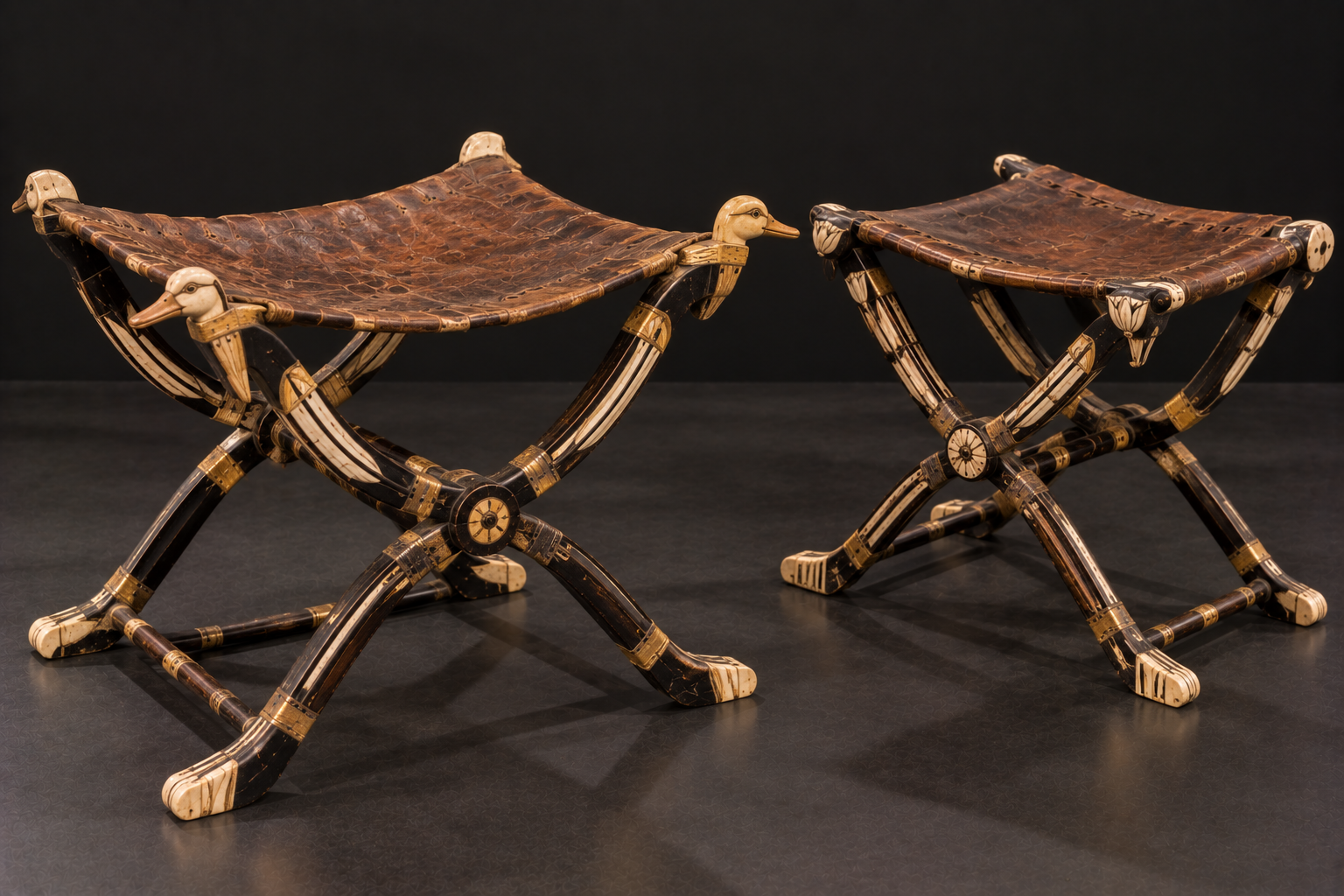
Portable seating makes sense within a mobile royal environment.
The court did not exist permanently inside one palace room.
Royal activity could involve movement between residences, ceremonies and other locations.
We should not invent a specific journey for any particular stool, but the technology itself demonstrates that mobility was considered in furniture design.
This complements what we see in the chariots found inside Tutankhamun’s tomb: royal material culture included objects designed around movement as well as permanence.
Ebony, Ivory, Gold and Leather
Portable did not necessarily mean cheap.
Two stools catalogued as Carter 139 and 140 demonstrate how sophisticated a relatively compact seat could become.
Records describe them as combining ebony, ivory, gold and leather.
Conservation notes describe ebony with ivory inlay, gold bands applied over gesso, and leather seating.
That combination is revealing.
Dark wood could provide a striking contrast with pale ivory.
Gold could emphasize selected parts of the structure.
Leather provided a flexible seating surface.
The object therefore brought together materials chosen for different purposes rather than relying on one substance throughout.
A stool could be mechanically practical and visually luxurious at the same time.
Did Tutankhamun’s Furniture Use Real Leather?
Yes. Leather formed part of some seating from the tomb.
For a stool, leather can create a relatively lightweight flexible seat stretched across a supporting frame.
Organic materials such as leather are also particularly vulnerable to deterioration.
The condition in which archaeologists encounter an ancient leather seat is therefore not necessarily a good representation of how it looked or behaved when new.
Thousands of years of drying, deformation and chemical change separate the archaeological object from the functional original.
The Remarkable Variety of Stools
The stools in KV62 were not simply copies of one standard design.
Carter emphasized their variety, and his records include forms made with very different construction methods and materials.
There were folding stools.
There were ebony-and-ivory examples.
There was trellis-work seating.
There were low stools and footstools.
There were also unusually shaped examples that demonstrate how experimental Egyptian furniture design could be.
The Three-Legged Stool
One especially unusual piece had three legs and a semicircular seat.
Carter described it as painted white, with carved decoration involving lions and legs formed in animal shapes.
Three-legged furniture solves stability differently from a conventional four-legged seat.
Three contact points naturally define a plane, meaning a three-legged stool can remain stable even on a slightly uneven surface where a four-legged object might rock.
That does not prove why this particular Egyptian example was designed with three legs, but it illustrates how form and practical mechanics can intersect.
The Trellis-Work Stool
Carter’s lecture material also singled out a trellis-work stool.
This kind of object is valuable because it demonstrates that the visual identity of Egyptian furniture did not depend exclusively on broad solid surfaces.
Open construction could reduce weight while creating a distinctive appearance.
Again, the tomb presents variety rather than a single definition of royal seating.
A Royal Chair Made From Plant Material
One of the most useful objects for challenging modern expectations of royal luxury was a rush-work chair recorded in the Annexe.
Its construction involved plant material, including papyrus elements.
That is important because discussions of Tutankhamun’s furniture can easily become dominated by ebony, ivory and gold.
Plant-based furniture belongs to the story too.
Materials do not have to be precious metals or imported hardwoods to require skill.
Splitting, shaping and weaving plant fibers into stable furniture requires specialized knowledge of how the material bends, dries and carries tension.
The chair also reminds us of a preservation bias.
Wood, rush, papyrus, leather and other organic substances can deteriorate much more dramatically than gold.
What survives most spectacularly is not automatically what was most common in the ancient environment.
Royal furniture was not always visually dominated by gold. The tomb also preserved evidence for seating made with leather, rushes, papyrus and other organic materials that are much more vulnerable to decay.
The Footstools Found in the Tomb
A footstool is physically small compared with a throne, but it can carry an unexpectedly large amount of meaning.
Several footstools were found among Tutankhamun’s possessions.
Some were practical pieces of furniture.
Others incorporated decoration connected with the visual language of kingship.
They also demonstrate that Egyptian seating should be considered as a system.
A high-status chair and a footstool could work together.
The sitter’s posture, the height of the seat and the support of the feet all contributed to how the furniture functioned.
But certain footstools added another layer.
They placed representations of foreign enemies directly beneath the king.
Why Were Enemies Shown Beneath the King’s Feet?
Images of defeated or bound foreign enemies belonged to a long-established Egyptian language of royal power.
They should not automatically be interpreted as portraits of specific people personally captured by Tutankhamun.
The imagery communicated an ideal.
The king stood above disorder and opposition.
When that imagery appeared on a footstool, the physical use of the furniture reinforced the composition.
The king’s feet would literally occupy a position above representations of defeated enemies.
The King’s Feet Became Part of the Image
This is what makes the footstool especially interesting as royal furniture.
The symbolism was not confined to an image hanging on a wall.
The user’s body could complete the visual statement.
A small practical object therefore participated in a much larger concept of kingship.
Similar caution applies when interpreting enemy imagery elsewhere in Tutankhamun’s collection.
As with the weapons found inside Tutankhamun’s tomb, royal domination imagery does not by itself prove that the young king personally participated in every kind of military action represented around him.
Why Did Egyptian Furniture Have Animal-Shaped Legs?
Animal forms appear repeatedly in ancient Egyptian furniture.
Chair and stool legs could resemble the legs or paws of animals, while other decorative elements might incorporate animal heads or bodies.
This created a striking visual effect, but we should resist assigning one universal symbolic explanation to every example.
Sometimes an animal form participated in a broader symbolic program.
In other cases, it belonged to a long-established furniture design tradition.
The important technical point is that the craftsman had to combine representation with structure.
A leg shaped like an animal’s limb still had to work as a furniture leg.
It needed sufficient strength at joints and load-bearing points.
The best Egyptian examples therefore blur the modern distinction between engineering and decoration.
The structure itself becomes art.
Were Tutankhamun’s Chairs Actually Used?
Some furniture from KV62 shows physical histories consistent with use, handling, deterioration or repair.
But answering whether Tutankhamun personally used a particular chair is much harder.
Wear can demonstrate that an object was not untouched.
It does not identify every person who used it.
A damaged leather seat can show the history of an organic material.
It does not tell us how many times the king sat there.
A small chair can be interpreted as children’s furniture without preserving the date of every occasion on which it was used.
This distinction is essential.
Archaeological objects preserve traces of behavior, but they rarely function as personal diaries.
Were Some Seats Made Specifically for Ceremonial Use?
Probably some seating had strongly ceremonial functions, but individual identifications need to be made carefully.
Carter himself struggled with terminology for exceptionally elaborate chairs.
In his discussion of furniture from the Annexe, he described one elaborate chair as perhaps better understood as a type of faldstool and compared its rank with the famous throne from the Antechamber.
He went further in proposing a specific religious function for it.
That interpretation is historically interesting because it shows how Carter understood the object, but it should not automatically be treated as proven fact.
The physical evidence supports the existence of different classes of seating more securely than it reconstructs every ceremony in which they participated.
How Were the Chairs Built?
A chair looks stationary, but sitting places significant stress on it.
Weight travels from the seat through rails and joints into the legs.
Movement shifts that load.
Repeated use can loosen connections.
A high-backed chair adds additional forces when a sitter leans backward.
Ancient Egyptian furniture makers therefore needed much more than decorative skill.
They needed structural knowledge.
Wooden components could be connected through carefully prepared joints, pegs and other fastening techniques.
Flexible materials such as leather or woven plant fibers could form seating surfaces.
Gesso could prepare surfaces for decoration.
Gold could be applied over selected areas.
Ivory, glass and other materials could provide contrast and color.
The finished object might look effortless, but it represented a sequence of technical decisions.
Why Use Ebony and Ivory Together?
Material contrast was visually powerful.
The dark appearance of ebony could be set against pale ivory, allowing decorative patterns and structural details to stand out.
Both materials also carried elite associations in Egyptian craftsmanship.
But we should avoid reducing the choice to a simple modern price comparison.
The value of a royal stool came from material, craftsmanship, design, labor and context working together.
Gold Was Decoration, Not the Whole Chair
The Golden Throne provides the clearest example, but the principle applies more broadly.
Gold could be applied to a wooden or prepared surface rather than serving as the entire structural material.
That allowed the craftsman to put precious material where it had the greatest visual effect while retaining a workable furniture structure underneath.
It also explains why conservation records pay close attention to layers.
When archaeologists study a gilded chair, they are not studying one material. They are studying a composite object.
Furniture as Royal Messaging
Tutankhamun’s seating shows that royal messaging did not require a temple wall or colossal statue.
It could be built into furniture.
The throne could carry an image of the royal couple.
A footstool could place representations of enemies beneath the king’s feet.
Animal forms could transform structural components.
Gold and rare materials could signal exceptional status.
The result was furniture that worked both physically and visually.
A royal seat could support the body, display craftsmanship and communicate kingship at the same time.
This also explains why we should not separate “art” and “furniture” too sharply when studying ancient Egypt.
The same chair can be both.
Its joints belong to the history of technology.
Its materials belong to the history of trade and craftsmanship.
Its images belong to the history of royal representation.
Its wear belongs to the history of use.
And its final placement in KV62 belongs to the archaeology of burial.
What the Chairs Reveal About Egyptian Craftspeople
Tutankhamun’s name dominates the story because it was his tomb.
But the chairs also preserve the work of people whose names are largely lost.
Carpenters selected and shaped wood.
Joiners created structural connections.
Leatherworkers prepared flexible seating surfaces.
Craftspeople worked ivory into decorative components.
Specialists prepared gesso and gold surfaces.
Others produced or fitted colored inlays.
Workers familiar with rushes and papyrus transformed plant material into usable furniture.
The most elaborate seats required these skills to cooperate.
A beautiful inlay was useless if the chair collapsed.
A strong frame was insufficient if a royal object demanded an exceptional visual finish.
The furniture therefore represents coordinated production rather than the work of a single anonymous “artist.”
Luxury Could Be Hidden in Technique
This is one of the most useful lessons from Tutankhamun’s seating.
Modern viewers naturally notice gold first.
But technical sophistication can exist in less obvious places.
A precisely fitted joint may require extraordinary skill.
A folding frame has to solve a mechanical problem.
A leather seat has to be attached under appropriate tension.
A plant-fiber chair has to turn flexible material into a stable structure.
These features may not shine under museum lights, but they reveal the knowledge behind the object.
What the Chairs Cannot Tell Us
Tutankhamun’s chairs and stools provide exceptional evidence, but they cannot answer every question we might want to ask.
They cannot tell us which chair was his favorite.
They cannot tell us which one he sat on most frequently.
They cannot identify the exact palace room in which every object originally stood.
They cannot prove that every seat was personally used by Tutankhamun.
They cannot prove that every elaborate chair served as a throne.
And decorative imagery cannot be treated as a photographic record of specific historical events.
| Evidence | What It Can Reveal | What It Does Not Prove |
|---|---|---|
| Golden Throne | Royal craftsmanship, composite materials and visual messaging | Every ceremony or setting in which it was used |
| The King’s Chair | Multiple forms of high-status royal seating | That every elaborate chair was a throne |
| Small chair associated with childhood | Furniture interpreted as belonging to an early stage of Tutankhamun’s life | The king’s exact age or frequency of personal use |
| Folding stools | Portable seating technology and mechanical design | A specific journey on which Tutankhamun used them |
| Ebony, ivory, gold and leather stools | Combination of luxury materials with practical furniture construction | That precious materials alone determined function |
| Rush-work seating | Use of lightweight organic materials in elite furniture | That royal furniture was always dominated by gold |
| Footstools with enemy imagery | Royal domination symbolism incorporated into furniture | Specific captives personally defeated by Tutankhamun |
| Wear and deterioration | The physical history of an object | Exclusive personal use by the king |
The limitations make the evidence stronger, not weaker.
Once we stop forcing the objects to tell personal stories they cannot securely preserve, they reveal something broader: the extraordinary range of technology, imagery and craftsmanship that could surround an Egyptian king.
Frequently Asked Questions
Were chairs found in Tutankhamun’s tomb?
Yes. Tutankhamun’s tomb contained several forms of seating, including elaborate chairs, stools, folding stools and footstools.
Was a throne found in Tutankhamun’s tomb?
Yes. Carter object 91, commonly known as Tutankhamun’s Golden Throne, was found in the Antechamber. The Tutankhamun archive describes it as a throne or ceremonial chair.
Was Tutankhamun’s Golden Throne made of solid gold?
No. Its structure depended on wood, with areas covered by thin gold plate or gilded gesso and decorated with colored inlays.
What was Tutankhamun’s throne made from?
The famous throne is a composite object. Wood forms the underlying furniture structure, while gold and colored materials were used extensively in its decoration.
Who is shown on the back of Tutankhamun’s throne?
The famous back panel represents Tutankhamun seated with his wife, Ankhesenamun, standing before him.
Does the throne show a real private moment between Tutankhamun and his wife?
It presents an intimate-looking royal scene, but it should not be interpreted as a photographic record of one specific private event. It belongs to the conventions of royal representation.
Was a childhood chair found in Tutankhamun’s tomb?
Howard Carter’s lecture notes identify Carter object 143 as “The King’s Chair When a Small Child.” The description supports an association with childhood furniture, although it does not establish the king’s exact age when it was used.
Were folding stools found in Tutankhamun’s tomb?
Yes. Folding stools formed part of the seating collection and demonstrate that portable furniture was known and technically sophisticated.
What were Tutankhamun’s stools made from?
The materials varied. Some examples combined ebony, ivory, gold and leather, while other forms used different woods, woven or trellis construction and plant materials.
Did ancient Egyptian stools have leather seats?
Some did. Carter’s records for stools 139 and 140 document leather seating combined with ebony, ivory and gold decoration.
Why did Egyptian chairs and stools have animal-shaped legs?
Animal forms were part of Egyptian furniture design and could contribute to the visual or symbolic character of an object. However, not every animal-shaped furniture element can be assigned one universal meaning.
Why were enemies shown on some royal footstools?
Images of defeated enemies belonged to the visual language of royal domination. On a footstool, the arrangement placed representations of opposition symbolically beneath the king’s feet.
Did the enemy images prove Tutankhamun personally defeated those people?
No. Such imagery expressed an established ideal of kingship and should not automatically be treated as documentation of specific military events.
Were Tutankhamun’s chairs actually used?
Some furniture preserves evidence of physical history, wear or deterioration consistent with functional objects. However, proving that Tutankhamun personally used a particular seat requires stronger evidence than wear alone.
Was every royal chair a throne?
No. The burial contained different forms of seating, and even Carter’s records distinguish between chairs, stools and objects interpreted as thrones or ceremonial chairs.
How were ancient Egyptian chairs constructed?
Furniture makers used carefully shaped wooden components and sophisticated joinery, while seats could incorporate leather or woven materials. Elite pieces could then receive gesso, gold, ivory and colored inlay.
What do Tutankhamun’s chairs reveal about royal life?
They reveal the diversity of elite seating, the importance of portable furniture, sophisticated woodworking and decorative techniques, and the ability of everyday objects to communicate royal status.
Final Thoughts
Tutankhamun’s Golden Throne deserves its fame, but concentrating on that single masterpiece hides one of the most interesting aspects of the burial.
There was no single type of royal seat.
There were elaborate chairs and relatively lightweight ones.
There were stools that folded.
There were seats combining ebony, ivory, leather and gold.
There was furniture made with plant material.
There were footstools whose decoration transformed the simple act of placing the feet into an image of royal authority.
And there was a small chair that Howard Carter associated with Tutankhamun as a child.
Each object answers a different question.
The Golden Throne shows how furniture could become a magnificent surface for royal representation.
The folding stools reveal portability and mechanical thinking.
The leather and woven seats reveal practical knowledge of organic materials.
The animal-shaped legs show how structure and visual design could become inseparable.
The footstools demonstrate how political symbolism could enter even the smallest pieces of furniture.
Behind all of them were craftspeople capable of transforming wood, ivory, leather, plant fibers, gold and colored materials into objects that had to work physically as well as visually.
That may be the most important lesson preserved by Tutankhamun’s chairs.
They do not tell us where the young king preferred to sit, which chair he liked most, or how often he used each one.
Instead, they reveal something archaeology can demonstrate much more securely: in the royal world of New Kingdom Egypt, a seat could be an engineered object, a portable possession, a work of art and a statement of kingship all at once.