
Seventy-one boxes were found inside Tutankhamun’s tomb. But some of them contained something very different from what their ancient labels suggested.
One box was labeled for linen but held headrests. Another had an internal fitting apparently intended to support a wig, yet its inscription referred to funerary figurines. When archaeologists examined it, neither the wig nor the figurines were there.
Were these boxes disturbed by ancient thieves and repacked afterward, or had some already been reused during preparations for Tutankhamun’s funeral?
The answer takes us beyond the famous gold treasures and into a less familiar part of the discovery: the containers that carried royal possessions into the tomb and the clues they preserved about the people who prepared the burial.
Quick Context
- King: Tutankhamun
- Dynasty: Eighteenth Dynasty
- Period: New Kingdom
- Tomb: KV62, Valley of the Kings
- Number of boxes: 71, as reported by the Metropolitan Museum of Art
- Discovery: Howard Carter and his team, beginning in November 1922
- Materials: Various woods, veneers, ivory, ebony, pigments and other decorative materials
- Contents: Jewelry, textiles, personal possessions and burial equipment
- Important evidence: Some inscriptions did not correspond to the contents discovered inside
- Main question: Were the mismatches caused by ancient disturbance, reuse during burial preparations, or both?
Seventy-One Boxes Inside a Royal Tomb
When Howard Carter discovered Tutankhamun’s tomb in November 1922, the extraordinary concentration of objects inside KV62 presented an immediate challenge.
The burial was not simply a collection of masterpieces arranged individually around the king. It also contained containers.
Boxes and chests held possessions together, protected fragile materials and helped organize objects that would otherwise have been difficult to move into the tomb.
The Metropolitan Museum of Art identifies 71 boxes among Tutankhamun’s burial possessions and suggests that many probably came from the palace, where they may have been used to pack belongings for the funeral.
That observation changes how we should understand the collection.
A box has a history separate from whatever happened to be inside it when archaeologists opened it.
It might have been manufactured for one purpose, used for another and eventually selected for burial. Its inscription might refer to an earlier function, while its contents could reflect a later decision.
And its final position inside the tomb might reflect events that occurred after the burial was first sealed.
Some of the most revealing objects in Tutankhamun’s tomb were not the treasures inside the boxes, but the boxes themselves.
Where Were the Boxes Found?
The boxes formed part of the crowded archaeological environment of KV62, where objects occupied different chambers rather than a single organized storage room.
The Antechamber contained numerous pieces of royal equipment, including furniture, chariots and containers.
The Annexe held a particularly dense accumulation of possessions, while the room Carter called the Treasury contained important boxes and other burial equipment.
These locations matter because archaeologists must distinguish between where an object was discovered and where it was originally intended to remain.
Ancient intruders entered the tomb after the burial. Officials subsequently restored order and resealed it, but some objects had already been removed, displaced or mixed together.
Consequently, an open box does not necessarily reveal the arrangement originally made by the people who prepared Tutankhamun’s funeral.
Nor does the presence of an object inside a container automatically prove that it had always been stored there.
Why Were So Many Boxes Needed?
The simplest answer is that Tutankhamun’s burial involved an enormous quantity of possessions, many of which needed protection and organization.
Jewelry could be stored in decorated caskets. Clothing and textiles could be folded into wooden containers. Personal equipment, ceremonial objects and other belongings could be grouped for transport.
Different objects presented different storage problems.
Delicate jewelry needed protection from crushing and abrasion. Textiles required space for folding. Fragile vessels might need internal supports or packing materials.
Long or irregularly shaped objects could require specially designed containers.
Some boxes may have been practical storage equipment already available to the royal household. Others had elaborate decorative or ceremonial characteristics.
The number 71 therefore does not imply that someone designed 71 identical boxes specifically for the burial.
It represents a varied group of objects whose individual histories may have differed considerably.
What Did Tutankhamun’s Boxes Look Like?
There was no single standard design.
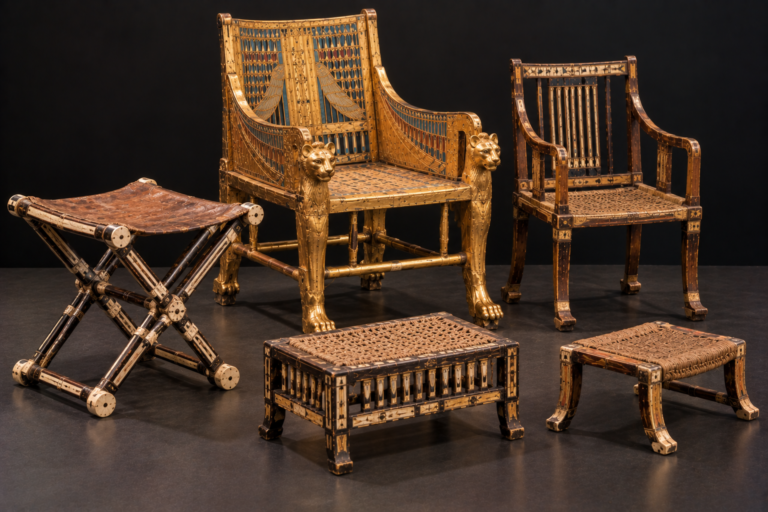
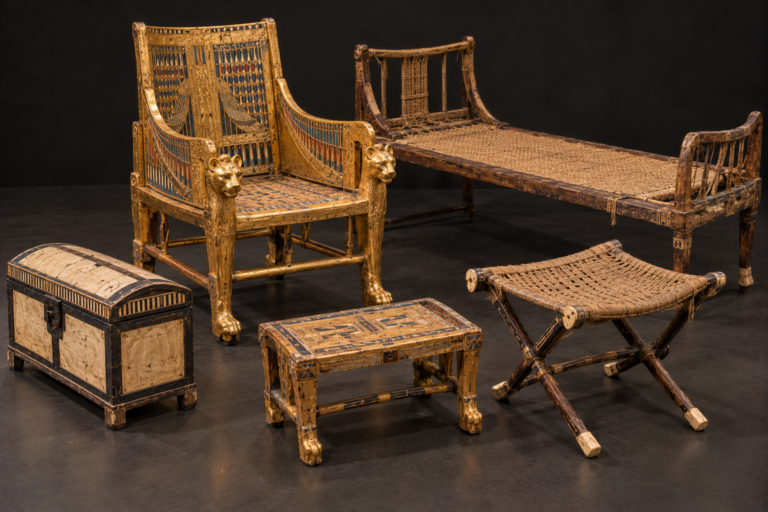
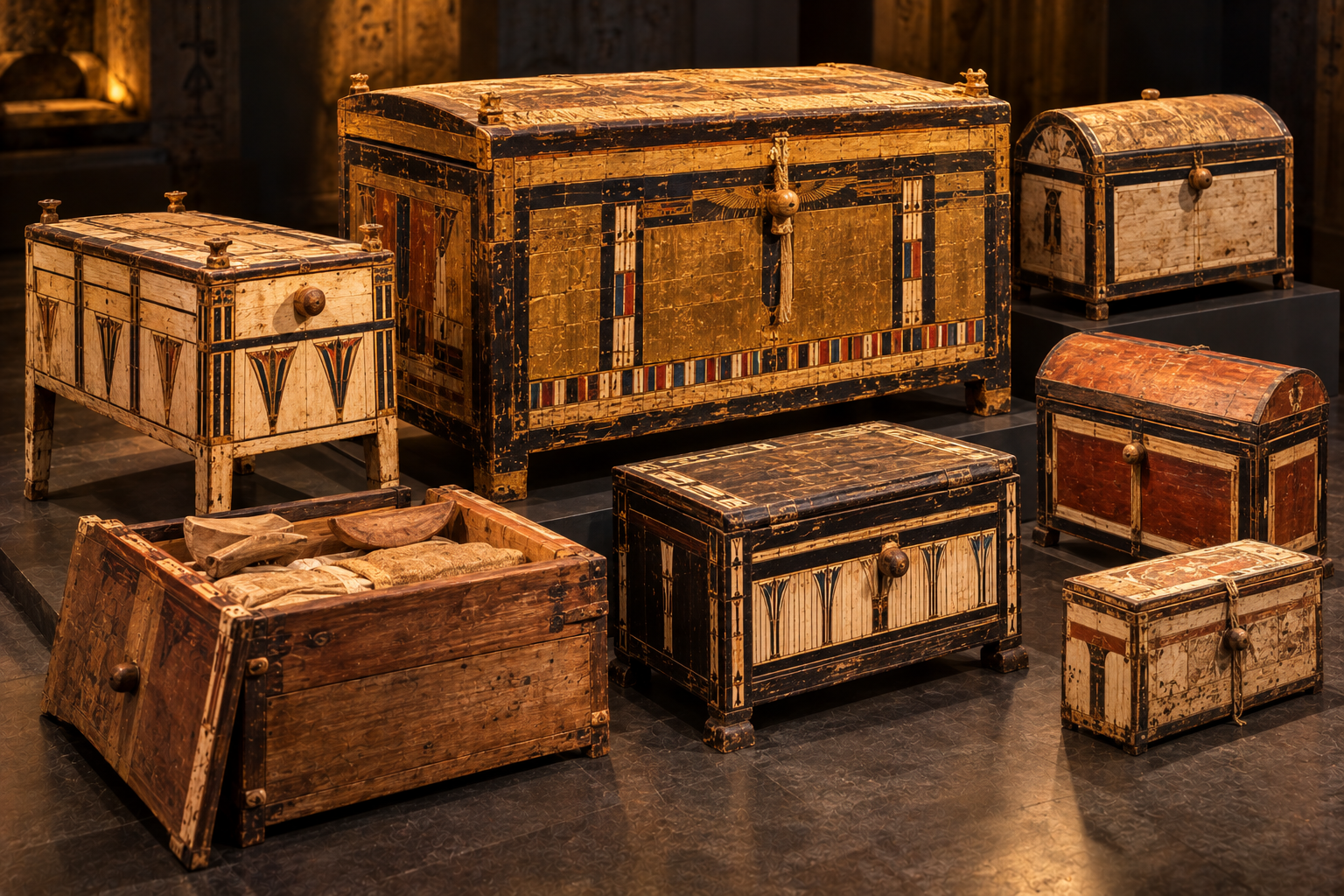
Some were relatively plain wooden containers. Others had carefully decorated surfaces, shaped lids, elaborate veneers or unusual proportions.
One particularly interesting example resembled a small table, with a rectangular container raised on slender legs.
Other boxes were constructed as richly ornamented caskets, with carefully finished surfaces that made the container itself a valuable object.
These variations reflect the broader sophistication of the furniture found inside Tutankhamun’s tomb.
Ancient Egyptian craftspeople understood that a storage box could be more than a wooden compartment with a lid.
Its proportions, structure, decoration and method of closure could all be adapted to its intended purpose.
What Was Stored Inside Them?
The surviving records show that the boxes contained a wide variety of objects.
Some held jewelry, including elaborate pectorals and other ornaments.
Others contained clothing, slippers, writing equipment, fans and additional personal or ceremonial possessions.
Carter’s excavation diary records that box 270 contained ornamental slippers. Another box, numbered 271, included a scribe’s outfit, a basket and an elaborate mirror case, although Carter believed the mirror itself had been stolen.
Box 272 contained a fan incorporating ostrich feathers and ivory.
These details connect the burial to the practical world of royal possessions.
They also show why the boxes should not be treated merely as containers for treasure.
Some preserved objects associated with clothing, writing, grooming and daily activity. Others held objects that communicated royal identity or belonged to ceremonial equipment.
For a broader understanding of these categories, see what Tutankhamun’s everyday objects reveal about his life.
The Box Labeled for Linen That Held Headrests
One of the clearest examples of a mismatched label is a table-shaped wooden box documented in Harry Burton’s photographs.
Its inscription indicated that it was intended for linen.
But when the box was found, it contained headrests.
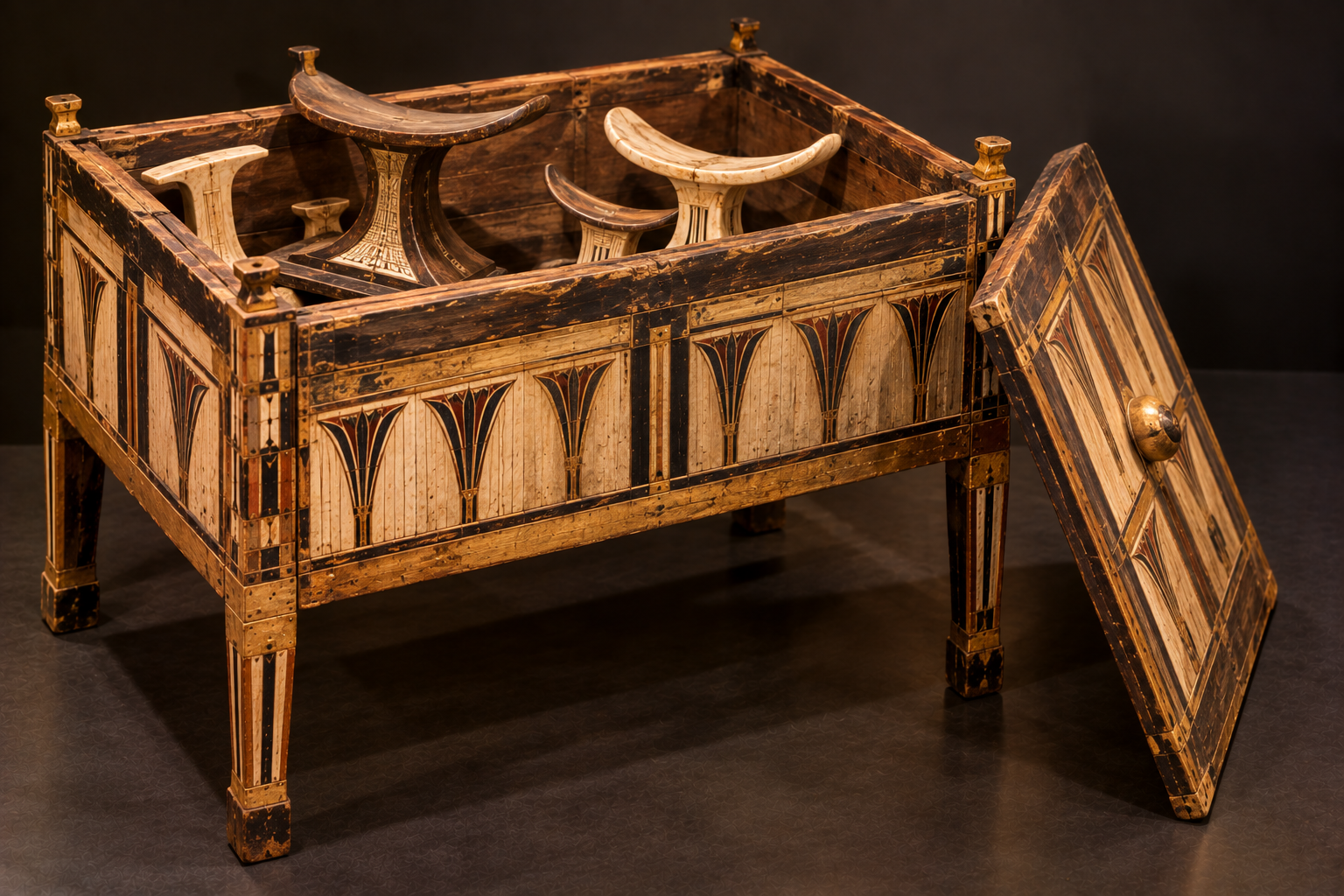
This is not a minor detail.
An inscription is often treated as a direct explanation of an ancient object. Yet here the writing and the contents tell different stories.
The label describes what the box was associated with at some point in its history.
The headrests document what the archaeologists encountered when they opened it.
Both observations are valid, but they do not automatically refer to the same moment.
Why Would Headrests Be Stored in a Linen Box?
There are several possibilities.
The box may have been emptied and reused during preparations for the burial.
Its original linen contents might have been removed before it entered the tomb.
Alternatively, its contents could have been disturbed during ancient robbery and replaced incorrectly when officials restored order.
The surviving evidence does not allow us to choose one explanation with complete certainty.
What makes the example important is that it demonstrates why archaeologists must examine inscriptions and contents independently.
Important distinction: The linen inscription is evidence of an intended or earlier association. The headrests are evidence of what was found inside. The mismatch does not, by itself, establish when or why the contents changed.
The Box Apparently Designed for a Wig
Another box presents an even more complicated problem.
Its interior contained a built-in support that appears to have been designed for a wig.
Yet the inscription on its exterior referred to shabti figurines, the small funerary figures included in ancient Egyptian burials.
Neither a wig nor the expected figurines were discovered inside.
This case is especially interesting because the evidence comes from two different features of the same object.
The internal construction suggests one purpose. The exterior inscription indicates another. And the surviving contents fail to confirm either.
What Does the Internal Support Tell Us?
A purpose-built fitting can reveal how a container was designed to hold an object.
If the support was intended for a wig, it suggests that the box once had a function different from the one indicated by its exterior label.
However, the identification remains an interpretation based on the structure.
It is not proof that a particular wig belonging to Tutankhamun was once stored there.
Nor can we establish exactly when the exterior inscription was added or whether the box was modified more than once.
What we can say is that the object preserves conflicting clues about its intended use.
That makes it particularly useful when evaluating the possibility that boxes were reused before the funeral.
The Jewelry Box That Preserved Remarkable Treasures
Some of the most informative containers were found in the Treasury.
One richly decorated casket, Carter number 267, contained important pieces of jewelry despite evidence of ancient disturbance.
Carter described the box as veneered with ivory and ebony and recorded that thieves had rummaged through it.
Nevertheless, the surviving contents included numerous elaborate gold-inlaid pectorals and other ornaments.
The objects had originally been grouped in linen and sealed, according to Carter’s account.
This detail reveals how valuable possessions could be protected within a larger container.
It also demonstrates that a box might preserve several levels of archaeological evidence: its exterior construction, its closure, the arrangement of its contents and the materials used to wrap individual objects.
The Importance of Harry Burton’s Photographs
Harry Burton photographed the interior of box 267 during the excavation.
One surviving photograph records a lower layer after several objects had already been removed.
It also reveals the numbering system used by the excavation team.
The box was assigned number 267, while individual objects within it were distinguished by letters.
This system allowed archaeologists to preserve the relationship between an object and the box in which it was discovered.
That relationship is essential because removing an artifact from its original context can destroy information about how it was stored.
Burton’s photographs therefore preserved evidence that written descriptions alone might not communicate.
His work is explored further in the story of Harry Burton and his photographs of Tutankhamun’s discovery.
The Box That Contained Only Packing Material
Not every box rewarded the excavators with a spectacular discovery.
One container documented by Burton contained only packing material.
For Carter, the surviving packing suggested that fragile objects had once occupied the space.
He considered the possibility that the missing contents had been glass vessels taken by ancient thieves.
But the packing did not preserve enough evidence to identify the missing objects with certainty.
This example reveals another important archaeological principle.
An empty container is not necessarily an object without information.
The shape of the internal compartments, traces of packing and evidence of disturbance can provide clues about what was originally intended to be stored there.
Yet the clues must not be transformed into invented certainty.
We can discuss the possibility of missing glass vessels without claiming that archaeologists recovered proof of those specific objects.
Why Did Some Labels Not Match Their Contents?
The mismatched labels are among the most intriguing details recorded inside Tutankhamun’s tomb.
They reveal an important distinction between what a container was designed to hold, what its inscription identified, and what archaeologists eventually discovered inside.
Those three forms of evidence do not always describe the same stage in an object’s history.
Two main explanations help account for the differences.
The first involves ancient tomb robbery and the subsequent restoration of the burial. The second involves the reuse of existing boxes during preparations for Tutankhamun’s funeral.
Both explanations are plausible, and they are not necessarily mutually exclusive.
Different containers may have experienced different sequences of events.
An ancient label could preserve what a box was once meant to hold, not necessarily what archaeologists eventually found inside.
Howard Carter’s Explanation: Ancient Robbery and Repacking
Howard Carter believed that some of the unusual contents resulted from the disturbance of the tomb in antiquity.
Ancient intruders entered KV62 and searched through containers for objects that could be carried away.
When officials restored the burial, displaced possessions may have been returned to boxes without preserving their original arrangements.
This interpretation is supported by evidence of disturbance found throughout parts of the tomb.
Some containers had been opened. Valuable objects were missing from certain groups. Other possessions appeared to have been displaced or mixed together.
For Carter, the condition of several boxes suggested that their contents had been examined by thieves before being rearranged.
What Happened to the Original Contents?
In some cases, the surviving objects were probably only part of what a container originally held.
The jewelry casket numbered 267 provides an example.
Although important ornaments remained inside, Carter believed that thieves had removed some of the more valuable pieces.
Other containers presented a different problem: their remaining contents did not seem to correspond to their inscriptions or internal arrangements.
These observations help explain why Carter considered ancient repacking an important factor.
However, his interpretation does not establish that every mismatched label resulted from robbery.
The physical construction of certain boxes suggests that some changes in function may have occurred before the burial was sealed.
Were the Boxes Reused From the Royal Palace?
The Metropolitan Museum of Art suggests that many of Tutankhamun’s 71 boxes probably came from the palace, where they may have been used to pack possessions for the burial.
This interpretation offers another explanation for the mismatched labels.
A container that had previously held linen might have been selected to transport headrests.
A box originally designed for a wig could have acquired a different intended function during its history.
If an earlier inscription remained on the exterior, it would no longer correspond to the objects packed inside.
The box itself could still have been perfectly suitable for its new purpose.
Does Reuse Mean the Burial Was Prepared in a Hurry?
Not necessarily.
Tutankhamun died young, and the preparation of his burial has prompted considerable archaeological discussion.
However, the reuse of a container is not sufficient evidence to establish that the funeral was rushed.
Existing boxes may have been selected because they were available, well constructed or appropriately sized for particular objects.
Reusing storage equipment could have been a practical decision rather than an emergency measure.
The surviving evidence does not reveal the reasoning behind every choice made by the people organizing the funeral.
Could Both Explanations Be Correct?
Yes.
Some boxes may have been reused before Tutankhamun’s burial.
Others may have been disturbed by thieves and repacked afterward.
It is also possible that a reused box was subsequently disturbed during an ancient robbery.
The most reliable approach is therefore to examine each container individually rather than assume that all 71 followed the same history.
Archaeological caution: A mismatched inscription is evidence of a difference between a box’s label and its discovered contents. It does not automatically identify who changed those contents or when the change occurred.
How Were Tutankhamun’s Wooden Boxes Made?
The boxes demonstrate the sophisticated woodworking traditions of ancient Egypt’s New Kingdom.
Craftspeople needed to produce containers that were strong enough to protect their contents while remaining practical to handle and transport.
The construction of each box depended on its size, intended use and decorative requirements.
Some were relatively simple wooden structures with fitted lids.
Others incorporated carefully shaped supports, decorative veneers and elaborate surface treatments.
Wooden Panels, Joints and Fitted Lids
A well-made wooden container required accurately shaped components.
The sides and base had to form a stable structure, while the lid needed to fit securely over the opening.
Ancient Egyptian woodworkers employed different joining methods according to the design of an object.
These could include wooden pegs, carefully fitted joints and other construction techniques.
Some containers also had projecting fittings that could be incorporated into a cord closure.
The result was a practical object whose construction could be adapted to its contents.
Why Did Some Boxes Have Unusual Shapes?
The table-shaped box associated with the headrests is an important reminder that ancient storage containers did not all resemble modern rectangular chests.
Raised legs, internal supports and specialized compartments could form part of a box’s design.
Such features sometimes provide stronger evidence of an intended function than a surviving inscription.
However, a particular shape should not automatically be interpreted as proof that the object was made specifically for Tutankhamun’s burial.
It may have been manufactured earlier and subsequently selected for use in the tomb.
How Were Ancient Egyptian Boxes Sealed?
Some ancient Egyptian containers were secured using cords and clay sealings rather than modern mechanical locks.
A cord could be passed around wooden knobs or other fittings to hold a lid in place.
Clay or mud could then be applied to part of the fastening and impressed with a seal.
The resulting impression could identify a sealing arrangement and provide visible evidence if it was broken.
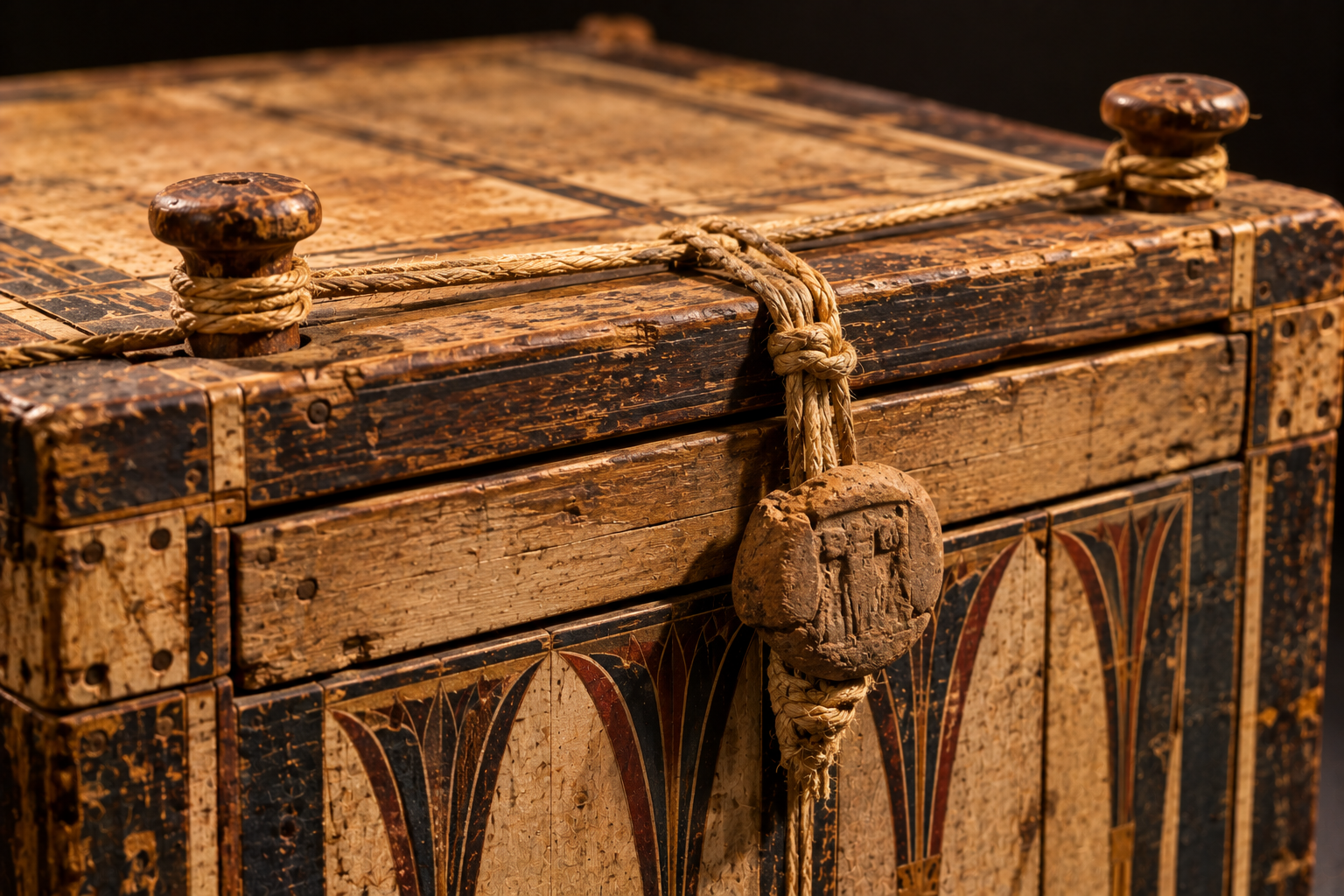
This type of closure is important because it combined practical fastening with a method of detecting interference.
A broken clay sealing could indicate that a container had been opened after the seal was applied.
But the interpretation was not always straightforward.
Could Someone Open a Box Without Breaking Its Seal?
That depended on the construction of the container and the arrangement of the fastening.
An intact sealing might indicate that a particular closure had not been disturbed since the seal was applied.
It would not necessarily prove that the box had never been opened earlier in its history.
A container could have been opened and resealed before its final placement in the tomb.
Similarly, a broken seal does not automatically identify a thief. It could have been broken during legitimate handling, ancient disturbance or later excavation.
Why Are Seal Impressions Important to Archaeologists?
Seal impressions can preserve designs and marks associated with the people or institutions responsible for securing objects.
When similar impressions appear on multiple containers, researchers can compare their forms and archaeological contexts.
Such comparisons may reveal relationships between groups of objects.
However, matching impressions do not necessarily establish that every container was packed at exactly the same moment.
Sealings are one category of evidence that must be considered alongside inscriptions, object positions and excavation records.
Why Were Some Boxes Beautifully Decorated?
Not every box in Tutankhamun’s tomb was an elaborate work of art.
But some containers demonstrate the extraordinary skill of royal Egyptian craftspeople.
Decorative materials could include contrasting woods, veneers, ivory, pigments and other carefully prepared surfaces.
Some containers were valuable objects in their own right, regardless of what they held.
This is particularly important when studying boxes that had been emptied or disturbed.
Even when the original contents are missing, the surviving construction and decoration can reveal information about materials, craftsmanship and elite Egyptian storage practices.
Were Decorated Boxes Only Used for Ceremonial Objects?
No such general rule can be established.
Decorated containers could hold different kinds of possessions, including personal belongings and valuable ornaments.
A richly made box was not necessarily produced exclusively for a funeral.
Some examples may have served practical functions in the royal household before being selected for burial.
The distinction matters because the tomb preserves objects from different aspects of royal life, not simply items manufactured for one final ceremony.
What the 71 Boxes Reveal About Burial Preparations
The boxes provide evidence for the practical work involved in preparing Tutankhamun’s burial.
Thousands of objects had to be selected, moved and arranged within the tomb.
Storage containers made it possible to group smaller possessions and protect them during handling.
But the evidence suggests that the process was more complicated than simply filling newly made boxes with objects selected for the funeral.
Some containers may already have had a history within the palace.
Others may have been modified or assigned new functions.
Ancient disturbance further complicated the arrangement that Carter eventually encountered.
What Can the Boxes Tell Us About Royal Storage?
Their inscriptions, fittings and construction reveal that different kinds of possessions could require different storage arrangements.
Textiles, jewelry, wigs and other personal objects presented distinct practical needs.
The boxes also demonstrate that storage equipment could combine function with visual refinement.
A container might protect its contents while also reflecting the resources and craftsmanship available to the royal household.
What Can They Tell Us About Tutankhamun Personally?
Less than we might expect.
The presence of a box in Tutankhamun’s tomb does not prove that he personally used it during his lifetime.
Some possessions may have belonged to the royal household more broadly.
Others could have been selected or prepared specifically for the burial.
Inscriptions and archaeological context can sometimes clarify an object’s association, but they do not always establish a personal history of use.
This distinction is especially important when interpreting the everyday objects found inside Tutankhamun’s tomb.
How Howard Carter Recorded the Contents of the Boxes
Documenting a box was more complicated than recording its external appearance.
Archaeologists also needed to establish which objects belonged inside it, how they were arranged and whether their positions showed signs of disturbance.
Carter’s excavation team used a detailed recording system that linked individual objects to their archaeological contexts.
Each major find received an identifying number.
Objects within a larger group could receive additional letters or subdivisions.
Written descriptions recorded materials, dimensions, condition and other observations.
Photographs preserved arrangements before and during removal.
Why Were Harry Burton’s Photographs So Valuable?
Harry Burton’s photographs provide visual evidence that cannot always be reconstructed from written records.
A photograph of an open box can reveal the position of objects, surviving packing materials and relationships between individual finds.
Once the contents have been removed for examination or conservation, that arrangement no longer exists in its original form.
Burton’s work helped preserve the information before it disappeared.
His photographs also allow modern researchers to compare Carter’s written descriptions with the visual evidence recorded during excavation.
For more on the documentation process, see how Howard Carter catalogued the objects from Tutankhamun’s tomb.
What the Evidence Can and Cannot Tell Us
The 71 boxes provide important evidence about ancient storage, burial preparations and the disturbance of Tutankhamun’s tomb.
But different observations support different levels of certainty.
A surviving inscription can identify an intended function or association.
An internal support can suggest the type of object a container was designed to hold.
Objects discovered inside can document the condition encountered during excavation.
None of these observations automatically establishes the complete history of a box.
| Archaeological Evidence | What It Shows | What It Does Not Prove |
|---|---|---|
| Seventy-one boxes | A substantial group of storage containers formed part of the burial equipment. | That every box was made specifically for Tutankhamun’s funeral. |
| Box labeled for linen containing headrests | The inscription and discovered contents did not correspond. | Exactly when or why the contents changed. |
| Box with wig support and shabti inscription | Its internal construction and exterior inscription suggest different functions. | That a wig or shabtis were necessarily inside it at the time of burial. |
| Jewelry casket 267 | Important ornaments survived despite evidence of disturbance. | That all its original contents remained intact. |
| Box containing packing material | Its surviving packing may indicate that objects were once stored inside. | The precise identity of any missing contents. |
| Cords and clay sealings | Some containers used methods of fastening that could reveal interference. | That a container was never opened or resealed. |
| Harry Burton’s photographs | They preserve visual records of the arrangement of excavated objects. | The complete earlier history of every object photographed. |
The most useful conclusion is not that all the boxes share one explanation.
It is that each container may preserve evidence of several stages in its history.
Manufacture, use, reuse, burial, disturbance and excavation could all leave traces on the same object.
Understanding those traces requires careful comparison rather than a single dramatic explanation.
Frequently Asked Questions
Why were 71 boxes found inside Tutankhamun’s tomb?
The boxes helped store, protect and transport possessions selected for the royal burial. Some probably came from the palace and may have been reused during funeral preparations.
What was inside Tutankhamun’s boxes?
Different boxes contained jewelry, textiles, headrests, slippers, personal equipment and other objects. Some had been disturbed, so their surviving contents may not represent everything originally stored inside.
Were all 71 boxes made specifically for the burial?
No such conclusion can be established. The Metropolitan Museum of Art suggests that many probably came from the palace.
Why did some box labels not match their contents?
Possible explanations include ancient robbery, repacking by officials who restored the tomb, and reuse of existing containers during burial preparations without changing their inscriptions.
Was a box labeled for linen found containing headrests?
Yes. The Metropolitan Museum of Art documents a table-shaped box whose inscription referred to linen but whose discovered contents included headrests.
Was a box designed to hold a wig discovered?
One box contained an internal support apparently designed for a wig, although its exterior inscription referred to shabti figurines. Neither a wig nor the expected figurines was found inside.
Did Tutankhamun’s boxes contain jewelry?
Yes. Carter object 267 is an important example of a decorated jewelry casket containing valuable ornaments, including elaborate pectorals.
Were any of the boxes found empty?
Some containers were found without the objects they may originally have held. One documented example retained packing material, which Carter interpreted as possible evidence of missing fragile contents.
Were the boxes disturbed by ancient tomb robbers?
Some containers show evidence of ancient disturbance. Carter believed that thieves removed valuables from certain boxes and that officials later returned remaining objects without always preserving their original arrangements.
How were ancient Egyptian wooden boxes made?
They were constructed using woodworking techniques adapted to their size and function. Some included fitted lids, supports, decorative veneers and elaborate surface treatments.
How were storage boxes sealed?
Some ancient Egyptian containers used cords and clay sealings. These arrangements could help secure lids and provide visible evidence if a fastening was disturbed.
Did ancient Egyptian boxes have locks?
Some used closure systems that differed from modern keyed locks. Cords, knobs and clay sealings could secure a lid, but the exact arrangement varied between objects.
How did Howard Carter record the boxes?
Carter’s team assigned object numbers, prepared written records and used photographs to document the containers and their contents. Harry Burton’s photographs are especially valuable for preserving their excavated arrangements.
What do the boxes reveal about Tutankhamun’s funeral?
They provide evidence of the practical organization of burial possessions and suggest that some containers may have been reused. They do not establish the precise sequence of every packing decision.
Where can researchers study the original excavation records?
The Griffith Institute at the University of Oxford preserves important documentation from Carter’s excavation, while the Metropolitan Museum of Art provides photographs and research records associated with the discovery.
Final Thoughts
The 71 boxes found inside Tutankhamun’s tomb were much more than containers for valuable possessions.
They were part of the practical organization of a royal burial.
Some held jewelry. Others contained personal objects, textiles or equipment. Several preserved inscriptions that did not correspond to what archaeologists discovered inside.
Those mismatches are particularly revealing.
They suggest that at least some containers had histories more complicated than a single use followed by burial.
A box might have served one purpose in the palace, another during funeral preparations and a different role after ancient disturbance.
The surviving evidence cannot reconstruct every stage with certainty.
But the boxes make it possible to investigate questions that the famous gold treasures alone cannot answer.
How were royal possessions organized? Which containers were reused? What happened when thieves disturbed the burial? And how much can an ancient label reveal when the contents beneath it have changed?
These questions turn apparently ordinary storage objects into valuable archaeological evidence.
In Tutankhamun’s tomb, even a wooden box could preserve clues about royal life, ancient craftsmanship and the complicated history of one of archaeology’s most extraordinary discoveries.
Research Sources
- The Metropolitan Museum of Art: Box Interior. Research and photographic documentation associated with Tutankhamun’s storage boxes.
- The Metropolitan Museum of Art: Box. Documentation associated with a box containing an internal support and an inscription referring to funerary figurines.
- The Metropolitan Museum of Art: Interior of Jewelry Box. Harry Burton’s photographic documentation of jewelry casket 267.
- Griffith Institute, University of Oxford: Tutankhamun Object Records. Original excavation documentation and descriptions.
- Griffith Institute: Scientific Notes. Archival research materials associated with the excavation.