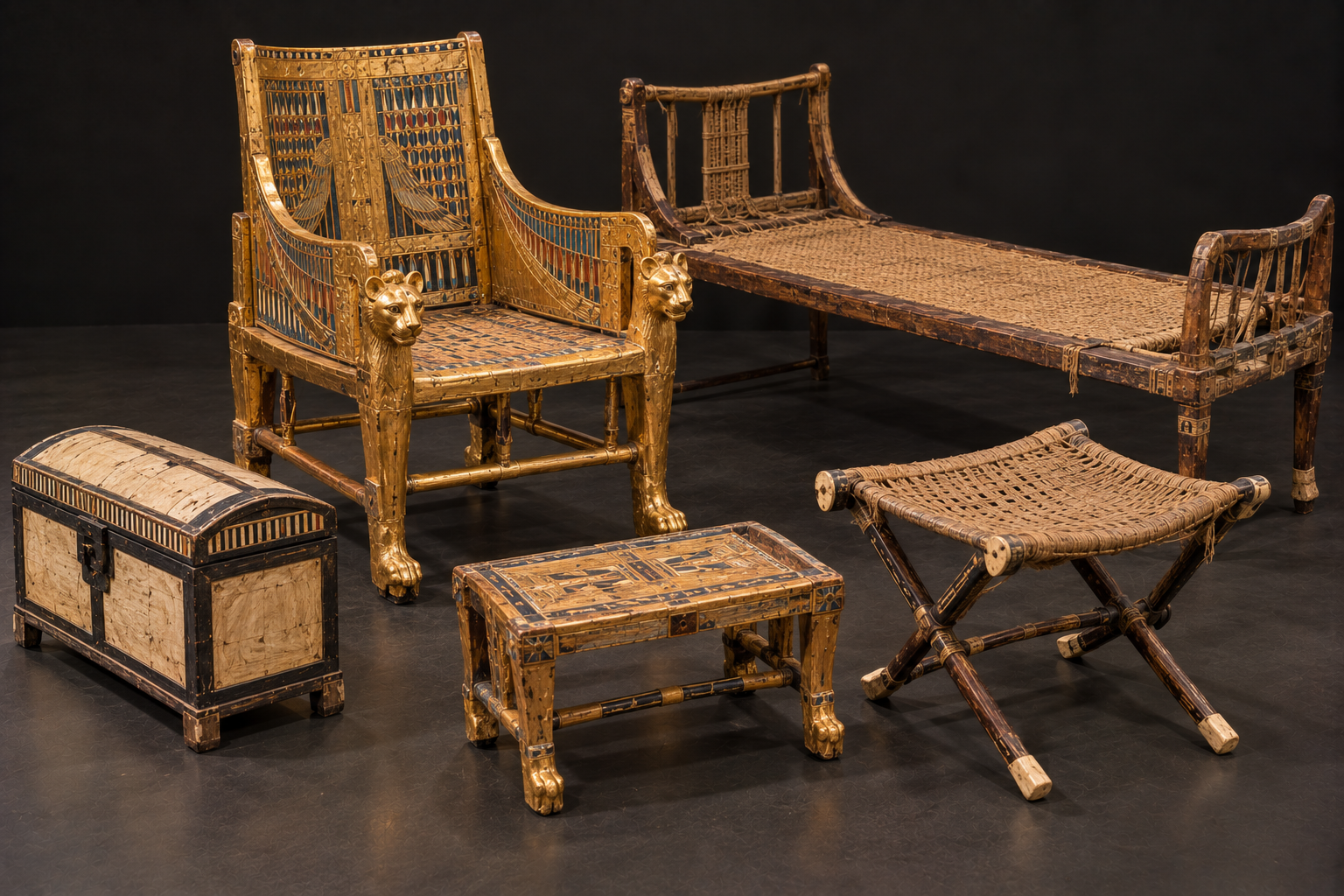

When Howard Carter entered Tutankhamun’s tomb, he did not find a few royal treasures standing neatly inside empty rooms. He encountered furniture almost everywhere.
Chairs, stools, beds, enormous animal-shaped couches, decorated boxes and other objects were crowded together with chariots, baskets, vessels, weapons and personal possessions. Some pieces glittered with gold and elaborate inlay. Others were surprisingly simple, built for practical use rather than visual spectacle.
Together, they raise a fascinating question. Are we looking at furniture created specifically for a royal burial, furniture that once belonged to the world of the palace, or a mixture of both? The surviving evidence suggests that Tutankhamun’s tomb preserved something more complicated and much more interesting than a matching collection of funerary furniture.
Quick Context
- King: Tutankhamun
- Dynasty: Eighteenth Dynasty
- Period: New Kingdom
- Tomb: KV62, Valley of the Kings
- Furniture types: Chairs, stools, footstools, beds, couches, headrests, boxes and folding furniture
- Folding furniture: Yes
- Most famous chair: The richly decorated object commonly known as Tutankhamun’s Golden Throne
- Boxes: Seventy-one were documented from the tomb
- Common materials: Wood, woven plant fibers, leather, ivory, gold, glass or faience, and other decorative materials depending on the object
- Evidence of use: Some pieces show signs consistent with practical use
- Key caution: Being found inside KV62 does not prove that every piece was made specifically for the burial or personally used by Tutankhamun
A Tomb Filled With Furniture
The original photographs of KV62 make one fact immediately clear: Tutankhamun’s furniture was not displayed like a modern museum collection.
It was packed into a relatively small tomb already crowded with thousands of objects.
The Antechamber contained some of the most visually dramatic furniture. Massive gilded couches with animal forms dominated the room, while decorated chests, chairs and other objects occupied the spaces around them. Dismantled chariots were stacked toward one end.
The Annexe presented an even more chaotic picture.
Howard Carter described bedsteads, chairs, footstools, hassocks, gaming boards, baskets, boxes and a rush-work armchair among objects turned over and piled together.
Ancient robbers had disturbed the tomb, and officials had apparently attempted to restore order in some areas before resealing it. The Annexe, however, retained extensive disorder.
That context matters because an object’s position when Carter found it was not always necessarily its original position when Tutankhamun was buried.
This is one reason the excavation required far more than simply removing treasures.
Carter’s team had to record objects and their relationships carefully, while Harry Burton’s photographs preserved the appearance of Tutankhamun’s tomb as the excavation progressed.
Tutankhamun’s tomb did not preserve one kind of royal furniture. It preserved objects associated with sitting, sleeping, storage, movement, ceremony and display.
Where Was Tutankhamun’s Furniture Found?
There was no single “furniture room.”
Furniture appeared across different spaces within KV62, and those locations help archaeologists reconstruct how the burial had been organized and later disturbed.
The Antechamber contained some of the best-known large pieces, including the extraordinary animal-shaped couches. Chairs, boxes and other objects were crowded around them.
The Annexe contained another large and diverse group.
Carter’s records identify multiple bedsteads there, along with chairs, footstools, hassocks and boxes.
The result is important for interpretation.
Modern photographs of individual museum objects can make each chair or bed appear isolated and self-contained. Inside the tomb, however, these pieces belonged to a much larger assemblage.
A chair might sit close to baskets, vessels or weapons.
A bed could be surrounded by unrelated equipment.
A box might contain objects different from those indicated by its original label.
Understanding that archaeological context is one reason Howard Carter’s cataloguing of Tutankhamun’s tomb remains so important.
Furniture or Funerary Equipment?
The word “furniture” sounds straightforward, but the collection from KV62 immediately complicates it.
A practical chair can be furniture.
A decorated royal chair can also communicate status.
A folding bed can be designed for portability.
An enormous animal-shaped couch placed in a royal tomb may have a very different purpose from a bed intended for ordinary sleep.
A storage box can begin its life in a palace and later be repacked for a funeral.
We therefore should not assume that every object found in the tomb was manufactured specifically for burial.
Nor should we assume the opposite.
KV62 brought together objects with different functions and potentially different histories.
Found in a tomb does not automatically mean made for a tomb. Some furniture may have had a practical history before the funeral, while other pieces were closely connected with ceremonial or funerary purposes. Each object has to be evaluated from its own evidence.
Tutankhamun’s Golden Throne
No discussion of Tutankhamun’s furniture can avoid the chair commonly known as his Golden Throne.
Its fame is understandable.
The piece transforms a functional form into an elaborate work of royal art.
Its wooden structure is enriched with gold and colored decoration, while the back carries one of the most recognizable images associated with Tutankhamun.
The scene shows the king seated while Ankhesenamun stands before him in an intimate royal composition.
That is very different from the aggressive hunting and domination imagery found on some other royal objects.
Here the furniture becomes a surface for communicating royal identity through a more personal-looking court scene.
Yet “personal-looking” does not mean we are watching a literal snapshot from palace life.
Ancient Egyptian royal art followed conventions and carried layers of meaning. The image can tell us about how the royal couple was represented, but it should not be read as a documentary photograph of a particular private moment.
Was the Golden Throne Solid Gold?
No.
This distinction matters because the popular language surrounding Tutankhamun often turns anything golden into an object made entirely from solid gold.
The throne is fundamentally a piece of crafted furniture with a wooden structure enriched by gold and other decorative materials.
This type of construction allowed Egyptian craftspeople to combine the structural advantages of wood with the visual brilliance of precious surfaces.
Understanding the object this way actually makes it more impressive.
It required several forms of specialized craftsmanship to work together: woodworking, surface preparation, gilding, inlay and decorative design.
Was It Really a Throne?
The term “Golden Throne” has become the standard popular name for the object, and it communicates its royal character effectively.
But the label should not encourage us to invent specific ceremonies in which Tutankhamun must have used it.
The object is an exceptionally elaborate royal chair.
Its design and decoration communicate kingship, but the archaeological evidence does not provide a complete schedule of when, where or how often Tutankhamun sat on it.
That distinction between what an object is and what we can prove about its individual use runs throughout the furniture collection.
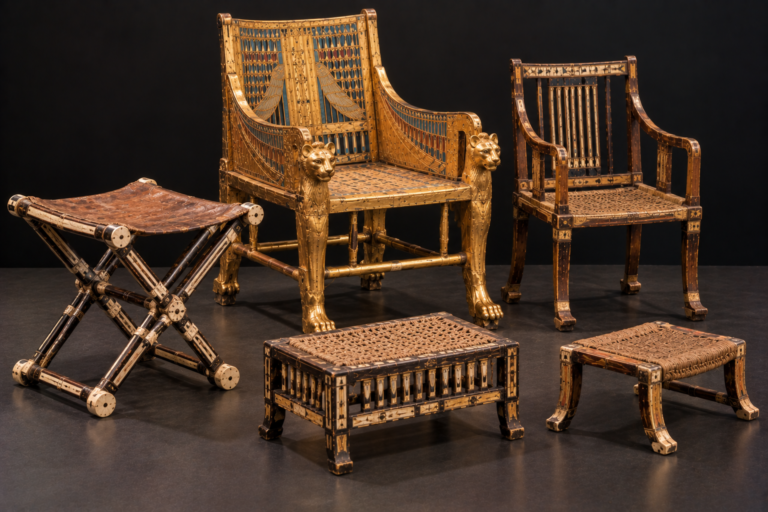
The Chairs Found in the Tomb
The Golden Throne was not Tutankhamun’s only chair.
The tomb preserved several forms of seating, ranging from elaborate royal furniture to lighter and more practical designs.
Carter’s archive even identifies one piece with the description “The King’s Chair When a Small Child.”
That description is intriguing because Tutankhamun became king at a young age, and furniture associated with different stages of his life could potentially have been preserved among his possessions.
But the wording should be treated as an archival identification rather than stretched into a detailed biography.
It does not tell us exactly when or how often Tutankhamun used that chair.
Other seating included wooden chairs and a rush-work armchair.
The variety is important.
Royal furniture was not one uniform category in which every seat was a throne.
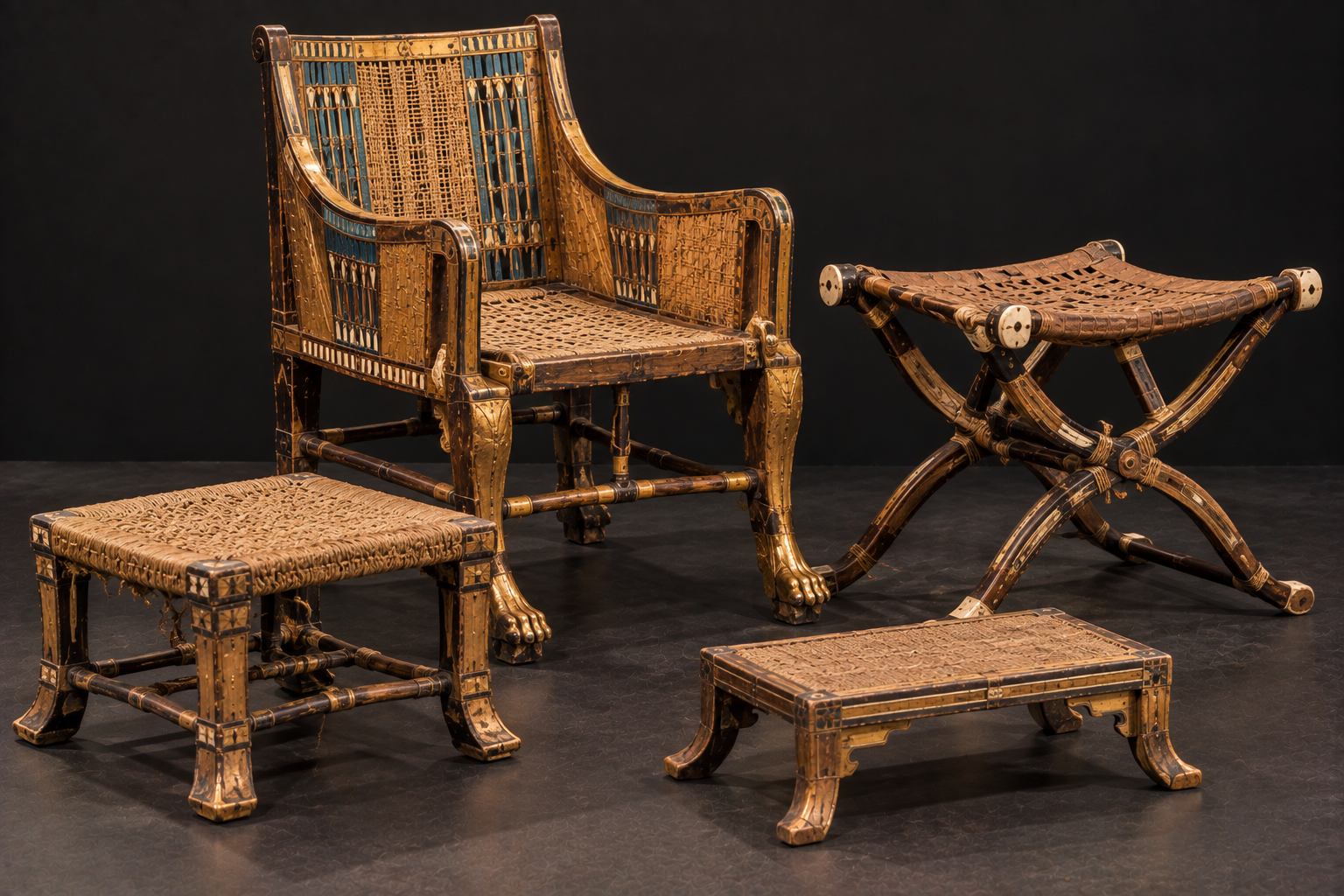
Different seats could answer different practical and representational needs.
Some were portable.
Some were richly decorated.
Some used woven materials.
Some carried imagery closely connected with royal status.
Placed together, they provide a much richer picture of Egyptian furniture than the Golden Throne alone.
Stools and Folding Seats
Stools were an important category of ancient Egyptian furniture, and Tutankhamun’s burial preserved multiple examples.
Carter emphasized their variety, describing stools of different shapes and designs made from both ordinary and rare materials.
This is significant because a stool can appear almost too simple to attract attention in a tomb famous for gold.
Yet stools reveal some of the same engineering intelligence found in more spectacular furniture.
A seat has to carry a person’s weight.
Its joints have to withstand repeated stress.
If it is designed to fold, the structure must also remain stable when opened while becoming compact enough to move when closed.
Portable furniture was especially useful in a world where royal activity was not confined to one permanent room.
The king and court moved between residences, ceremonial settings and outdoor environments. Furniture capable of being transported had obvious practical advantages.
This makes folding furniture particularly interesting when considered alongside the six chariots found in Tutankhamun’s tomb. Both remind us that royal life involved movement as well as monumental architecture.
The Meaning of Tutankhamun’s Footstools
A footstool seems like one of the simplest pieces of furniture imaginable.
In a royal context, however, its decoration could turn it into a statement about kingship.
Some examples associated with Tutankhamun use images of bound or defeated foreign enemies.
The placement is deliberate.
When the king used such an object, representations of enemies were symbolically positioned beneath his feet.
This belongs to a much older Egyptian visual language of royal domination and the maintenance of order.
It should not be confused with a literal documentary scene showing a specific event or a particular group of prisoners captured personally by Tutankhamun.
The imagery communicates an ideal of kingship.
This is another example of furniture doing two jobs at once.
Physically, the object supports the feet.
Visually, it communicates royal power.
Furniture could communicate status even when it was being used. A decorated chair, stool or footstool was not simply an object placed in a room. Its materials, proportions and imagery could participate in the visual language of kingship.
The Beds Found in Tutankhamun’s Tomb
Tutankhamun’s tomb also contained several bedsteads.
Carter’s records for the Annexe refer to multiple examples, demonstrating that the burial did not contain only one object that could be called a bed.
Ancient Egyptian beds differed from the heavily upholstered beds familiar in many modern homes.
The basic principle was an elevated frame supporting a sleeping surface.
Depending on the object, woven material could form or contribute to that surface.
Wooden legs raised the sleeper above the floor, while the construction had to balance strength against the relatively limited amount of material needed for the frame.
But the beds from Tutankhamun’s tomb should not all be treated as identical.
Different examples vary in construction, decoration and likely purpose.
And one of them is technologically extraordinary.
The Remarkable Three-Part Folding Bed
Carter object 586, later registered as JE 62018, looks modest compared with the gilded furniture around it.
It is painted white.
It carries no inscription.
Its surfaces show wear.
Yet its apparent simplicity hides one of the most sophisticated furniture designs preserved from ancient Egypt.
The bed was engineered to fold into three sections.
That is far more difficult than making an ordinary rigid bed frame.
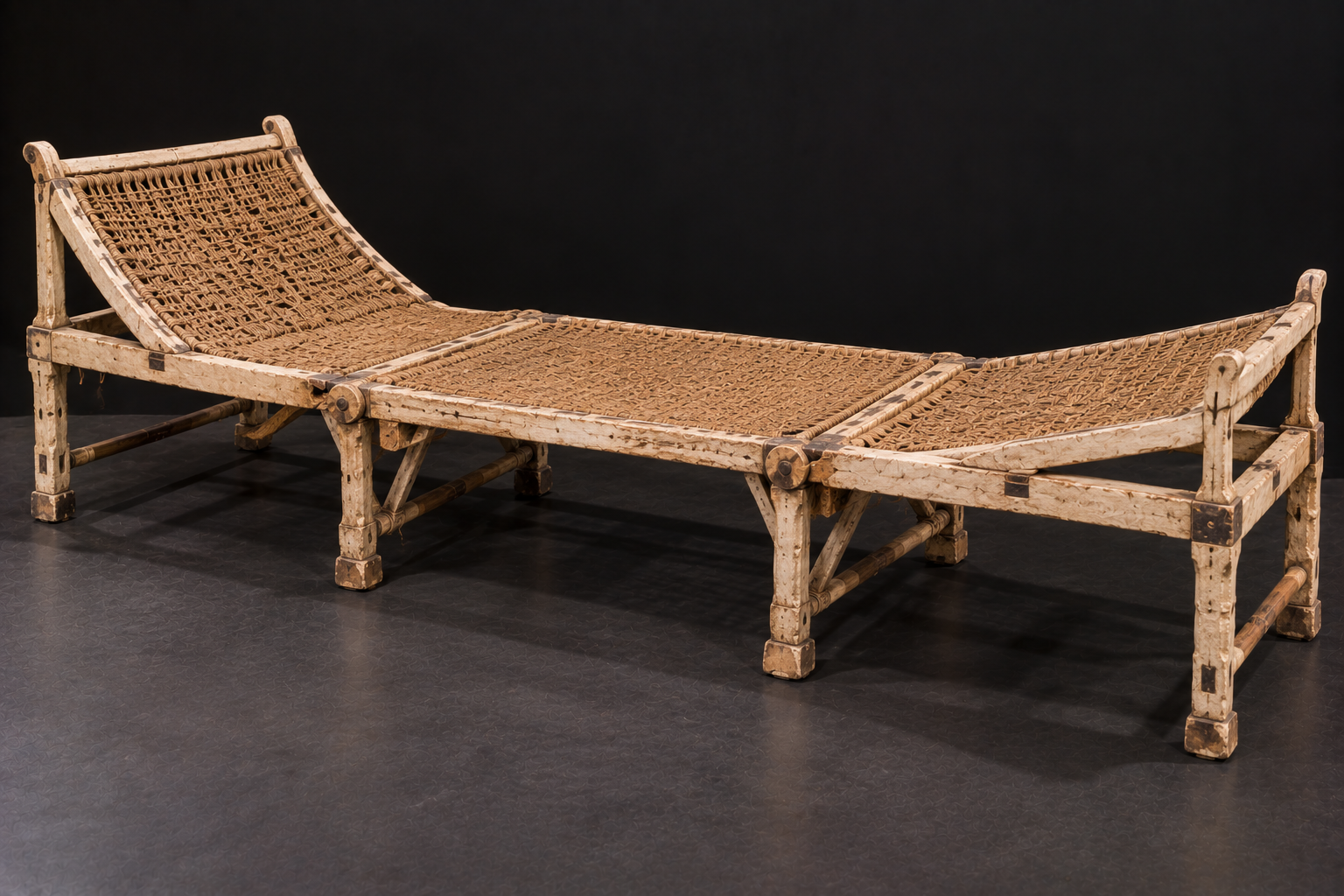
Recent research highlighted by the Tutankhamun Spatial Archive has examined the mechanics in detail.
The bed uses carefully positioned metal hinges, including an unusual double-hinge arrangement that allows parts of the legs to fold inward as the frame collapses.
Instead of the four legs we might expect from a conventional bed, it has eight.
The legs are shaped as lion paws, combining familiar Egyptian furniture design with the unusual structural requirements created by the folding mechanism.
Some of the most revealing furniture in Tutankhamun’s tomb was not covered in gold. Its importance was hidden in the way it was built.
How Could an Ancient Egyptian Bed Fold?
The folding bed is especially valuable because it preserves evidence of problem-solving rather than simply finished decoration.
When opened, the sections had to form a stable surface capable of supporting weight.
When closed, those same sections had to fold without the legs or woven surface preventing movement.
The surviving structure shows that this was not solved with a single simple hinge.
The craftsmen developed a more complex arrangement that allowed the bed to collapse into a distinctive folded form.
Research on the woven surface has revealed something even more interesting.
Cord was threaded through holes in the wooden frame to create the supporting surface, but holes near the hinges were left unused.
Reconstruction work helps explain why.
If the cord continued through those areas as apparently first intended, it interfered with the bed’s ability to fold.
The construction therefore appears to preserve evidence of adjustment during the manufacturing process.
In other words, the makers may have encountered a practical problem and modified their solution.
That gives us something rare.
Instead of seeing ancient Egyptian craftsmanship only as perfect finished work, we can glimpse experimentation.
The craftsmen designed, tested, encountered constraints and adapted.
A Bed With Eight Legs
The eight legs are another consequence of the design.
Egyptian furniture makers often shaped furniture legs in animal forms, and the folding bed continues that tradition with lion-paw forms.
But the central legs had to perform an unusual mechanical role.
The demands of the folding structure therefore affected how the traditional animal-leg design could be executed.
This makes the bed a particularly useful object for understanding innovation.
Its makers did not abandon familiar Egyptian visual conventions when faced with a new engineering problem.
They adapted those conventions to the mechanism.
Was Tutankhamun’s Folding Bed Actually Used?
The bed shows signs of wear, which is important.
Wear means the object had a history before archaeologists found it.
But we have to be precise about what that history proves.
It supports the idea that the bed was a functional object rather than merely an untouched display piece created to imitate a bed.
It does not prove that Tutankhamun personally slept on it every night, took it on a specific journey, or used it in any particular event.
Those stories would require evidence we do not have.
The safest conclusion is also interesting enough: the object was built as sophisticated folding furniture and preserves traces consistent with practical use.
The Three Giant Animal-Shaped Couches
The folding bed represents the practical and mechanical side of furniture from KV62.
The three enormous gilded couches from the Antechamber represent something very different.
They were among the objects that made the first view into the tomb so extraordinary.
Their large animal forms rose above the surrounding mass of boxes, chairs, vessels and other equipment.
These couches are sometimes casually grouped with Tutankhamun’s “beds,” but that can be misleading.
Their scale, decoration, animal forms and burial context point toward a specialized funerary role rather than simply ordinary bedroom furniture.
They therefore should not be imagined as three extravagant beds on which the young king routinely slept in the palace.
The distinction matters because visual similarity does not establish identical function.
An object may have a horizontal surface resembling a bed while belonging to a very different ritual or funerary context.
Headrests Instead of Modern Pillows
Another category of furniture associated with sleeping and resting is the headrest.
Ancient Egyptian headrests supported the head above a base through a curved upper element designed to receive the neck or head area.
To a modern viewer accustomed to soft pillows, the form can look surprisingly rigid.
Tutankhamun’s tomb contained examples made from unusually varied materials.
Carter’s records include headrests of blue glass, blue faience and ivory, as well as wooden examples.
Some were highly decorated.
Others emphasize form and material.
As with the beds, however, possession does not automatically prove habitual personal use of every surviving example.
The collection demonstrates that headrests formed part of the material world assembled around Tutankhamun, while individual objects need to be interpreted according to their context and construction.
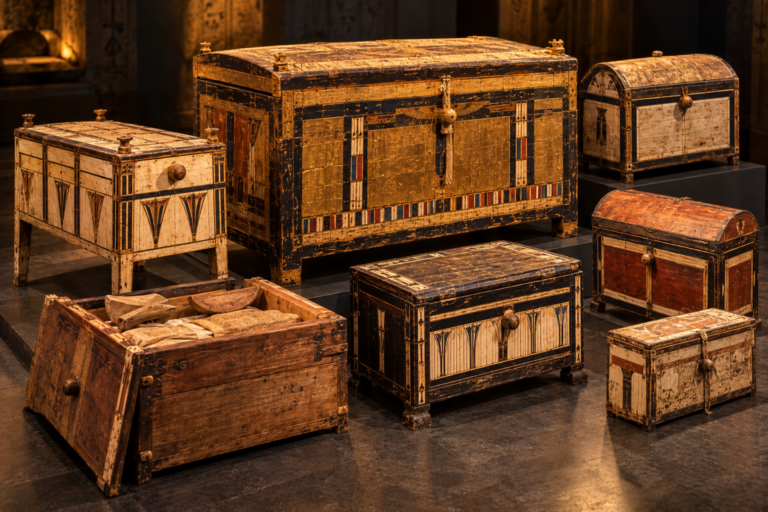
Tutankhamun’s 71 Boxes
Furniture is not only about sitting and sleeping.
Storage was essential too.
Tutankhamun’s tomb contained seventy-one boxes, providing an extraordinary sample of how possessions could be packed, organized and transported.
Some were decorated.
Some were more practical.
They varied in form and contents.
But one of the most revealing discoveries is that the information associated with a box did not always match what archaeologists found inside it.
One table-shaped box, for example, contained headrests even though its label referred to linen.
Another had an interior arrangement apparently suited to holding a wig while an exterior label referred to funerary figurines.
Howard Carter initially connected such inconsistencies with the disruption caused by ancient thieves and the later efforts to restore the tomb.
A more recent interpretation offers another possibility: some boxes may have been reused from the palace and repacked during preparations for Tutankhamun’s funeral without having their old labels replaced.
If that interpretation is correct, the boxes preserve evidence of hurried or pragmatic burial preparation rather than a perfectly coordinated set of containers manufactured from scratch.
Seventy-one boxes do not mean seventy-one perfectly preserved original inventories. Some labels and contents do not match, and reuse or repacking during funeral preparations may explain at least part of the discrepancy.
This deserves its own investigation because the boxes offer a rare opportunity to study the transition between royal possessions and burial equipment.
What Was Tutankhamun’s Furniture Made From?
The furniture collection demonstrates how many different materials Egyptian craftspeople could combine in a single object.
Wood usually provided the structural framework.
Depending on the piece, that framework might then be painted, covered, gilded or combined with decorative materials.
Ivory could provide contrasting details.
Glass and faience could contribute color.
Gold could transform the visible surface.
Leather and woven plant fibers had practical structural roles in certain forms of seating or bedding.
The result was not simply decoration applied to furniture.
It was collaboration between specialized crafts.
A richly finished royal chair might require woodworking, carving, surface preparation, gilding and inlay before it reached its completed form.
A simpler woven chair still required careful selection and shaping of wood followed by skilled work with flexible plant materials.
The level of luxury varied dramatically, but craftsmanship remained essential.
Gold Was Often a Surface, Not the Structure
This is particularly important when looking at photographs.
A brilliantly golden piece of furniture can create the impression that the entire object was made from solid precious metal.
That was often not the case.
Wood could provide the structural body while gold sheet, foil or other surface treatments created the visible brilliance.
This was technically sensible.
Wood is far better suited to many structural furniture components than a heavy mass of precious metal.
Gilding allowed craftspeople to combine useful structural properties with a prestigious appearance.
It also demonstrates why Tutankhamun’s furniture should be studied as engineering as well as art.
How Was Ancient Egyptian Furniture Built?
The survival of Egyptian furniture can make its construction look deceptively simple.
There were no modern power tools, standardized factory screws or mass-produced metal brackets.
Instead, furniture makers depended on carefully shaped wooden components and sophisticated joinery.
Mortise-and-tenon joints, pegs, dowels, lashings and other solutions could be used depending on the object.
The goal was the same problem furniture makers face today: connect separate pieces strongly enough to survive repeated load and movement.
Good joinery also had to account for the natural behavior of wood.
Wood expands, contracts, cracks and deforms according to species, cut, moisture and environmental conditions.
The craftsmen responsible for elite furniture needed practical knowledge accumulated through experience.
The folding bed takes this skill one stage further because some of its joints were supposed to move.
A normal joint aims for stability.
A folding mechanism must provide controlled movement and then become stable in its working position.
That is a much more demanding engineering problem.
Furniture Without Modern Screws
The fact that some pieces survived for more than three thousand years does not mean they remained perfectly intact or unchanged.
Many required extensive conservation, and organic materials could become extremely fragile.
Still, enough original structure survived to show that Egyptian furniture makers understood how to distribute loads and create durable joints without modern fastening systems.
This technical evidence is easy to miss when attention stays focused only on gold and royal imagery.
Yet for anyone interested in how ancient objects were actually made, a joint or hinge can be as informative as a decorated surface.
Did Some Furniture Come From the Palace?
Probably at least some of the broader collection had a history before Tutankhamun’s funeral, although we should avoid treating every object in the same way.
The seventy-one boxes provide particularly interesting evidence.
The Metropolitan Museum of Art notes that many may have come from the palace and been used to pack Tutankhamun’s possessions for the tomb.
The mismatches between labels and surviving contents support the possibility of reuse and repacking.
The folding bed provides a different clue.
Its signs of wear indicate that it was not simply a pristine object sealed away immediately after manufacture.
Together, evidence like this changes how we should imagine the tomb.
KV62 was not necessarily filled with thousands of objects created at one moment for one purpose. Some possessions may already have had lives of their own before they entered the tomb.
That makes Tutankhamun’s furniture especially valuable for the study of the everyday objects associated with Tutankhamun’s life.
The tomb may preserve traces of the living royal environment alongside objects whose primary purpose was funerary.
The challenge is determining which is which.
What the Furniture Reveals About Royal Life
Taken together, Tutankhamun’s furniture opens a window onto several different aspects of New Kingdom royal life.
The chairs reveal different forms of seating and display.
The stools reveal practical and portable furniture.
The footstools show how even functional objects could carry political symbolism.
The beds reveal construction techniques associated with rest and portability.
The folding bed reveals experimentation and mechanical ingenuity.
The great animal-shaped couches reveal a specialized funerary world very different from ordinary household furniture.
The headrests preserve another approach to supporting the body during rest.
The boxes reveal storage, packing and possibly the reuse of palace possessions during funeral preparation.
Most importantly, the collection demonstrates that “royal furniture” did not mean one level of luxury.
A king could be surrounded by objects covered in gold and objects whose value lay primarily in how cleverly they worked.
That contrast is one of the strongest lessons of KV62.
| Furniture Evidence | What It Can Reveal | What It Does Not Prove |
|---|---|---|
| Golden Throne | Royal craftsmanship, decoration and visual representation | How frequently Tutankhamun personally used it |
| Other chairs | Variety in royal seating and construction | That every chair was a ceremonial throne |
| Stools | Practical, portable and decorative seating traditions | That every stool belonged exclusively to the king |
| Decorated footstools | How furniture could carry imagery of royal domination | That the images record specific campaigns by Tutankhamun |
| Folding bed | Advanced portable furniture engineering and evidence of design adjustment | That Tutankhamun personally slept on it during a specific journey |
| Animal-shaped couches | Specialized monumental furniture within the funerary assemblage | That they were ordinary palace beds |
| Headrests | Different forms and materials used for head support | That every example was used nightly by Tutankhamun |
| Seventy-one boxes | Storage, packing, labeling and possible reuse | That every surviving label describes the final contents |
What the Furniture Cannot Tell Us
The furniture from KV62 is unusually rich evidence, but it has limits.
We cannot assume Tutankhamun personally used every chair, stool or bed.
We cannot assume every piece came from his palace.
We cannot assume every piece was made specifically for his burial.
We cannot describe every horizontal couch as an everyday sleeping bed.
We cannot call every elaborate chair a throne.
We cannot assume a golden surface means an object was made from solid gold.
And we cannot always assume that the label on a storage box describes what was inside when the tomb was finally sealed.
These limitations are not weaknesses in the archaeology.
They are part of interpreting it responsibly.
What survives is not a photograph of one day in Tutankhamun’s palace.
It is an archaeological assemblage shaped by manufacture, use, funeral preparation, burial, ancient disturbance, deterioration, excavation and conservation.
Understanding that history allows the furniture to tell a more accurate story.
Frequently Asked Questions
What furniture was found in Tutankhamun’s tomb?
The tomb contained many forms of furniture, including chairs, stools, footstools, beds, large animal-shaped couches, headrests, boxes and folding furniture.
Was a throne found in Tutankhamun’s tomb?
Yes. The richly decorated royal chair commonly called Tutankhamun’s Golden Throne is one of the best-known pieces of furniture from KV62.
Was Tutankhamun’s Golden Throne made of solid gold?
No. It is fundamentally a crafted wooden piece enriched with gold and other decorative materials rather than a chair made entirely from solid gold.
Were beds found in Tutankhamun’s tomb?
Yes. Multiple bedsteads were documented, including an exceptionally sophisticated three-part folding bed.
How did Tutankhamun’s folding bed work?
The bed used articulated sections and metal hinges, including an unusual double-hinge arrangement, allowing the structure and legs to fold into a compact configuration.
Why did the folding bed have eight legs?
The unusual number of legs was connected with its three-part folding structure. The legs were shaped with lion-paw forms while also meeting the mechanical requirements of the design.
Was Tutankhamun’s folding bed actually used?
The bed shows signs of wear consistent with practical use. However, that does not prove exactly when, where or how often Tutankhamun personally used it.
Were chairs found in Tutankhamun’s tomb?
Yes. Several forms of seating were found, including elaborate royal chairs, stools and a rush-work armchair.
Were all Tutankhamun’s chairs thrones?
No. The tomb contained different types of seating with different levels of decoration and likely different functions.
What were the giant animal-shaped couches?
Three massive gilded animal-shaped couches were found in the Antechamber. Their design and archaeological context distinguish them from ordinary everyday beds and connect them closely with the funerary assemblage.
Did ancient Egyptians use headrests?
Yes. Headrests were used in ancient Egypt, and Tutankhamun’s tomb contained examples made from materials including wood, ivory, glass and faience.
How many boxes were found in Tutankhamun’s tomb?
Seventy-one boxes were documented from the tomb.
Why did some box labels not match their contents?
Carter associated some inconsistencies with ancient robbery and subsequent reorganization. A more recent interpretation suggests that some palace boxes may have been reused and repacked for the funeral without being relabeled.
Was all of Tutankhamun’s furniture made specifically for his burial?
There is no good reason to treat the entire collection that way. Some objects show evidence of use, and some storage boxes may have come from a palace context before being repacked for the burial. Other pieces had specialized funerary roles.
What materials were used to make Tutankhamun’s furniture?
Materials varied by object and included different woods, woven plant fibers, leather, ivory, gold, glass, faience and other decorative materials.
How was ancient Egyptian furniture built without modern screws?
Egyptian craftspeople used carefully designed woodworking joints, pegs, dowels, lashings and, where required, specialized metal fittings such as the hinges used on Tutankhamun’s folding bed.
Final Thoughts
The furniture found inside Tutankhamun’s tomb tells a story that gold alone cannot.
It shows a world in which furniture could be practical and symbolic at the same time.
A chair could support the body while communicating royal identity.
A footstool could serve a simple physical function while placing images of defeated enemies beneath the king’s feet.
A box could carry possessions from one context into another.
A bed could fold through an ingenious mechanical system developed by craftsmen working more than three thousand years ago.
And an object with almost no decoration could preserve more evidence of experimentation than some of the tomb’s most spectacular treasures.
The collection also warns us against treating everything from KV62 as if it had one history.
Some objects may have been used before the funeral.
Some may have been repacked.
Some belonged closely to the funerary environment.
Some combined practical function with royal imagery.
What Howard Carter discovered was therefore not simply a room full of ancient furniture.
It was a collection of objects that had been made, decorated, used, moved, stored, selected, disturbed and finally preserved together inside one extraordinary tomb.
That is what makes Tutankhamun’s furniture so valuable today. It does not only show us what surrounded a king in death. Piece by piece, it helps reconstruct the craftsmanship, technology and material world that existed around Egyptian kingship during life.