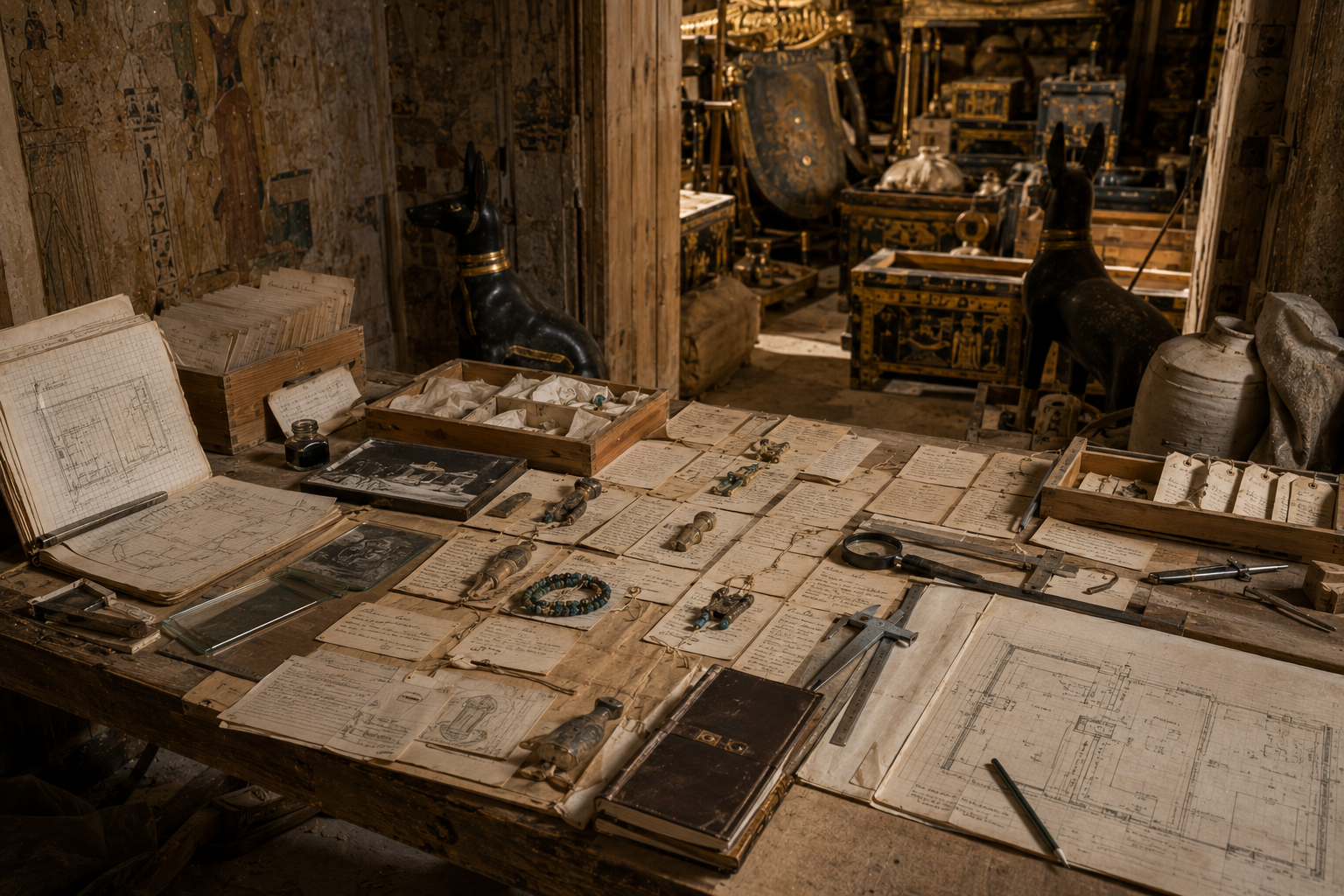

Imagine opening a room sealed for more than 3,000 years and finding it crowded with ancient furniture, chariots, boxes, statues, weapons, jewelry, clothing, vessels, and hundreds of smaller objects. Now imagine that there is no computer, no digital camera, no barcode scanner, and no searchable database. Every object must eventually be moved, yet the moment something leaves its original position, part of the archaeological evidence can disappear forever.
That was one of the greatest challenges Howard Carter and his team faced after the discovery of Tutankhamun’s tomb in 1922. The spectacular gold captured the world’s attention, but behind the famous photographs was a slower and less glamorous operation: assigning identities to objects, describing them, photographing them, mapping their locations, recording inscriptions, noting their condition, and linking separated fragments to the correct finds.
The result was an extraordinary paper and photographic archive. More than a century later, researchers can still trace individual objects through Carter’s cards, excavation journals, plans, drawings, and Harry Burton’s photographs. Yet one detail is often misunderstood. The tomb contained more than 5,000 artifacts and components, but Carter did not simply number them from 1 to 5,000. His system was far more layered, and understanding it reveals how one of archaeology’s most famous discoveries was transformed from a crowded tomb into a scientific record.
Quick Context
- Tomb: KV62 in the Valley of the Kings
- Discovery: November 1922
- Excavation director: Howard Carter
- Main catalogue sequence: Carter numbers 1 through 620
- Total finds: More than 5,000 individual artifacts and components
- Principal photographer: Harry Burton
- Documentation: Object cards, photographs, excavation journals, drawings, plans, measurements, and notes
- Archive today: Much of the surviving excavation documentation is preserved by the Griffith Institute at the University of Oxford
The Problem Carter Faced Inside the Tomb
Tutankhamun’s tomb was small by royal standards, but its chambers contained an extraordinary concentration of burial equipment. This created a problem that went far beyond identifying beautiful objects. Carter’s team had to understand how thousands of pieces related to one another before disturbing that arrangement.
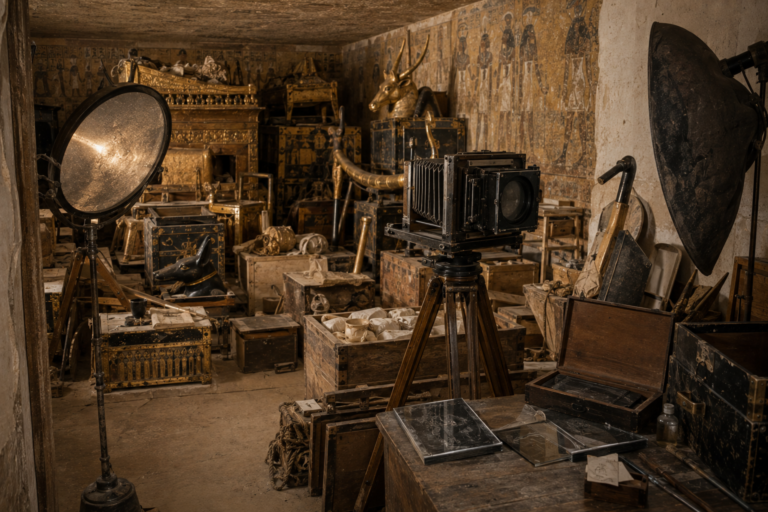
The antechamber was especially difficult. Ceremonial beds, chariot components, boxes, stools, statues, baskets, vessels, and other objects occupied much of the available floor space. Some leaned against one another. Some had been dismantled before burial. Smaller artifacts could lie beneath or inside larger ones. Ancient intrusions had also disturbed parts of the original arrangement.
The annex was even more densely packed. Containers, food supplies, furniture, baskets, oils, and other objects had been placed in a confined room in what appeared to be a less orderly arrangement. Simply reaching one artifact might require dealing with several others first.
In archaeology, the position of a discovery is part of the evidence. The same principle mattered inside KV62. A bowl lying inside a chest tells a different story from the same bowl found beside a doorway. A chariot component found near related pieces may help reconstruct how the vehicle was dismantled. A seal attached to a container can reveal how that container was closed and sometimes how it was administered.
Once an object had been removed without documentation, those relationships could never be restored with certainty. Carter therefore faced two simultaneous tasks: excavating the tomb and preserving a record of a physical arrangement that excavation itself would gradually destroy.
Why context matters: Archaeological information is not contained only in an object. Its location, orientation, neighboring finds, container, condition, and relationship to other objects may all help explain how it was used or deposited.
Why Every Object Needed an Identity Before It Moved
A museum visitor sees an artifact after it has been separated from the excavation process. It has a label, an identification number, and usually a clear description. Inside Tutankhamun’s tomb, none of that existed when Carter first entered. The excavation team had to create those identities.
Before important finds were moved, they were recorded in place whenever conditions allowed. Numbers connected physical objects with written cards, photographs, sketches, measurements, and excavation notes. If an artifact later entered conservation or storage, researchers could use that number to reconnect it with information gathered when it was still inside the tomb.
This was especially important for objects made from several components. A chariot was not simply “a chariot.” It could include a body, wheels, fittings, leather elements, decorative pieces, and associated fragments. A box might contain dozens of smaller discoveries. Jewelry could consist of hundreds of beads or separately manufactured elements.
Without a structured system, the excavation would quickly have produced thousands of disconnected artifacts whose original relationships were increasingly difficult to reconstruct.
The catalogue did more than count the treasures. It preserved the relationships that turned individual objects into archaeological evidence.
The Numbering System That Organized the Tomb
The familiar figure of more than 5,000 objects can make Carter’s catalogue sound deceptively simple. It is easy to imagine archaeologists writing a different number on every artifact until they reached number 5,000. That is not how the surviving records are organized.
Carter’s principal catalogue sequence runs from number 1 to number 620. Within those main numbers, however, letters and further subdivisions identify associated finds, contents, components, and smaller groups. This allowed the team to preserve connections between objects that belonged together instead of treating every fragment as an unrelated discovery.
That distinction matters because the number of catalogue groups is not the same as the number of physical artifacts. One main Carter number could represent a complex assemblage containing many individual pieces, and those pieces could then receive additional lettered or numbered subdivisions.
Why There Were 620 Main Numbers, Not 5,000
One of the clearest examples comes from the king’s burial itself. Carter number 256 was used for the mummy of Tutankhamun and the associated group surrounding it. Within that sequence, subdivisions identified individual elements, including the famous gold mask and other items connected with the mummy.
This hierarchical method preserved relationships. Instead of giving every bead, fitting, fragment, or nested object a completely unrelated number, the system could show that several discoveries belonged to the same larger archaeological context.
5,000 objects, but not 5,000 main Carter numbers: The catalogue uses 620 principal numbers, many of which branch into lettered and further subdivided entries. This is why saying that Carter simply numbered the treasures from 1 to 5,000 is inaccurate. The system was designed to record groups and relationships as well as individual components.
The numbering system was more than an administrative tool. It became the address system for the excavation. A researcher could connect an object number with its written description, photographs, drawings, notes, and sometimes its original position inside the tomb.
What Was Written on an Object Card?
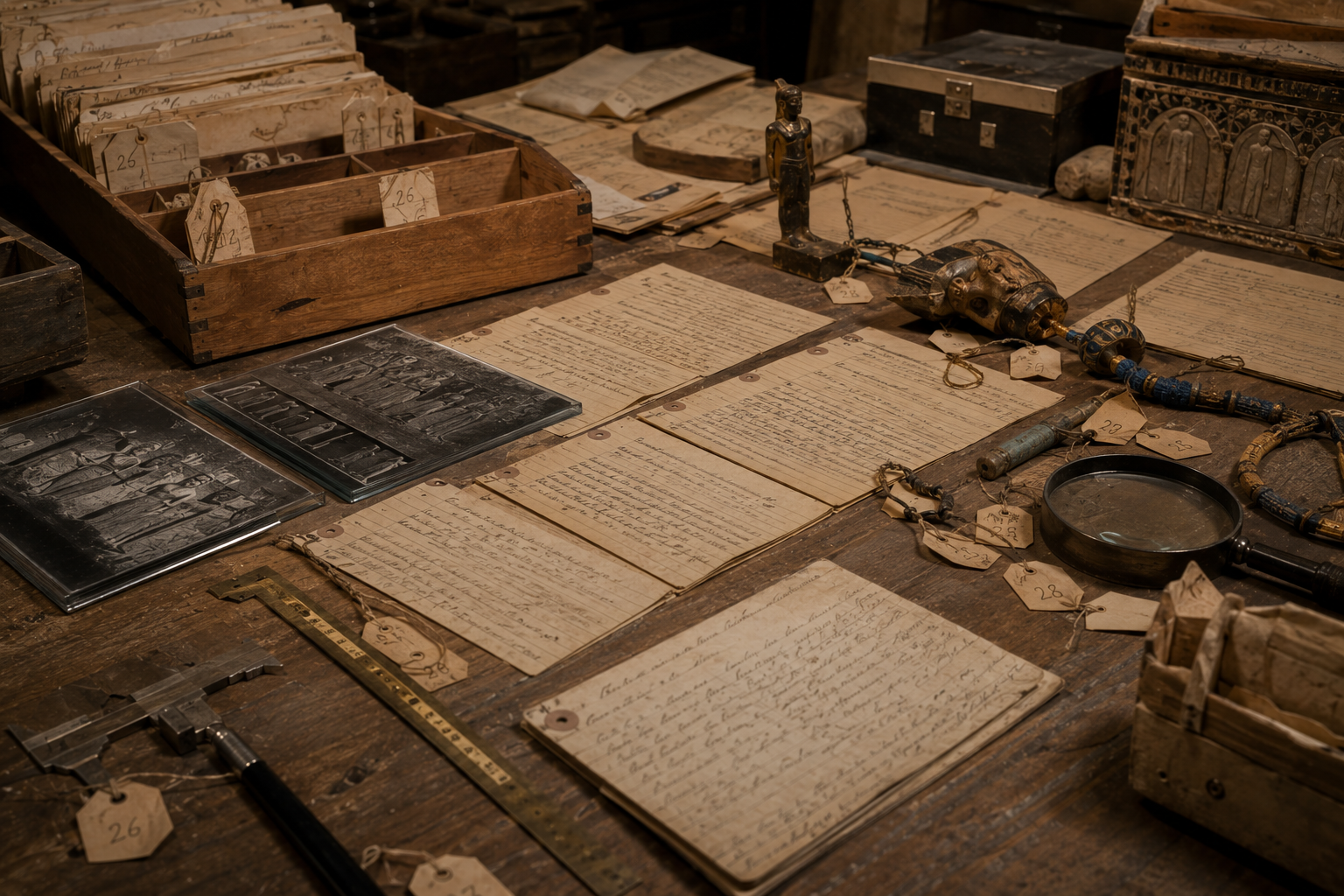
The object cards formed one of the foundations of the excavation archive. They were working documents rather than polished museum labels. Their purpose was to preserve information that might become important long after an object left the tomb.
Depending on the artifact, a card could include an identification number, physical description, dimensions, material, inscriptions, drawings, observations about condition, references to photographs, and notes concerning associated pieces. More complicated objects could require additional pages or specialist observations.
The surviving cards also make clear that the archive was not the work of Carter alone. Specialists contributed according to their expertise. Alfred Lucas dealt extensively with materials and conservation. Alan Gardiner worked on inscriptions and language. Percy Newberry contributed specialist knowledge of Egyptian material culture and botanical remains. Arthur Mace assisted with excavation, conservation, and recording.
The result was a layered record in which the same object might be understood from several perspectives. An excavator recorded where it was found. A conservator noted whether its surface was unstable. An epigrapher examined inscriptions. A photographer preserved its appearance before and after removal.
Recording What Was Seen, Not Just What Was Expected
Good archaeological documentation must preserve evidence even when its meaning is uncertain. Carter’s team sometimes encountered fragments that could not immediately be identified or objects whose purpose was unclear. In those cases, physical characteristics, dimensions, materials, location, and relationships could still be recorded while interpretation remained open.
This is one reason old excavation records remain so valuable. An interpretation written in the 1920s can be reconsidered, while measurements, photographs, sketches, and observations may still support a different conclusion decades later.
The archive also included objects that were visually modest compared with the famous gold pieces: fragments of pottery, linen, resin, wood, glass, stone vessels, seals, fittings, and other small remains. These materials were essential because archaeology does not judge importance by beauty or monetary value.
A broken fragment may reveal how a container was made. A piece of linen may preserve evidence of wrapping or storage. A seal can provide administrative information. A small fitting may help reconstruct a larger object whose components were found apart.
Harry Burton Added the Visual Evidence
Numbers and written descriptions could organize the excavation, but they could not fully capture what the chambers looked like before objects were moved. For that, Carter relied heavily on photography.
Harry Burton, an experienced archaeological photographer associated with the Metropolitan Museum of Art’s Egyptian Expedition, became responsible for the excavation’s principal visual record. Across the years of work at KV62, he produced roughly 1,400 glass-plate negatives documenting the tomb, its artifacts, and the excavation process.
Burton’s task was technically demanding. The chambers were small and dark, photographic equipment was bulky, and many surfaces were highly reflective. Large objects could not simply be rearranged to make a better picture. Cameras, lighting, and working positions had to be adapted to the archaeology.
The photographs preserved information that written descriptions could never fully replace. They recorded the way beds stood above neighboring objects, how boxes were stacked, where fragments lay, how shrines filled the burial chamber, and how the spaces changed as objects were gradually removed.
Why Photographing an Object in Place Mattered
Consider two photographs of the same chair. One shows the chair after cleaning, isolated against a neutral background. It is ideal for studying decoration and craftsmanship. The other shows it exactly where it was discovered, surrounded by boxes, fragments, and other burial equipment.
The first image records the object. The second preserves its archaeological context.
Researchers need both. Studio photography can reveal fine details that are difficult to see inside the tomb, while excavation photography preserves relationships that disappeared as soon as clearance progressed.
Burton also photographed stages of removal and conservation. His work created a visual history of KV62 changing from a crowded burial environment into an excavated archaeological space.
A record that cannot be recreated: Modern cameras can produce far more detailed images, but no modern photographer can return to the untouched arrangement of KV62 as it appeared during the original excavation. Once the artifacts were moved, that archaeological moment was gone.
Maps Turned the Tomb Into a Spatial Record
Object cards answered the question “What is it?” Photography helped answer “What did it look like?” Plans and measurements addressed another essential question: “Where was it?”
Carter’s excavation records included plans of the entrance, passage, chambers, architectural measurements, orientation information, and drawings showing different parts of KV62. These records allowed researchers to connect artifacts not only with catalogue numbers but also with physical spaces inside the tomb.
This spatial information is critical because the tomb’s chambers were not interchangeable. The antechamber, annex, burial chamber, and treasury contained different concentrations of objects and served different functions within the burial complex.
An artifact found beside the canopic equipment in the treasury has a different context from an everyday object stored in a box elsewhere. Measurements can also help researchers understand how enormous shrines, beds, chariots, and furniture were maneuvered into a tomb with such limited space.
When Carter numbers, object cards, photographs, and plans are studied together, the archive becomes much more than a list of treasures. It becomes a partial reconstruction of the tomb as it existed during the excavation.
When One Number Contained Many Objects
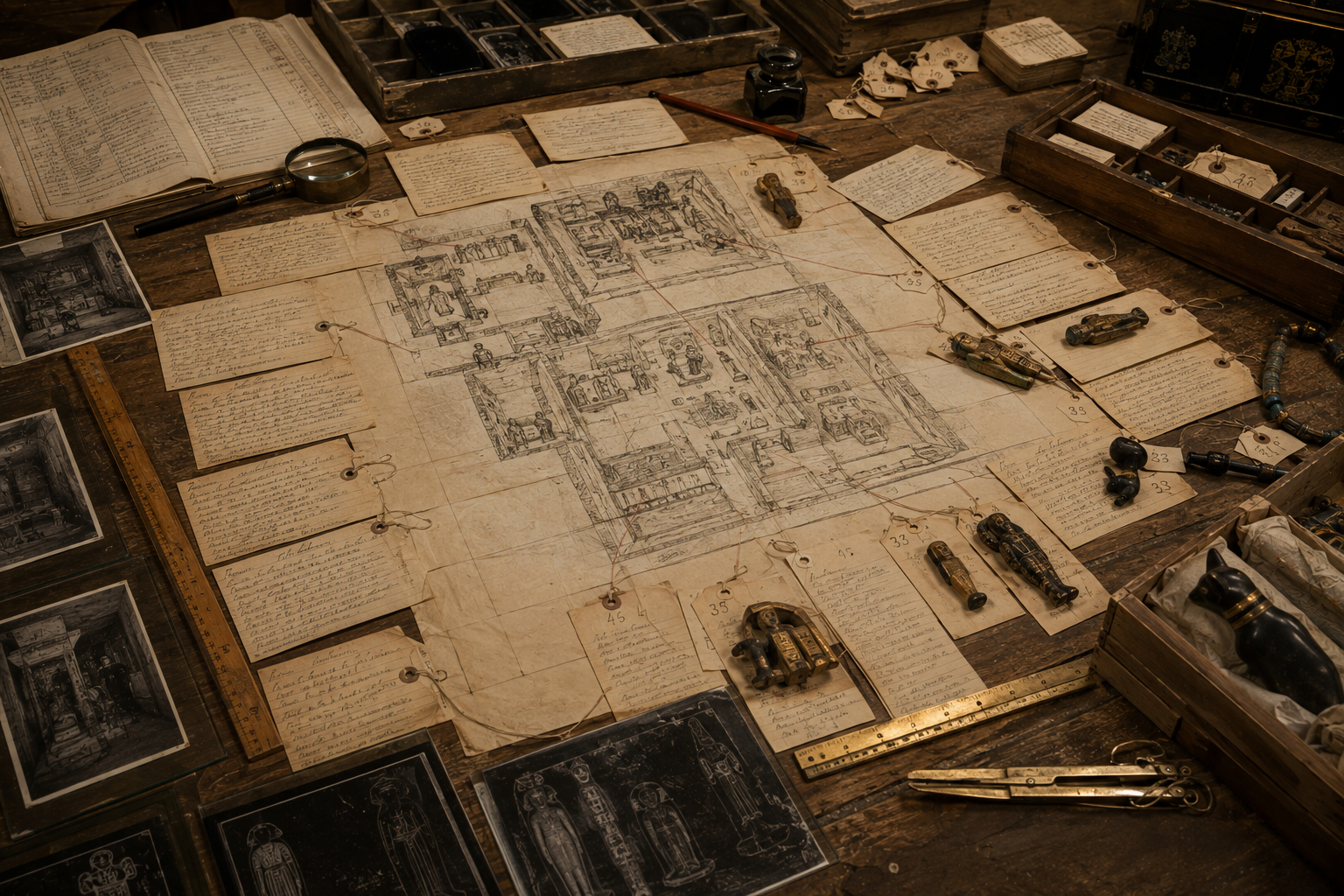
One of the most useful features of Carter’s system was its ability to preserve groups. Archaeological finds do not always appear as isolated objects. A chest can contain many items. A necklace can include dozens or hundreds of beads. A dismantled chariot can survive as wheels, fittings, leather parts, and fragments scattered across a chamber.
By using subdivisions beneath a principal number, Carter’s team could keep those relationships visible. A main number might identify the larger archaeological group, while letters and additional identifiers distinguished individual pieces within it.
This prevented an important kind of information loss. If every fragment had been given a completely unrelated number, later researchers might struggle to recognize that several pieces belonged to the same original object or container.
The approach also reflected the reality of the tomb. KV62 was not a collection assembled for display. It was a burial environment containing nested objects, grouped possessions, containers within containers, dismantled equipment, and items that had shifted or been disturbed in antiquity.
Why grouped numbers matter: Archaeological catalogues are designed to preserve relationships, not simply count objects. One number can represent a context, while subdivisions record the individual pieces within it.
The People Behind Carter’s Catalogue
Howard Carter’s name is inseparable from Tutankhamun’s tomb, but the catalogue was created by a team. The excavation required photography, conservation, epigraphy, material analysis, drawing, logistics, and fieldwork, and no single person could have performed all of those tasks alone.
Howard Carter
Carter directed the excavation and established the overall recording system. His experience in Egyptian archaeology shaped the way objects were numbered, described, and connected to their context.
Harry Burton
Burton created the principal photographic record. His images documented objects in situ, after removal, during conservation, and under more controlled photographic conditions.
Alfred Lucas
Lucas was central to conservation and material study. He examined fragile objects, identified materials where possible, and developed treatments that helped stabilize artifacts before transport.
Alan Gardiner
Gardiner contributed expertise in Egyptian language and inscriptions. His work helped interpret texts, names, titles, and hieroglyphic material recorded on objects from the tomb.
Percy Newberry
Newberry brought specialist knowledge of Egyptian material culture and botanical remains, helping interpret some of the organic and plant-based materials recovered from the burial.
Arthur Mace
Mace assisted with excavation, conservation, and documentation during important phases of the project.
Egyptian workers, foremen, guards, and antiquities personnel were also essential to the excavation. They handled difficult physical work, movement, security, and practical field operations. The surviving documentation, however, does not preserve the names and contributions of all participants with equal detail, which is an important limitation of the historical record.
No Database, No Cloud, No Digital Camera
For a modern reader, perhaps the most striking aspect of the Tutankhamun archive is how much information was preserved without digital technology.
The team relied on handwritten cards, notebooks, measured drawings, glass-plate negatives, paper plans, and manually copied inscriptions. Every connection between an object and its records had to be maintained physically and intellectually.
Today, archaeologists can use databases, digital photography, photogrammetry, laser scanning, geographic information systems, and three-dimensional modeling. These technologies can record enormous amounts of information rapidly and connect different forms of evidence almost instantly.
| Carter’s Era | Modern Archaeology |
|---|---|
| Handwritten object cards | Searchable digital databases |
| Glass-plate photography | High-resolution digital imaging |
| Manual measurements | Digital surveying and laser measurement |
| Paper tomb plans | GIS and three-dimensional spatial models |
| Hand-copied inscriptions | Digital epigraphy and enhanced imaging |
| Physical cross-referencing | Linked databases connecting objects, images, contexts, and conservation records |
Yet modern technology does not replace Carter’s archive. It depends on it. A three-dimensional reconstruction of KV62 can only place an object accurately if researchers know where that object was found. A modern conservation study is more useful if it can compare today’s condition with Burton’s photographs. Digital tools increase what scholars can do with the old evidence, but they cannot recreate information that was never recorded.
Technology can improve an archaeological record, but it cannot recover a lost context once excavation has destroyed it.
Mistakes, Corrections, and Changing Interpretations
The strength of Carter’s archive does not mean that every original identification was correct or that every decision would be repeated by archaeologists today. Archaeology develops as new evidence, methods, and technologies become available.
Some fragments were later recognized as belonging to larger objects. Some inscriptions received improved readings. Materials could be identified more precisely with laboratory analysis. Old restoration materials sometimes complicated later conservation. Interpretations about the original ownership, reuse, or modification of certain objects have also changed over time.
This is normal in archaeology. A catalogue should not be judged only by whether every first interpretation proved correct. Its deeper value lies in whether it preserved enough evidence for later researchers to test those interpretations.
Carter’s detailed notes, photographs, and object relationships often allow modern scholars to return to the original evidence instead of relying only on conclusions written a century ago.
Historical caution: Not every theory about Tutankhamun’s burial equipment is settled. Suggestions that some objects were originally made for other royal individuals, for example, must be evaluated object by object and should not be treated as proven for the entire collection.
How the Archive Survived After Carter
The excavation records did not disappear after the tomb was cleared. A substantial body of Carter’s papers, object cards, plans, drawings, photographs, and related documentation eventually became part of the Griffith Institute’s collections at the University of Oxford.
This preserved archive is one of the reasons the excavation remains unusually accessible to researchers. Scholars can examine original records rather than depending entirely on later summaries or popular retellings.
Digitization has expanded that access dramatically. The Tutankhamun archive has been made available through online research projects that connect object records, cards, photographs, maps, and related documentation.
This creates something Carter could never have imagined: a researcher thousands of miles from Egypt can now compare an object card with excavation photographs, review the numbering structure, study plans of KV62, and follow the history of a specific artifact through multiple records.
The original paper system has, in effect, become the foundation of a modern digital archaeological resource.
Why Researchers Still Use Carter’s Records Today
More than a century after the discovery, Carter’s records continue to answer questions that were not even being asked in the 1920s.
Researchers can use them to reconstruct where artifacts were found, compare objects that may belong together, study inscriptions, identify old conservation treatments, investigate workshop practices, and examine the organization of Tutankhamun’s burial.
They are especially useful when physical objects have changed. An artifact may have been cleaned, restored, reconstructed, or displayed differently over the decades. Burton’s photographs and Carter’s notes can reveal its earlier condition.
The archive also helps when fragments become separated. If a small piece in storage appears to match a larger object, catalogue numbers, photographs, dimensions, and original descriptions can help test whether the connection is plausible.
Modern projects that digitally reconstruct the tomb also depend heavily on this information. The more precisely an object’s original location was documented, the more accurately researchers can rebuild the spatial logic of KV62.
What the Catalogue Reveals That Gold Cannot
The gold mask became the symbol of Tutankhamun’s tomb because it is visually extraordinary. Yet if archaeologists studied only the most spectacular pieces, much of the burial would remain invisible.
The catalogue preserves sandals, clothing, baskets, food containers, tools, games, walking sticks, weapon components, fragments, vessels, seals, plant material, and countless small objects that reveal how a royal burial was prepared and what kinds of possessions were considered important for the king’s afterlife.
These less famous objects can answer questions gold cannot. What did the king wear? What foods were placed in the tomb? How were boxes sealed? What materials did craftsmen use? Which objects showed signs of wear? Which pieces had been repaired before burial?
A catalogue transforms those questions from speculation into research possibilities because it preserves evidence across the entire assemblage, not only the masterpieces.
This is why the excavation archive may ultimately be as important as any single treasure. The mask can show extraordinary craftsmanship. The full record can help reconstruct an entire burial system.
Frequently Asked Questions
How many objects were found in Tutankhamun’s tomb?
The tomb contained more than 5,000 individual artifacts and components. The exact figure depends on how groups, fragments, and subcomponents are counted.
Why does Carter’s catalogue have only 620 main numbers?
Because Carter’s system was hierarchical. The 620 principal numbers could contain lettered and further subdivided entries representing multiple objects, fragments, or associated components within one larger archaeological group.
What is a Carter number?
A Carter number is the excavation identifier assigned to an object or object group from Tutankhamun’s tomb. These numbers link physical artifacts to cards, photographs, notes, plans, and other excavation records.
Did Howard Carter personally catalogue every object?
No. Carter directed the recording system, but the work involved a team of specialists, including photographers, conservators, epigraphers, archaeologists, and other assistants.
Who photographed Tutankhamun’s tomb?
Harry Burton created the principal photographic record of the excavation. His glass-plate photographs documented the tomb, artifacts, conservation work, and different stages of clearance.
What information appeared on Carter’s object cards?
Depending on the object, cards could include descriptions, dimensions, materials, inscriptions, condition notes, drawings, photograph references, and information about associated finds.
Where are Howard Carter’s original records today?
A major collection of the excavation records is preserved by the Griffith Institute at the University of Oxford, where many documents have also been digitized for research.
Can researchers still study the Tutankhamun excavation records?
Yes. The surviving archive remains an important research resource, and digitization has made many object cards, photographs, maps, and related records much easier to access and compare.
Did Carter’s team make mistakes?
Some early identifications and interpretations have been revised as research advanced. This does not make the archive unreliable. Its detailed documentation often allows later scholars to reassess those original conclusions.
Why are the original photographs so valuable?
They preserve objects in their excavation context before removal, cleaning, restoration, reconstruction, or museum display changed their appearance or surroundings.
Final Thoughts
Howard Carter is remembered for discovering Tutankhamun’s tomb, but discovery was only one part of his legacy. The harder achievement was turning an overwhelming mass of objects into a record that could survive the excavation itself.
The system was not perfect, and it was created with the tools and assumptions of archaeology in the 1920s. Yet its combination of catalogue numbers, object cards, plans, drawings, photographs, specialist notes, and contextual observations preserved an extraordinary amount of information.
Without that work, many of Tutankhamun’s treasures would still be beautiful museum objects, but researchers would know far less about where they came from, what surrounded them, how they were grouped, and what condition they were in when first uncovered.
Perhaps the most important lesson of the archive is simple: archaeology is not only about finding things. It is about recording enough evidence that people who were not there can continue asking questions long after the excavation is over.
More than a century later, that is exactly what Carter’s catalogue still allows us to do.