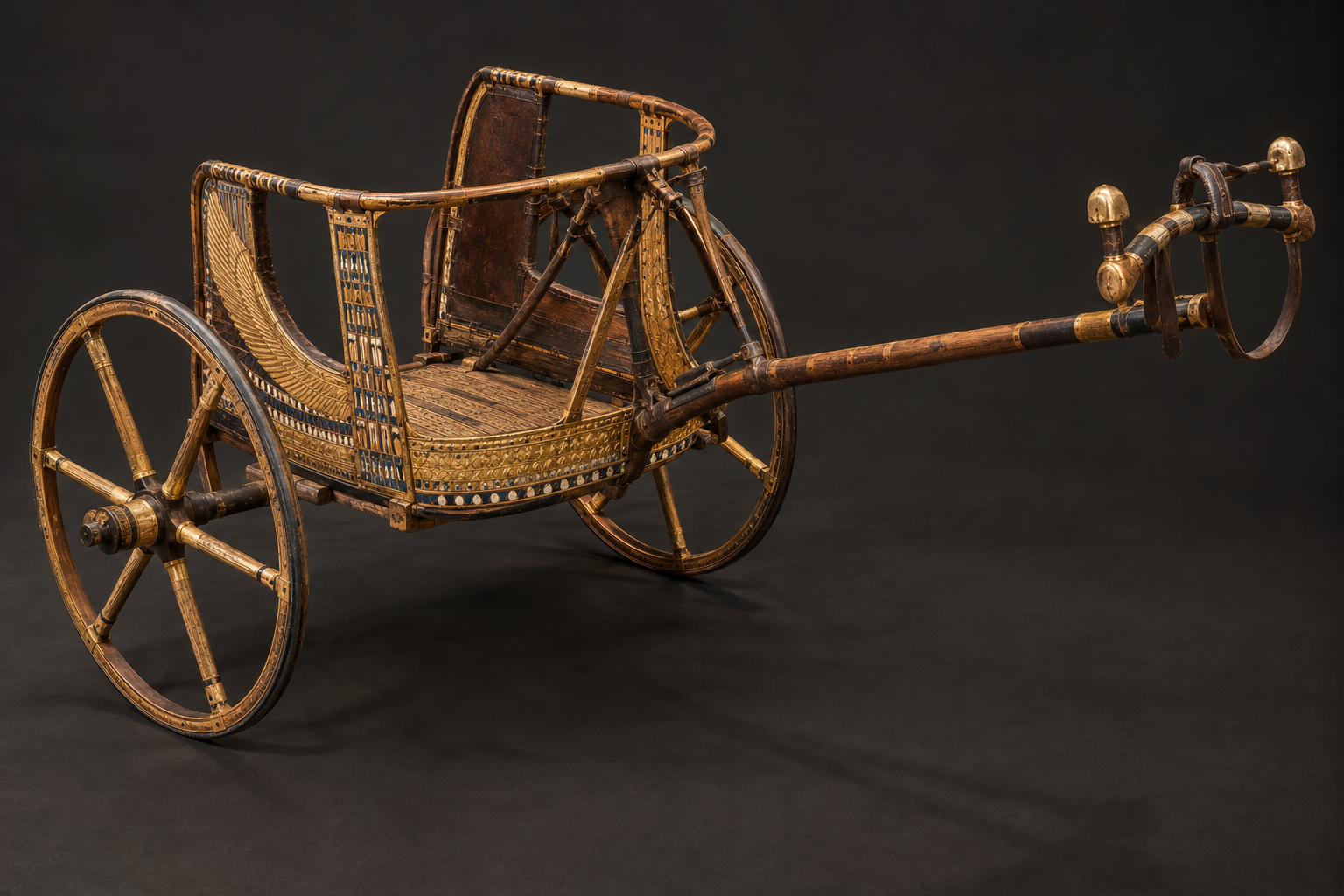

Six chariots were buried inside Tutankhamun’s tomb. But they were not six identical vehicles waiting to carry a warrior into battle.
Some were richly decorated and closely connected with royal display. Others were heavier and plainer. Two were smaller and lighter. Their construction, condition, decoration, and archaeological context reveal that the chariot could occupy several different worlds at once: transportation, hunting, warfare, royal ceremony, and burial.
That variety makes the six vehicles far more interesting than the simple label “war chariots” suggests. Why did one young king need so many different chariots in his tomb, how did these remarkable machines work, and what can they really tell us about Tutankhamun’s life?
Quick Context
- King: Tutankhamun
- Dynasty: Eighteenth Dynasty
- Period: New Kingdom
- Tomb: KV62, Valley of the Kings
- Chariots found: Six
- Antechamber: Four chariots
- Treasury: Two chariots
- Vehicle types: Highly decorated State chariots, heavier open chariots, and smaller lighter examples
- Typical Egyptian chariot: A lightweight two-wheeled vehicle drawn by a pair of horses
- Possible roles: Royal display, transport, hunting, military use, and burial provision
- Key caution: The six chariots did not all have the same construction or probable function
Six Chariots Inside KV62
The number sounds simple: six chariots.
But the archaeological evidence immediately makes the story more complicated.
Howard Carter’s records and later notes on the vehicles distinguish between several different designs. Two were highly decorated State chariots. Two others in the Antechamber were heavier, open vehicles. The remaining two, discovered in the Treasury, were smaller and lighter.
That means Tutankhamun was not buried with six copies of one standard royal vehicle.
His tomb contained a collection.
The differences in size, weight, body construction, decoration, and apparent use suggest that chariots could serve several purposes within the royal environment.
Tutankhamun was not buried with six copies of one vehicle. He was buried with a collection showing how many different roles a chariot could play in royal life.
This distinction matters because the word “chariot” often immediately creates an image of warfare.
In New Kingdom Egypt, chariots certainly had an important military role. But they were also used in hunting, royal movement, display, and ceremonial contexts.
The six vehicles from KV62 should therefore be studied individually before assigning them all the same function.
Where Were Tutankhamun’s Chariots Found?
The chariots were divided between two rooms of the tomb.
Four were discovered in the Antechamber, the large room that Carter entered shortly after the sealed tomb was opened. The remaining two were found in the Treasury.
The four Antechamber vehicles were catalogued as Carter numbers 120, 121, 122, and 161.
The two Treasury examples were numbered 332 and 333.
But Carter did not walk into the tomb and find six complete vehicles neatly parked side by side.
The Antechamber was crowded with furniture, boxes, animal-shaped couches, containers, and other objects. Dismantled chariot components occupied part of this already dense space.
The Metropolitan Museum of Art’s account of the discovery describes dismantled chariots filling one end of the room.
This is important for understanding both the burial and the excavation.
A reconstructed museum chariot presents a complete machine.
Carter encountered separated wheels, frames, poles, axles, fittings, and other components that had to be documented and associated correctly.
Why Were the Chariots Taken Apart?
A complete horse-drawn chariot is an awkward object to move through the narrow architecture of a royal tomb.
The practical solution was to dismantle the vehicles into major components.
The surviving records identify parts such as the body framework, axle, pole, yoke, yoke saddles, wheels, and fragments of harness equipment.
This modular construction was useful long before the vehicles entered KV62.
Wheels and other components needed to be fitted securely but also maintained. Leather bindings could reinforce joints. Separate elements could be repaired or replaced when necessary.
For burial, however, disassembly solved another problem: space.
The tomb of Tutankhamun was relatively compact, and its chambers were already packed with objects.
Taking the chariots apart allowed large vehicles to be moved into the tomb and stored much more efficiently.
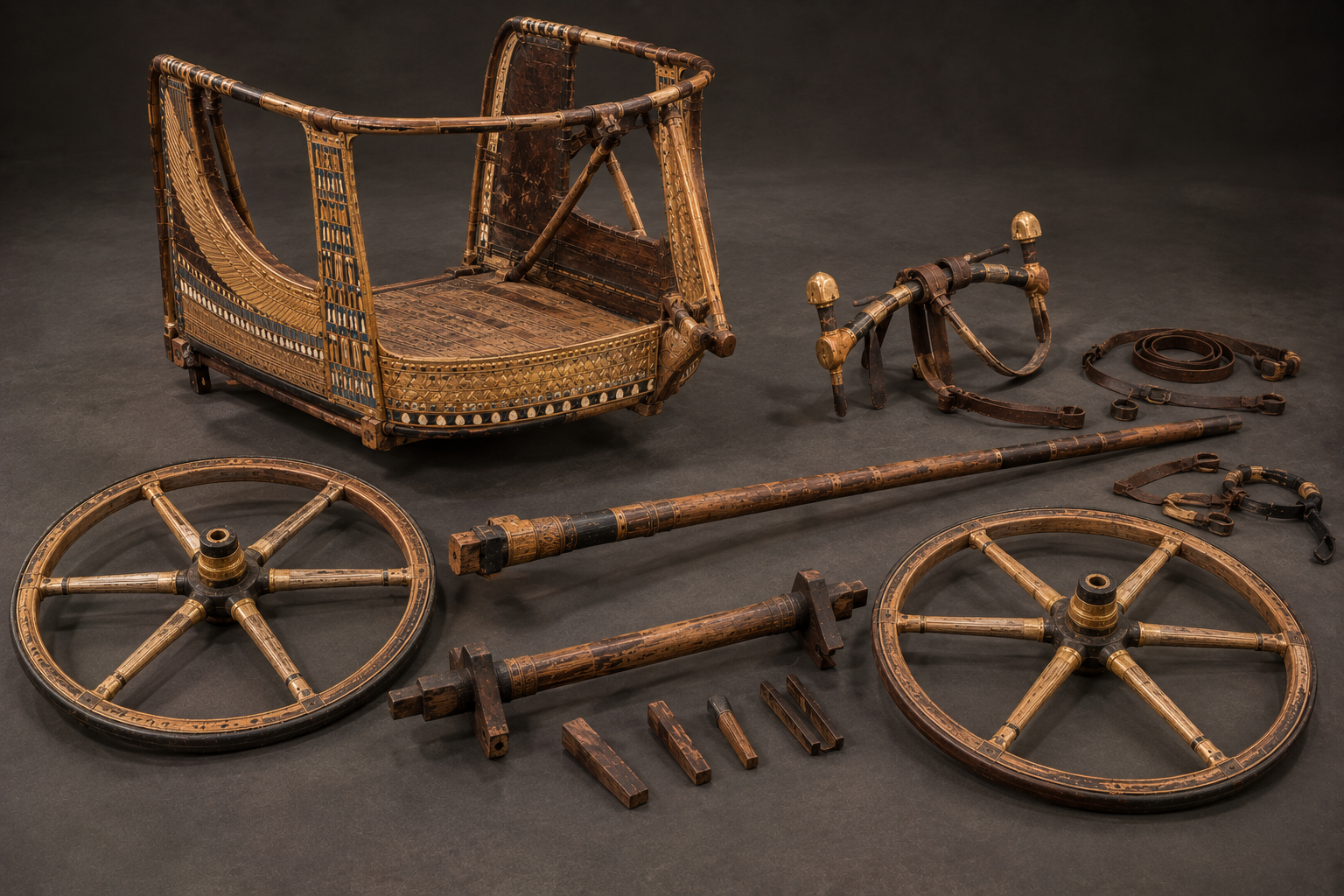
For the excavation team, the dismantled condition created a considerable documentation problem.
A wheel had to be connected with the correct body.
A pole had to be identified.
Decorative fragments needed to be recorded before further deterioration occurred.
Harness components could become separated from the vehicle with which they were originally associated.
This is where Carter’s detailed system for cataloguing the objects from Tutankhamun’s tomb became essential.
The six chariots were not simply treasures to remove. They were complex archaeological machines that had to be reconstructed from their surviving parts.
Tutankhamun’s State Chariots
Two of the most spectacular vehicles from the Antechamber were catalogued as numbers 120 and 122.
They are described in the surviving chariot notes as State chariots.
Their wooden framework supported surfaces covered with elaborate decoration. Gold, colored glass, ivory, and other decorative materials transformed the lightweight vehicle into something intended to be seen as much as ridden.
The effect must have been extraordinary in strong daylight.
Gold-covered surfaces would have reflected light while colored inlays added contrast across the body and fittings.
This was transportation turned into royal display.
But there is another important detail.
Notes based on Carter’s records state that the two highly decorated chariots appear hardly to have been used before they were placed in the tomb.
That observation immediately challenges the assumption that every vehicle in KV62 had accumulated a long history of everyday driving.
These elaborate chariots may have belonged primarily to State display, ceremonial occasions, or royal pageantry rather than repeated hard use.
They were vehicles, but they were also moving statements of kingship.
The Heavier Open Chariots
Standing in sharp contrast to the decorated State vehicles were two heavier open chariots, catalogued as 121 and 161.
Their construction exposed more of the structural framework instead of hiding it behind the fully enclosed and richly decorated surfaces associated with the State examples.
That difference is useful.
It shows that Egyptian chariot builders were not producing a single design and merely changing the decoration.
The underlying vehicle itself could vary.
Weight, body construction, reinforcement, and finishing could be adapted according to the intended role.
A plainer vehicle might be better suited to activities where durability and practical performance mattered more than spectacular appearance.
Hunting and general movement are reasonable contexts to consider for such vehicles, although assigning one exact activity to each surviving chariot requires caution.
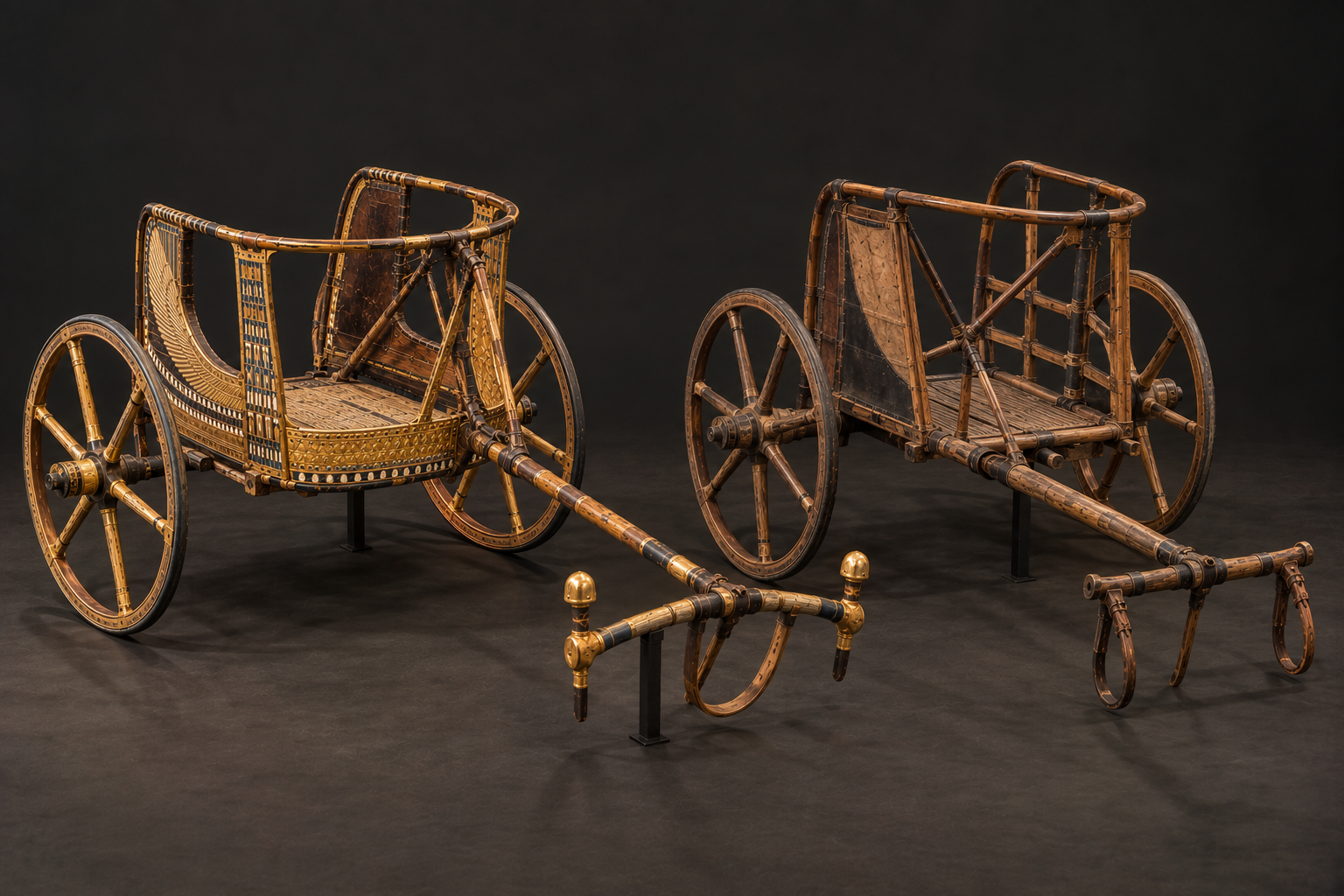
The contrast also demonstrates why decoration alone cannot tell us everything about a vehicle.
A less spectacular chariot may actually preserve more evidence about practical transportation than an almost unused royal display vehicle.
The Two Smaller Chariots
The Treasury contained another pair of vehicles, catalogued as numbers 332 and 333.
These were smaller and lighter than the heavier open chariots in the Antechamber.
Their bodies incorporated leather, but organic materials do not survive as reliably as gold or dry wood. Deterioration therefore changed what archaeologists could see when the tomb was excavated.
This raises a broader issue that applies throughout KV62.
What survives today is not identical to what Tutankhamun’s burial equipment looked like more than three thousand years ago.
Leather can shrink, crack, fragment, or disappear.
Bindings can fail.
Adhesives can deteriorate.
Decorative layers can separate from their underlying structure.
A chariot that now appears skeletal may originally have presented a much more complete surface.
Reconstruction therefore depends on more than assembling surviving pieces like a modern puzzle. Archaeologists also have to understand materials that have partially or completely vanished.
Were All Six Chariots Functional?
Not in the same sense.
The vehicles differed too much in robustness, decoration, condition, and probable purpose to treat them as six interchangeable working chariots.
The Metropolitan Museum of Art notes that of the six chariots from Tutankhamun’s tomb, only one was sturdy enough for war or hunting.
Meanwhile, Carter’s records distinguish highly decorated State vehicles from heavier open examples and lighter chariots.
These observations point in the same general direction: the collection represented multiple vehicle types.
That does not mean a decorated chariot was incapable of movement.
It means that being capable of rolling behind horses is not the same as being optimized for the stresses of hard hunting or military use.
“Chariot” describes the vehicle type, not a single function. Tutankhamun’s six examples differed significantly enough that they should not all be described simply as war chariots.
How an Egyptian Chariot Was Built
Behind the gold and royal imagery was an impressive piece of engineering.
An Egyptian chariot had to solve a difficult problem.
It needed to carry standing occupants over uneven ground at speed while remaining light enough for a pair of horses to accelerate and maneuver effectively.
Adding more wood could make a structure stronger, but it would also make it heavier.
Removing too much material could reduce weight but weaken the vehicle.
The solution depended on intelligent material selection and carefully controlled construction.
The main system included a lightweight body, floor, axle, two wheels, a long central pole, a yoke, and harness equipment connecting the vehicle to its horses.
The rear of the body remained open, allowing occupants to step into the vehicle.
The axle was positioned toward the rear, placing the wheels behind much of the standing platform rather than directly beneath its center.
Wooden members were bent into carefully controlled shapes, while leather bindings reinforced vulnerable areas.
Different parts of the vehicle could use different woods according to the mechanical demands placed on them.
The result was not simply a wooden cart with two wheels.
It was a lightweight system whose components had to flex, absorb shock, and remain aligned while moving quickly.
Why the Wheels Were So Important
The wheel was one of the most technically demanding components of the chariot.
Tutankhamun’s chariot wheels used six spokes connecting the central hub to the outer rim.
This arrangement provided strength without requiring a heavy solid wooden wheel.
At the center, the hub rotated around the axle.
Surviving construction notes describe leather associated with the bearing surfaces, helping manage the contact between moving wooden components.
The outer rim itself had to withstand repeated contact with the ground while maintaining the circular geometry necessary for smooth movement.
Every part affected every other part.
A badly shaped wheel would vibrate.
A weak spoke could fail.
A poorly fitted hub would create excessive friction.
An axle that did not align correctly could make the entire vehicle unstable.
Chariot building therefore demanded precision even though the craftspeople did not possess modern machine tools.
Six Spokes Instead of a Solid Wheel
A solid wooden wheel would have been much heavier.
Spokes removed unnecessary material while transferring forces between the hub and rim.
This helped reduce rotating mass, an important advantage for a vehicle whose performance depended on acceleration and speed.
Lightness, however, could never come at the cost of catastrophic weakness.
The wheel had to remain strong enough to carry the vehicle, its occupants, and the forces generated while moving across imperfect ground.
The six-spoked wheels from Tutankhamun’s chariots preserve the result of generations of development in New Kingdom vehicle technology.
Why Egyptian Chariots Were So Light
Howard Carter’s notes describe Egyptian chariots as small vehicles, generally large enough for two people standing upright.
That compactness was an advantage.
For a fast horse-drawn vehicle, every unnecessary kilogram makes acceleration harder and increases the load on the horses.
Egyptian chariot makers therefore sought strength without excessive mass.
Thin structural members, bent wood, open frameworks, leather components, spoke wheels, and carefully designed joints all contributed to this balance.
The builders also needed high-quality materials.
A hidden flaw in a piece of wood that remained harmless in furniture could become dangerous in a wheel spoke, axle, or pole repeatedly stressed at speed.
Material selection was therefore part of the engineering process.
The sophistication of an Egyptian chariot came partly from what its builders left out. Reducing unnecessary weight while preserving structural strength was essential to creating a fast, responsive vehicle.
How Horses Were Attached
The chariot itself was only half of the system.
Without trained horses and carefully designed harness equipment, it could not move effectively.
A long pole projected forward from the vehicle toward a yoke positioned across a pair of horses.
Harness components helped secure the team, while reins allowed the driver to control direction and speed.
Surviving New Kingdom equipment and records associated with Tutankhamun’s vehicles include elements connected with bridles, reins, yokes, and other horse trappings.
The two horses needed to work together.
If one accelerated while the other resisted, the vehicle would become difficult to control.
Turning also required coordination because the horses, pole, yoke, wheels, and driver were mechanically linked.
The chariot should therefore be understood as a complete system:
horses + harness + reins + yoke + pole + vehicle + occupants.
Removing any one part from that chain gives only a partial picture of how the technology worked.
Who Stood Inside a Chariot?
Egyptian chariots were generally compact enough for two standing occupants.
In military use, a common arrangement paired a driver with a warrior.
The driver controlled the horses while the second occupant could concentrate on the bow or another weapon.
This division of labor made practical sense.
Controlling two fast-moving horses required constant attention. Trying to manage reins while simultaneously using a bow would make both tasks more difficult.
Royal art, however, complicates this picture.
Egyptian kings are often represented alone in their chariots, dramatically controlling the horses while simultaneously attacking enemies or hunting.
That image should not automatically be treated as a literal record of normal crew arrangements.
Royal art had its own visual language.
The king could be shown as exceptionally capable because the scene communicated mastery and power.
Chariots for Hunting
For hunting in open terrain, the chariot offered several advantages.
It could move quickly across ground that would take much longer to cover on foot.
It could help a hunter pursue fast animals.
Its standing platform provided a mobile position from which a bow could be used.
This is where Tutankhamun’s chariots connect directly with the weapons found inside Tutankhamun’s tomb.
KV62 preserved bows, arrows, quivers, and other projectile equipment alongside the vehicles.
Viewed together, they reveal technologies that could function as parts of a larger system.
A bow by itself tells us about archery.
A chariot by itself tells us about transportation.
Combine the two and we can understand why mobile archery became so important in elite hunting and warfare during the New Kingdom.
But the presence of both technologies in Tutankhamun’s tomb does not prove that every surviving chariot was used by the king for hunting.
As with the weapons, individual objects need individual interpretation.
Chariots in Warfare
By Tutankhamun’s period, the horse-drawn chariot had become an important part of New Kingdom military organization.
Its great advantage was mobility.
A chariot could move warriors and archers rapidly across suitable terrain, reposition them, and combine speed with long-range projectile weapons.
Chariot crews belonged to an elite military environment, and the vehicle became closely associated with royal martial power.
Yet this broader military importance should not be used to turn all six vehicles from KV62 into battlefield machines.
The physical evidence argues against that simplification.
Some were highly decorated.
Some were lighter.
Some were heavier.
The State examples appear to have seen very little use.
The Metropolitan Museum’s assessment that only one of the six was sturdy enough for war or hunting provides an especially useful warning against calling the entire group “war chariots.”
The military chariot was real.
But Tutankhamun’s collection was broader than military equipment alone.
Chariots for Royal Display
A chariot covered with gold and colored decoration would have created an entirely different impression from a plain practical vehicle.
In a royal procession, the vehicle itself became part of the king’s appearance.
It raised him above many of the people around him.
It moved quickly.
Its wheels, horses, harness, and decorated surfaces created a coordinated visual display.
Evidence from the wider Eighteenth Dynasty also shows chariots being used for court movement. Amarna reliefs from the period shortly before Tutankhamun depict royal chariots arriving at major settings, while attendants and horses wait outside.
That wider evidence reminds us that chariotry belonged to royal mobility as well as hunting and warfare.
A richly decorated State chariot could therefore communicate status simply by appearing in public.
A royal chariot was both a vehicle and a statement of kingship.
Gold, Leather and Decoration
The chariots from KV62 combined materials that served very different purposes.
Wood provided the primary structural framework.
Leather could form coverings, bindings, harness components, and flexible surfaces.
Linen and other organic materials could contribute to construction and finishing.
Metal fittings reinforced or decorated particular areas.
On the most elaborate vehicles, gold, colored glass, ivory, and inlay transformed structural surfaces into royal display.
These materials should not be divided too simply into “useful” and “decorative.”
A leather binding could strengthen a joint while remaining visually unobtrusive.
A gold covering might contribute little to structural strength but completely change the social meaning of the vehicle.
The finished State chariot therefore combined engineering with visual communication.
It had to exist physically as a vehicle, but it also had to look appropriate for a king.
The Craftspeople Behind the Chariots
No single craft could produce an object this complex.
A chariot required knowledge of woodworking, wheel construction, bending and joining timber, leatherworking, harness manufacture, and fitting separate components into a functioning vehicle.
A royal chariot added still more specialists.
Goldworkers could cover surfaces.
Inlay specialists fitted colored materials.
Leatherworkers produced flexible coverings and harness elements.
Painters and decorators finished visible surfaces.
Metalworkers supplied fittings where needed.
The precision of the wheels alone demanded highly specialized knowledge.
The result was a product of coordinated expertise.
A royal chariot was not simply the work of one carpenter. It brought together vehicle construction, wheel making, leatherworking, harness production, metalwork and, on the richest examples, gilding and inlay.
This makes the six vehicles important evidence for the organization of skilled labor around the Egyptian court.
Behind each finished chariot stood a network of people whose names are mostly lost but whose technical decisions survive in the objects they made.
Were Tutankhamun’s Chariots Actually Used?
At least some of the vehicles may have had practical histories, but the six cannot be treated identically.
The most important clue comes from the two highly decorated State chariots.
Notes based on Carter’s documentation state that they appear hardly to have been used before being placed in the tomb.
That observation is significant.
A chariot used regularly outdoors would experience stress.
Wheels contact the ground.
Hubs rotate around axles.
Leather flexes.
Joints move.
Surfaces are exposed to dust and abrasion.
A vehicle showing little evidence of such use may have had a very different history from a heavily worked hunting or transport chariot.
But lack of heavy wear does not tell us exactly why a vehicle was little used.
It could have been reserved for special occasions.
It could have been relatively new.
It could have served primarily ceremonial display.
Or its surviving condition may reflect a more complicated history.
The secure conclusion is narrower: the six chariots did not all experience the same pattern of use.
Could Tutankhamun Personally Drive a Chariot?
This question is much harder to answer than it first appears.
Chariot driving clearly belonged to the royal environment of the Eighteenth Dynasty. Kings and members of the royal family were represented with chariots, and the vehicles had become established within court, hunting, and military culture well before Tutankhamun’s reign.
It is therefore reasonable to consider chariot driving part of the world in which the young king was raised.
What we cannot securely reconstruct is his individual level of driving experience.
The tomb does not provide a record of how often he drove.
It does not identify a favorite chariot.
And it does not justify confident claims that every vehicle belonged to his personal daily routine.
The same caution applies to attempts to use debated reconstructions of Tutankhamun’s physical condition to declare either that he could or could not drive a chariot.
The surviving vehicles themselves do not settle that question.
For the archaeology of KV62, the stronger evidence concerns the machines, their construction, their different designs, and their place within the royal environment.
The King Shooting From a Chariot
Tutankhamun is famously represented standing in a chariot while using a bow.
Such scenes are visually powerful because the king appears completely in control.
The horses move rapidly.
The vehicle remains stable.
The king draws his bow.
Enemies or animals appear before him.
It is tempting to read such an image as a snapshot from Tutankhamun’s life.
That would go beyond what royal art can securely tell us.
By the Eighteenth Dynasty, the image of the king commanding a chariot had become part of royal visual culture. The ruler could be shown alone even though ordinary military chariot operation commonly involved a driver and warrior working together.
The image therefore communicates an ideal.
The king controls the horses.
He controls the weapon.
He controls the battlefield or hunt.
Everything in the composition reinforces royal mastery.
That does not make the image historically useless.
It makes it evidence of a different kind.
The surviving chariots tell us how vehicles were built.
The royal scenes tell us what chariot mastery could mean in the visual language of kingship.
Understanding the difference between those two forms of evidence is essential.
Chariots and Tutankhamun’s Weapons
The chariots become even more informative when they are studied alongside the weapons preserved in KV62.
Tutankhamun’s tomb contained extensive archery equipment, including different types of bows, numerous arrows, bow cases, and related objects. These were not technologically separate from the world of chariotry.
A lightweight chariot and a composite bow could work together as part of a highly mobile system.
The horses supplied speed.
The chariot provided a moving platform.
The driver controlled the team.
The bow allowed a second occupant to attack or hunt from a distance.
Quivers kept arrows available while the vehicle was moving.
When these technologies are examined together, the weapons found inside Tutankhamun’s tomb become part of a much larger technological picture.
This relationship was particularly important in warfare and elite hunting, where mobility could change how archery was used.
But the archaeological caution remains the same.
Possessing both chariots and bows does not prove that Tutankhamun personally used every surviving combination of equipment.
The tomb preserves the technologies of his royal environment more securely than it preserves a detailed record of his individual activities.
Why Chariot Archery Required Skill
Shooting accurately from a moving platform is very different from shooting while standing on the ground.
The vehicle moves vertically and laterally as its wheels cross uneven terrain.
The horses accelerate and turn.
The archer must maintain balance while handling a bow and preparing another arrow.
At the same time, the driver must control the horses and anticipate changes in terrain.
This helps explain why chariot crews belonged to a specialized military environment.
The technology depended not only on the vehicle but also on trained people and trained horses.
A beautifully constructed chariot was useless without the human and animal skills necessary to operate it.
That broader system is easy to miss when a chariot is displayed motionless in a museum.
Originally, it was part of a fast and highly dynamic form of transportation.
What Happened When a Chariot Turned?
Turning placed very different stresses on a chariot than moving in a straight line.
The horses had to change direction together.
The pole and yoke transmitted movement between the team and the vehicle.
The wheels followed different paths through the turn.
The occupants had to shift their balance while remaining upright.
A lightweight body helped the vehicle respond quickly, but the structure still needed enough strength to withstand repeated forces at the axle, wheels, floor, and joints.
This balance between flexibility and strength is one reason Egyptian chariot construction was so sophisticated.
The builders were not simply trying to make the lightest possible vehicle.
They were trying to make a vehicle light enough to perform while remaining strong enough to survive the stresses created by horses, speed, terrain, and occupants.
Why the Chariots Were More Than Transportation
It would be misleading to think of Tutankhamun’s chariots as the ancient equivalent of six ordinary vehicles parked in a royal garage.
Transportation was only one part of their significance.
Chariots were expensive machines.
They required specialist materials.
They depended on skilled craftspeople.
They needed horses, harness equipment, training, maintenance, and people capable of operating them.
Owning and maintaining chariots therefore reflected access to substantial resources.
A richly decorated State chariot added another layer.
It transformed mobility into public display.
The king was not merely being transported from one location to another. The vehicle, horses, decoration, attendants, and royal appearance could combine into a carefully controlled presentation of status.
This helps explain why the chariot became such a powerful royal image during the New Kingdom.
What the Chariots Reveal About Horses in Royal Egypt
The six vehicles also point toward something that is physically absent from the tomb: the living horses that once made chariotry possible.
A chariot required more than two animals strong enough to pull it.
The horses needed training.
They had to respond to reins and commands.
They had to move together under a shared yoke.
They had to remain controllable around other horses, vehicles, noise, and rapid movement.
That implies an entire supporting system beyond the surviving chariots themselves.
Royal stables required handlers.
Harness equipment required maintenance.
Horses needed food, water, grooming, and veterinary attention.
Teams needed repeated training with the vehicles they were expected to pull.
None of those activities survives as dramatically as a gold-covered chariot body, but they were necessary for chariot technology to function.
A chariot was never just a vehicle. Its operation depended on trained horses, harness equipment, drivers, maintenance, specialist craftspeople, and the resources required to keep the entire system working.
Repair and Maintenance Were Part of Chariot Life
Even a perfectly constructed chariot would eventually need attention.
Wooden components experienced repeated stress.
Leather could stretch and wear.
Bindings could loosen.
Wheel hubs and axles created friction.
Rims encountered stones and irregular ground.
Harness components were pulled by powerful animals.
For a working chariot, maintenance was not optional.
This gives the vehicle another layer of archaeological importance.
Construction techniques tell us how the chariot was originally made, while repairs and modifications can potentially reveal parts of its later history.
But evidence of repair must still be interpreted carefully.
A repaired component proves that someone considered the object worth maintaining.
It does not automatically tell us that Tutankhamun himself was using the vehicle when the damage occurred.
As with the sticks and staffs buried with Tutankhamun, an object’s physical history and the king’s personal history are related questions, but they are not always the same question.
Why Put Six Chariots in a Tomb?
There is no need to search for one explanation that applies equally to all six vehicles.
The differences between them suggest the opposite.
Chariots belonged to several important aspects of royal life.
They represented mobility.
They were connected with hunting.
They belonged to military technology.
They appeared in royal processions and public display.
They were powerful images of kingship.
And once placed inside KV62, they became part of Tutankhamun’s funerary equipment.
The State chariots may have emphasized royal status and ceremonial display.
More robust vehicles could represent practical aspects of chariot technology.
The smaller examples add further variation to the collection.
Together, the six vehicles created something much broader than a set of war machines.
The six chariots did not preserve one role from Tutankhamun’s world. Together they preserved mobility, technology, hunting, military identity, royal display, and burial.
The decision to include them also required considerable effort.
Large vehicles had to be dismantled.
Their components had to be moved into the tomb.
Space had to be found among hundreds of other objects.
Parts needed to remain associated closely enough for the vehicles to retain their identity.
This was deliberate burial preparation.
The chariots mattered enough to be included despite their size and complexity.
What Burial Changed About the Chariots
A vehicle used during life and a vehicle placed in a tomb are not archaeologically identical things.
The act of burial changes context.
A chariot that once moved through an open landscape became stationary.
Its horses disappeared from the system.
Its wheels were removed.
Its pole and yoke were detached.
The complete machine became a collection of components packed into a protected underground space.
Its practical ability to move was temporarily sacrificed so that the vehicle itself could enter the burial.
This transformation is especially important when interpreting the State chariots.
If they were only lightly used before burial, their value may have depended less on a long working history and more on what they represented within the royal world.
But even a practical chariot acquired new significance once it became part of KV62.
Its final archaeological context was funerary.
Ancient Disturbance Complicated the Evidence
Tutankhamun’s tomb was not completely untouched between the burial and Carter’s arrival.
Ancient intruders entered KV62, and objects in several areas were disturbed.
This makes the original placement of some equipment difficult to reconstruct with complete certainty.
Large dismantled objects create an additional challenge because their components may already have been separated intentionally before burial.
An excavator therefore has to distinguish between deliberate dismantling, ancient disturbance, deterioration, and movement during excavation.
Carter’s object cards, plans, drawings, and notes became essential for this reason.
So did photography.
Harry Burton’s photographs of Tutankhamun’s discovery preserved the position and condition of objects before the excavation process permanently changed the chambers.
For something as mechanically complex as a dismantled chariot, those records are particularly valuable.
Why Organic Materials Changed After Burial
Gold survives extremely well.
Leather does not.
This simple difference can distort the way we imagine Tutankhamun’s possessions today.
A surviving gold surface remains visually dominant after more than three thousand years, while leather coverings, bindings, straps, and flexible components may shrink, fragment, harden, or disappear.
Wood can split and warp.
Adhesives can fail.
Painted surfaces can flake.
Textiles can become extremely fragile.
When a reconstructed chariot appears incomplete, that does not necessarily mean it looked incomplete when placed in KV62.
Some of its original visual and structural character may have depended on organic materials that survived poorly.
This is an important reminder whenever we try to imagine the six vehicles in Tutankhamun’s lifetime.
Archaeologists work with what survived, not with a perfectly preserved version of the original object.
What the Six Chariots Reveal About Skilled Labor
The collection also reveals the scale of expertise available to the royal court.
Producing one high-quality chariot required multiple technical traditions.
Producing several different vehicle types required even more.
Craftspeople needed access to suitable wood.
Wheel makers needed precise knowledge of hubs, spokes, rims, and axles.
Leatherworkers produced bindings and harness components.
Other specialists supplied metal fittings.
Decorators worked with gold, glass, ivory, pigments, and inlay.
Horse specialists completed the operational system.
Behind the six vehicles therefore stood a much larger human network.
The chariots are surviving endpoints of that network.
The workshops, supply chains, training, and daily labor are less visible, but they were necessary for the objects to exist.
This makes the vehicles evidence not only for Tutankhamun’s royal status but also for the technical organization of New Kingdom Egypt.
What the Chariots Cannot Tell Us
The six chariots are unusually informative, but they do not answer every question about Tutankhamun.
They cannot prove that he personally drove all six.
They cannot prove that every vehicle was used during his lifetime.
They cannot establish that each chariot had one fixed purpose.
They cannot prove that Tutankhamun drove one of them into battle.
They cannot establish that every hunting scene showing him in a chariot records a specific historical event.
They cannot tell us exactly how often he traveled by chariot.
They cannot identify a favorite vehicle.
And damage or wear on an individual component cannot automatically be attributed to Tutankhamun himself.
These limits are especially important because the visual evidence can be so persuasive.
A royal scene showing the king alone in a speeding chariot looks immediate and personal.
But royal art communicates ideals as well as events.
The physical vehicles and the images should therefore be compared without treating either as a complete biography.
| Evidence | What It Reveals | What It Does Not Prove |
|---|---|---|
| Six chariots in KV62 | Chariots were important within Tutankhamun’s royal and funerary environment | That Tutankhamun personally drove all six |
| Two decorated State chariots | Vehicles could function as extraordinary displays of royal status and craftsmanship | That they were regularly used in warfare |
| Heavier open chariots | The collection included more robust and practical vehicle designs | The exact activity performed with each vehicle |
| Two smaller lighter chariots | New Kingdom chariot design was not limited to one size or construction | Who personally used them |
| Six-spoked wheels, hubs and axles | Egyptian craftspeople understood sophisticated lightweight vehicle engineering | How often an individual chariot was driven |
| Harness equipment | The chariot operated as part of a complete horse-and-vehicle system | That Tutankhamun personally trained or harnessed the horses |
| Royal hunting and battle scenes | Chariot mastery formed an important part of royal representation | That every depicted scene records a literal event from Tutankhamun’s life |
What the Chariots Reveal About Royal Life
The most important thing about Tutankhamun’s chariots may be their differences.
If all six had been identical, the collection would tell a much simpler story.
Instead, we have richly decorated State vehicles, heavier open constructions, and smaller lighter examples.
That variety reflects the multiple environments in which chariot technology could operate.
Royal life was not confined to a palace interior.
The king could appear in public processions.
He could be represented hunting.
Military power was central to royal identity.
Travel and movement required organized transport.
Horses and vehicles demanded specialized personnel and considerable resources.
The chariots bring these different aspects of royal life together.
They also reveal something about technology that gold alone cannot show.
The builders understood how to reduce weight.
They understood wheel construction.
They understood how different woods behaved.
They knew how to use leather as a structural and flexible material.
They created harness systems capable of transferring the power of two horses into controlled movement.
And on the most elaborate examples, they transformed that engineering into royal art.
A royal chariot was a machine, a product of specialist craftsmanship, and a visible expression of status at the same time.
Frequently Asked Questions
How many chariots were found in Tutankhamun’s tomb?
Six chariots were found in KV62. Four were discovered in the Antechamber and two in the Treasury.
Were all six of Tutankhamun’s chariots the same?
No. The collection included two highly decorated State chariots, two heavier open chariots in the Antechamber, and two smaller lighter examples in the Treasury.
Were Tutankhamun’s chariots found complete?
The vehicles had been dismantled into major components before being placed in the tomb. Wheels, bodies, poles, axles, yokes, and other parts therefore had to be documented and associated during excavation.
Why were the chariots dismantled?
Taking the vehicles apart made it possible to move and store them within the restricted spaces of KV62. A complete chariot would have been far more difficult to maneuver through the tomb.
Were all Tutankhamun’s chariots war chariots?
No. The six vehicles differed substantially in construction and probable role. Some were highly decorated State chariots, while others were more robust or lighter in design. It is therefore inaccurate to describe the entire collection simply as six war chariots.
How many horses pulled an Egyptian chariot?
A New Kingdom Egyptian chariot was typically drawn by a pair of horses connected to the vehicle through a central pole, yoke, and harness system.
How many people could stand in an Egyptian chariot?
Egyptian chariots were generally compact vehicles capable of carrying approximately two standing occupants. In military use, a driver and warrior could work together as a crew.
Why did Egyptian chariots use spoked wheels?
Spoked wheels reduced weight compared with heavy solid wheels while maintaining enough strength to support the vehicle and occupants. Tutankhamun’s chariot wheels used six spokes.
What were Tutankhamun’s chariots made from?
Wood formed the main structure, while leather was important for bindings, coverings, harness equipment, and other flexible components. The richest vehicles also incorporated materials such as gold, colored glass, ivory, and decorative inlay.
Were Tutankhamun’s chariots actually used?
The six vehicles appear to have had different histories. The two highly decorated State chariots were recorded as showing very little evidence of use before burial, while other vehicles may have had more practical roles.
Did Tutankhamun personally drive a chariot?
Chariot driving belonged to the royal environment of Tutankhamun’s period, making familiarity with the technology plausible. However, the surviving chariots do not tell us exactly how often he personally drove or which individual vehicles he used.
Did Tutankhamun use a chariot in battle?
The surviving chariots and royal imagery do not securely prove that Tutankhamun personally drove a chariot in a specific battle. Images of the king fighting from a chariot also belong to established traditions of royal representation.
Were chariots used for hunting in ancient Egypt?
Yes. Chariots provided speed and mobility during elite hunting, and royal imagery shows kings using bows from moving chariots. They also had important military and ceremonial roles.
Why were chariots important in New Kingdom warfare?
Chariots provided rapid mobility and could carry archers across suitable terrain. A driver could control the horses while another crew member concentrated on using weapons.
Why were six chariots placed in Tutankhamun’s tomb?
No single explanation necessarily applies to all six. Together, the vehicles reflect several aspects of the royal world, including mobility, hunting, military identity, public display, specialized craftsmanship, and funerary provision.
Final Thoughts
Six chariots entered Tutankhamun’s tomb, but they did not tell one simple story.
Two were spectacular State vehicles.
Others were heavier and plainer.
Two were smaller and lighter.
Some appear to have seen little use, while other designs were better suited to more practical demands.
Their wheels reveal lightweight engineering.
Their wooden frames reveal careful material selection.
Their harness equipment points to trained horses and specialized handlers.
Their decoration reveals the resources of royal workshops.
And their differences show that the chariot could occupy several places in Egyptian royal life.
It could move.
It could hunt.
It could belong to warfare.
It could carry the king through a public display.
And eventually, dismantled and carefully placed underground, it could become part of a royal burial.
What the six chariots cannot give us is a complete driving history of Tutankhamun himself.
They do not tell us which vehicle he preferred, how often he held the reins, or whether a particular royal battle scene records something he personally experienced.
But they reveal something broader and more securely grounded.
They show the extraordinary technical and human system that surrounded a New Kingdom king: craftspeople, wheel makers, leatherworkers, decorators, horse handlers, drivers, archers, workshops, materials, and generations of accumulated engineering knowledge.
Tutankhamun’s chariots were more than vehicles.
They were machines built for movement, objects designed for display, symbols of royal power, and ultimately part of one of the most remarkable burials ever discovered in Egypt.