
When Tutankhamun’s tomb was opened in 1922, the world was desperate to see what Howard Carter had found. There was no television broadcast from the Valley of the Kings, no digital camera, and no instant way to share thousands of images. Yet within a remarkably short time, people far beyond Egypt were able to see dark chambers crowded with gilded furniture, statues, chariots, boxes, shrines, and objects that had remained hidden for more than 3,000 years.
Much of that visual memory exists because of Harry Burton. Working with large-format cameras, glass photographic plates, heavy equipment, and carefully controlled lighting, Burton documented the excavation with a precision that went far beyond newspaper photography. His task was not simply to produce dramatic pictures. He had to preserve evidence before the excavation itself changed the scene forever.
Every time an object was removed from KV62, part of the tomb’s original arrangement disappeared. Burton’s photographs captured those moments before they were lost. Today, his images allow researchers to study how artifacts were positioned, how rooms were cleared, how fragile objects looked before conservation, and how one of archaeology’s greatest discoveries unfolded step by step.
Quick Context
- Name: Harry Burton
- Born: 1879
- Died: 1940
- Profession: Archaeological photographer
- Association: Metropolitan Museum of Art’s Egyptian Expedition
- Role at KV62: Principal photographer of the excavation of Tutankhamun’s tomb
- Photography method: Large-format cameras using glass-plate negatives
- Photographic record: Roughly 1,400 glass-plate negatives connected with the excavation
- Importance: His photographs preserved the tomb’s archaeological context before objects were removed
Who Was Harry Burton?
Harry Burton was already an experienced photographer of ancient Egyptian monuments before the discovery of Tutankhamun’s tomb made his work internationally famous. Born in England in 1879, he developed his career in an era when archaeological photography demanded patience, technical knowledge, and an intimate understanding of light.
His long association with Egypt eventually brought him into the work of the Metropolitan Museum of Art’s Egyptian Expedition. That experience mattered enormously. Photographing archaeological sites is very different from ordinary portrait or landscape photography. A photographer must work around fragile surfaces, restricted spaces, uneven lighting, architectural obstacles, dust, and objects that cannot simply be rearranged for a better composition.
Burton became particularly skilled at producing clear, carefully controlled images of monuments, reliefs, tombs, and excavated objects. By the time Carter needed comprehensive photographic documentation for KV62, Burton possessed exactly the combination of technical ability and archaeological experience the project demanded.
His contribution would ultimately become so closely connected with the discovery that many of the images people now associate with Tutankhamun are, in fact, Burton’s view of the excavation.
Why Howard Carter Needed More Than an Archaeologist
The discovery of a tomb is irreversible. The moment excavation begins, the site starts to change. Dust is removed. Boxes are opened. Furniture is lifted. Fragments are collected. Doorways are cleared. Objects leave the positions they have occupied for centuries.
Howard Carter understood this problem clearly. Written notes could describe an artifact and measured plans could record its approximate location, but neither could fully preserve the visual complexity of a chamber crowded with overlapping objects.
Photography offered something different. It could capture the arrangement before disturbance and create a visual record against which later interpretations could be tested.
This was especially valuable in Tutankhamun’s tomb because the burial equipment was unusually dense. The antechamber contained large ceremonial beds, chariots, boxes, stools, statues, baskets, and other items packed into a relatively small space. The annex was even more crowded. In the burial chamber, enormous gilded shrines surrounded the sarcophagus and occupied most of the available room.
Removing one object could expose another or change the apparent relationship between several pieces. A carefully timed photograph preserved the scene before that happened.
Burton did not simply photograph the treasures. He photographed their archaeological context before it disappeared forever.
The Camera That Entered Tutankhamun’s Tomb
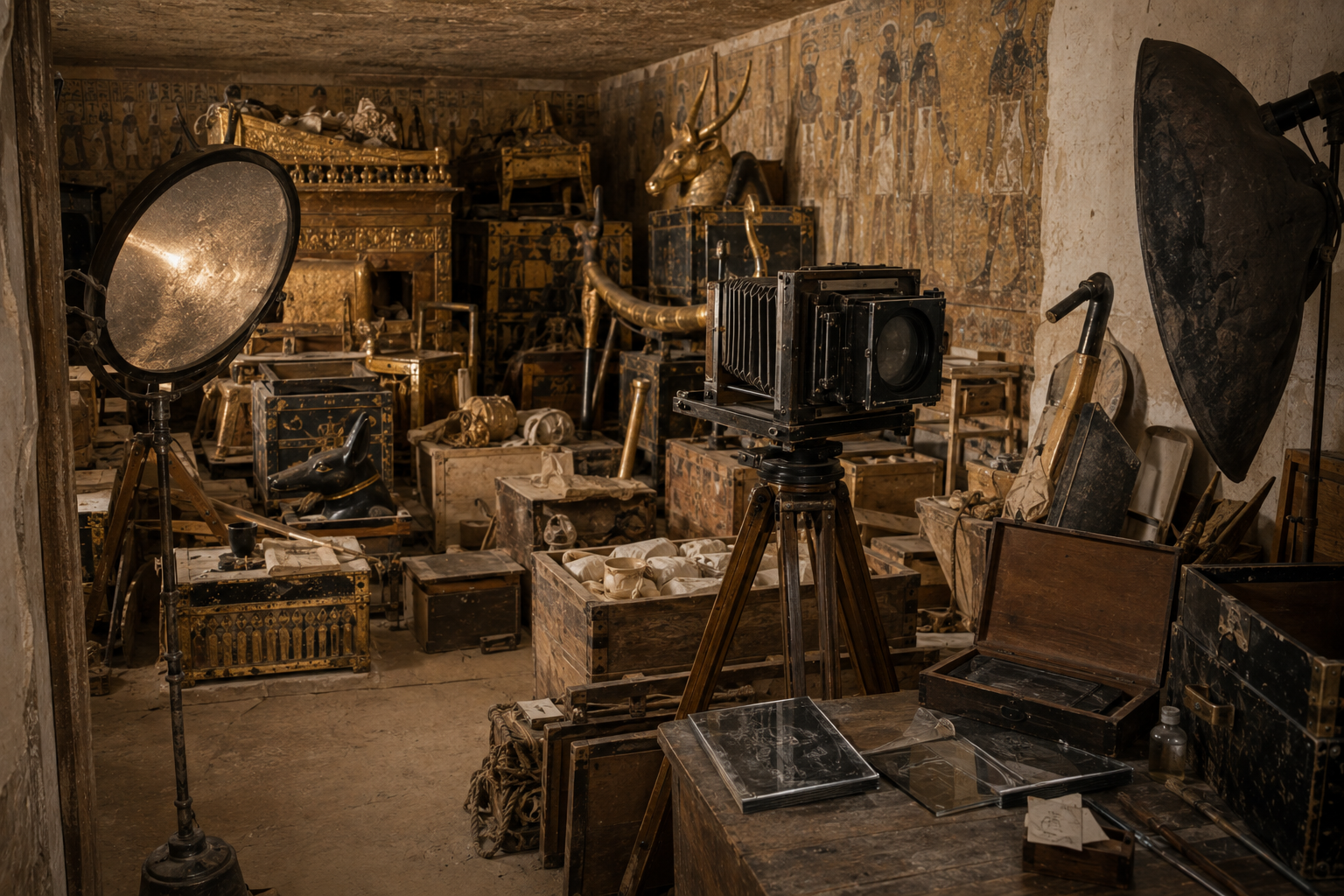
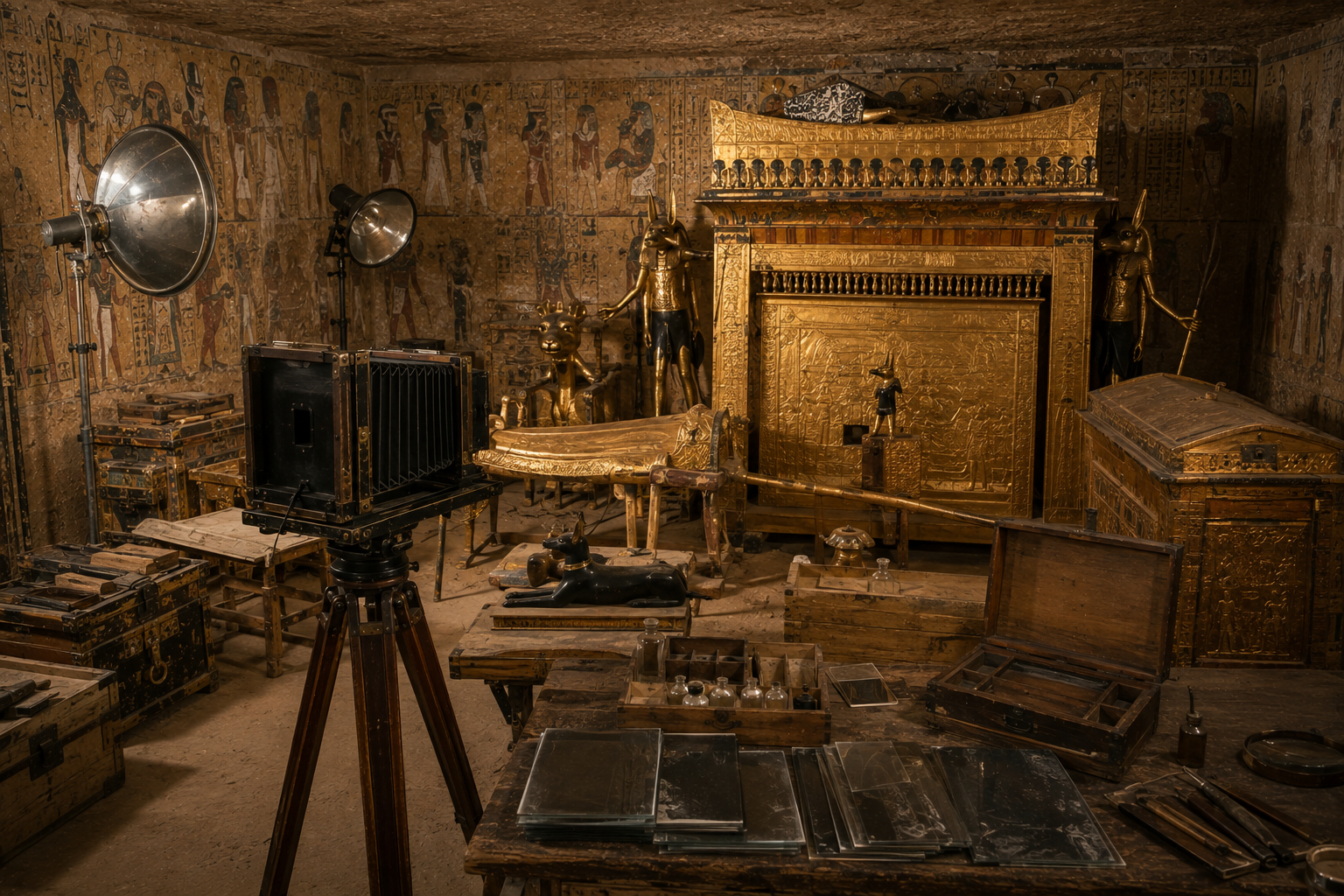
Burton’s equipment would look cumbersome beside a modern digital camera. Large-format photography required a substantial camera body, a stable tripod, photographic plates, focusing equipment, and careful preparation before each exposure.
The camera recorded images on glass plates coated with a light-sensitive photographic emulsion. These plates could capture remarkable detail, but they were fragile, heavy, and far less forgiving than modern memory cards.
Each photograph therefore required planning. The camera had to be positioned correctly before the plate was exposed. Focus had to be checked. Lighting had to be managed. Exposure times could be long, particularly inside dark archaeological spaces.
There was also very little room for error. A failed exposure cost time and photographic material. More importantly, the scene being documented might soon change as excavation continued.
Why Glass-Plate Negatives Mattered
Glass-plate photography had one major advantage for archaeological documentation: extraordinary detail. Large negatives could preserve fine textures, inscriptions, decorative surfaces, cracks, joins, fragments, and spatial relationships with impressive clarity.
That level of detail made Burton’s photographs useful far beyond publication. Researchers could enlarge portions of an image and examine features that might be difficult to see directly once the object had been cleaned, restored, transported, or placed behind museum glass.
The drawback was the physical difficulty of using the plates. Glass could break. Plates had to be prepared, protected, processed, and stored carefully. Transporting them around an excavation demanded discipline.
Yet those fragile sheets of glass became one of the most durable records of the discovery.
Photographing Objects Before They Were Moved
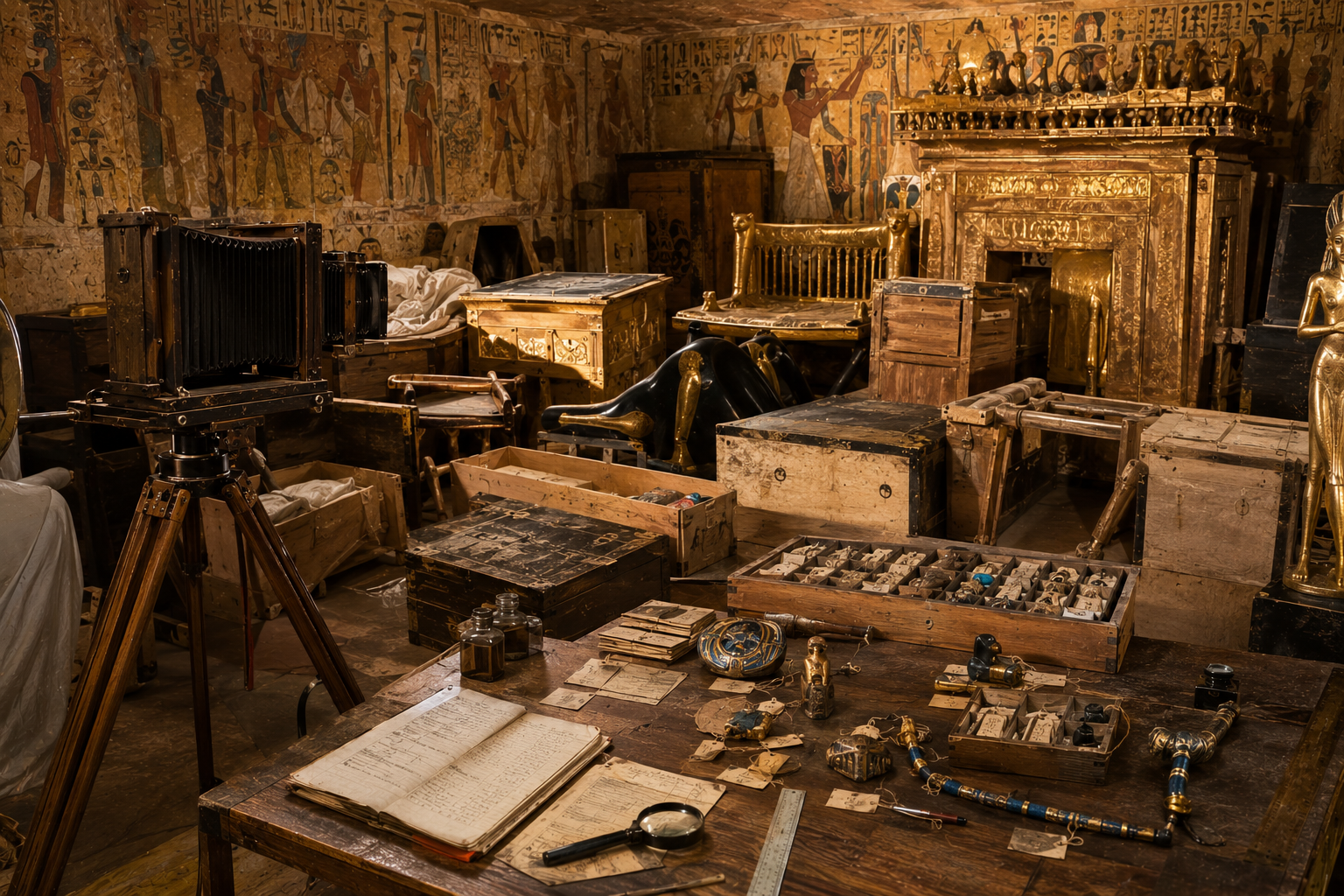
One of Burton’s most important responsibilities was photographing artifacts in situ, meaning in the positions where they were found.
This distinction is fundamental. A museum photograph shows what an object looks like. An excavation photograph can show what that object was doing within an archaeological context.
A box photographed in isolation may reveal its decoration. The same box photographed inside the tomb may reveal that it stood beneath a bed, beside another container, or behind a group of objects that had to be removed first. Those relationships can help researchers reconstruct the sequence in which burial equipment was placed or later disturbed.
Burton photographed chambers before clearance and returned to them repeatedly as excavation progressed. This created visual sequences showing how the tomb changed over time.
He also photographed individual objects after removal when clearer views were needed. These controlled images were useful for studying decoration, inscriptions, construction details, and condition.
Together, the two types of photography served different purposes. The in situ image preserved archaeological context. The isolated object photograph preserved detail.
Why timing mattered: Once an artifact was lifted from its original position, no photographer could recreate that archaeological context with complete certainty. Burton’s camera therefore had to record key stages before excavation moved forward.
The Challenges of Photographing Inside KV62
Burton worked in conditions that would test even modern equipment. KV62 was dark, cramped, hot, dusty, and crowded with fragile artifacts. There was rarely enough space to choose an ideal camera position.
Some surfaces created additional problems. Gold reflected light strongly, while dark wood and shadowed corners absorbed it. A photograph that exposed one surface correctly could lose detail in another.
The photographer also had to avoid disturbing the excavation. A tripod could not simply be placed wherever it offered the best composition. Fragile objects might occupy the floor, while narrow passages restricted movement.
Lighting required particular care. Artificial illumination could help reveal objects hidden in darkness, but badly positioned light could create harsh reflections or deep shadows that concealed important details.
| Challenge | Why It Mattered |
|---|---|
| Extreme darkness | Artificial lighting and carefully calculated exposures were necessary inside the chambers. |
| Limited space | Large cameras and tripods had to be positioned without disturbing nearby artifacts. |
| Reflective gilded surfaces | Strong reflections could hide details or create uneven exposures. |
| Fragile objects | The archaeological scene could not be rearranged simply to improve a photograph. |
| Glass photographic plates | The plates were detailed but heavy, fragile, and required careful handling. |
| Changing excavation | Important views had to be captured before objects were removed and the scene disappeared. |
These restrictions help explain why Burton’s work is so impressive. His photographs often appear calm, balanced, and deliberate, even though they were produced inside an active excavation where space and time were limited.
Turning Darkness Into a Readable Image
Burton had to think like both a photographer and an archaeological recorder. A dramatic shadow might create a visually powerful image, but if it concealed an artifact or inscription, the photograph became less useful scientifically.
His goal was therefore not simply atmosphere. He needed clarity.
Artificial illumination allowed him to reveal forms that would otherwise disappear into darkness. Careful exposure preserved detail across complicated surfaces. The resulting images gave viewers an impression of entering the tomb while still providing researchers with useful visual evidence.
This balance between documentation and visual impact is one reason the photographs remain so memorable.
Why Burton’s Images Changed Archaeology
Photography had been used in archaeology long before Tutankhamun’s tomb was discovered. Burton did not invent archaeological photography. What made the KV62 project exceptional was the scale, consistency, and quality of the photographic record produced during one of the most important excavations of the twentieth century.
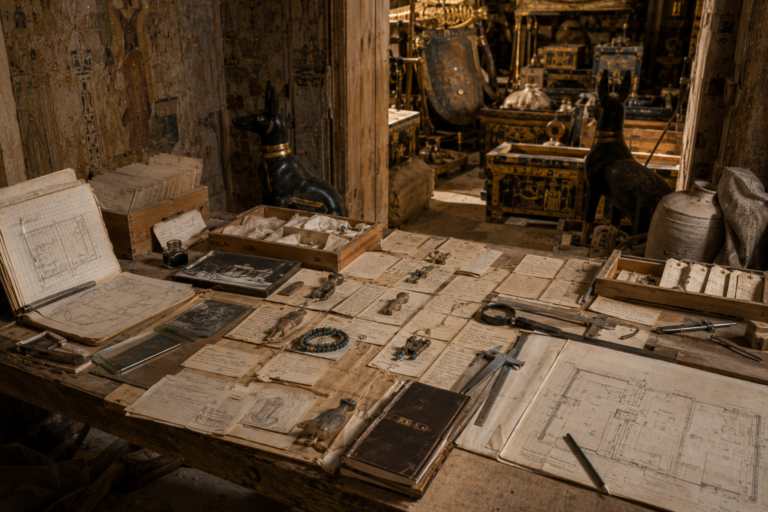
The images became integrated with the wider documentation system. Carter numbers, object cards, drawings, notes, and photographs could be compared with one another. A researcher was not limited to a description such as “wooden chest found in the antechamber.” The photograph could show the chest’s exact appearance and surroundings during excavation.
This combination created a much richer archaeological archive than text alone could provide.
Burton’s photographs also helped demonstrate the value of documenting excavation stages rather than photographing only the spectacular final discoveries. A partially cleared room, a dismantled shrine, or an artifact under conservation might appear less dramatic than a finished museum display, but scientifically those images could be invaluable.
Photography as Evidence, Not Decoration
This is perhaps Burton’s greatest contribution to the excavation. His photographs were beautiful, but beauty was not their only purpose.
A photograph could confirm the location of an artifact. It could reveal whether a surface was already cracked when discovered. It could show how an object was supported by nearby material. It could document the condition of decoration before later conservation. It could help identify a fragment that was subsequently separated from a larger object.
That turns photography into evidence.
A century later, researchers can place Burton’s images beside modern photographs and ask how an artifact has changed. They can compare excavation photographs with Carter’s notes or use multiple views to reconstruct objects and spaces digitally.
The camera therefore became part of the archaeological method, not simply a way to tell the public what had been found.
The Photographs That Defined the Discovery
Some of Burton’s photographs have become so familiar that they now shape how the world imagines the discovery of Tutankhamun’s tomb. They appear in books, documentaries, museum exhibitions, and historical studies, often becoming almost inseparable from the story itself.
Among the most powerful are his views of the antechamber before clearance. These photographs show an extraordinary concentration of burial equipment: ceremonial couches, boxes, dismantled chariots, statues, vessels, and other objects occupying nearly every available space. Rather than presenting isolated masterpieces, the images reveal the overwhelming archaeological reality Carter’s team encountered.
Another remarkable sequence documents the burial chamber. Burton photographed the enormous gilded shrines that surrounded Tutankhamun’s sarcophagus, including stages of their careful dismantling. Because the shrines almost filled the chamber, these photographs are crucial for understanding both their scale and the difficulty of removing them from such a confined space.
He also documented the moment-by-moment opening of the king’s burial equipment. Photographs preserve the sarcophagus, the nested coffins, the mummy, the gold mask, jewelry, amulets, and other objects as successive layers were examined.
This sequential documentation is particularly important. Burton did not merely photograph the beginning and end of the process. In many cases, he recorded intermediate stages that existed for only a short time.
A Tomb Disappearing One Photograph at a Time
Excavation is unusual because successful work gradually destroys the scene being investigated. Not the artifacts themselves, if excavation is performed correctly, but their original physical arrangement.
Burton’s photographs allow us to reverse that process visually.
We can see an object inside a crowded chamber, then after surrounding material has been removed, then isolated for documentation, and sometimes during conservation. Together, these images create a sequence that helps reconstruct how the excavation unfolded.
One particularly valuable series records the examination of Tutankhamun’s mummy in November 1925. As layers of material and funerary ornaments were carefully documented and removed, Burton photographed successive stages. Those images preserve relationships between objects that could never again be observed in exactly the same configuration.
Why photographic sequences matter: A single photograph records one moment. A sequence can record an archaeological process, showing how objects, layers, and spaces relate to one another as excavation progresses.
More Than Beautiful Pictures
Burton’s photographs are frequently praised for their composition, lighting, and atmosphere. That appreciation is justified, but focusing only on their beauty can obscure their greatest value.
They are archaeological documents.
A researcher examining an artifact today may find that its appearance has changed since the 1920s. A fragile surface may have undergone conservation. Separate components may have been reassembled. Earlier repairs may have been removed or replaced. Decades of storage and display may have affected some materials.
Burton’s photographs provide a historical reference point. They can show whether a crack was already present during excavation, whether a decorative element remained attached, or how fragments were positioned when first documented.
They can also preserve evidence that no longer exists physically. Organic materials are particularly vulnerable to deterioration. Textiles, leather, flowers, plant remains, and other delicate substances may change significantly over time. A detailed early photograph can therefore contain information that the surviving artifact no longer preserves as clearly.
The photographs are equally important for understanding the tomb itself. Modern visitors encounter KV62 after its burial equipment has been removed. Burton’s camera recorded an entirely different space: a tomb still filled with the material world of a royal burial.
A photograph can preserve more than an artifact’s appearance. It can preserve a moment in the life of an archaeological site that can never happen again.
What Happened to Burton’s Photographic Archive?
The survival of Burton’s photographs is itself an important part of the story. Photography is useful to future researchers only if negatives, prints, captions, and connections to archaeological records remain identifiable and accessible.
A major body of material from the Tutankhamun excavation is preserved today in the Griffith Institute Archive at the University of Oxford. The wider Howard Carter archive includes object cards, journals, diaries, notes, drawings, maps, plans, and Burton’s photographs.
Burton also assembled photographic albums connected with the excavation. Preserving photographs alongside Carter’s written documentation allows researchers to move between different forms of evidence rather than studying each source in isolation.
The original negatives are particularly valuable because glass plates can contain far more visual detail than many early printed reproductions. Modern high-resolution scanning can recover subtle information from these negatives without requiring researchers to repeatedly handle the fragile originals.
From Glass Plates to a Digital Archive
The transformation of Burton’s work from physical glass plates into digital research material represents another stage in the preservation of Tutankhamun’s discovery.
Digitization allows photographs to be connected directly with Carter numbers and related records. A researcher studying a particular object can compare images with catalogue cards, room information, drawings, and other documentation.
This is particularly powerful because the original excavation produced different kinds of records for different purposes. Carter’s notes may describe an object. Burton’s photograph shows it. A plan establishes its broader spatial context. A conservation record may explain its condition.
Digital archives can bring those separate pieces together.
Important distinction: Some modern versions of Burton’s famous black-and-white photographs have been digitally colorized. These can help modern audiences visualize the scenes, but the added colors are modern reconstructions. They should not be confused with original color photographs of the excavation.
How Researchers Still Use Burton’s Work
The scientific usefulness of Burton’s photography did not end when the excavation finished. In some respects, the photographs have become more valuable with time because researchers can now examine them using tools that did not exist when they were created.
High-resolution digital scans allow specialists to enlarge tiny areas without touching the original glass negatives. Details that were difficult to study in older printed reproductions can become much clearer on modern screens.
Researchers can also compare Burton’s photographs with contemporary images of the same artifact. This can help document changes in condition and identify the effects of earlier conservation or reconstruction.
Reconstructing Where Objects Were Found
One of the most important applications involves archaeological context. Because many photographs are associated with Carter numbers, researchers can connect visual evidence with the excavation catalogue.
Suppose a scholar is studying a group of objects from the burial chamber. Carter’s records may identify their numbers and descriptions, while Burton’s photographs can show how those objects appeared in relation to the king’s mummy, coffins, sarcophagus, or surrounding equipment.
This becomes especially useful when dealing with complex groups containing many individual components.
Studying Conservation History
Early photographs can also function as condition records.
If a decorative surface appears damaged today, Burton’s images may help determine whether the damage existed when the object was excavated. If a component appears in one position in a modern museum display but another position in an excavation photograph, researchers can investigate when and why the arrangement changed.
This does not mean every question can be answered from photography alone. Camera angle, lighting, image quality, and hidden surfaces impose limitations. But when photographs are combined with object cards and conservation records, they can provide powerful evidence.
Building Digital Reconstructions of KV62
Modern researchers can also use historical photography as part of digital reconstructions of archaeological spaces.
Burton could never have imagined photogrammetry, three-dimensional modeling, or searchable online archaeological databases. Yet the information needed for these technologies often begins with the records his generation created.
Photographs, measurements, plans, and object locations can be combined to help visualize how Tutankhamun’s tomb looked during different stages of excavation.
In that sense, a camera used in the 1920s continues to contribute to twenty-first-century archaeology.
The Legacy of Harry Burton
Howard Carter will always be the name most closely associated with the discovery of Tutankhamun’s tomb. But our visual memory of that discovery belongs largely to Harry Burton.
His achievement was not simply technical. He understood that archaeological photography had to serve two audiences at once.
The first was the contemporary public. Burton’s images allowed people who would never enter the Valley of the Kings to witness an extraordinary discovery. They helped transform Tutankhamun into an international phenomenon.
The second audience had not yet been born.
Future archaeologists, conservators, historians, museum specialists, and students would need evidence of what Carter’s team had seen. Burton photographed for them as well, whether or not he could have predicted the technologies they would eventually use to study his work.
That is why his photographs have aged differently from ordinary news images. Their historical importance increased as the physical excavation moved further into the past.
What Burton Preserved That No Museum Can Display
A museum can preserve Tutankhamun’s throne. It can conserve a chariot, a chest, a piece of jewelry, or a ceremonial object. It can even arrange thousands of artifacts to explain the burial.
But it cannot physically preserve the moment when all those objects were still inside KV62 exactly as the excavation team encountered them.
Burton could.
His photographs preserve crowded rooms that no longer exist in that state. They preserve temporary stages of excavation that lasted hours or days. They preserve objects before cleaning, conservation, transport, and display altered how later generations would encounter them.
That makes his archive something more than a collection of photographs of ancient Egyptian treasures. It is a visual record of an archaeological site undergoing irreversible change.
One of Burton’s final chapters at KV62: The photographic documentation continued for years as different parts of the tomb were cleared. His later images included the sarcophagus itself, demonstrating how photography remained part of the excavation process long after the excitement of the initial discovery had faded.
Harry Burton and the Way We Remember Tutankhamun
There is another reason Burton matters. Photography does not merely record history. It can influence which parts of history people remember.
The darkness surrounding a gilded object, the dense arrangement of the antechamber, the imposing shrines filling the burial chamber, and the careful staging of individual artifacts all helped establish the visual language through which generations encountered Tutankhamun.
For many people, their first experience of the discovery did not come from Carter’s excavation notes. It came from a Burton photograph.
That influence continues today. Modern documentaries often return to his images when recreating the discovery. Museum exhibitions use them to restore archaeological context around objects that are now displayed separately. Historians use them to explain the excavation process. Researchers examine them for evidence.
The same image can therefore operate on several levels: historical document, archaeological record, museum resource, and powerful visual storytelling.
Few photographers have had such a lasting influence on how a single archaeological discovery is remembered.
Frequently Asked Questions
Who was Harry Burton?
Harry Burton was an English archaeological photographer born in 1879. He worked extensively in Egypt and became the principal photographer documenting Howard Carter’s excavation of Tutankhamun’s tomb.
Did Harry Burton discover Tutankhamun’s tomb?
No. Howard Carter’s excavation team discovered the tomb in November 1922. Burton was brought into the project as the specialist photographer responsible for creating a systematic visual record of the excavation and its finds.
Who did Harry Burton work for?
Burton was associated with the Metropolitan Museum of Art’s Egyptian Expedition. His expertise was made available for the Tutankhamun excavation, where his photography became an essential part of Carter’s documentation program.
What kind of photography did Harry Burton use?
Burton worked primarily with large-format photographic equipment and glass-plate negatives. The process was slower and more demanding than modern digital photography, but the large negatives could preserve exceptional detail.
How many photographs did Harry Burton take of Tutankhamun’s tomb?
The photographic record is commonly described in terms of roughly 1,400 glass-plate negatives associated with Burton’s work on the excavation. Counts can differ depending on whether negatives, prints, duplicate views, and other photographic material are being discussed, so the terms should not be treated as interchangeable.
Why are Burton’s photographs important to archaeologists?
Many show artifacts in their original archaeological context before they were removed. Researchers can use them to study object positions, condition, excavation stages, conservation history, and relationships between different finds.
Did Burton photograph Tutankhamun’s gold mask?
Yes. Burton documented the king’s mummy and its funerary equipment during the 1925 examination, and his photographic record includes the famous gold mask as well as other objects associated with the mummy.
Where are Harry Burton’s Tutankhamun photographs today?
A major collection of Burton’s photographic material connected with the excavation is preserved in the Griffith Institute Archive at the University of Oxford. Many images and related excavation records have also been digitized for research and public access.
Were Burton’s famous tomb photographs originally in color?
The iconic excavation photographs are black-and-white images. Some have been digitally colorized in modern times, but those versions are reconstructions created from the original monochrome photographs and should not be mistaken for original color documentation.
Can Burton’s photographs still reveal new information?
Yes. High-resolution digitization, comparisons with modern conservation records, and integration with object databases and spatial information allow researchers to ask new questions of photographs created more than a century ago.
Why couldn’t the tomb simply be photographed again today?
The tomb itself can be photographed, but its original archaeological arrangement cannot. Thousands of objects have been removed, conserved, stored, or displayed elsewhere. Burton’s photographs preserve stages of the excavation that disappeared permanently as the chambers were cleared.
Final Thoughts
Howard Carter opened a doorway into a world that had been hidden for more than 3,000 years. Harry Burton made sure that the world behind that doorway would not vanish when the excavation moved forward.
His camera recorded the tomb while it was still crowded with burial equipment. It followed the removal of objects, the opening of shrines and coffins, the examination of the king’s mummy, and the slow transformation of KV62 from an ancient burial into an archaeological site.
The equipment Burton used now belongs to another technological age. Glass plates have given way to digital sensors. Handwritten catalogues have become searchable databases. Archaeologists can create three-dimensional models and capture millions of measurements in ways that would have seemed impossible in the 1920s.
Yet none of those technologies can return to the moment before the treasures moved.
For that, researchers still depend on the photographer who was there.
Harry Burton did more than show the world Tutankhamun’s discovery. He preserved a visual record of moments that archaeology could experience only once.