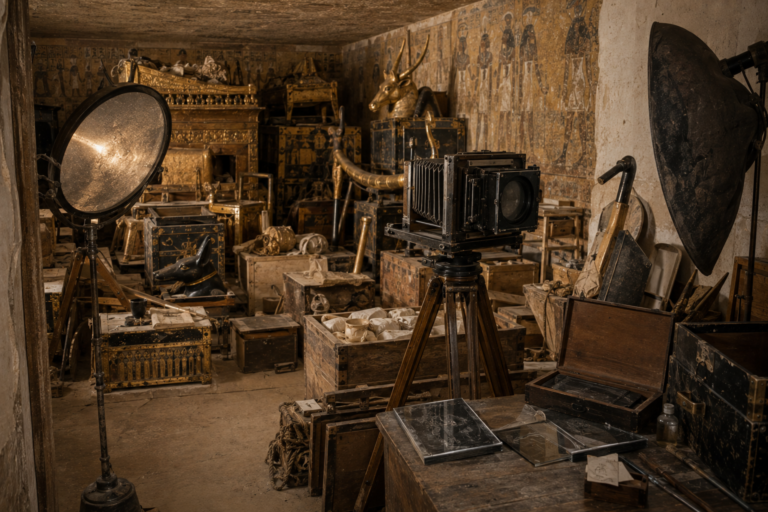
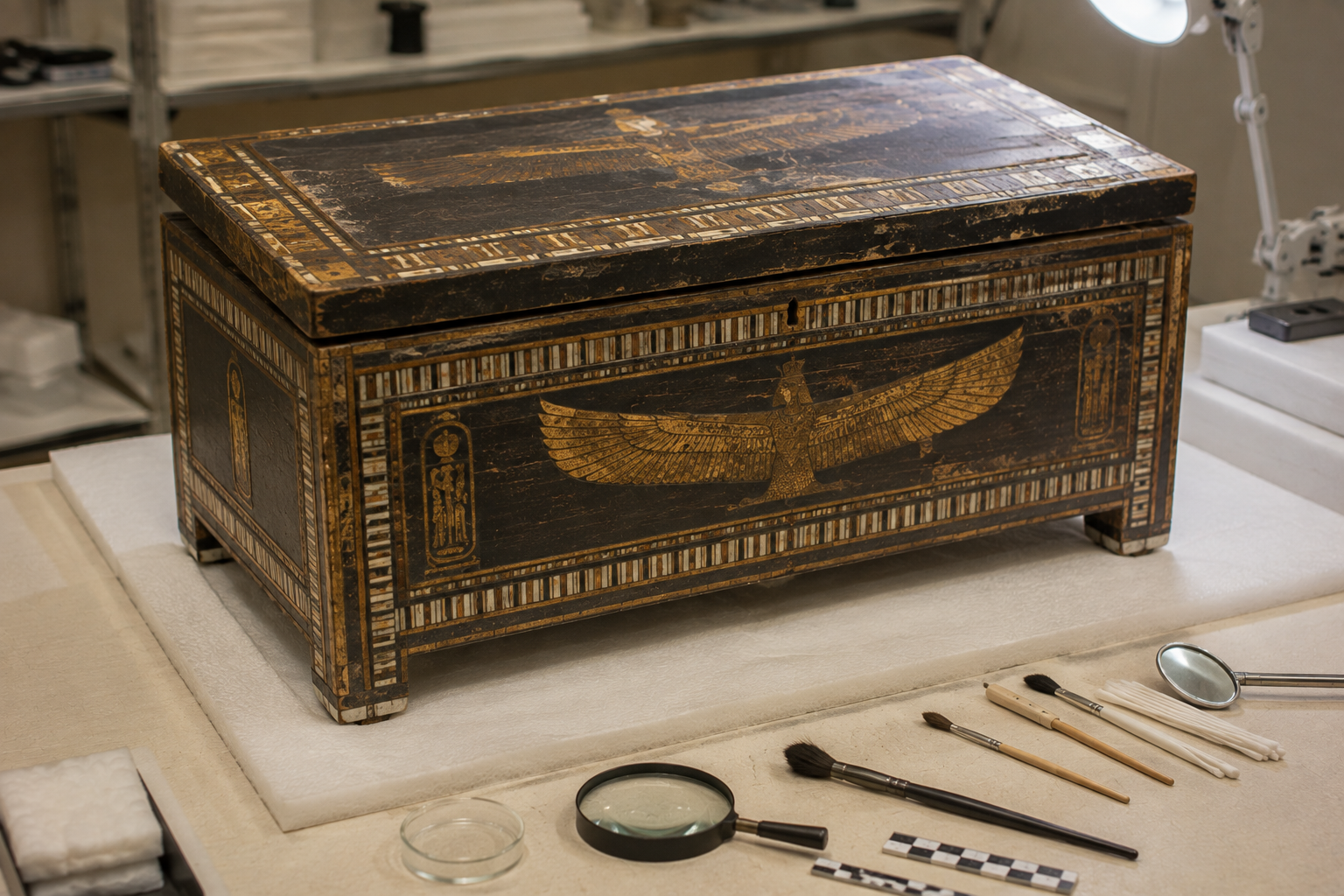

When Howard Carter’s team entered Tutankhamun’s tomb, the astonishing survival of its contents seemed almost impossible. Gold still covered royal furniture. Linen, leather, wood, baskets, sandals, plant material, and other fragile substances had endured for more than three millennia. But survival inside a tomb did not mean those objects were safe once they were uncovered.
Excavation changed everything around them. Objects that had spent centuries in a relatively sheltered environment now had to be examined, handled, photographed, stabilized, packed, transported, stored, and eventually displayed. A gilded wooden object might look solid while its ancient timber had become dangerously fragile. A sandal could retain its recognizable shape even though its leather and plant fibers could no longer tolerate ordinary handling.
Preserving Tutankhamun’s collection therefore became a second archaeological challenge almost as remarkable as finding it. Beginning with the painstaking work of chemist and conservator Alfred Lucas in the 1920s and continuing through modern museum laboratories, the story of the treasures is also the story of how conservation science changed over the last century.
Quick Context
- Tomb: KV62 in the Valley of the Kings
- Discovery: November 1922
- Excavation director: Howard Carter
- Key early conservation specialist: Alfred Lucas
- Materials preserved: Gold, wood, linen, leather, glass, faience, stone, resins, plant fibers, pigments, and composite objects
- Early priority: Examine, stabilize, document, and safely move vulnerable objects
- Modern priority: Prevent deterioration through scientific analysis, environmental control, careful support, monitoring, and minimal intervention
- Major modern facility: Grand Egyptian Museum Conservation Centre
The Treasures Had Survived, But They Were Not Safe
It is tempting to assume that anything capable of surviving for more than 3,000 years must be exceptionally durable. Archaeology repeatedly proves otherwise.
An ancient object can survive because the environment around it remained favorable enough to slow deterioration. Burial conditions, temperature, moisture, air movement, microorganisms, salts, and the properties of the material itself can all affect what survives and what disappears.
Inside KV62, preservation varied dramatically. Gold remained comparatively stable, while many organic materials presented far greater difficulties. Wood could be weakened beneath an apparently recognizable surface. Leather could become brittle. Linen could survive but lose much of the strength it once possessed. Decorative layers could separate from the material beneath them.
The condition of one object could also differ sharply from another only a short distance away. There was no single “state of preservation” for the entire tomb.
This meant Carter’s team could not simply remove the treasures and send them to a museum. Before many objects could travel anywhere, conservators had to determine whether they could survive being moved at all.
Survival is not stability: An artifact can remain recognizable for thousands of years and still be extremely vulnerable to movement, changes in humidity, physical stress, light, or inappropriate treatment.
What Happens When a 3,000-Year-Old Object Meets the Modern World?
Opening an archaeological environment introduces change. Air circulation increases. Lighting changes. People enter. Objects are uncovered and handled. Materials that had been supported by surrounding debris may suddenly need to support their own weight.
Humidity is particularly important because many materials respond physically to changes in the amount of moisture in the air. Wood, leather, textiles, and other organic substances can expand, contract, warp, stiffen, or become more vulnerable when environmental conditions fluctuate.
Salts can create additional problems. When moisture conditions change, soluble salts within or on an artifact can crystallize or dissolve, potentially placing stress on surfaces. Alfred Lucas’s surviving scientific notes show that salts and other deposits from the Tutankhamun material were examined rather than simply brushed aside as dirt.
Physical handling is another risk. An object that has lost structural strength may look perfectly capable of being lifted until pressure is applied to a weakened joint. Ancient adhesives may no longer hold components securely. A textile that appears complete can tear under its own weight if lifted without support.
This is why conservation begins with observation rather than cleaning.
Before deciding what should be done to an ancient object, a conservator needs to understand what it is made from, how it was constructed, how it has deteriorated, and what risks the proposed treatment might introduce.
Alfred Lucas: The Chemist Who Helped Save the Collection
One of the most important figures in this story was Alfred Lucas, a British chemist whose career in Egypt eventually brought him into the Antiquities Service. He joined Carter’s project as a conservation specialist and remained involved across numerous excavation seasons.
Lucas brought something essential to KV62: the ability to approach ancient objects as materials as well as historical artifacts.
A decorated surface might contain pigments, binding media, resins, metal, wood, or several materials layered together. Before treatment, understanding those substances could determine whether a cleaning method was safe, whether a fragile surface needed consolidation, or whether an apparent deposit was actually part of the object’s original construction.
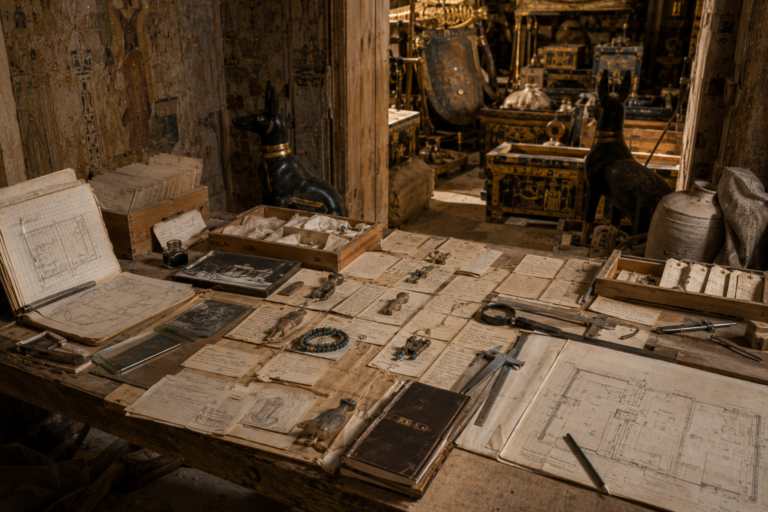
Lucas examined materials, recorded observations, collected samples, and documented treatments. His surviving conservation notebooks cover multiple excavation seasons, and his records include registers of samples and examinations of materials.
Why Carter Needed a Chemist
The need becomes clearer when we imagine the practical decisions facing the excavation team.
Should a dark substance on an object be removed or preserved?
Is a white deposit evidence of deterioration, a salt, or an original material?
Can a weakened surface be consolidated before transport?
What substance can safely stabilize an object without immediately damaging another material attached to it?
These are not questions that visual inspection alone can always answer. Chemistry provided another layer of evidence.
Lucas’s surviving notes show attention to materials and deterioration products at a level that is sometimes overlooked when early twentieth-century archaeology is compared with modern practice. His equipment was far less sophisticated than today’s laboratory instruments, but the underlying idea was already important: treatment should be informed by an understanding of the material.
Testing Before Treating
The conservation records associated with Lucas include examinations of materials and registers of samples extending across years of work on the collection. They demonstrate that conservation was not an improvised effort carried out only when something broke.
Observation, testing, documentation, and treatment formed part of the excavation process.
This distinction matters because Tutankhamun’s treasures included materials that behaved very differently. A method appropriate for metal might be disastrous for painted wood. A treatment that strengthened one component could affect an adjacent textile, adhesive, or decorative layer.
There was no universal substance that could simply be applied to every fragile artifact.
The challenge was not merely to remove Tutankhamun’s treasures from the tomb. It was to move them without losing the evidence that 3,000 years had left behind.
Conservation Is Not the Same as Restoration
The words “conservation” and “restoration” are often used as though they mean the same thing. They do not.
Conservation focuses primarily on understanding an object’s condition, slowing deterioration, stabilizing vulnerable materials, and preserving as much original evidence as possible.
Restoration can involve interventions intended to return an object closer to a known or interpreted earlier appearance, structure, or presentation.
The distinction is important because modern conservation generally does not aim to make an ancient artifact look new.
A crack may be historically meaningful. Wear can reveal use. A faded surface may contain evidence of ancient materials. Replacing missing areas simply because they look incomplete can blur the boundary between original material and modern reconstruction.
Modern practice therefore places great emphasis on documentation, restraint, compatibility of treatment materials, and avoiding unnecessary intervention.
The key principle: A successful conservation treatment does not need to make an artifact more visually perfect. Its first responsibility is to preserve the object and the information it carries.
Gold Was Not the Biggest Problem
Gold dominates the popular image of Tutankhamun’s tomb, but it was not necessarily the material conservators had most reason to fear.
Gold is chemically resistant compared with many other materials. That is one reason ancient gold can retain an extraordinary appearance after thousands of years.
But even a “golden” object may not be made entirely of gold.
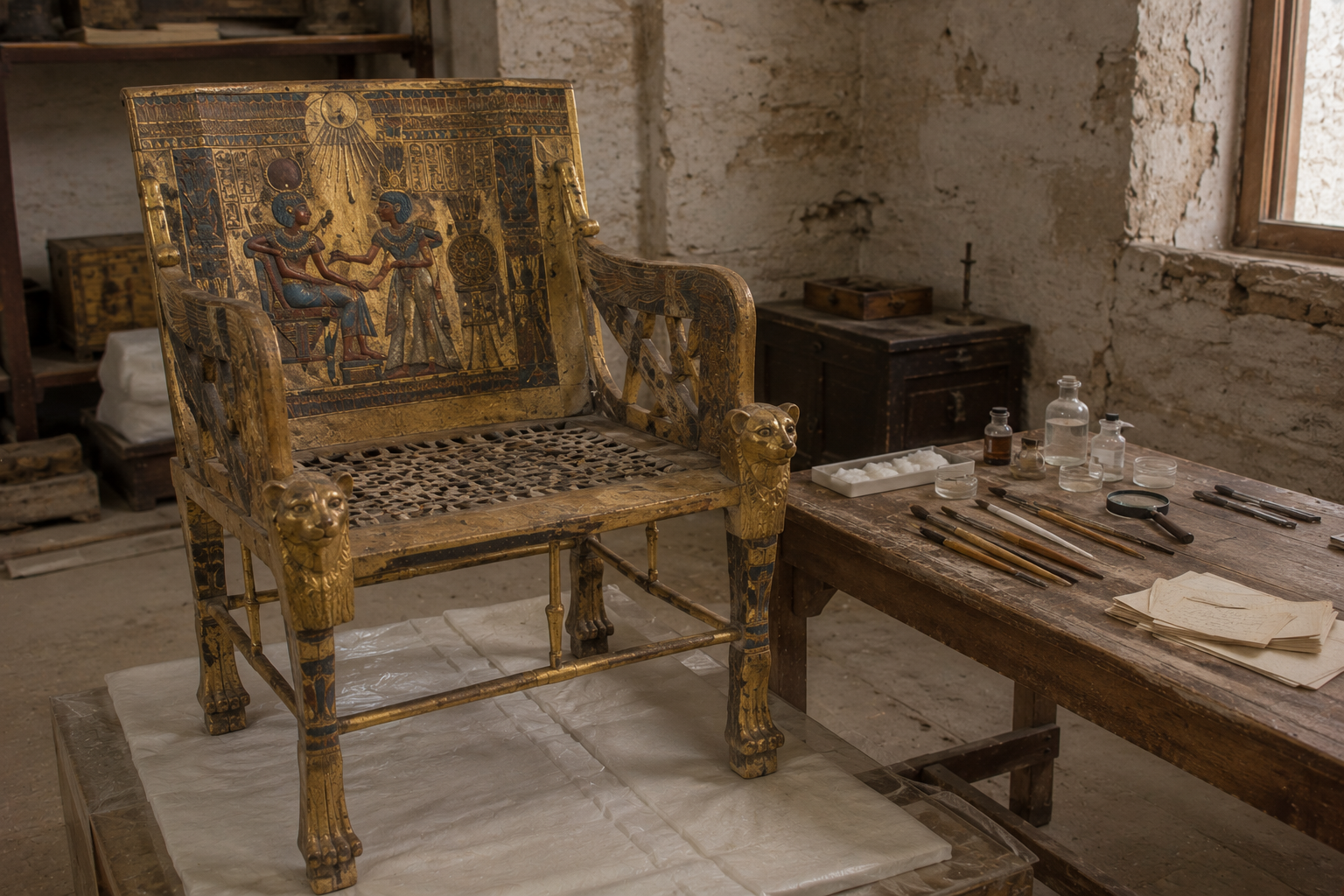
Many pieces from the tomb use thin gold sheet or gilding over another material, often wood. What appears to be a surviving golden surface may therefore depend on a much more vulnerable structure underneath it.
If the wood shrinks, cracks, warps, or loses strength, the decorative layer above it can lift or detach. Preserving the visible gold may require understanding what is happening inside a material the visitor barely notices.
Other objects contained no precious metal at all yet presented much more difficult conservation problems. Textiles, leather, basketry, plant fibers, wooden furniture, and composite artifacts could be extremely sensitive to handling and environmental change.
This is one reason the conservation story of KV62 looks very different from its popular image. The spectacular gold attracted attention, but some of the quietest objects demanded the greatest care.
The Hidden Problem of Composite Objects
Some of the most challenging artifacts are those made from several materials at once.
Consider a piece of royal furniture. Its structure might be wooden. Parts could be gilded. Decorative inlays might use glass, stone, faience, or other substances. Adhesives hold elements together. Leather or woven material may form another component.
Each material responds differently to its surroundings.
Wood reacts strongly to moisture changes. Metals can corrode under particular conditions. Ancient adhesives can weaken. Organic fibers can become brittle. Decorative surfaces can detach from their support.
The conservator therefore cannot treat the object as a single substance.
A treatment that benefits the wood must not damage the gilding. Supporting a weakened frame must not place pressure on fragile inlays. Cleaning one surface must not dissolve or disturb another.
This complexity is one reason careful examination precedes intervention.
Saving Tutankhamun’s Textiles
Among the most remarkable survivals from the tomb are textiles. Linen clothing, wrappings, and other woven materials can tell researchers about manufacturing, craftsmanship, use, storage, and aspects of royal life that gold objects cannot reveal.
But archaeological textiles are particularly vulnerable.
A fabric can preserve its shape while individual fibers have lost much of their original strength. Folding, unfolding, lifting, or allowing unsupported fabric to hang can place damaging stress on weakened areas.
For this reason, support is often as important as direct treatment. Instead of forcing a fragile textile into a more attractive shape, conservators may provide a stable surface that distributes its weight and minimizes movement.
Light exposure also matters. Organic materials can be sensitive to prolonged illumination, which is one reason museums carefully consider how textiles are displayed and for how long.
Modern work on Tutankhamun’s collection demonstrates how seriously these materials are treated. A major joint conservation project involving the Grand Egyptian Museum and the Japan International Cooperation Agency included 57 textile objects from the king’s collection among the artifacts selected for investigation, conservation, and preparation for the museum.
The inclusion of so many textiles is a useful reminder that Tutankhamun’s legacy is not simply a collection of gold masterpieces. Some of the most informative objects are also among the most fragile.
Leather, Wood, and Chariots Presented Different Problems
Tutankhamun’s chariots demonstrate the challenge of conserving large, complex archaeological objects particularly well.
A chariot is not simply a wooden vehicle. Its construction can involve multiple wooden elements, joints, bindings, leather, decorative surfaces, and components that respond differently to age and environmental conditions.
After thousands of years, the original mechanical strength of those materials cannot be assumed. A wheel that looks complete may contain weakened joints. Leather can become stiff or fragile. Wood can deform or crack. Moving such an object creates forces that did not exist while it remained stationary.
Modern conservation therefore considers not only treatment but also support, packing, transportation, storage, and display.
The Grand Egyptian Museum and JICA conservation project included five chariots and three funerary couches from Tutankhamun’s collection among its wooden objects. The project involved Egyptian and Japanese specialists and addressed investigation, analysis, conservation, and transportation as interconnected parts of preservation.
That approach represents an important development in conservation thinking. Protecting an artifact does not begin when it reaches the laboratory and end when treatment is finished. Every stage of its movement and display can affect its long-term survival.
From Emergency Treatment to Preventive Conservation
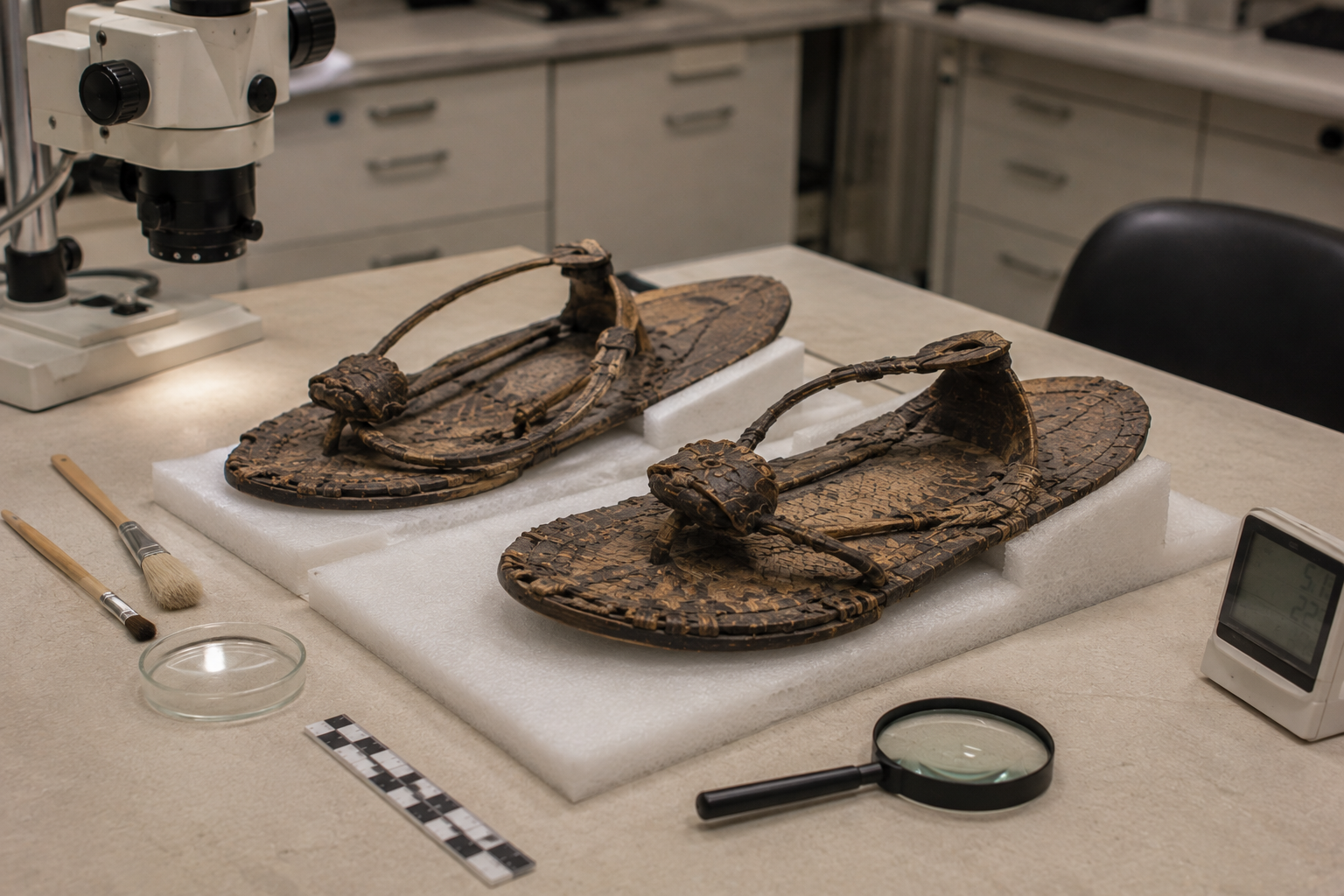
Conservation has changed substantially since the 1920s, but it would be misleading to describe the difference as primitive methods versus scientific methods. Lucas was already using chemical knowledge, examining materials, recording samples, and documenting treatments.
The greater transformation lies in the technologies available and in the growing emphasis on preventing damage before treatment becomes necessary.
During the excavation of KV62, a pressing question was often practical: how can this vulnerable object be stabilized sufficiently to document and move it safely?
Modern conservation asks that question too, but it also considers what environment will minimize deterioration over the next decade, fifty years, or longer.
This approach is known as preventive conservation.
Instead of waiting for a textile to deteriorate and then attempting to repair it, conservators can manage light exposure, temperature, relative humidity, handling, storage materials, pollutants, vibration, dust, and other risks.
Preventing damage is often safer than repairing it afterward.
| Early KV62 Conservation | Modern Conservation |
|---|---|
| Detailed visual examination | Visual examination supported by microscopy and advanced analytical techniques |
| Handwritten condition and treatment notes | Digital condition records, imaging, and linked databases |
| Chemical tests and material sampling | Expanded range of analytical methods, including many minimally invasive or non-destructive techniques |
| Stabilization needed for excavation and transport | Stabilization combined with long-term preventive conservation |
| Careful packing based on available materials and knowledge | Custom supports, transport planning, environmental monitoring, and risk assessment |
| Treatment of visible conservation problems | Greater emphasis on preventing deterioration before treatment becomes necessary |
The change is therefore not a simple story of replacing old conservation with new conservation. It is the development of a discipline that now has access to better analytical tools, more extensive research, improved materials, and a deeper understanding of how interventions themselves can affect an artifact decades later.
The goal of conservation is not to erase 3,000 years of history. It is to prevent the next few decades from destroying what those 3,000 years left behind.
Why Modern Conservators Often Try to Do Less
One of the most important changes in conservation over the last century is philosophical rather than technological. Earlier generations often focused heavily on making an object stable enough to handle, display, or reconstruct. Modern conservators still care about stability, but they are generally more cautious about changing original material than earlier practice sometimes allowed.
The principle is simple: every treatment is also an intervention.
Adding an adhesive, cleaning a surface, filling a loss, reshaping a material, or removing an older repair can alter the artifact permanently. Even when an intervention is well intentioned, future researchers may later discover that a removed deposit contained useful evidence or that a modern material has aged badly.
This is why modern conservation often favors minimum intervention. If an artifact is stable and can be safely stored or displayed without aggressive treatment, doing less may preserve more information.
Preventive Conservation Comes First
Preventive conservation attempts to control the environment around the object rather than repeatedly altering the object itself. Stable temperature and humidity, carefully managed lighting, appropriate supports, safe storage materials, dust control, restricted handling, and secure transport can all reduce deterioration without changing the artifact.
For Tutankhamun’s collection, this approach is especially important because many objects are composite. A single environmental condition that is acceptable for one material may be less suitable for another. Conservators therefore aim for stable conditions that reduce risk across the whole object.
Non-Destructive Analysis
Modern conservators also have access to analytical techniques that can reveal information without removing significant material from an artifact. Imaging, microscopy, X-radiography, spectroscopy, and other methods can help identify construction, pigments, corrosion, previous repairs, and hidden structural problems.
The ability to examine more while disturbing less represents one of the major advances since the days of Carter and Lucas.
Modern conservation principle: The safest treatment is not always the most visible one. Sometimes the best decision is to stabilize the environment, support the object properly, and leave original material untouched.
Inside the Grand Egyptian Museum Conservation Centre
The Grand Egyptian Museum represents a new stage in the preservation of Tutankhamun’s collection. Long before objects entered exhibition galleries, many passed through dedicated conservation facilities where specialists could examine, stabilize, document, and prepare them for long-term display or storage.
The museum’s Conservation Centre was designed as a major research and treatment facility rather than simply a repair workshop. It includes specialized laboratories for different categories of archaeological material, allowing conservators to work with the specific requirements of wood, organic remains, stone, metals, painted surfaces, human remains, and other materials.
This specialization matters because a 3,000-year-old textile and a gilded wooden shrine do not deteriorate in the same way. Treating them safely requires different expertise, equipment, supports, storage conditions, and analytical methods.
Modern conservation also creates far more documentation than a visitor ever sees. Before treatment, specialists may photograph every side of an object, map cracks and losses, record earlier repairs, measure environmental sensitivity, study construction, and note any unstable areas.
That documentation then becomes part of the object’s history.
A Laboratory for Long-Term Decisions
The goal of a modern conservation center is not simply to make an object ready for opening day. Decisions may affect its condition decades into the future.
For that reason, conservators must consider how an artifact will be mounted, how much light it will receive, whether its case needs environmental control, how vibration from visitor movement or transport could affect it, and how easily it can be inspected later.
A good display system must protect the object while still allowing the public to see it clearly. Those two goals can sometimes conflict, especially with fragile organic materials.
Lighting is a good example. Strong light may reveal decoration beautifully, but prolonged exposure can damage textiles, pigments, leather, and other sensitive materials. Conservation therefore influences exhibition design directly.
Behind every museum display: What looks like a simple case containing an ancient artifact may depend on years of analysis, custom supports, lighting calculations, environmental monitoring, transport planning, and repeated condition checks.
Moving the Treasures Became a Conservation Project
Transport is one of the most dangerous moments in the life of a fragile museum object. An artifact that remains stable for years on a shelf or mount may suddenly experience vibration, acceleration, changes in orientation, handling, and a different environment once movement begins.
This is why the later transfers of Tutankhamun’s objects became conservation operations in their own right.
Before movement, specialists needed to understand each object’s weak points. A large piece of furniture might appear sturdy but contain weakened joints. A decorative panel could be securely attached in one direction yet vulnerable if the object were tilted. A chariot wheel could require support at several points to avoid concentrating weight on fragile ancient wood.
Custom packing helps distribute these forces safely. Rather than placing an object inside a generic crate, conservators can design internal supports around its actual shape and condition.
For particularly complex artifacts, transportation planning can involve conservators, engineers, curators, security teams, handlers, and logistics specialists. Routes may be checked in advance. Crates can be designed to reduce vibration. Environmental conditions may be monitored during movement.
This modern process continues the same basic principle Carter’s team faced in the 1920s: an artifact is not truly preserved if it is damaged while being moved from one safe place to another.
The broader story of those transfers connects directly with the difficult journey of Tutankhamun’s treasures after they left KV62, but from a conservation perspective the important point is that movement itself must be treated as a risk.
What About the Tomb Itself?
The conservation of Tutankhamun’s portable treasures should not be confused with the conservation of KV62 itself.
Once most of the burial equipment had been removed, the tomb remained an archaeological monument with its own conservation problems. The burial chamber’s wall paintings, carved surfaces, environmental conditions, visitor traffic, dust, and infrastructure all required separate study.
A major conservation and management project involving Egyptian authorities and the Getty Conservation Institute examined the condition of the tomb and its wall paintings, environmental behavior, visitor impact, and long-term management.
This work was fundamentally different from conserving a sandal, chest, chariot, or textile. The tomb cannot be placed inside a laboratory. Its environment has to be managed in place, while also accommodating controlled public access.
The distinction matters because discussions of “Tutankhamun conservation” often combine two separate subjects: preserving the objects removed from the tomb and preserving the architectural and painted space that remains in the Valley of the Kings.
The Brown Spots on Tutankhamun’s Burial Chamber
One of the most recognizable features of the burial chamber paintings is the presence of dark brown spotting across parts of the walls.
These marks have attracted scientific attention because they are unusual and visually prominent. Importantly, historical photographs show that the spots were already present during the period of Carter’s excavation. They are therefore not simply a modern problem caused by recent tourism.
Scientific investigation has explored possible biological and chemical explanations for the spots, but their exact origin has been difficult to establish with complete certainty.
The practical conservation question is just as important as the historical one: are the spots still active and spreading, or are they stable remnants of an earlier process?
That distinction changes how conservators respond. Removing a stable historical feature without clear evidence that it is damaging the paintings could destroy original material unnecessarily.
Not every unusual feature should be removed: Conservation first asks whether a change is active, harmful, and treatable. A visually imperfect surface may still be historically authentic and stable.
Can Conservation Make an Artifact Last Forever?
No conservation treatment can make an ancient object permanent.
Every material continues to age. Metals corrode. Wood responds to moisture. Textiles weaken. Leather changes chemically. Adhesives lose strength. Pigments can fade. Even stone can fracture or react with salts and pollutants.
Conservation cannot stop time. It can slow deterioration and reduce avoidable risks.
This is why long-term preservation depends on repeated observation. An artifact that is stable today may need a different support system decades from now. New cracks can develop. Old repairs can fail. Environmental conditions can change. Scientific understanding can improve.
Modern conservation is therefore not a single event. It is a continuing process of monitoring, documentation, risk assessment, and selective intervention.
This principle is especially important for Tutankhamun’s collection because the objects are expected to survive not merely for one exhibition, but for future generations of visitors and researchers.
Conservation does not defeat time. It gives fragile objects more time to survive.
When Old Conservation Treatments Become a New Problem
One of the hardest lessons in conservation is that a treatment can age too.
Materials applied decades ago may yellow, shrink, become brittle, attract dust, darken a surface, or become difficult to remove. An adhesive once considered reliable may later behave differently as chemistry and conservation science advance.
This creates a difficult problem for modern conservators. Removing an old treatment can sometimes improve stability, but the removal process may also threaten original material. Leaving it in place can carry different risks.
Every case has to be evaluated individually.
It would be unfair to judge early conservators only by modern standards. Alfred Lucas and his contemporaries worked with the scientific knowledge, materials, and analytical tools available to them. In many cases, their interventions were essential to getting fragile artifacts safely out of the tomb.
The more useful lesson is that conservation itself has a history. Today’s treatments will also be judged by future specialists using knowledge we do not yet possess.
This is one reason documentation is so important. Future conservators need to know what substances were applied, where they were used, and why the treatment was performed.
How a Century of Conservation Changed Archaeology
The conservation of Tutankhamun’s treasures provides an unusually clear view of how the discipline changed between the 1920s and the twenty-first century.
At the beginning, Carter’s team relied on close visual examination, practical experience, chemical testing, handwritten records, photography, and field-based stabilization. These methods were often sophisticated for their time, but the team had limited access to the analytical technologies available today.
Modern specialists can examine materials at microscopic scales, map chemical compositions, image hidden structures, monitor temperature and humidity continuously, build digital condition records, and compare results across decades.
Yet the purpose has remained surprisingly consistent.
Understand the object. Record its condition. Avoid unnecessary damage. Stabilize what is vulnerable. Preserve as much evidence as possible.
The tools changed dramatically. The responsibility did not.
That continuity is one reason the records created during the original excavation remain so valuable. Carter’s detailed documentation system and Harry Burton’s photographic record of the excavation give modern conservators historical reference points that can be compared with the condition of objects today.
A century-old photograph may show whether a crack existed at the moment of discovery. An object card can identify an early treatment. A photograph taken during conservation may reveal a component that was later repositioned.
Preservation therefore depends not only on chemistry and physical treatment, but on information.
The Goal Is Not to Make an Object Look New
Ancient artifacts are often expected to look beautiful in museums, and Tutankhamun’s collection contains some of the most visually spectacular objects ever excavated in Egypt. But conservation is not a process of polishing away age.
A faded surface, worn edge, ancient repair, crack, or missing element can tell part of an object’s history.
Some objects from Tutankhamun’s tomb may have been used before burial. Others were modified, repaired, dismantled, packed, or adapted. Those traces can help researchers distinguish between objects made specifically for the burial and possessions that had a longer history.
Aggressive restoration could erase that evidence.
Modern conservation therefore tries to preserve authenticity alongside physical stability. When reconstruction is necessary for support or interpretation, specialists aim to distinguish modern additions from original material and document what has been done.
The result may not always look perfectly new or symmetrical. That is not a failure.
An archaeological artifact is valuable precisely because it carries evidence of time.
What preservation really means: The objective is not to return Tutankhamun’s treasures to how they looked in the fourteenth century BCE. That appearance can never be recovered with certainty. The objective is to preserve the ancient material, the evidence it carries, and the documented history of what happened to it afterward.
Frequently Asked Questions
How were Tutankhamun’s treasures preserved after discovery?
Objects were documented, examined, stabilized when necessary, packed carefully, and moved in stages. Early conservation involved specialists such as Alfred Lucas, while later preservation added increasingly sophisticated laboratory analysis, environmental control, custom supports, and preventive conservation.
Who conserved Tutankhamun’s treasures?
Many people contributed over the last century. Alfred Lucas was the key conservation specialist during the original excavation, but Egyptian conservators, museum specialists, scientists, engineers, and international conservation teams have continued the work through subsequent decades.
Who was Alfred Lucas?
Alfred Lucas was a chemist associated with Egypt’s Antiquities Service who became an important member of Carter’s excavation team. He examined materials, investigated deterioration, recorded samples, and developed treatments to stabilize fragile artifacts from KV62.
Why did some artifacts become vulnerable after excavation?
Objects that had remained in a relatively sheltered burial environment were suddenly exposed to handling, air movement, light, transport, and changing humidity. Their materials had also aged for thousands of years, so an object could appear intact while having very little structural strength.
Was gold difficult to conserve?
Gold itself is relatively chemically stable, but many “golden” objects are composite. Thin gold sheet or gilding may cover fragile wood, adhesives, or other materials. The vulnerable support beneath the gold can therefore become the greater conservation challenge.
How are Tutankhamun’s textiles preserved?
Fragile textiles are carefully supported to reduce mechanical stress and protected from excessive light, handling, dust, and unstable environmental conditions. Treatment depends on the condition and construction of each textile rather than following a single method.
Are Tutankhamun’s treasures still being conserved?
Yes. Conservation is an ongoing responsibility rather than a one-time treatment. Objects require continued monitoring, condition assessment, environmental management, and occasional intervention as materials age or display and storage conditions change.
What is preventive conservation?
Preventive conservation reduces risks before damage occurs. It includes controlling temperature, relative humidity, light, handling, storage materials, dust, vibration, transport, pollutants, and other environmental factors.
Where are Tutankhamun’s artifacts conserved today?
Major conservation work has been carried out within Egypt’s museum and antiquities institutions, including specialized facilities associated with the Grand Egyptian Museum and its Conservation Centre.
Does restoration mean making an artifact look new?
Not in modern conservation practice. The priority is generally stability and preservation of original evidence. Reconstructing or replacing missing areas is approached cautiously and should not obscure what is ancient and what is modern.
Can ancient artifacts last forever?
No. All materials continue to age. Conservation can dramatically slow deterioration and reduce preventable damage, but it cannot stop chemical and physical change permanently.
Why are old excavation photographs useful to conservators?
Early photographs show how objects looked when first discovered. Comparing them with modern images can reveal changes in condition, identify earlier damage, document old repairs, and help reconstruct how individual components were originally arranged.
Final Thoughts
Tutankhamun’s treasures are famous because they survived more than 3,000 years before Howard Carter entered KV62. But their survival after 1922 required an entirely different form of protection.
The sealed tomb could no longer protect them. From that point forward, preservation depended on observation, chemistry, photography, careful handling, controlled environments, stable storage, skilled conservation, and countless decisions made by people working mostly outside public view.
Alfred Lucas helped establish that process during the excavation, examining materials and finding practical ways to stabilize objects that had never been expected to move again. Later generations inherited both the treasures and the responsibility for every earlier treatment.
Modern conservators now have tools Lucas could never have imagined, but they also work with a more cautious principle: understanding an object can be more important than changing it.
That principle may ultimately be what gives Tutankhamun’s collection its best chance of surviving another century.
The treasures endured more than three millennia before their discovery. Their survival since then has depended not on darkness and sealed stone, but on the continuing science of conservation.