
The men who built Egypt’s royal tombs left behind something almost as remarkable as the tombs themselves: records of their own lives.
They wrote about missing work, delayed food payments, family disputes, and the problems of everyday life. Some even stopped working and confronted government officials when their rations failed to arrive.
These were not anonymous laborers known only through the monuments they created. Many had names, families, houses, and personal histories that can still be traced through ancient documents.
Their home was Deir el-Medina, a small settlement hidden among the desert hills on the west bank of the Nile at ancient Thebes.
While the nearby Valley of the Kings preserved the burials of pharaohs, Deir el-Medina preserved something different: the lives of the skilled people who helped create those royal monuments.
Quick Context
- Ancient site: Deir el-Medina
- Location: West bank of the Nile, near modern Luxor, Egypt
- Historical period: New Kingdom, especially the Eighteenth to Twentieth Dynasties
- Main inhabitants: Royal tomb artisans, scribes, workers, and their families
- Primary occupation: Construction and decoration of royal tombs
- Ancient designation: The community was associated with the Place of Truth
- Important discoveries: Houses, decorated tombs, papyri, and inscribed pottery or limestone fragments
- Famous document: Turin Strike Papyrus, Cat. 1880
Where Was Deir el-Medina Located?
Deir el-Medina stands in a small desert valley on the west bank of the Nile, opposite the ancient city of Thebes and close to modern Luxor.
Its location was closely connected to the royal cemeteries.
The Valley of the Kings lay within reach of the settlement, while the Valley of the Queens was another major area of royal burial activity nearby.
This was not an ordinary agricultural village surrounded by fields.
It stood in a dry landscape among the Theban hills, away from the cultivated land beside the Nile.
The location helped place the specialist workforce close to the royal tomb projects for which it was responsible.
It also meant that the inhabitants depended heavily on supplies delivered from outside the settlement.
Food, water, fuel, and other necessities had to be obtained through organized systems of provision.
That dependence would eventually become central to one of the most famous events in the village’s history.
Why Was Deir el-Medina Built?
The settlement was established to house the specialized community responsible for working on royal tombs during the New Kingdom.
Royal burial chambers were not simple underground spaces.
They required excavation, careful planning, architectural knowledge, plastering, painting, and the production of complex religious imagery.
Such work demanded experienced craftspeople who understood both technical construction and the visual traditions of Egyptian royal burial.
Keeping these specialists together in a settlement near the royal cemeteries provided a practical way to organize the work.
The community developed over generations, and its inhabitants became closely associated with the royal necropolis.
Its surviving records are particularly rich for the Ramesside period, when the village’s administrative and personal documents reveal extraordinary details of daily life.
Who Lived at Deir el-Medina?
The inhabitants included skilled artisans, quarrymen, draftsmen, sculptors, painters, carpenters, and scribes.
They were part of an organized workforce serving the royal tomb projects.
The Metropolitan Museum of Art describes a crew that commonly numbered no more than about sixty workers, although the wider village population also included their families and other residents.
These workers were not all performing the same task.
A quarryman excavated stone. A draftsman prepared designs. A sculptor carved reliefs, while painters completed the visual decoration.
Scribes maintained administrative records and helped coordinate work.
Each specialization contributed to the finished royal tomb.
Were the Tomb Builders Enslaved?
Deir el-Medina’s documented workforce should not be described simply as a community of enslaved laborers.
The surviving records identify skilled workers who received rations, maintained households, participated in community affairs, and could make formal complaints to authorities.
They operated within a state-controlled labor system, but their documented circumstances were more complex than the popular image of anonymous slaves forced to build monuments.
The evidence is especially valuable because it allows us to examine these individuals as people rather than as an undifferentiated workforce.
Archaeological detail: Members of the royal tomb workforce could be described as “servants in the Place of Truth,” a title connected to their specialized work in the royal necropolis.
What Did the Workers’ Houses Look Like?
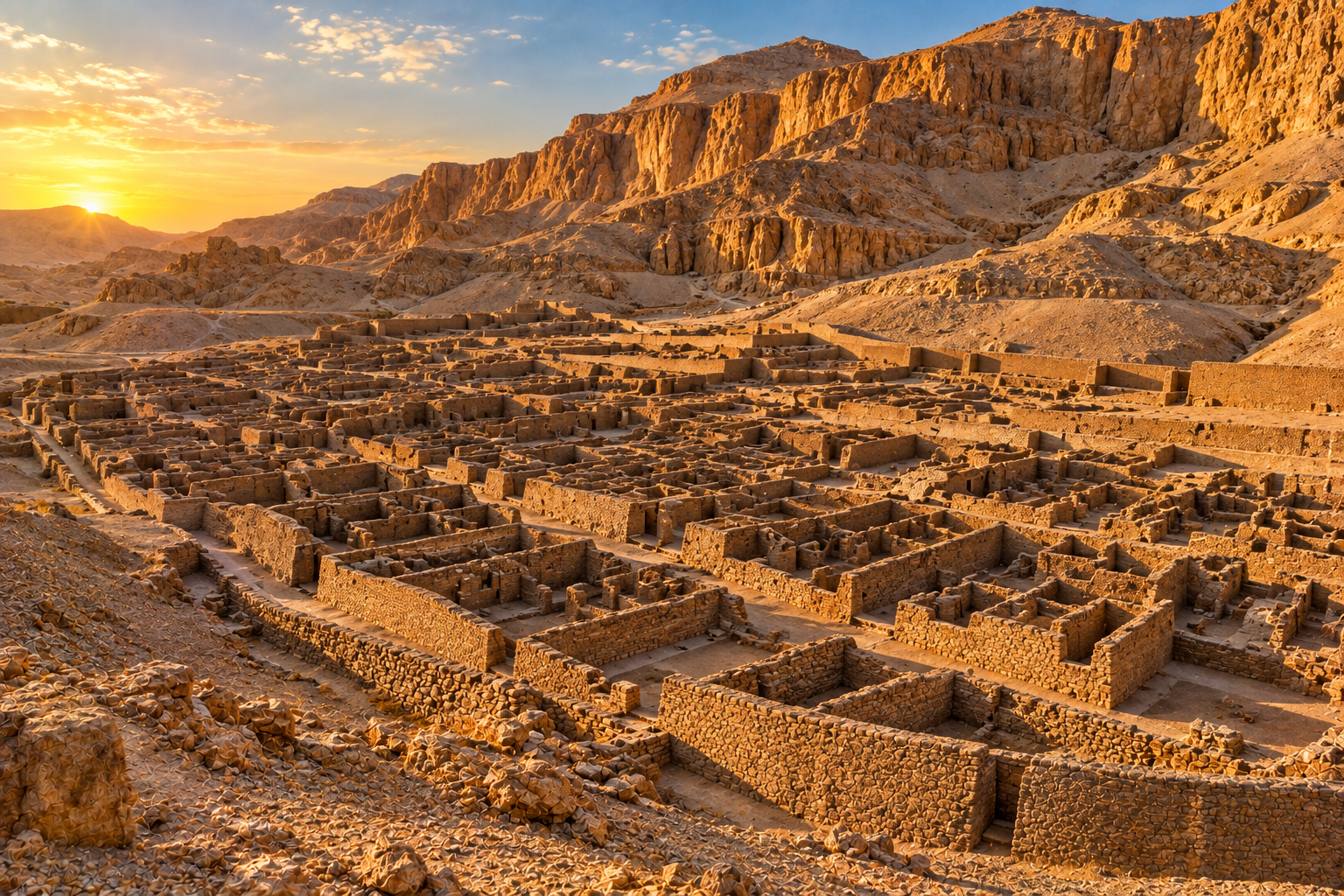
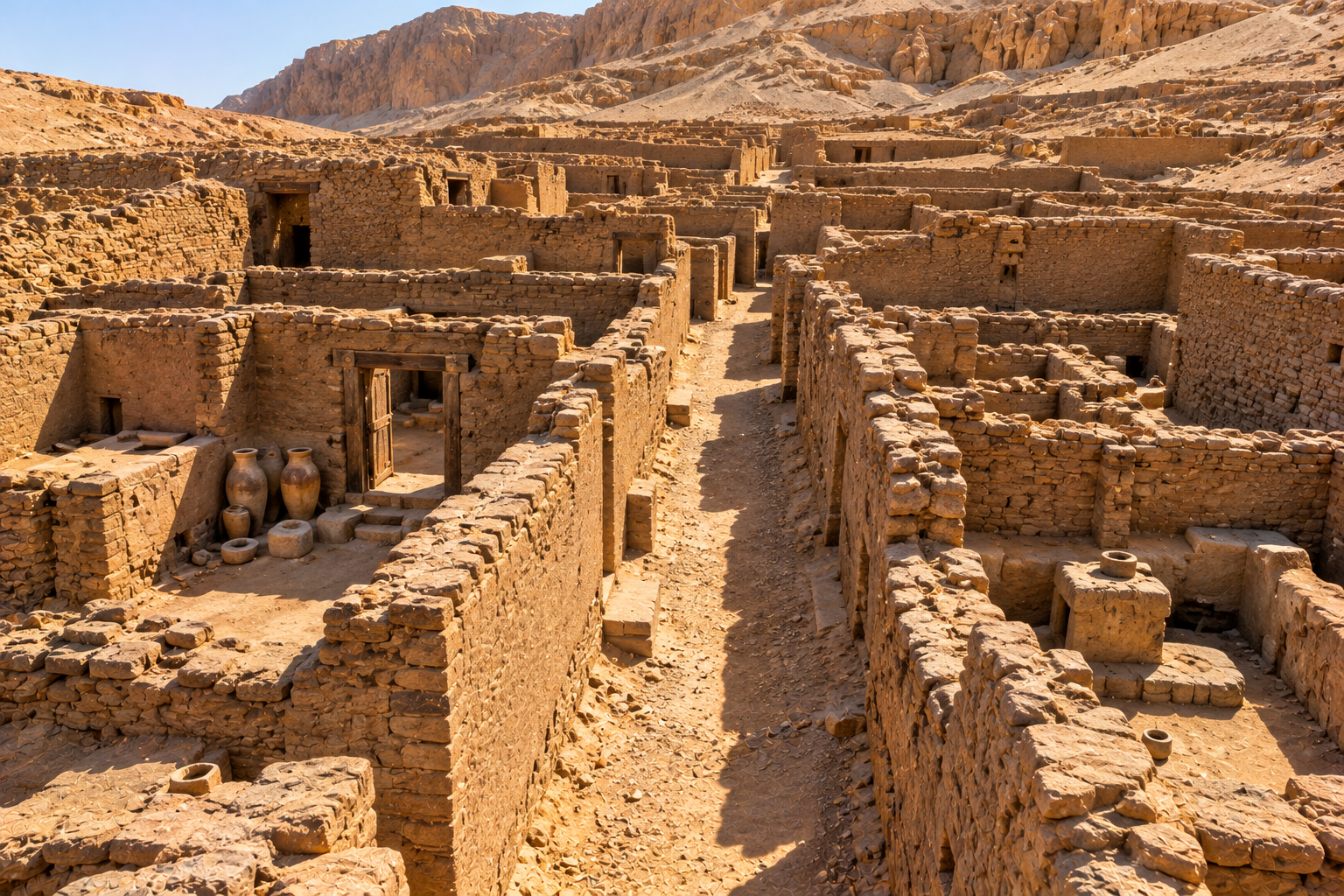
One of Deir el-Medina’s most important archaeological features is the survival of its residential layout.
The settlement contained closely arranged houses separated by narrow streets and passages.
Although the buildings are now largely preserved as foundations and lower wall remains, their layouts provide evidence of how domestic space was organized.
How Were the Houses Arranged?
Houses generally contained a sequence of domestic spaces rather than a single large room.
These could include an entrance area, a principal living space, smaller rooms, and areas associated with cooking or household activities.
Architectural details varied, and not every house remained unchanged throughout the village’s history.
Families could modify or adapt spaces according to their circumstances.
That means the archaeological remains represent a developing community, not a perfectly uniform housing project.
What Was Daily Life Like Inside?
Domestic life involved preparing food, storing household goods, caring for children, maintaining clothing, and carrying out personal and religious activities.
People lived close to their neighbors.
In a settlement of limited size, family relationships, professional connections, and disputes could become closely intertwined.
The surviving written records demonstrate that the inhabitants were concerned with ordinary human problems as well as royal construction.
They argued, negotiated, exchanged property, managed households, and recorded matters that had little direct connection with the tombs they built.
How Did the Workers Build Royal Tombs?
Creating a royal tomb involved several stages of specialized labor.
Workers first had to excavate the chambers and corridors into the rock.
The surfaces then required preparation for decoration.
Draftsmen established the arrangement of scenes and inscriptions, while sculptors and painters executed the designs.
These decorations were not simply artistic additions.
They formed part of the religious program intended to support the deceased king in the afterlife.
Different tombs required different combinations of excavation, relief carving, painting, and finishing work.
Did the Workers Travel to the Valley of the Kings Every Day?
The workforce operated between the settlement and the royal tomb work areas.
Archaeological evidence also indicates that workers used temporary huts closer to their work sites, reducing the need for repeated journeys back to the village.
This arrangement reflects the practical challenges of working in the desert landscape.
The royal tombs were complex projects, and workers needed access to tools, supplies, and places to rest.
Work organization was therefore shaped by both the technical requirements of tomb construction and the geography of western Thebes.
How Was the Workforce Organized?
The royal tomb workforce operated within an administrative hierarchy.
Foremen supervised groups of workers, while scribes maintained records and documented important activities.
The workforce was commonly organized into two sides, conventionally called the right and left sides.
These divisions helped coordinate labor and administrative responsibilities.
Officials recorded attendance, work assignments, deliveries, and interruptions.
Some records are detailed enough to identify individual workers and specific dates.
That level of documentation is one reason Deir el-Medina provides such a valuable window into ancient Egyptian labor organization.
What Did the Scribes Record?
Scribes could document the arrival of supplies, the presence or absence of workers, and events affecting the royal necropolis.
They also preserved correspondence and administrative decisions.
These documents were not written for modern historians.
They were practical records created because the community and its work needed to be managed.
Yet their survival allows modern researchers to reconstruct aspects of ancient life that monumental inscriptions rarely describe.
How Were the Workers Paid?
The royal tomb workers did not receive modern salaries deposited into bank accounts.
Their compensation relied heavily on regular distributions of food and other provisions.
Grain was particularly important.
Rations helped sustain workers and their households, while additional supplies could include other foodstuffs and necessary materials.
These distributions formed part of a wider administrative system that supported the settlement.
Why Were Grain Rations So Important?
Grain was a fundamental resource in ancient Egyptian life.
It could be used to produce bread and beer, two major elements of the diet.
Because the inhabitants of Deir el-Medina lived in a desert settlement rather than an agricultural village, reliable deliveries were essential.
A delay in provisions was therefore more than an administrative inconvenience.
It could directly affect the ability of families to feed themselves.
The surviving records show that problems with these deliveries eventually contributed to organized worker protests.
The Records That Reveal Their Daily Lives
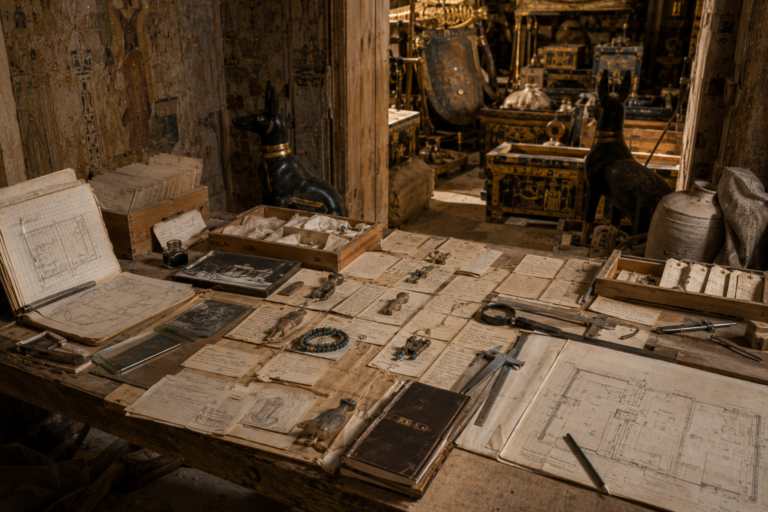
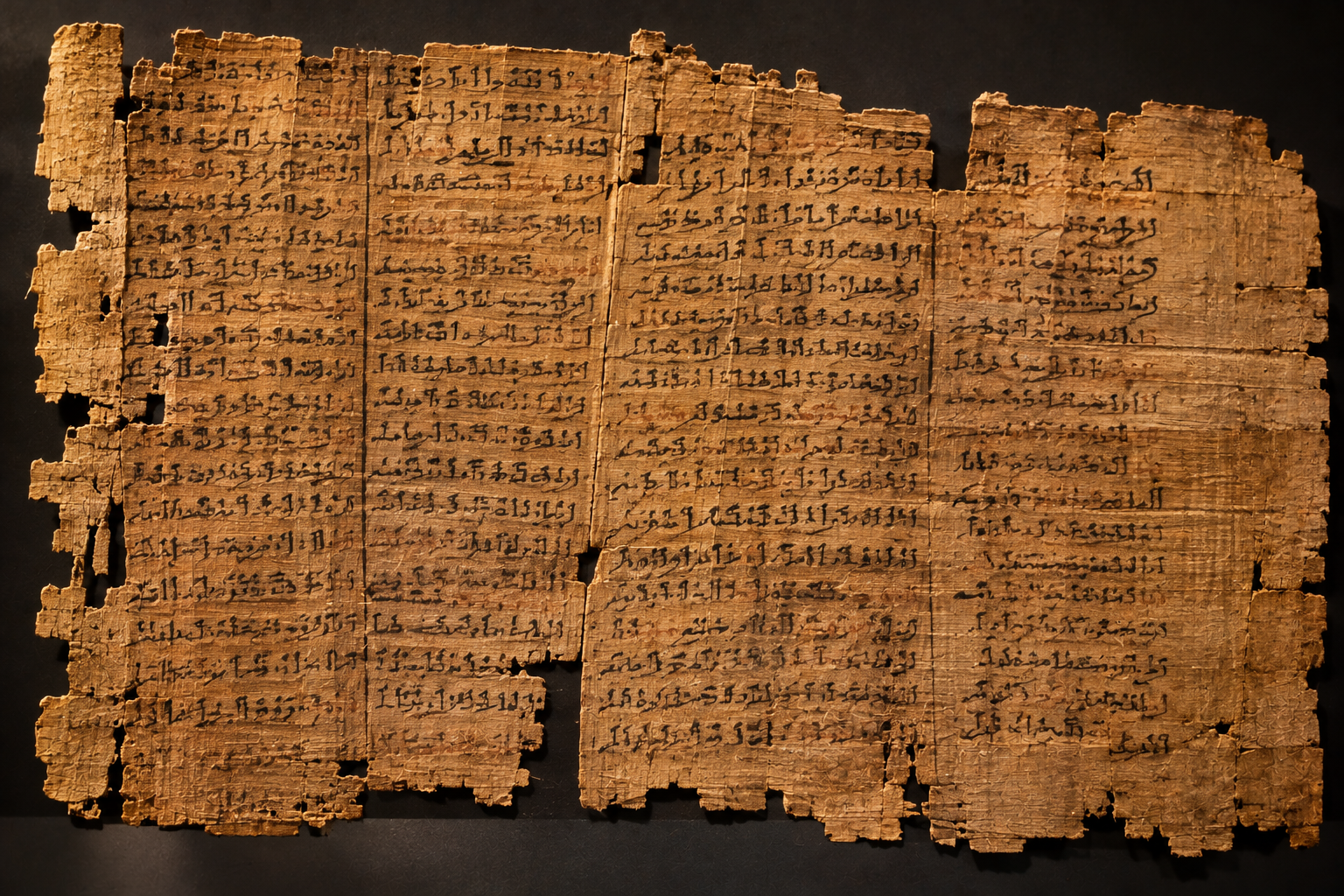
Deir el-Medina is especially famous for its written evidence.
Thousands of inscribed fragments and documents associated with the community provide information about administration, work, religion, education, and personal relationships.
Many were written in hieratic, a cursive form of Egyptian writing commonly used for practical documents.
Some texts were written on papyrus.
Others were written on pottery fragments or pieces of limestone known as ostraca.
Why Were Ostraca So Useful?
Papyrus required preparation and could be valuable.
Pottery fragments and suitable limestone pieces offered convenient writing surfaces for shorter records and notes.
At Deir el-Medina, these materials preserve information that might otherwise have disappeared.
Some record attendance.
Others contain letters, administrative notes, legal matters, drawings, or literary exercises.
Together, they reveal a community whose inhabitants communicated in writing about a wide range of subjects.
What Makes These Documents Different From Royal Inscriptions?
Royal monuments generally emphasize kingship, religious legitimacy, military victories, and ceremonial achievements.
The documents from Deir el-Medina often concern much smaller events.
A worker missed a day.
A delivery failed to arrive.
A disagreement required attention.
A household needed supplies.
These details make the village exceptional because they bring ordinary concerns into the historical record.
The royal tombs tell us how pharaohs wanted to be remembered. The records of Deir el-Medina reveal how some of the people who built those tombs actually lived.
Why Did Workers Miss Work?
One of the most revealing documents associated with Deir el-Medina is an attendance register preserved in the British Museum.
The limestone ostracon, numbered EA5634, dates to year 40 of Ramesses II.
It records a group of workers across a substantial period, including dates and explanations for absences.
The document is remarkable because it preserves administrative information about named individuals rather than an idealized description of labor.
What Could Cause an Absence?
Surviving attendance records show that workers did not perform their duties every single day.
Absences could be connected to illness, personal responsibilities, religious observances, or other circumstances.
The exact reasons depended on the individual entry.
We should not assume that every absence was misconduct or that every worker experienced identical conditions.
These documents are valuable precisely because they record variation in people’s lives.
Another British Museum ostracon, EA50730, preserves records of work and absence associated with several workmen during the reign of Ramesses VI.
Such evidence allows researchers to study the practical operation of the royal tomb workforce across different periods.
The Famous Workers’ Strike at Deir el-Medina
One of the most extraordinary events associated with Deir el-Medina occurred during the reign of Ramesses III.
In year 29 of his reign, royal tomb workers protested because their food rations had not been delivered as expected.
The event is recorded in the Turin Strike Papyrus, Cat. 1880, preserved by the Museo Egizio in Turin.
It is among the earliest documented organized labor strikes in history.
Why Did the Workers Stop Working?
The immediate issue was the interruption of provisions.
Workers depended on regular distributions to support their households.
When those supplies failed to arrive, the situation became serious enough for the workforce to abandon its normal duties and demand action.
The papyrus records the workers passing control points and protesting their hunger.
They gathered at locations in the Theban necropolis and sought intervention from officials.
How Did the Authorities Respond?
The surviving account describes attempts by officials to address the complaints.
Some overdue grain was distributed, but the conflict did not immediately disappear.
The workers protested again and continued pressing for their provisions.
The events demonstrate that the royal tomb workforce was not isolated from the wider economic and administrative difficulties affecting Egypt during the late New Kingdom.
They also show that workers could organize collective action and communicate their demands through official channels.
Historical clarification: The Turin Strike Papyrus records protests during Ramesses III’s reign, not during Tutankhamun’s lifetime. Deir el-Medina existed across multiple generations, and its surviving documents must be interpreted within their own historical periods.
Was This the First Strike in History?
The Deir el-Medina protest is often described as the first recorded labor strike.
A more precise description is that it is one of the earliest clearly documented examples of organized workers stopping work to demand overdue provisions.
Earlier labor disputes may have occurred without leaving surviving written records.
What makes the Deir el-Medina strike exceptional is the detail preserved in the ancient account.
Women and Family Life at Deir el-Medina
Deir el-Medina was not simply a workplace for men employed on royal tomb projects.
It was also a residential community where women, children, and other family members lived.
Household life continued while workers carried out their duties in the necropolis.
Women participated in domestic and economic activities, maintained social relationships, and appear in documents concerning property and family matters.
The written evidence shows that personal relationships could become the subject of legal complaints and disputes.
What Do Legal Records Reveal?
A limestone ostracon in the British Museum, EA65938, preserves records of proceedings before a local court associated with the necropolis community.
One case concerns a complaint involving a woman who had reportedly been mistreated by her husband.
The document provides evidence that domestic conflicts could enter formal legal proceedings.
It does not tell us everything about the lives of women in the village, but it demonstrates that family relationships and disputes formed part of the surviving written record.
Did Families Own Personal Possessions?
Documents from Deir el-Medina preserve references to property, household goods, and transactions.
These records show that the inhabitants managed material possessions beyond the tools required for royal tomb construction.
Furniture, clothing, domestic equipment, and other objects were part of everyday life.
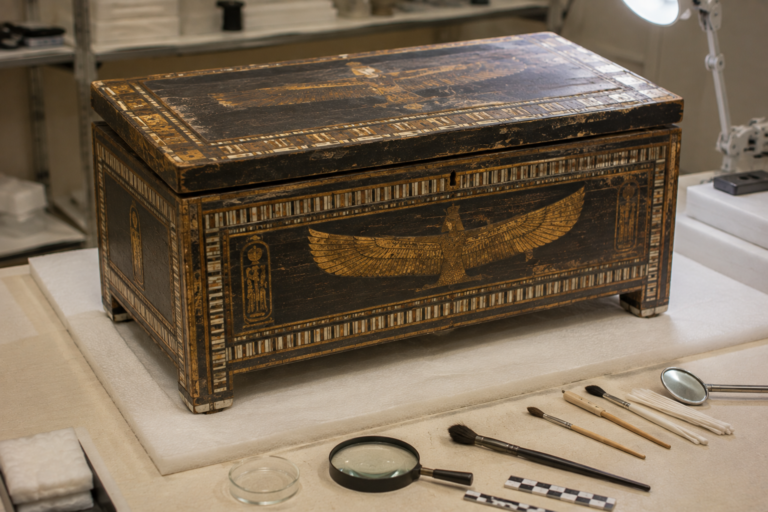
The evidence also helps explain why the study of ancient Egyptian furniture and personal belongings is so important.
Objects such as the furniture found inside Tutankhamun’s tomb represent a very different social context, but they reveal related traditions of Egyptian craftsmanship and material culture.
Religion Inside the Workers’ Village
The inhabitants of Deir el-Medina lived close to some of Egypt’s most important royal burial landscapes.
Religion was part of their professional work and their personal lives.
The community worshipped deities associated with protection, the afterlife, and the Theban region.
Religious objects, decorated tombs, and surviving inscriptions provide evidence of these beliefs.
Why Were Amenhotep I and Ahmose-Nefertari Important?
Amenhotep I and his mother Ahmose-Nefertari became particularly important figures in the religious life of the Theban necropolis community.
They were honored as deified royal patrons by later generations of workers and their families.
A limestone stela belonging to the sculptor Qen, now in the Metropolitan Museum of Art, shows the artisan and members of his family worshipping these royal figures.
The stela dates to the Ramesside period and was discovered in Qen’s tomb at Deir el-Medina.
It provides a direct connection between a named artisan, his family, and the religious traditions of the community.
The Tombs of the Tomb Builders
The workers of Deir el-Medina spent their professional lives helping create tombs for royalty.
Some also prepared decorated tombs for themselves and their families.
These private burials are among the most valuable sources for understanding the artistic and religious world of the village.
They show how skilled artisans applied their knowledge to monuments associated with their own households.
Were the Workers’ Tombs Decorated Like Royal Tombs?
There were important differences in scale, resources, and religious programs.
Royal tombs were created for kings and could involve extensive excavation and elaborate decorative schemes.
The tombs of Deir el-Medina’s inhabitants were generally much smaller.
Nevertheless, some contained exceptional paintings and carefully designed scenes reflecting the beliefs and aspirations of their owners.
What Does the Tomb of Sennedjem Reveal?
The tomb of Sennedjem, TT1, is one of the best-known private tombs at Deir el-Medina.
Its decoration includes religious scenes associated with the deceased and the afterlife.
The tomb demonstrates the artistic ability of members of the community and the importance they attached to their own burial preparations.
It also reminds us that the people who produced royal monuments had personal religious identities and family histories.
They were not defined solely by their service to the pharaoh.
Why Did Deir el-Medina Decline?
Deir el-Medina’s history extended across generations, but the settlement did not remain an active royal tomb workers’ village indefinitely.
During the later New Kingdom, Egypt experienced political, administrative, and economic changes.
The royal burial system itself also changed.
As royal funerary practices and the organization of the necropolis shifted, the settlement’s original role became increasingly difficult to maintain.
The village eventually ceased functioning as the specialized community it had once been.
Was the Village Abandoned Immediately After the Strike?
No.
The famous strike occurred during the reign of Ramesses III, but the community’s history continued beyond that event.
Documents from later reigns demonstrate continued activity in the royal necropolis administration.
For example, records associated with the reign of Ramesses IX preserve information about deliveries and supplies.
The decline of Deir el-Medina should therefore be understood as part of a longer historical transformation rather than the direct result of a single protest.
What the Archaeological Evidence Reveals
Deir el-Medina is unusual because several different categories of evidence survive from the same community.
Archaeological remains reveal the physical settlement.
Written documents identify people, administrative systems, and individual events.
Decorated tombs provide evidence of artistic traditions and religious beliefs.
These sources complement one another, although they do not always provide a complete or equally detailed picture of every period.
| Evidence | What It Reveals | Important Limitation |
|---|---|---|
| Village houses | Residential layouts, domestic spaces, and settlement organization. | Not every building phase or household activity survives archaeologically. |
| Attendance ostraca | Names, work records, dates, and absences. | Individual documents cover specific workers and periods. |
| Administrative papyri | Supplies, deliveries, work organization, and official communication. | Records may be incomplete or preserve only selected events. |
| Turin Strike Papyrus | Organized protests over delayed rations during Ramesses III’s reign. | It does not describe every labor dispute in ancient Egypt. |
| Legal ostraca | Disputes, complaints, and aspects of community relationships. | Legal cases do not represent every household’s experience. |
| Workers’ tombs | Religious beliefs, artistic skills, and family commemoration. | Surviving decorated tombs do not represent all residents equally. |
| Religious stelae | Personal devotion and the community’s patron deities. | A single stela reflects a particular owner and historical context. |
Why Deir el-Medina Still Matters Today
Ancient Egypt is often introduced through the achievements of its kings.
The pyramids, temples, royal tombs, and monumental statues dominate popular accounts of Egyptian history.
Deir el-Medina allows us to examine a different side of the civilization.
It preserves evidence of skilled workers who contributed to royal monuments while managing their own households, relationships, and economic concerns.
We can identify individual artisans.
We can study their work schedules.
We can examine their religious beliefs.
And we can read records of disputes and protests that were important to the people involved, even though they were not major events in royal history.
That combination of evidence makes Deir el-Medina one of the most informative ancient settlements for understanding life in New Kingdom Egypt.
Its importance lies not only in what its residents built, but also in what they left behind about themselves.
Frequently Asked Questions
What is Deir el-Medina famous for?
Deir el-Medina is famous as the settlement of skilled artisans and workers who constructed and decorated royal tombs in the Theban necropolis during Egypt’s New Kingdom. It is also known for its extensive written records.
Where is Deir el-Medina located?
It is on the west bank of the Nile near modern Luxor, Egypt, in the Theban necropolis close to the Valley of the Kings and Valley of the Queens.
Who lived in Deir el-Medina?
The community included royal tomb artisans, quarrymen, painters, sculptors, carpenters, scribes, and their families.
Did Deir el-Medina workers build the pyramids?
No. Deir el-Medina is associated primarily with the royal rock-cut tombs of the New Kingdom. The major pyramids at Giza were built much earlier, during the Old Kingdom.
Were the workers at Deir el-Medina paid?
Yes. The documented workforce received regular provisions, especially grain rations, as part of the system supporting royal tomb construction.
Why did the workers at Deir el-Medina go on strike?
During the reign of Ramesses III, workers protested because their expected food rations had been delayed. Their actions are documented in the Turin Strike Papyrus.
Was Deir el-Medina the site of the first labor strike?
It preserves one of the earliest clearly documented organized labor strikes. The surviving evidence does not prove that no earlier strikes occurred elsewhere.
What are Deir el-Medina ostraca?
They are inscribed fragments of pottery or limestone used for writing. Examples preserve work records, letters, administrative notes, drawings, and other texts.
What did the houses at Deir el-Medina look like?
The settlement contained closely arranged houses with multiple domestic spaces and narrow streets. Excavated foundations provide evidence of their layouts.
Did the workers have their own tombs?
Yes. Some residents prepared decorated tombs for themselves and their families. The tomb of Sennedjem is among the best-known examples.
Why is Deir el-Medina important to archaeologists?
Its combination of houses, tombs, administrative documents, personal records, and religious objects allows researchers to study the lives of identifiable people in unusual detail.
Final Thoughts
Deir el-Medina offers a rare opportunity to look beyond the pharaohs and examine the people who helped create Egypt’s royal burial monuments.
Its residents were skilled craftspeople, but they were also parents, spouses, neighbors, and members of a closely connected community.
They worked on tombs designed to preserve royal identities for eternity, yet many of the most revealing records they left behind concern ordinary problems.
A missed workday.
A disagreement between neighbors.
A delayed delivery of grain.
A family’s religious devotion.
These details are not incidental to the history of ancient Egypt. They are part of that history.
The extraordinary value of Deir el-Medina is that it allows us to connect monumental achievement with human experience.
Behind the decorated walls of the Valley of the Kings stood a community of workers whose lives were far more complicated and recognizable than the monuments alone might suggest.
The royal tombs preserved the memory of kings. Deir el-Medina helped preserve the voices of the people who built them.
Research Sources
- The Metropolitan Museum of Art — An Artisan’s Tomb in New Kingdom Egypt. Background on the royal tomb workforce, its organization, and community.
- Museo Egizio — Highlights: Turin Strike Papyrus. Historical context and documentary evidence for the workers’ protests.
- Museo Egizio — Turin Strike Papyrus, Cat. 1880. Archival record of the papyrus.
- British Museum — Ostracon EA5634. Attendance register from the reign of Ramesses II.
- British Museum — Ostracon EA50730. Records of work and absences from the reign of Ramesses VI.
- British Museum — Ostracon EA65938. Evidence of legal proceedings involving the necropolis community.
- The Metropolitan Museum of Art — Stela of the Sculptor Qen. Evidence of family devotion to Amenhotep I and Ahmose-Nefertari.
- The Metropolitan Museum of Art — New Kingdom Jar. Archaeological evidence associated with temporary workers’ huts near the Valley of the Kings.