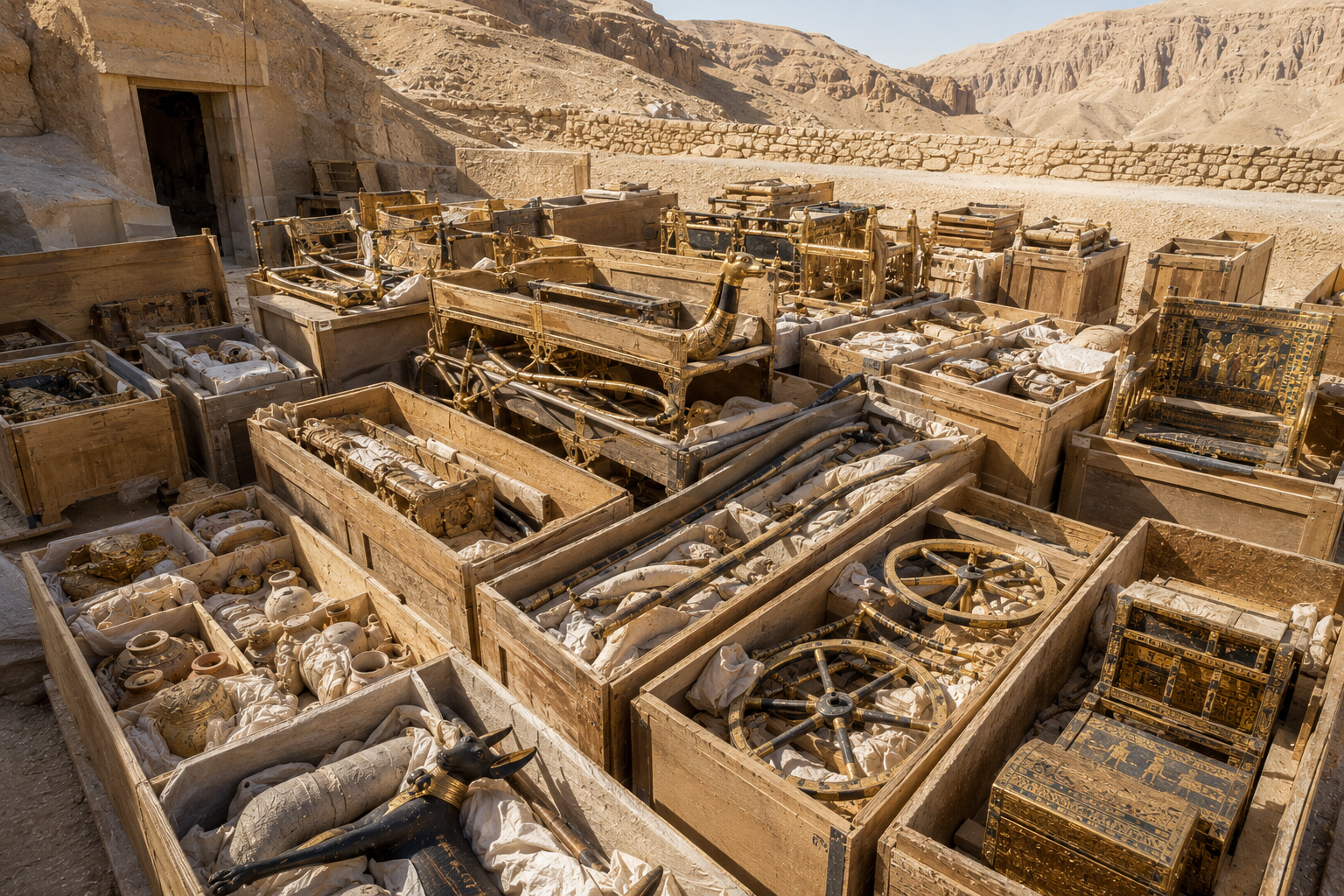

When Howard Carter looked through a small opening in Tutankhamun’s tomb in November 1922, he saw rooms crowded with objects that had remained hidden for more than 3,000 years. Gilded beds, dismantled chariots, sealed boxes, ritual furniture, statues, weapons, jewelry, clothing, food containers, and countless smaller possessions filled the darkness. To the outside world, the discovery appeared to be the triumphant end of a long search. In reality, it was the beginning of an even more difficult journey.
Finding the treasures was one challenge. Removing them without destroying them was another. Many objects were fragile, unstable, or trapped beneath other artifacts. Some had been damaged by ancient robbery attempts, flooding, pressure, insects, or the slow decay of wood, fabric, leather, and adhesives. The team could not simply carry the treasures out of the tomb. Every object first had to be photographed, numbered, described, studied, stabilized, packed, and transported with extraordinary care.
Over the following years, Tutankhamun’s burial goods travelled from the cramped chambers of KV62 to temporary conservation spaces near the tomb, then onward through Egypt’s museum system. Their journey changed archaeology, conservation, and public understanding of ancient Egypt. It also revealed a truth often lost behind the glitter of gold: the survival of Tutankhamun’s treasures depended not only on the tomb that protected them, but also on the people who worked patiently to preserve them after the seal was broken.
Quick Context
- Tomb: KV62 in the Valley of the Kings
- Discovery: November 1922
- Excavation director: Howard Carter
- Financial sponsor: George Herbert, the fifth Earl of Carnarvon
- Photographer: Harry Burton
- Conservation specialist: Alfred Lucas
- Number of catalogued object groups: More than 5,000 individual artifacts and object components
- Clearance period: Work continued through much of the 1920s and into the early 1930s
- Importance: The excavation became one of the best-documented archaeological projects of its era
The Discovery Was Only the Beginning
The opening of Tutankhamun’s tomb is often remembered as a single dramatic moment: a candle held near a small opening, golden objects appearing through the darkness, and Carter struggling to describe what he could see. Yet the tomb was not a ready-made museum display. It was a crowded burial complex in which hundreds of objects had been placed quickly, tightly, and sometimes irregularly.
The antechamber alone presented an overwhelming problem. Large ceremonial beds stood among chariots, boxes, stools, baskets, vessels, and pieces of royal furniture. Some objects had been dismantled before burial. Others had fallen, shifted, or been moved during ancient intrusions. Narrow spaces between them made it difficult for the excavation team to enter, photograph, measure, or lift anything safely.
The burial chamber created an entirely different challenge. Much of the room was occupied by a series of enormous gilded wooden shrines built around the stone sarcophagus. These nested structures filled almost all the available space between the sarcophagus and the painted walls. Each shrine had to be documented and dismantled in sequence before the team could reach the coffins and the king’s mummy.
The treasury and annex were equally complex. The treasury contained ritual equipment connected with the king’s journey into the afterlife, including the canopic shrine, funerary figures, chests, models, boats, and statues. The annex was even more disorderly, with containers, food supplies, oils, baskets, furniture, and other objects packed into a small chamber. Excavating it required patience because removing the wrong item first could disturb an entire group.
Important: The position of an artifact is archaeological evidence. A box, chariot component, garment, or vessel can reveal far more when its exact location and relationship to nearby objects are recorded before removal.
Why Nothing Could Be Moved Immediately
To an untrained observer, many of the objects inside the tomb appeared intact. Gold still reflected light. Painted surfaces remained colorful. Furniture retained recognizable shapes. But appearance could be deceptive. A gilded wooden object might look solid while the wood beneath its surface had weakened dramatically. A linen wrapping might hold its shape until touched, then begin to break apart. Ancient leather could be dry and rigid, while decorative elements might be attached with adhesives that had become brittle.
Opening the tomb also changed its environment. For centuries, the chambers had remained largely sealed from the outside world. Once archaeologists entered, the objects were exposed to new air movement, changing humidity, dust, artificial light, and repeated human activity. These changes did not instantly destroy the collection, but they increased the need for controlled handling and careful conservation.
Before an object could be removed, the team needed to answer several questions. Was it strong enough to lift? Did it support another object? Could its decoration detach? Were its joints stable? Did it require a temporary support? Should it be treated inside the tomb, or could it be moved to a nearby workspace first?
This meant that excavation progressed according to condition, access, and context rather than visual importance. A small piece of wood or fragment of linen might demand more immediate attention than a large gold-covered object. The most spectacular treasure was not always the most difficult to save.
Opening the tomb revealed the treasures. Recording and conserving them made their survival possible.
Recording Every Object Before It Left the Tomb
Howard Carter understood that once an artifact left its original position, part of the tomb’s story could be lost forever. He therefore organized a detailed recording process designed to preserve as much archaeological information as possible before anything moved.
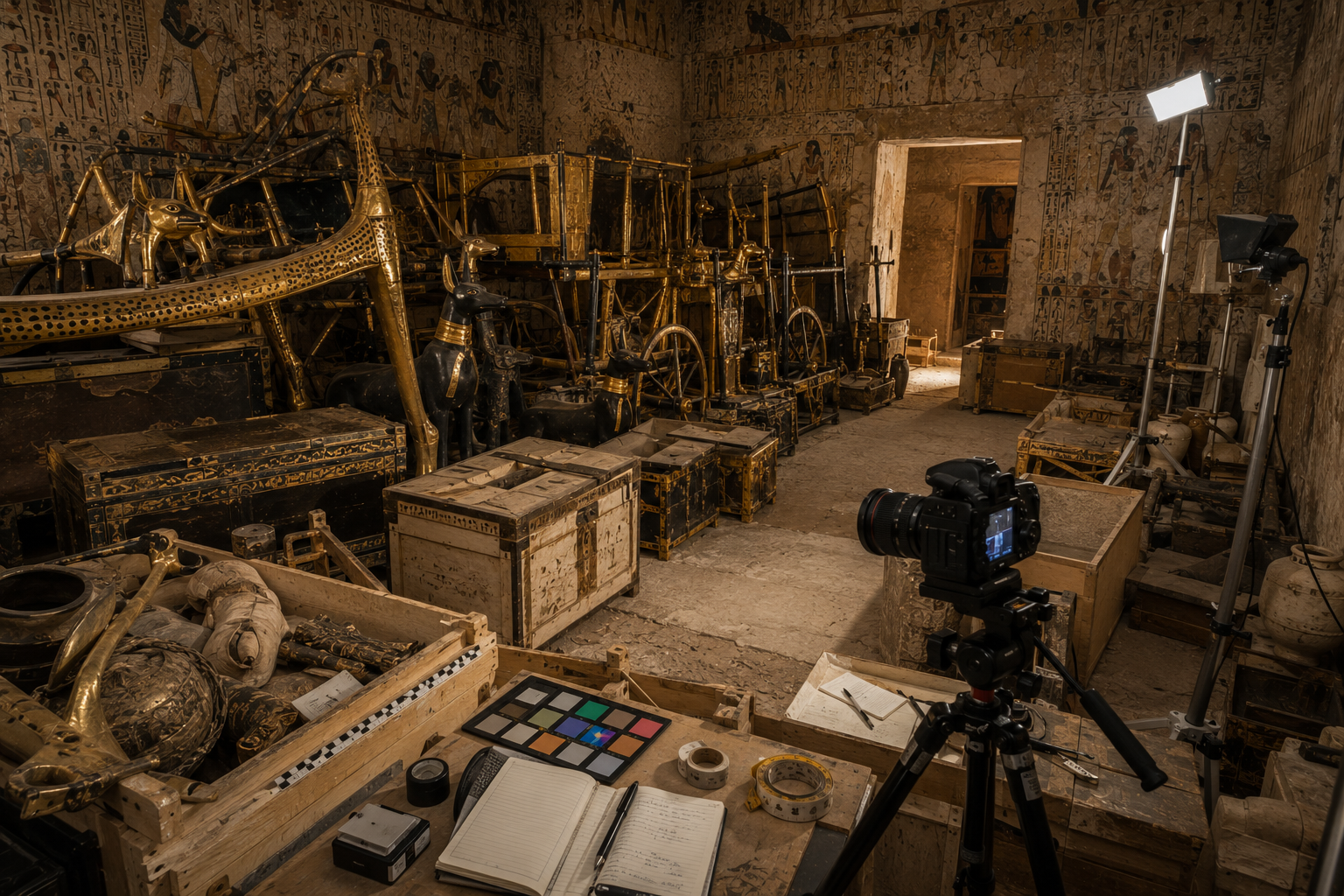
The team assigned numbers to objects and object groups, wrote description cards, measured dimensions, identified materials, noted decoration, and recorded the location of each discovery. Plans and sketches helped show how objects related to one another inside the chambers. Photographs captured the scene before, during, and after removal.
This documentation was especially important because many catalogued entries represented complex groups rather than single objects. A chest might contain jewelry, clothing, weapons, or ritual equipment. A chariot could consist of multiple separated parts. A piece of furniture might include wooden elements, metal fittings, leather attachments, textile remains, and decorative inlays. Each component had to be connected to the correct record.
The resulting archive allowed researchers to study the tomb long after its rooms had been cleared. Even today, historians and archaeologists use Carter’s notes, object cards, plans, and photographs to examine the burial, reconstruct the original arrangement, identify materials, and reconsider earlier interpretations.
Harry Burton and the Photographs That Preserved the Discovery
Photography became one of the most important tools used during the excavation. Harry Burton, an experienced archaeological photographer associated with the Metropolitan Museum of Art’s Egyptian Expedition, was responsible for creating the visual record of the tomb.
Burton worked under difficult conditions. The chambers were small, crowded, dark, and filled with reflective surfaces. Large photographic equipment had to be positioned carefully without disturbing the artifacts. Long exposures were often necessary, and lighting had to reveal details without overwhelming the scene.
His photographs documented much more than famous treasures. They showed objects exactly as they appeared during excavation, including their positions, layers, damage, supports, wrappings, and relationships with surrounding material. He also photographed conservation work, transportation preparations, and the gradual clearance of the chambers.
These images changed the way the discovery was understood by both specialists and the public. Newspapers and magazines used them to share the tomb with audiences around the world. More importantly, they became permanent archaeological evidence. A modern researcher can study Burton’s photographs to see details that may have changed after cleaning, restoration, reconstruction, or display.
Why Burton’s photographs still matter: They preserve the appearance of the tomb during excavation, not merely the polished appearance of selected objects in museum cases. They show context, condition, and the difficult working environment in which the collection was recovered.
The Cataloguing System Behind the Treasures
Every major discovery required a clear identity. Carter’s team used a numbering system to connect each object with written records, photographs, plans, drawings, and conservation notes. This helped prevent artifacts from becoming separated from their archaeological history after they left the tomb.
Cataloguing was not always simple. Some objects belonged together but were found apart. Others were discovered inside containers, beneath furniture, or mixed with fragments from neighboring objects. In several cases, an artifact’s purpose was not immediately understood. The team had to record what they observed while leaving room for later interpretation.
The catalogue also reveals how broad the collection was. Tutankhamun’s tomb did not contain only royal gold. It preserved everyday and ceremonial objects made from wood, stone, metal, glass, faience, linen, leather, ivory, food products, plant material, oils, resins, and other substances. Each material required different methods of handling and preservation.
This variety is one reason the excavation became such a demanding scientific operation. The team was not dealing with one type of treasure. It was dealing with an entire royal burial assemblage, created by many workshops and composed of materials that had aged in very different ways.
Why Removing the Treasures Took Years
The clearance of Tutankhamun’s tomb was not a rapid extraction. Work continued over multiple excavation seasons because documentation, conservation, access, weather, transportation, and the physical arrangement of the chambers all slowed the process.
The team generally worked during the cooler months, when conditions in the Valley of the Kings were more manageable. Even then, heat, dust, limited space, and the need to protect the tomb made each task difficult. Before one object could be removed, several others might need to be recorded or supported. A fragile surface could require treatment before packing. A large piece might need a specially built frame or crate.
The nested shrines in the burial chamber required particularly careful work. They had to be examined and dismantled in the correct order. Their size left little working room, and their gilded wooden surfaces were vulnerable. Only after these structures were removed could the team fully access the sarcophagus, coffins, and mummy.
| Challenge | Why It Slowed the Work |
|---|---|
| Crowded chambers | Objects blocked access to one another and had to be removed in a carefully planned order. |
| Fragile wood | Furniture and shrines could appear stable while their internal structure had weakened. |
| Loose gilding and paint | Decorative surfaces could detach during lifting, wrapping, or transport. |
| Ancient textiles | Linen garments and wrappings often required delicate handling and stabilization. |
| Complex object groups | Chests, chariots, furniture, and ritual equipment could contain many separate components. |
| Seasonal conditions | Much of the work had to be organized around the extreme climate of the Valley of the Kings. |
| Detailed documentation | Photography, notes, measurements, drawings, and numbering had to be completed before removal. |
The slow pace was not evidence of hesitation. It was evidence of responsibility. The longer process allowed the team to preserve context, reduce damage, and create records detailed enough to support research for generations.
Protecting Fragile Materials Before They Left the Tomb
Some treasures could not be moved immediately after documentation. Their materials first needed to be strengthened, supported, or protected. Conservator Alfred Lucas played a central role in examining the condition of objects and finding practical ways to stabilize them.
Wood was among the most serious concerns. Many royal objects were made from wooden cores covered with gesso, paint, gilding, veneer, or inlay. If the core had shrunk, cracked, or weakened, the decorative surface could lift away. Moving the object without support might cause the outer layers to fall.
Textiles created different problems. Linen could be folded, compressed, stained, or weakened by age. Leather elements used in chariots, sandals, quivers, and furniture could become stiff and brittle. Plant fibers, baskets, food remains, and organic materials also required careful handling because they responded differently to exposure and movement.
There was no single treatment suitable for everything. Each object had to be evaluated according to its materials, condition, construction, and intended method of transport. This made conservation inseparable from excavation. The team could not simply uncover first and preserve later. Preservation had to happen throughout the process.
Transporting the Treasures Beyond the Valley
Once an artifact had been documented and stabilized, it faced another dangerous stage: movement. For the first time since Tutankhamun’s burial, objects that had remained motionless for more than three millennia had to be lifted, carried through narrow doorways, taken up the tomb’s entrance passage, and transported across the Valley of the Kings.
The distance from the tomb to a temporary workspace might seem short, but every step introduced risk. A sudden vibration could loosen gilding. A weakened joint could separate under its own weight. Small fragments could disappear if an object shifted inside its wrapping. The challenge was not merely to protect each treasure from impact, but to support it in a way that respected its ancient construction.
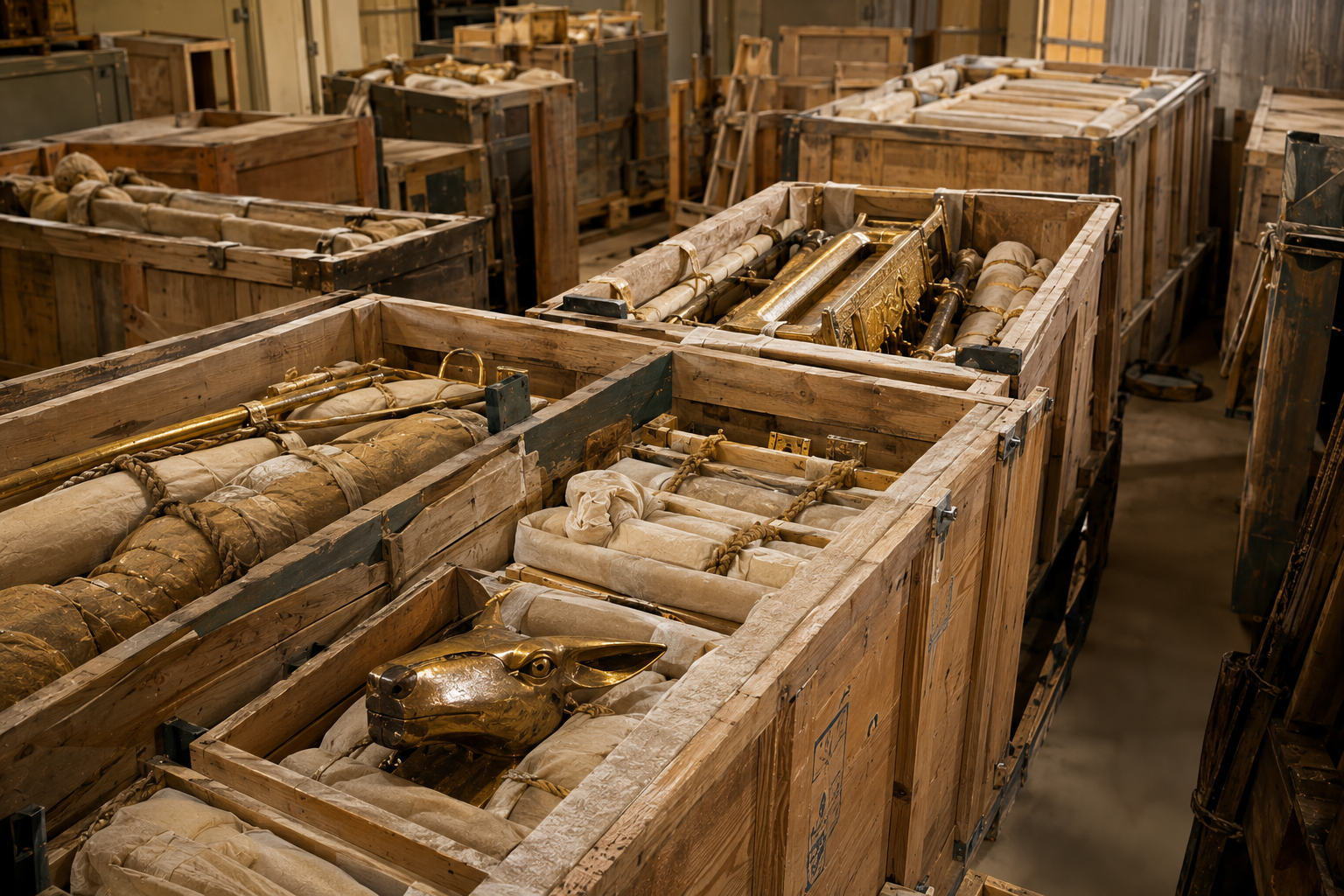
Different objects required different solutions. Small artifacts could be placed in padded boxes after careful wrapping. Larger pieces needed wooden frames, trays, or custom-built crates. Furniture often required support beneath vulnerable sections rather than being lifted from handles, legs, or decorative elements that were never designed to carry the object’s full weight.
The packing materials available in the 1920s were far less advanced than those used by museum conservators today. There were no modern vibration sensors, inert foams, digital climate monitors, or computer-designed supports. Carter’s team relied on close observation, practical engineering, and individually prepared containers.
From the Tomb to the Temporary Laboratory
Before beginning the longer journey north, many objects were taken to temporary work areas near the excavation. One important space was established in the nearby tomb of Seti II, where members of the team could examine, clean, conserve, photograph, and prepare artifacts under more manageable conditions than those inside KV62.
This temporary laboratory became a bridge between excavation and museum preservation. Objects arrived carrying dust, loose fragments, weakened surfaces, and materials that sometimes reacted unpredictably after exposure. Conservators could study them more closely there and decide whether they were stable enough to travel.
The laboratory also allowed separated parts to be identified and reunited. A fragment found beside one object might belong to another artifact removed days earlier. Decorative pieces, fittings, beads, textile fragments, and sections of furniture had to be compared with photographs and excavation records before their associations were confirmed.
Some treatments were designed only to make an artifact safe enough for transport. A complete restoration was not always possible or desirable at that stage. The immediate goal was survival: prevent further loss, secure unstable sections, and prepare the object for the next part of its journey.
Conservation is not the same as making an object look new. The primary goal is to stabilize original material, reduce further deterioration, and preserve evidence of how the artifact was made, used, buried, and discovered.
Leaving Luxor
After preparation, many of the treasures travelled from the Luxor region toward Cairo. This was a far more complicated operation than placing crates on a vehicle and beginning the journey. Routes, handling points, weather, security, and the condition of each artifact all had to be considered.
The Nile remained an important transport route, and objects could be moved by boat before continuing to Cairo. Water transport reduced some of the difficulties associated with long journeys over rough roads, although loading and unloading still required careful supervision. Large crates had to remain stable, protected from direct sunlight, and shielded from sudden movement.
Security was another concern. News of the discovery had spread around the world, and Tutankhamun’s treasures had become internationally famous before the tomb had even been fully cleared. The movements of important objects attracted public interest, making controlled transport essential.
Each successful arrival marked the end of one journey but the beginning of another. The treasures were no longer part of an active excavation. They were becoming a museum collection that would require permanent documentation, storage, conservation, research, and display.
From the Tomb to the Egyptian Museum in Cairo
For much of the twentieth century, the Egyptian Museum in Cairo became the public home of Tutankhamun’s most famous treasures. The museum, located in Tahrir Square, had opened in 1902, two decades before the discovery of KV62. Its galleries already held an extraordinary collection of royal statues, mummies, coffins, papyri, jewelry, and objects from archaeological excavations across Egypt.
The arrival of Tutankhamun’s burial equipment transformed the museum’s international reputation. Visitors came to see the gold mask, nested coffins, jewelry, royal furniture, weapons, chariots, ritual vessels, statues, and personal belongings associated with the young king. These objects gave audiences an unusually detailed view of a royal burial from the Eighteenth Dynasty.
Yet displaying the collection created difficult choices. The tomb contained thousands of items, while museum galleries had limited space. Large shrines, chariots, beds, boxes, and other objects required substantial display areas. Smaller artifacts demanded secure cases and controlled conditions. Some pieces were too fragile to remain on permanent exhibition.
As a result, the public usually saw only part of the collection. Many objects remained in storage or entered galleries at different times. Others required conservation, study, photography, or preparation before they could be displayed safely.
How Museum Display Changed the Treasures
Inside the tomb, every object had been part of a burial environment. In the museum, those same objects were separated, cleaned, reconstructed, labelled, illuminated, and arranged for visitors. This allowed individual masterpieces to be appreciated more clearly, but it also changed how the collection was understood.
A throne displayed alone can be admired as a work of royal craftsmanship. Inside the tomb, however, it was one object among beds, boxes, chariots, clothing, weapons, food, and ritual equipment. Its meaning was connected to the wider burial assemblage.
Museum curators therefore faced a central challenge: how could they display spectacular objects while still explaining their original relationships? The answer evolved over time. Earlier displays often emphasized gold, beauty, and royal luxury. Later approaches placed greater attention on archaeology, funerary belief, craftsmanship, daily life, conservation, and the context recorded by Carter’s team.
The treasures did not leave their history behind when they left the tomb. Their museum journey created a new chapter in that history.
Research Continued After the Excavation
Removal from the tomb did not mark the end of scientific investigation. Museum researchers continued examining materials, inscriptions, construction methods, repairs, signs of use, and evidence of ancient workshop practices.
Some objects raised questions that Carter’s team could not answer during the excavation. Were certain treasures made specifically for Tutankhamun, or adapted from objects created for someone else? Had names and inscriptions been altered? Why did some pieces show signs of use while others appeared ceremonial? Which workshops produced the furniture, jewelry, weapons, and coffins?
New scientific techniques allowed later generations to revisit these questions. Radiography revealed construction details hidden beneath surfaces. Material analysis helped identify metals, pigments, glass, resins, woods, and adhesives. High-resolution photography exposed tiny tool marks and repairs. Digital imaging made it easier to compare inscriptions and decorative elements across the collection.
These studies demonstrated that Tutankhamun’s treasures were not frozen in time. Their interpretation continued to develop as technology improved and new evidence emerged.
How the Treasures Became Global Icons
Tutankhamun’s treasures became famous almost immediately after the discovery, but their international influence grew dramatically during the decades that followed. Burton’s photographs circulated through newspapers, books, exhibitions, and lectures. Egyptian-inspired jewelry, architecture, furniture, fashion, cinema, and advertising appeared across Europe and the United States.
The king’s image became especially recognizable during major travelling exhibitions. Carefully selected artifacts were loaned for temporary displays abroad under agreements with Egyptian authorities. These exhibitions attracted enormous audiences and introduced millions of visitors to the art of ancient Egypt.
The most famous international exhibition campaigns did not transport the entire tomb collection. Instead, curators selected groups of objects that could tell a coherent story while meeting conservation and security requirements. Some of the most fragile or irreplaceable treasures remained in Egypt.
Travelling exhibitions served several purposes. They expanded public knowledge, supported cultural exchange, and helped generate international interest in Egyptian heritage. They also created a difficult conservation equation: every movement increased exposure to vibration, handling, changing environments, and possible damage.
Modern museum loans therefore require detailed condition reports, secure cases, specialized packing, controlled transportation, insurance arrangements, and supervision by conservators. An artifact is examined before departure, monitored throughout the journey, and checked again after arrival.
A common misunderstanding: Tutankhamun’s entire collection did not travel around the world. International exhibitions displayed selected groups of authorized objects, while the majority of the burial assemblage remained under Egyptian care.
Modern Conservation and the Grand Egyptian Museum
After decades at the Egyptian Museum in Cairo, Tutankhamun’s treasures entered another major stage in their journey: preparation for the Grand Egyptian Museum near the Giza Plateau.
The new museum was designed to provide expanded galleries, modern conservation facilities, specialized storage, and a broader interpretation of ancient Egyptian civilization. For Tutankhamun’s collection, the project offered an opportunity to bring together objects that had long been divided between display areas, storage rooms, and conservation laboratories.
Moving the collection required far more than transporting artifacts from one building to another. Each object needed to be identified, examined, photographed, documented, treated when necessary, packed, moved, unpacked, and checked again.
The process happened gradually. Smaller artifacts could be transferred in carefully prepared containers, while monumental pieces demanded complex engineering. Gilded shrines, chariots, large beds, coffins, and other heavy or fragile objects required custom supports and detailed movement plans.
Conserving Objects Before the Move
Decades of display, storage, earlier restoration, dust, environmental exposure, and natural aging had affected different objects in different ways. Before transfer, specialists assessed their condition and identified areas needing attention.
Conservators examined cracks, loose paint, unstable gilding, weakened joints, corrosion, previous repairs, surface deposits, textile damage, and deformation. Modern imaging and analytical tools helped them distinguish original materials from later restoration products.
This distinction matters because conservation decisions can permanently affect an artifact. Removing an old repair may reveal original material, but it can also place the object at risk. Adding a new support may improve stability while changing how the artifact carries its weight. Every intervention must therefore be documented and kept as limited as possible.
Modern Transport Technology
The later transfers to the Grand Egyptian Museum differed greatly from those of the 1920s. Contemporary museum teams could use shock-resistant crates, vibration monitoring, environmental sensors, padded internal supports, controlled vehicles, digital records, and carefully planned routes.
Before a major artifact moved, specialists could create a three-dimensional understanding of its shape, weak points, center of gravity, and support requirements. The crate was designed around the object rather than expecting the object to fit a standard container.
During transport, conservators and security teams supervised every stage. The crate’s position, temperature, humidity, vibration, and movement could be monitored. After arrival, the artifact was examined before being released for further conservation or installation.
| 1920s Excavation Transport | Modern Museum Transport |
|---|---|
| Handwritten object records | Digital databases supported by photography and condition mapping |
| Individually built wooden boxes and supports | Engineered crates with specialized cushioning systems |
| Visual checks during movement | Digital monitoring of vibration and environmental conditions |
| Limited material analysis | Advanced imaging and laboratory examination before treatment |
| Practical conservation based on close observation | Preventive conservation informed by material science |
Reuniting a Royal Burial Collection
One of the most important goals of the Grand Egyptian Museum’s Tutankhamun galleries is to present the burial collection on a scale not previously possible. Rather than concentrating only on the mask and a small group of famous gold objects, the galleries can reveal the extraordinary range of possessions found in KV62.
That broader display changes the story. Tutankhamun was buried not only with symbols of kingship, but also with clothing, sandals, beds, chairs, games, walking sticks, weapons, containers, food, oils, jewelry, chariots, ritual figures, model boats, and objects connected with daily royal life.
Seen together, these artifacts provide a more human portrait of the king and a more complete picture of the people who prepared his burial. They reveal carpenters, metalworkers, painters, stone carvers, jewelers, leatherworkers, weavers, embalmers, priests, administrators, and laborers whose work was preserved inside the tomb.
The collection therefore tells two stories at once. It tells the story of a young pharaoh’s burial, and it preserves the skills of the ancient Egyptian society that created everything around him.
Are All of Tutankhamun’s Treasures on Display?
The phrase “Tutankhamun’s treasures” can create the impression of a single group of gold objects arranged permanently in one gallery. The reality is more complex. The tomb contained thousands of artifacts and components ranging from monumental shrines to tiny beads, fragments, plant remains, containers, and pieces of ancient material that may not appear visually impressive but remain archaeologically important.
Not every object can or should be displayed at the same time. Some artifacts are too fragile for continuous exposure. Others require study or conservation. Certain fragments make more sense as part of a research archive than as individual exhibition pieces. Museums must also balance gallery space, lighting, security, visitor movement, and environmental stability.
Objects made from organic materials are particularly sensitive. Linen, leather, wood, basketry, feathers, plant fibers, and food remains can be affected by light, humidity, insects, and temperature changes. Limiting their time on display may extend their survival.
Rotating selected artifacts can allow museums to show more of the collection over time while reducing prolonged exposure. It also creates opportunities for new interpretations, displaying objects according to themes such as royal childhood, craftsmanship, warfare, clothing, food, burial ritual, or conservation.
Why storage matters: Museum storage is not a place where unimportant objects are forgotten. Properly managed storage protects sensitive artifacts and keeps them available for research, conservation, photography, and future exhibitions.
Five Remarkable Facts About the Treasures’ Journey
1. The excavation became a long-term project
Clearing the tomb required years of seasonal work. Documentation and conservation often consumed more time than the physical act of removing an object.
2. The collection is far more than gold
Gold made the discovery famous, but the burial preserved textiles, leather, wood, food, plants, weapons, games, furniture, tools, and personal possessions that provide equally valuable historical evidence.
3. Photography preserved lost contexts
Harry Burton’s images show the position and condition of objects before they were moved, cleaned, reconstructed, or displayed.
4. Many objects have travelled more than once
After leaving KV62, artifacts could pass through temporary laboratories, museum storage, conservation spaces, exhibitions, and later the Grand Egyptian Museum.
5. The journey is still producing discoveries
Modern analysis continues to reveal information about ancient materials, workshop practices, construction methods, repairs, inscriptions, and the possible reuse of royal objects.
Why This Journey Still Matters
The discovery of Tutankhamun’s tomb is often described as an archaeological miracle because so much survived. Yet survival did not end when Carter opened the doorway. From that moment onward, preservation depended on human decisions.
Every photograph taken before removal preserved context. Every number written on an object card protected identity. Every temporary support prevented movement. Every conservation treatment attempted to slow deterioration. Every transport crate carried not only an artifact, but evidence that could never be replaced.
The project also helped demonstrate that archaeology is not simply the search for beautiful objects. It is a discipline built around relationships: where something was found, what surrounded it, how it was made, how it changed, and what it can reveal about the people who created and used it.
Modern standards have advanced far beyond those available to Carter’s team, and some early conservation methods would not be repeated today. That does not diminish the scale of what the team achieved. Working with the knowledge and tools of their time, they created an unusually detailed record and preserved an enormous, complex collection under difficult conditions.
Their work also provides lessons for archaeology today. Excavation is irreversible. Once a site is cleared, its original arrangement is gone. Thorough recording, cautious conservation, responsible storage, and long-term planning are therefore as important as discovery itself.
Tutankhamun’s treasures now connect several moments in history: the king’s burial in the fourteenth century BCE, the reopening of his tomb in 1922, the museum age that turned him into a global icon, and the modern scientific effort to preserve his collection for the future.
Frequently Asked Questions
How many treasures were found in Tutankhamun’s tomb?
The excavation records include more than 5,000 artifacts and object components. The exact total can vary according to whether complex groups, fragments, and individual elements are counted separately.
How long did it take to clear Tutankhamun’s tomb?
The work extended across multiple excavation seasons from the discovery in 1922 into the early 1930s. Documentation, conservation, and the difficult arrangement of objects made the process far slower than a simple removal operation.
Why were the treasures not removed immediately?
Many objects were fragile, crowded together, or supporting nearby artifacts. Each discovery had to be photographed, numbered, described, assessed, stabilized, and packed before it could be moved safely.
Who photographed the excavation?
Harry Burton created the principal photographic record of the tomb. His images documented the chambers, individual artifacts, conservation work, and the gradual progress of the excavation.
Where were the objects treated near the tomb?
Carter’s team used nearby working spaces, including part of the tomb of Seti II, as a temporary laboratory where objects could be examined, conserved, photographed, and prepared for transport.
Where did Tutankhamun’s treasures go after leaving Luxor?
Many objects were transported to the Egyptian Museum in Cairo, where they were stored, studied, conserved, and displayed. The collection later entered a major new phase through transfers to the Grand Egyptian Museum.
Did all of Tutankhamun’s treasures travel outside Egypt?
No. Selected artifacts were included in authorized international exhibitions, but the tomb’s entire collection did not travel abroad. Most objects remained in Egypt under the care of Egyptian museum and antiquities authorities.
Are all the treasures made of gold?
No. The burial contained objects made from wood, stone, bronze, iron, glass, faience, linen, leather, ivory, plant fibers, resins, food materials, and many other substances. Gold is only one part of the collection.
Are all the artifacts permanently displayed?
No. Some objects remain in storage, conservation laboratories, or research areas. Fragile materials may need limited exposure, and museums can rotate objects to protect them while presenting different parts of the collection.
Why are the excavation photographs still important?
They record how the tomb appeared before its contents were removed. This allows researchers to study original positions, damage, object groupings, and details that may have changed during conservation or museum display.
What makes the Grand Egyptian Museum important for the collection?
Its dedicated conservation facilities and expanded galleries make it possible to preserve and interpret Tutankhamun’s burial equipment on a broader scale, connecting famous masterpieces with the thousands of less familiar objects found beside them.
Final Thoughts
The most famous moment in Tutankhamun’s story lasted only seconds: Howard Carter looked through an opening and saw gold shining in the darkness. The journey that followed lasted more than a century.
One by one, the objects were photographed, numbered, examined, strengthened, wrapped, packed, and carried from the tomb. They travelled from the silent chambers of KV62 to temporary laboratories, museum storerooms, exhibition galleries, conservation centers, and carefully prepared modern displays.
That journey changed the treasures. They were no longer hidden burial objects known only to the people who sealed the tomb. They became archaeological evidence, national heritage, scientific material, museum exhibits, and some of the most recognizable works of ancient art in the world.
But behind every glittering object lies a quieter story of patience. Tutankhamun’s legacy survived not only because his tomb escaped almost complete destruction in antiquity, but because generations of Egyptian workers, archaeologists, photographers, conservators, curators, scientists, and engineers continued protecting what emerged from it.
The opening of the tomb gave the world a spectacular discovery. The long journey afterward ensured that the discovery would still be here for the future.