
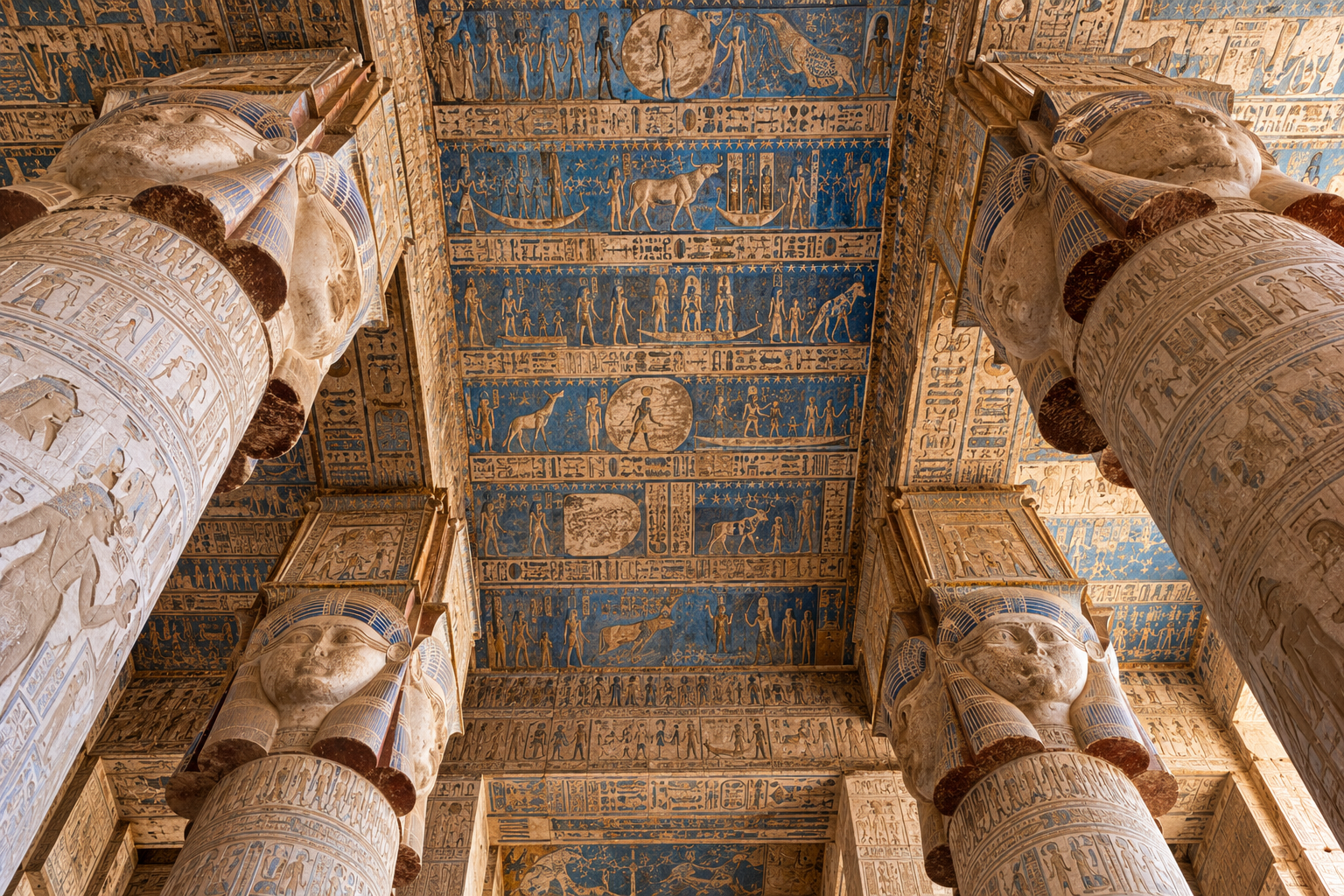

Look up inside the Temple of Hathor at Dendera, and the ceiling seems to open into another world.
Across enormous stone surfaces, celestial figures stretch between rows of columns. Stars, divine beings, astronomical symbols, and carefully arranged inscriptions transform the architecture into an elaborate vision of the Egyptian sky.
The colors are equally striking. Deep blue backgrounds surround figures carved into stone, while surviving painted details reveal an artistic program that required remarkable planning and precision.
But the most interesting question is not simply what these images represent.
How did ancient Egyptian builders and artists create such a complicated astronomical ceiling high above the temple floor?
The answer involves architecture, stoneworking, religious knowledge, painted decoration, and the practical challenges of executing a coordinated design across a monumental building.
It also requires separating what survives at Dendera from what historians can reasonably reconstruct about ancient Egyptian building techniques.
- Location: Dendera, Qena Governorate, Egypt
- Main temple: Temple of Hathor
- Principal surviving construction: Ptolemaic period, with important Roman-period additions and decoration
- Principal deity: Hathor, associated with the sky, music, joy, and motherhood
- Famous feature: Elaborate astronomical ceiling decoration
- Materials: Carved stone surfaces with surviving ancient pigments
- Related artifact: The circular Dendera Zodiac, originally from a rooftop Osiris chapel
- Current location of the original Zodiac: Musée du Louvre, Paris
When Was the Dendera Temple Ceiling Created?
The surviving Temple of Hathor at Dendera belongs principally to Egypt’s Ptolemaic and Roman periods.
This is an important distinction because the temple’s artistic style is unmistakably Egyptian, yet much of the monument was constructed long after the great pyramids and the famous royal tombs of the New Kingdom.
The Ptolemaic dynasty ruled Egypt after the conquest of Alexander the Great. Its rulers continued many Egyptian religious and architectural traditions, including the construction and decoration of temples dedicated to established Egyptian gods.
Dendera became one of the most impressive surviving examples of this tradition.
The temple’s monumental entrance hall, often called the pronaos or great hypostyle hall, is associated with the Roman period. Its astronomical ceiling belongs to the building’s later decorative program, while other astronomical imagery at Dendera comes from different areas and phases of the complex.
Was There an Older Temple at Dendera?
Yes. The religious history of the site extends far beyond the surviving temple building.
The Egyptian Ministry of Tourism and Antiquities notes evidence of earlier structures at Dendera reaching back to the reign of Pepy I in the Old Kingdom.
That long history helps explain why the temple’s religious imagery draws upon traditions developed over many centuries.
However, the presence of an older sanctuary does not mean the astronomical ceiling visible today dates to the Old Kingdom.
The surviving architecture must be studied within its Ptolemaic and Roman historical setting.
Why Was the Ceiling Covered With Astronomy?
The astronomical ceiling at Dendera was not designed simply to decorate an empty architectural surface.
It formed part of a religious environment in which the sky, the gods, time, and the recurring cycles of nature were deeply connected.
Ancient Egyptian religious thought treated the heavens as an active divine realm.
The movements of the sun, moon, and stars were associated with renewal, cosmic order, and the continuing life of the universe.
In a temple dedicated to Hathor, a goddess with important celestial associations, astronomical decoration was especially meaningful.
Was It an Ancient Observatory?
Although Dendera preserves sophisticated astronomical imagery, the decorated ceiling should not automatically be described as an observatory in the modern scientific sense.
The ceiling is part of a temple’s religious and visual program.
Some of its imagery reflects recognizable astronomical knowledge, but that knowledge is presented through divine figures, ritual symbolism, and established artistic conventions.
The distinction matters because ancient Egyptian astronomy was not separated from religion in the same way that modern scientific disciplines are often organized.
At Dendera, celestial observation and religious interpretation appear within the same visual language.
How Was the Stone Ceiling Constructed?
Before artists could carve a single star or divine figure, builders needed to create the architectural surfaces that would support the decoration.
The great hall of Dendera is defined by massive columns supporting an extensive stone ceiling.
Its structural design had to carry the weight of large stone elements while preserving enough uninterrupted surface for the elaborate decorative program.
This required coordinated work between quarrying, transport, stone dressing, and architectural assembly.
How Did Builders Position the Ceiling Blocks?
Egyptian builders had long experience moving and positioning large stone components.
Known ancient construction practices included the use of ramps, sledges, ropes, levers, and temporary supporting arrangements, although the precise combination used at Dendera cannot be established for every stage of construction.
The temple’s stone ceiling would have required the placement of substantial architectural elements above the columns and walls.
The finished surfaces then provided the setting for the astronomical decoration.
It is reasonable to expect that temporary working platforms were needed for high-level construction and decoration.
However, no specific surviving scaffold can be identified as the one used to create Dendera’s astronomical ceiling.
Engineering clarification: General evidence for Egyptian stone construction helps explain how monumental ceilings could be built. It does not prove the exact lifting equipment, scaffolding arrangement, or construction sequence used at Dendera.
Why Was the Architecture Important to the Artwork?
The ceiling’s artistic design depended on the architecture beneath it.
Columns divided the hall into a series of bays, creating distinct overhead surfaces.
Artists had to work within these architectural boundaries while maintaining a coherent visual program.
That required planning at a scale much larger than a single painted panel.
The relationship between structure and decoration is one of the reasons Dendera is such an important example of Egyptian temple design.
How Did Artists Plan the Astronomical Scenes?
Complex temple decoration could not be created successfully through improvisation alone.
The artists needed to arrange divine figures, astronomical symbols, inscriptions, and ornamental bands within predetermined architectural spaces.
Egyptian artistic traditions employed established proportions, compositional conventions, and preliminary drawing techniques.
Such practices made it possible for groups of craftspeople to work on large projects while maintaining stylistic consistency.
Did Artists Draw the Images Before Carving?
Preliminary drawing was a familiar part of Egyptian artistic practice.
Artists could establish outlines and positions before the stone was carved.
At Dendera, the intricate alignment of figures and inscriptions indicates careful organization of the decorative surfaces.
Yet the surviving ceiling does not preserve a complete workshop record explaining every planning stage.
We can describe the broader artistic methods known from Egyptian monuments without claiming to possess a detailed instruction manual for Dendera’s decorators.
How Were Different Scenes Coordinated?
The arrangement of celestial imagery required more than technical drawing ability.
It also depended on knowledge of religious texts and astronomical traditions.
The content of a temple ceiling was not necessarily decided by the stone carvers themselves.
Priestly authorities and specialists familiar with the temple’s ritual program likely played important roles in determining what the decoration should communicate.
Artists then translated those requirements into carefully organized visual compositions.
The surviving result suggests close cooperation between religious planning and skilled craftsmanship.
How Were the Ceiling Reliefs Carved?
The astronomical scenes at Dendera were carved into the stone rather than merely painted onto a smooth surface.
Relief carving created differences in depth that made figures and inscriptions visible through the interaction of light and shadow.
Ancient Egyptian artisans had a long tradition of working stone with metal tools, abrasive materials, and carefully controlled cutting techniques.
By the Ptolemaic and Roman periods, these traditions had developed through centuries of temple construction.
What Was the Likely Working Sequence?
A broadly plausible sequence would begin with preparing the stone surface, establishing the composition, carving the relief, and completing the painted decoration.
But this is a general reconstruction of the artistic process, not a documented day-by-day sequence for Dendera.
Some details may have been adjusted during carving or painting.
The final surface combines the effects of the carved relief and the applied colors.
Understanding both is essential because the painted details often helped distinguish forms that might otherwise be difficult to interpret from below.
Why Was Working Overhead Difficult?
Carving a ceiling introduces challenges that differ from carving a wall.
Workers must reach the underside of the stone while controlling their tools and maintaining accurate proportions.
Large figures must also appear visually coherent when seen from the temple floor.
The surviving reliefs demonstrate that the artists successfully adapted their work to these unusual conditions.
They were creating images intended to be viewed as part of a monumental interior, not as isolated artworks at eye level.
How Were the Colors Applied?
Carving was only one stage in the creation of Dendera’s ceiling.
Painted decoration gave the astronomical scenes much of their visual impact.
Blue backgrounds, contrasting figure colors, and detailed ornamental elements helped transform the stone architecture into a representation of the heavens.
What Pigments Did Egyptian Artists Use?
Egyptian painters used a range of mineral and manufactured pigments.
These included red and yellow ochres, carbon-based black, white mineral pigments, and blue and green colorants.
Egyptian blue, a manufactured copper-based pigment, was an important material in ancient Egyptian painting.
However, the exact pigment composition of a particular area of Dendera’s ceiling must be established through conservation analysis rather than assumed from its visible color.
Different areas of a temple can preserve different materials and painting histories.
Was the Ceiling Painted Directly Onto Stone?
Egyptian temple decoration could involve prepared surfaces and layers of paint applied over carved stone.
The details of surface preparation varied according to the monument and its condition.
At Dendera, surviving pigments demonstrate that painted decoration formed an essential part of the original visual program.
Modern conservation work has also made clear how much of that painted detail had become obscured over time.
What Do the Stars and Celestial Figures Mean?
Dendera’s astronomical decoration brings together several traditions of representing the heavens.
Its images include celestial bodies, divine figures, and symbolic arrangements connected with time and cosmic order.
Some motifs have roots in older Egyptian astronomical traditions, while others reflect the cultural environment of the Ptolemaic and Roman periods.
What Were the Decans?
The decans were groups of stars or star-related divisions used in ancient Egyptian systems of timekeeping and celestial organization.
They had an important history in Egyptian astronomy long before the surviving temple at Dendera was constructed.
In later astronomical representations, decanal traditions could appear alongside other celestial imagery.
Their presence helps demonstrate how Dendera combined established Egyptian knowledge with developments from the wider Mediterranean world.
Did the Egyptians Know the Zodiac?
The twelve-sign zodiac became prominent in Egypt during the Greco-Roman period through cultural exchanges involving Egyptian, Babylonian, and Greek astronomical traditions.
The circular Dendera Zodiac is one of the best-known examples of this combination.
It should not be used as proof that the complete twelve-sign zodiac existed in Egypt in the same form thousands of years earlier.
The monument belongs to a particular historical period and reflects the astronomical knowledge available at that time.
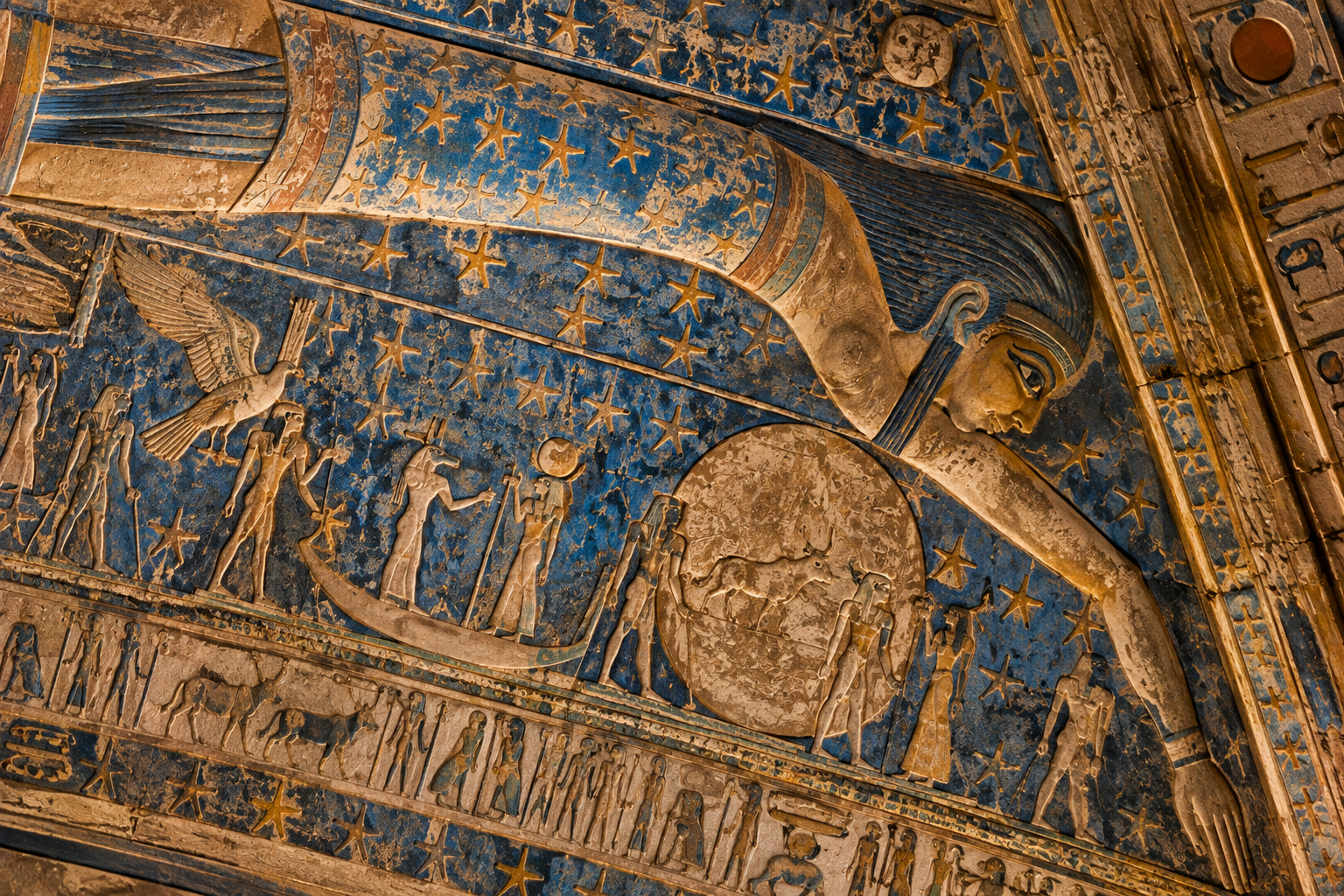
Why Does the Goddess Nut Appear on the Ceiling?
Nut was the ancient Egyptian goddess of the sky.
She was frequently represented as an elongated female figure whose body stretched across the heavens.
In Egyptian religious thought, Nut was associated with the daily movement and renewal of the sun.
The sun could be imagined as entering her body at sunset and emerging again at dawn.
This imagery expressed a recurring cosmic cycle rather than a literal anatomical explanation of astronomical events.
What Did Nut Represent at Dendera?
At Dendera, sky imagery participates in a larger religious vision of the universe.
Nut and other celestial figures connect the temple’s decoration with ideas of divine order, renewal, and the relationship between the earthly and heavenly realms.
The ceiling’s placement above the worshipper reinforces that symbolism.
Looking upward, visitors encountered not an undecorated roof but a visual representation of the divine sky.
The architecture itself became part of the religious experience.
Is the Dendera Zodiac Part of the Same Ceiling?
This is one of the most common sources of confusion about Dendera.
The famous circular Dendera Zodiac and the astronomical decoration of the great hypostyle hall are not the same object.
The circular Zodiac originally occupied part of the ceiling of an Osiris chapel on the temple roof.
It was removed from Egypt in the nineteenth century and is now preserved at the Musée du Louvre in Paris.
The original sandstone relief is cataloged as E 13482.
According to the Louvre, the piece measures approximately 255 by 253 centimeters and dates to around 50 BCE.
What Does the Circular Zodiac Show?
The relief presents a complex celestial composition combining zodiacal signs with Egyptian astronomical and religious imagery.
Its design includes constellations, decanal figures, and divine beings supporting the celestial scene.
It is particularly important because it demonstrates the interaction of Egyptian traditions with the astronomical systems of the wider ancient Mediterranean.
Its circular composition is visually different from the extensive astronomical decoration covering the monumental hall below.
Examine the original circular sandstone relief in the official Louvre collection, or view an academic photographic reconstruction published under a Creative Commons license.
View the Original at the Louvre View the Licensed Academic Image Original artifact: Musée du Louvre, E 13482. Academic orthographic image: Alexander Jones, NYU Faculty Digital Archive, licensed CC BY 4.0. This section links to the original documentation rather than embedding an unverified third-party image URL.Why Is the Difference Important?
Online articles sometimes treat every astronomical image at Dendera as if it were part of the circular Zodiac.
That creates confusion about the monument’s architecture and chronology.
The hypostyle hall contains an extensive program of ceiling decoration integrated with its columns and stone roof.
The circular Zodiac came from a separate rooftop chapel dedicated to Osiris.
Understanding that distinction helps readers interpret each monument in its proper architectural and religious context.
Why Are the Colors So Vivid Today?
Many photographs of Dendera show remarkably bright blues, yellows, reds, and other surviving colors.
These images sometimes lead viewers to assume that the ceiling has been completely repainted in modern times.
That assumption is misleading.
Modern conservation projects have involved cleaning dark deposits from the decorated surfaces and stabilizing surviving ancient pigments.
Over many centuries, soot, dust, and other materials obscured parts of the original decoration.
When conservators removed these deposits under controlled conditions, details that had been difficult to see became more visible.
Were the Ancient Colors Recreated?
Conservation and reconstruction are not the same thing.
Cleaning can reveal surviving pigment without requiring an artist to invent a replacement image.
Consolidation can help stabilize fragile paint layers.
Some conservation interventions may also address losses or damaged surfaces, but the precise treatment of any area should be established from official project documentation.
It would therefore be inaccurate to describe the entire colorful ceiling as a modern repainting.
It would be equally inaccurate to claim that every visible surface remains completely untouched since antiquity.
Conservation insight: The vivid appearance of parts of Dendera’s ceiling reflects both the survival of ancient painted decoration and modern efforts to reveal and protect it.
Why Does Cleaning Matter for Research?
Cleaning does more than improve the appearance of a monument.
Previously obscured details can become easier to photograph, document, and interpret.
Color differences may help distinguish figures, decorative borders, and individual components of a scene.
At the same time, conservation work must protect fragile original materials.
That is why professional treatment requires careful assessment rather than aggressive removal of surface deposits.
What Do We Know About the Building Techniques?
The surviving temple provides strong evidence for the scale and quality of its construction.
Its stone architecture, relief carving, and painted surfaces can be examined directly.
However, the evidence does not answer every practical question about the original building process.
Researchers must distinguish between what the monument demonstrates and what can only be inferred from broader Egyptian construction traditions.
| Question | What the Evidence Supports | What Remains Uncertain |
|---|---|---|
| Was the ceiling carved in stone? | Yes. Relief decoration survives on the stone surfaces. | The precise sequence of carving across every ceiling section. |
| Was the ceiling originally painted? | Yes. Ancient pigments survive in decorated areas. | The complete original appearance and pigment recipe of every scene. |
| Was the design carefully planned? | The coordinated imagery and inscriptions demonstrate organized composition. | The identities and exact responsibilities of individual designers. |
| Were temporary working platforms needed? | Elevated construction and decoration required practical access arrangements. | The precise scaffolding system used at Dendera. |
| Does the ceiling contain astronomical imagery? | Yes. The decoration includes celestial and religious representations. | Some individual symbols and relationships remain subjects of interpretation. |
| Were the colors painted recently? | Surviving ancient colors have been revealed and stabilized through conservation. | The detailed treatment history of every individual surface. |
How Does Dendera Compare With Earlier Egyptian Engineering?
Dendera belongs to a long architectural tradition in which Egyptian builders transformed stone into structures of extraordinary complexity.
Earlier monuments solved different engineering problems.
Old Kingdom pyramid builders, for example, worked with massive volumes of stone and the challenge of creating stable monumental forms.
The builders of Dendera faced the demands of large roofed spaces, intricately carved architectural surfaces, and coordinated religious decoration.
These achievements should not be treated as identical technologies, but they demonstrate the changing ambitions of Egyptian monumental construction.
For another example of how landscape, stone, and architectural design came together in ancient Egypt, explore The Mountain That Became a Pyramid.
Why the Dendera Ceiling Matters
The astronomical ceiling at Dendera is important because it preserves several forms of knowledge within a single architectural setting.
It is evidence of sophisticated stoneworking and painted decoration.
It reveals how Egyptian religious traditions represented the heavens.
It demonstrates the continuation and adaptation of Egyptian artistic conventions during the Ptolemaic and Roman periods.
And it provides a valuable case study in the modern conservation of ancient painted surfaces.
Its significance is not dependent on mysterious lost technologies or unsupported claims about ancient astronomy.
The documented achievement is impressive enough.
Builders created a monumental stone hall, while artists and religious specialists coordinated a complex celestial program across its ceiling.
The result united engineering, artistic skill, and religious thought in one of Egypt’s best-preserved temple complexes.
Frequently Asked Questions
How was the Dendera Temple ceiling made?
The ceiling was created using monumental stone construction, carved relief decoration, and painted details. Its complex astronomical imagery required careful artistic and religious planning.
When was the Dendera astronomical ceiling created?
The surviving Temple of Hathor was principally built and decorated during the Ptolemaic and Roman periods. Different astronomical scenes belong to different parts and phases of the complex.
Who built the Temple of Hathor at Dendera?
The surviving temple was constructed and decorated under Ptolemaic and Roman rulers, drawing upon much older Egyptian religious and architectural traditions.
What is painted on the Dendera Temple ceiling?
The ceiling contains celestial figures, stars, astronomical symbols, divine beings, and religious inscriptions associated with Egyptian concepts of the heavens.
What does the goddess Nut represent?
Nut represents the sky in ancient Egyptian religion and is associated with the movement and renewal of the sun and the cosmic order.
Is the Dendera Zodiac still in Egypt?
The original circular Dendera Zodiac is preserved at the Musée du Louvre in Paris. It originally came from an Osiris chapel on the roof of the Temple of Hathor.
How old is the Dendera Zodiac?
The Louvre dates the original circular sandstone Zodiac to approximately 50 BCE, during the late Ptolemaic period.
Why is the Dendera Temple ceiling blue?
Blue was an important color for representing the heavens in Egyptian religious art. Surviving pigments and modern conservation work help reveal the original painted decoration.
Was the Dendera ceiling repainted during restoration?
Conservation projects have cleaned accumulated deposits and stabilized surviving ancient pigments. The vivid colors visible today should not be assumed to be entirely modern repainting.
Did ancient Egyptians use scaffolding to decorate the ceiling?
High-level decoration required practical access, and temporary platforms were likely involved. However, the exact scaffolding system used at Dendera has not been established from a complete surviving construction record.
Does the Dendera ceiling prove the Egyptians had modern astronomical technology?
No. It demonstrates sophisticated ancient astronomical traditions and religious symbolism, but it does not establish the existence of modern scientific instruments or technologies.
Final Thoughts
The ceiling of Dendera is more than a collection of beautiful astronomical images.
It represents a carefully organized collaboration between architecture, religious knowledge, sculpture, and painting.
Stone builders created the enormous overhead surfaces. Artists transformed those surfaces into detailed reliefs. Painters added color, while the temple’s religious program gave the celestial imagery its meaning.
Centuries later, conservation work has allowed visitors to appreciate details that were once hidden beneath dark deposits.
Some practical questions remain unanswered, particularly about the exact construction sequence and working arrangements used by the ancient craftspeople.
But those uncertainties do not diminish the achievement.
At Dendera, the builders did not merely construct a roof over a sacred space.
They transformed that roof into a vision of the heavens, creating an architectural experience in which the sky itself became part of the temple.
Research Sources
- Egyptian Ministry of Tourism and Antiquities — Temple of Dendera. Official site description, historical background, and architectural features.
- Musée du Louvre — Dendera Zodiac, E 13482. Official collection record, provenance, dimensions, material, and dating.
- Musée du Louvre — The Dendera Zodiac and Its Historical Interpretation. Discussion of astronomical imagery and the history of its interpretation.
- Alexander Jones — Dendera Circular Astronomical Ceiling, NYU Faculty Digital Archive. Academic photogrammetric documentation and orthographic image, CC BY 4.0.
- Science Museum Group — Plaster Cast From the Chapel Ceiling at Dendera. Documentation of the original Zodiac’s architectural context.
