

Estimated reading time: 15 minutes
The Great Pyramid often feels like the beginning of Egypt’s architectural story. It dominates books, documentaries, and travel guides, making it easy to imagine that the ancient Egyptians suddenly mastered pyramid construction. Archaeology tells a very different story. The Great Pyramid was not the first success. It was the result of centuries of experimentation, mistakes, and remarkable engineering progress.
Long before smooth limestone pyramids rose above the desert, Egyptian builders were already solving difficult problems one generation at a time. They experimented with new materials, larger structures, steeper angles, and stronger foundations. Every monument became a lesson that inspired the next. This article follows that extraordinary journey—from humble mastabas to one of humanity’s greatest architectural achievements.
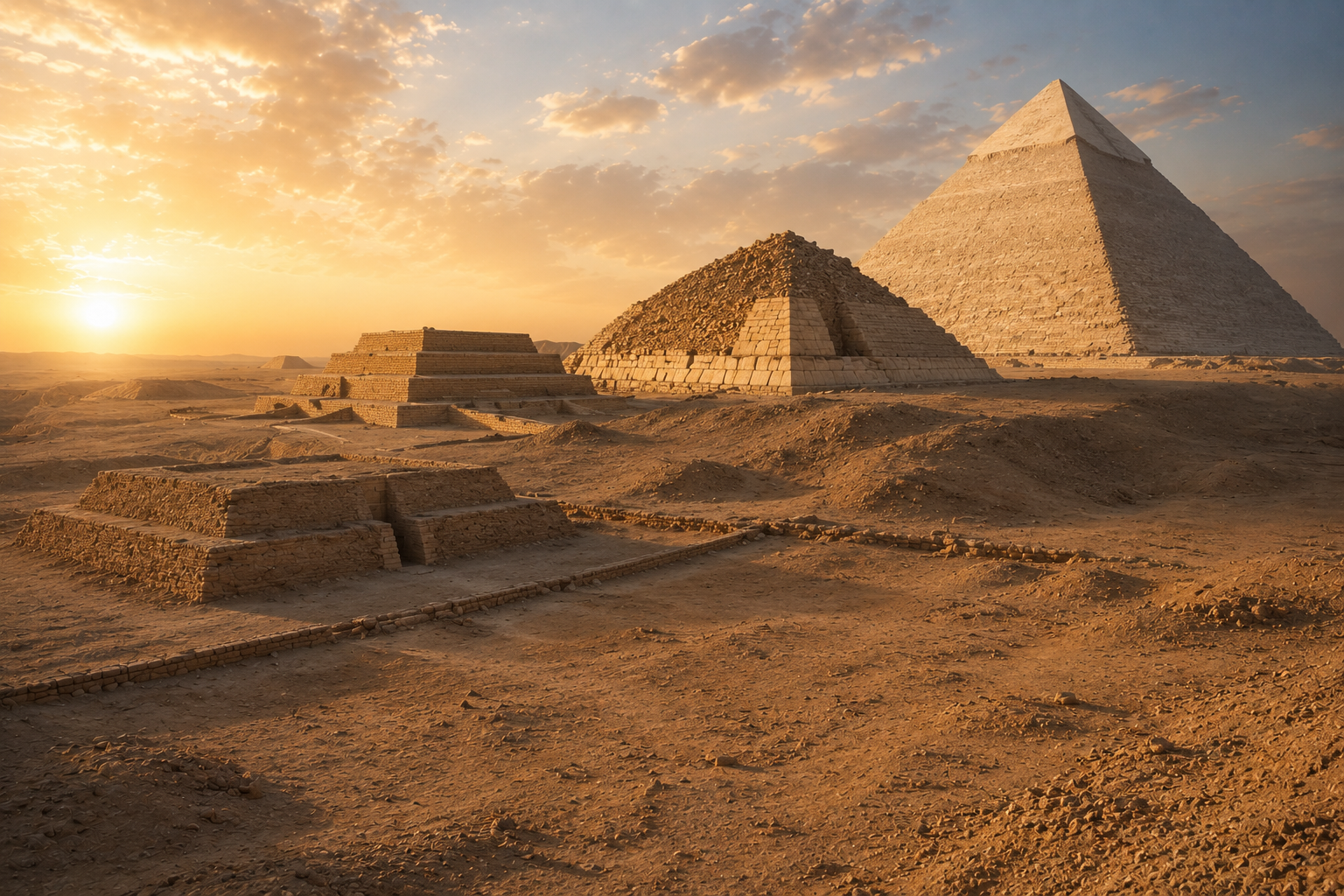
Egyptian pyramids did not appear fully developed. Their design evolved over generations, beginning with rectangular mastabas before progressing through the Step Pyramid, the Bent Pyramid, and finally the first successful true pyramids of the Old Kingdom.
- Before There Were Pyramids
- From Mastaba to Monument
- Djoser’s Architectural Revolution
- Sneferu’s Bold Experiments
- The Pyramid That Changed Direction
- The First True Pyramid
- The Great Pyramid Was Not the Beginning
- Why Pyramid Building Changed
- What Archaeologists Continue to Learn
- Final Thoughts
Before There Were Pyramids
For much of Egypt’s earliest history, pyramids simply did not exist. Kings and elite officials were buried beneath rectangular tombs known today as mastabas. Built from mud brick and later stone, these flat-topped structures protected underground burial chambers while providing a place where offerings could be made to the deceased.
Although simple in appearance, mastabas introduced ideas that would shape Egyptian architecture for centuries. Builders learned how to prepare foundations, organize underground chambers, move heavy materials, and create monuments that expressed permanence. These early tombs became the starting point for one of history’s greatest engineering journeys.
What makes this evolution remarkable is that it happened gradually. There was no single moment when someone invented the pyramid. Instead, each generation inherited the knowledge of the previous one and searched for ways to build something larger, stronger, and more enduring.
From Mastaba to Monument
The breakthrough came during Egypt’s Third Dynasty. Rather than constructing a single mastaba, architects began stacking smaller mastabas on top of one another, creating a monument unlike anything the ancient world had seen before. Instead of spreading across the landscape, the tomb now reached toward the sky.
This was far more than an aesthetic change. Building upward introduced entirely new engineering challenges. Greater height meant greater weight, stronger foundations, and more careful planning. Every additional layer demanded confidence in both design and construction.
The shift also reflected changing royal ambitions. Kings no longer wanted monuments that blended into the desert. They wanted structures visible from great distances, proclaiming both power and permanence.
Djoser’s Architectural Revolution
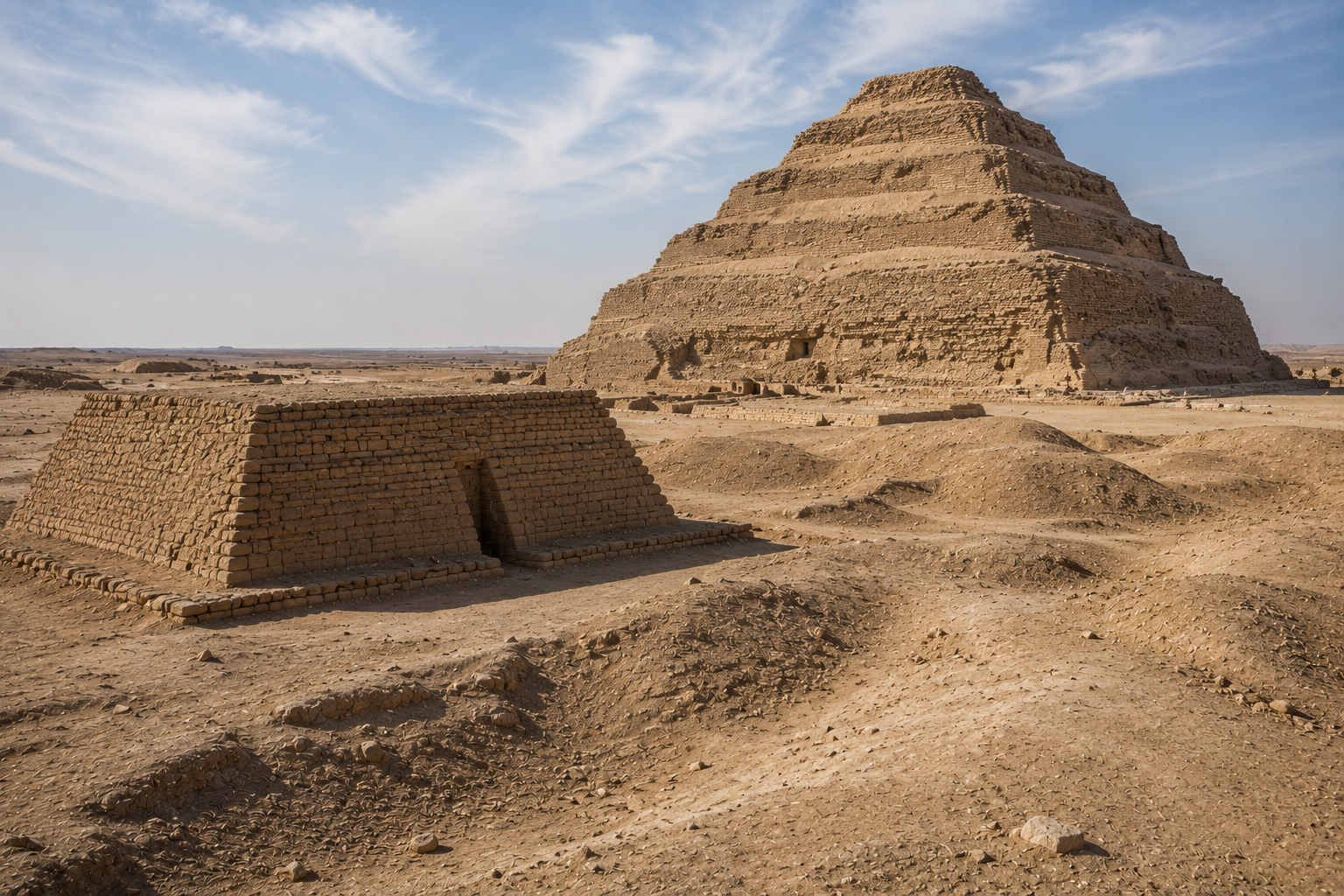
The clearest expression of this new vision appeared at Saqqara during the reign of King Djoser. His monument, now known as the Step Pyramid, became the first large-scale stone building in history and the first pyramid ever constructed.
Designed under the direction of the brilliant architect Imhotep, the monument represented far more than stacked stone. It demonstrated that monumental architecture could evolve beyond earlier traditions while still respecting them. Instead of abandoning the mastaba, Egyptian builders transformed it into something completely new.
The Step Pyramid was not yet a smooth-sided pyramid like those at Giza. Its distinct terraces reveal the gradual nature of Egyptian innovation. Rather than jumping directly to perfection, the builders experimented with ideas that future generations would continue refining.
Standing before the Step Pyramid today, it becomes clear that Egypt’s architectural story is not about one miraculous achievement. It is about continuous improvement. Every stone laid at Saqqara became part of an experiment that would eventually lead to the smooth pyramids we know today.
The next ruler to inherit this legacy would push Egyptian engineering even further. Under King Sneferu, builders would attempt something far more ambitious—a true smooth-sided pyramid. Their first attempt, however, would leave behind one of the most fascinating monuments in archaeological history.
Sneferu’s Bold Experiments
When King Sneferu came to the throne, Egyptian builders already knew how to construct monumental stone structures. What they had not yet mastered was the true smooth-sided pyramid. Sneferu’s reign became one of history’s greatest periods of architectural experimentation, with engineers testing new techniques on a scale never attempted before.
Rather than repeating earlier designs, Sneferu’s builders sought to eliminate the stepped appearance that characterized Djoser’s monument. Their goal was ambitious: create a pyramid with continuous, smooth faces rising toward a single point. Achieving that vision required solving engineering problems that no one had encountered before.
These experiments demonstrate something often overlooked about ancient Egypt. Innovation did not happen through sudden inspiration. It emerged through careful observation, practical experience, and the willingness to learn from failure. Every construction project became a lesson for the next one.
The Pyramid That Changed Direction
One of those lessons still stands in the Egyptian desert today. Modern visitors immediately notice that the Bent Pyramid looks unusual because its angle changes roughly halfway to the summit. This distinctive appearance has fascinated archaeologists for generations.
Most researchers believe the builders reduced the pyramid’s slope during construction after recognizing structural concerns associated with the original, steeper angle. By decreasing the incline, they reduced pressure on the monument and greatly improved its long-term stability. Although the precise sequence of decisions is still debated, the change is widely understood as evidence of engineering adaptation rather than symbolic design.
Instead of hiding the problem, the Bent Pyramid preserves the decision itself. It offers a rare opportunity to observe ancient architects responding to real construction challenges while work was still underway. Few monuments anywhere in the world document an engineering correction so clearly.
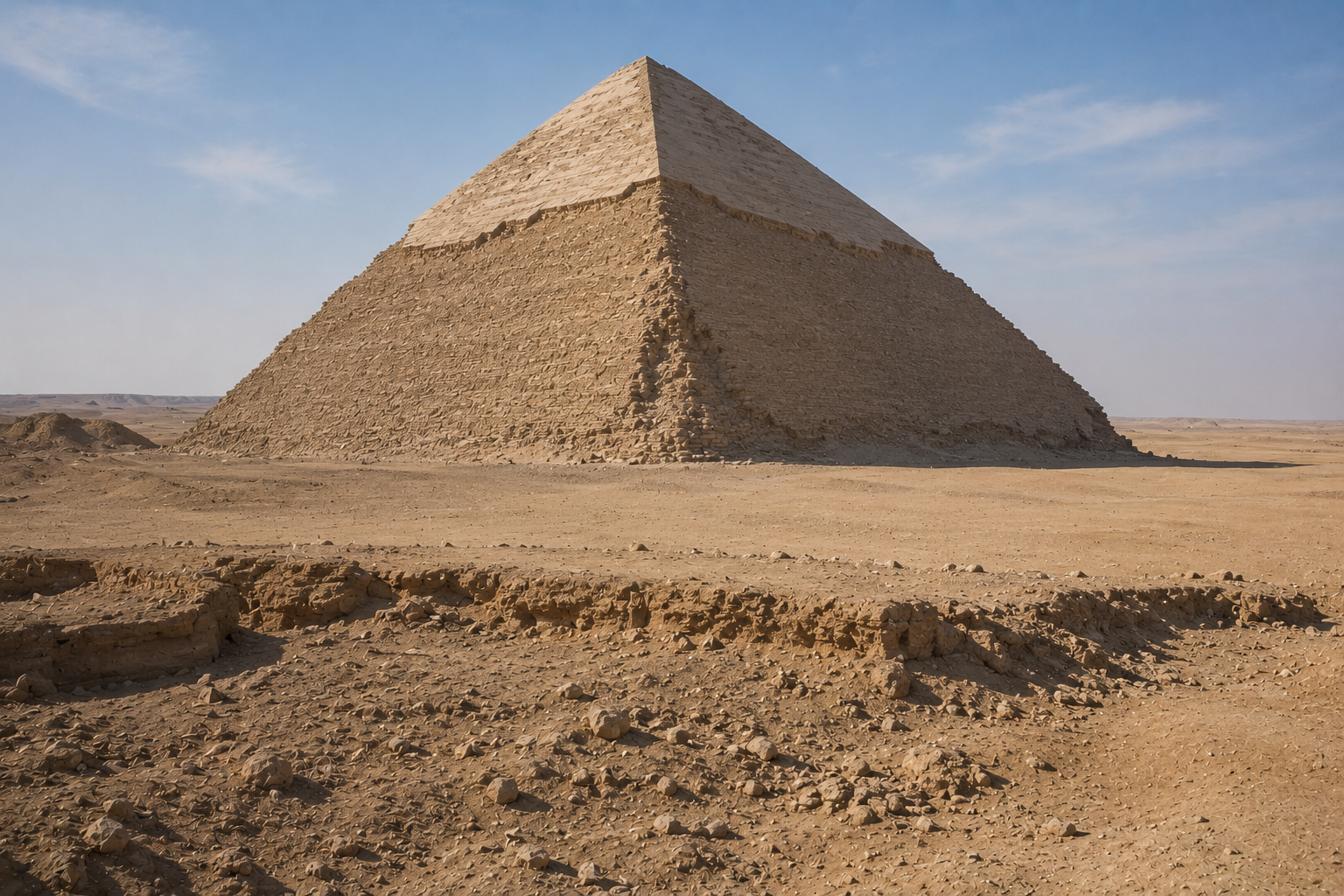
Far from being a failed monument, the Bent Pyramid represents one of archaeology’s most valuable engineering documents. Without it, historians would understand far less about how Egyptian architects refined their techniques through experience.
The Bent Pyramid reminds us that ancient Egyptian engineers were practical problem-solvers. Rather than abandoning a difficult project, they modified their design while construction continued—an extraordinary achievement nearly 4,600 years ago.
The First True Pyramid
The lessons learned during Sneferu’s earlier projects led directly to another remarkable achievement: the Red Pyramid. Unlike its unusual predecessor, this monument was completed with smooth, consistent sides from base to summit and is generally regarded as the earliest successfully completed true pyramid.
Its appearance may seem less dramatic than the pyramids at Giza, yet its historical importance cannot be overstated. The Red Pyramid proved that Egyptian builders had finally solved the major engineering challenges involved in constructing a true pyramid at monumental scale.
The techniques perfected here created the foundation for everything that followed. The Great Pyramid did not appear from nowhere—it inherited generations of accumulated knowledge.
The Great Pyramid Was Not the Beginning
The Great Pyramid of Khufu is often treated as the starting point of pyramid history because it survives as the largest and most famous example. In reality, it represents the culmination of nearly a century of architectural progress.
By the time work began at Giza, Egyptian engineers already understood quarrying, transportation, foundation preparation, stone placement, internal planning, and structural stability far better than they had during the age of Djoser. Every earlier monument had contributed knowledge to the next generation.
Seen from this perspective, the Great Pyramid becomes even more impressive. It was not an isolated miracle. It was the product of continuous innovation supported by skilled architects, experienced craftsmen, and thousands of workers whose expertise had matured over decades.
Communities like those discussed in The Village Behind the Tombs remind us that Egypt’s greatest monuments depended on organized, highly trained workforces rather than mysterious lost technologies.
Why Pyramid Building Changed
The age of giant pyramids did not last forever. During later periods, royal burial practices gradually evolved, and rulers increasingly chose different forms of tomb architecture. Security became a growing concern, while changing political, economic, and religious circumstances influenced how kings prepared for the afterlife.
This shift did not diminish the importance of the pyramids already standing across the landscape. Instead, those monuments became lasting symbols of an extraordinary period when Egyptian engineering reached new levels of ambition and confidence.
| Monument | Innovation | Historical Importance |
|---|---|---|
| Mastaba | Underground burial beneath a rectangular superstructure | Foundation of later royal tomb architecture |
| Step Pyramid | Stacked stone mastabas | First pyramid and first monumental stone complex |
| Bent Pyramid | Mid-construction change of slope | Evidence of engineering adaptation |
| Red Pyramid | Successful smooth-sided design | Earliest completed true pyramid |
| Great Pyramid | Refinement of earlier innovations | Peak achievement of Old Kingdom pyramid building |
What Archaeologists Continue to Learn
Modern archaeology continues to reveal new information about pyramid construction through excavation, architectural analysis, remote sensing, material studies, and careful examination of quarry marks and construction techniques. Rather than searching for mythical explanations, researchers increasingly understand the pyramids as the result of remarkable human organization and accumulated engineering knowledge.
Every newly studied block, unfinished quarry, workers’ settlement, and construction trace adds another piece to the story. The evolution of the pyramid remains one of archaeology’s clearest demonstrations that great achievements often emerge through gradual improvement rather than sudden invention.
The story of the Egyptian pyramid is not the story of a single monument. It is the story of an idea that evolved over generations. Beginning with simple mastabas, transformed through Djoser’s revolutionary Step Pyramid, refined by Sneferu’s bold experiments, and perfected in the great pyramids of the Fourth Dynasty, each stage built upon the lessons of the one before it. Seen this way, the Great Pyramid becomes even more extraordinary. It was never the beginning of Egypt’s architectural genius—it was its reward.
Frequently Asked Questions
What was the first pyramid in Egypt?
The Step Pyramid of King Djoser at Saqqara is widely recognized as Egypt’s first pyramid and the earliest monumental stone building of its kind.
Why is the Bent Pyramid bent?
Most Egyptologists believe its angle was reduced during construction to improve structural stability after concerns arose about the original, steeper design.
Which was the first true pyramid?
The Red Pyramid, built during the reign of Sneferu, is generally regarded as the first successfully completed true smooth-sided pyramid.
Did the Great Pyramid come first?
No. Several important monuments—including mastabas, the Step Pyramid, the Bent Pyramid, and the Red Pyramid—were built before the Great Pyramid at Giza.
Why did Egyptians stop building pyramids?
Royal burial traditions gradually changed over time due to evolving religious beliefs, security concerns, political developments, and economic priorities.
How do archaeologists study pyramid construction today?
Researchers combine excavation, architectural analysis, quarry studies, material science, remote sensing, and evidence from workers’ settlements to better understand how pyramids were designed and built.