
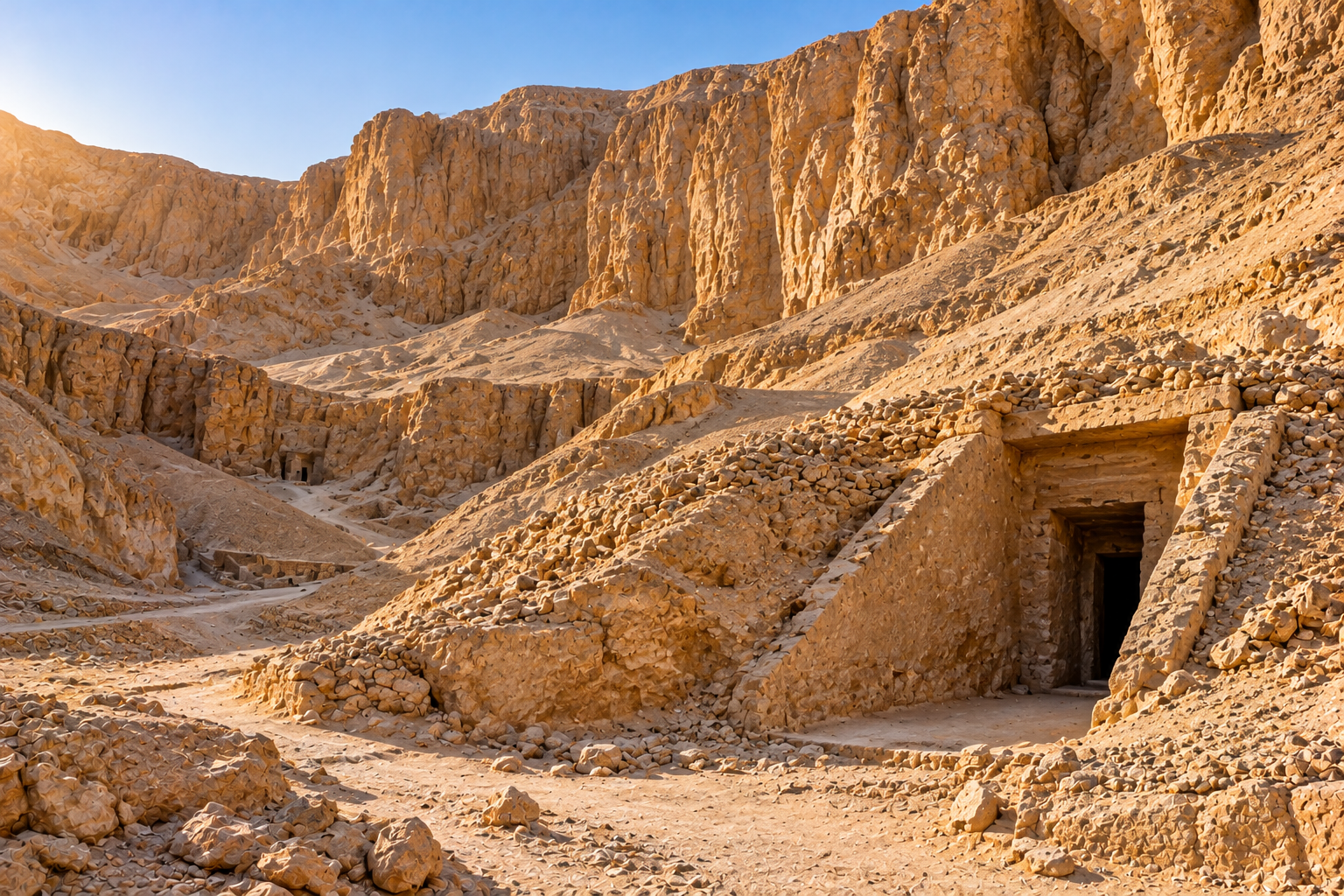

In 1995, archaeologists working in Egypt’s Valley of the Kings realized that a tomb entrance known for more than a century concealed something extraordinary.
Behind it lay a network of passages and chambers extending deep into the limestone hillside. The tomb was not simply larger than expected. Its layout was unlike that of the familiar royal tombs nearby.
Today, KV5 is recognized as the largest known tomb complex in the Valley of the Kings, with more than 150 corridors and chambers reported in archaeological publications.
Its connection to the sons of Ramesses II raises an unusual question.
Why would one royal family need so many underground rooms?
The answer involves royal succession, burial traditions, architectural planning, and a series of discoveries that transformed a largely overlooked entrance into one of the valley’s most remarkable archaeological sites.
But there is an important complication: although archaeologists understand the tomb’s general purpose, they cannot yet explain the function of every chamber or identify every person originally buried inside.
- Location: East Valley of the Kings, Luxor, Egypt
- Tomb designation: KV5, also written KV 5
- Royal association: Sons of Ramesses II
- Dynasty: Nineteenth Dynasty, New Kingdom
- Known for: An extensive network of underground chambers and corridors
- Major modern breakthrough: 1995, during work by the Theban Mapping Project
- Principal archaeologist: Kent R. Weeks
- Reported scale: More than 150 corridors and chambers in published accounts
- Central question: How was the complex used and expanded for members of the royal family?
The Tomb That Was Known but Not Understood
The story of KV5 is often described as a dramatic discovery in 1995.
That description captures the excitement of the event, but it leaves out an important part of the history.
The entrance to KV5 had already been investigated in the nineteenth century.
British explorer James Burton examined the tomb in the 1820s and recorded parts of its accessible interior. However, extensive accumulations of debris prevented explorers from recognizing the scale of the complex.
What appeared to be a relatively limited tomb was, in fact, the beginning of a much larger underground system.
What Changed in 1995?
Under the direction of Kent Weeks, the Theban Mapping Project undertook systematic work at KV5.
The team had been investigating the tomb and its condition before the full extent of the complex became clear.
As accumulated material was removed, archaeologists encountered passages leading toward additional rooms.
Those passages opened into further corridors and chambers.
The expanding layout demonstrated that KV5 was not an ordinary royal tomb with a straightforward sequence of rooms.
It was an extensive burial complex associated with members of the family of Ramesses II.
Why the distinction matters: KV5 was not an entirely unknown tomb suddenly discovered in 1995. The breakthrough was the recognition and exploration of its extraordinary extent.
Where Is KV5 Located?
KV5 lies in the main eastern branch of the Valley of the Kings, on the west bank of the Nile near modern Luxor.
Its entrance is situated in a landscape containing some of the most famous royal tombs of the New Kingdom.
The location is significant because the valley was primarily associated with royal burials, including those of pharaohs.
KV5, however, appears to have served several royal sons rather than a single reigning king.
This makes it an important example of how the burial landscape could accommodate members of the royal family beyond the pharaoh himself.
The tomb’s location also created practical problems for its preservation.
Its relatively low position made it vulnerable to debris carried through the valley during episodes of heavy rainfall and flash flooding.
Over time, sediment and rubble accumulated inside the tomb, concealing passages and damaging some of the ancient surfaces.
How Many Chambers Does KV5 Have?
Published descriptions of KV5 commonly refer to more than 150 corridors and chambers.
That number is striking, but it needs to be understood carefully.
Archaeological accounts have reported different totals at different stages of excavation and mapping.
Some figures count rooms and corridors together, while others focus on individual chambers.
As exploration progressed, the known extent of the tomb changed.
The most useful conclusion is not that KV5 contains one permanently established number of rooms, but that its documented scale is exceptional within the Valley of the Kings.
Does KV5 Really Have 200 Rooms?
Figures approaching or exceeding 200 have appeared in discussions of the tomb’s possible ultimate extent.
However, an estimate of what might remain undiscovered is not the same as a confirmed archaeological count.
For this reason, describing KV5 as a complex with more than 150 documented corridors and chambers is more responsible than presenting 200 as an established total.
Even without speculative additions, the tomb is an extraordinary achievement of underground excavation.
Why Did Ramesses II’s Sons Need So Many Chambers?
The leading interpretation is that KV5 functioned as a family burial complex for several sons of Ramesses II.
Ramesses II ruled Egypt for an exceptionally long period during the Nineteenth Dynasty and had a large royal family.
Several of his sons died during his lifetime.
Because the king outlived many of his children, the royal household faced the problem of providing appropriate funerary arrangements for princes who would never become pharaoh.
KV5 appears to have offered a burial setting within the prestigious Valley of the Kings.
Its numerous chambers and passages could accommodate multiple funerary spaces and associated ritual functions.
Yet that explanation should not be reduced to a simple formula of one prince per chamber.
Did Every Son Receive a Separate Room?
There is no secure evidence that every chamber corresponded to a different son.
Ancient Egyptian tombs contained spaces used for purposes beyond the placement of a body.
Rooms could be associated with funerary equipment, offerings, ritual activities, access routes, or architectural arrangements.
KV5 also contains spaces that differ considerably in size and configuration.
Some form part of corridors and side-chamber sequences, while others belong to larger architectural groups.
The tomb’s complexity therefore reflects more than the number of people who may have been buried there.
Important distinction: The association of KV5 with sons of Ramesses II is supported by archaeological evidence. The exact number of princes buried there, and the original purpose of every chamber, remain less certain.
Was the Tomb a Symbol of Royal Status?
The decision to create an extensive burial complex for royal princes also had a symbolic dimension.
Burial in the Valley of the Kings connected the deceased to a landscape closely associated with royal funerary traditions.
The scale of KV5 may reflect the importance of the princes within the royal family and the resources available to the court.
However, archaeologists must distinguish the tomb’s visible scale from assumptions about the intentions of its builders.
Without a complete ancient construction record, the full reasoning behind every architectural decision cannot be reconstructed with certainty.
Which Sons of Ramesses II Were Associated With KV5?
One of the strongest reasons for identifying KV5 as a burial complex for royal princes comes from inscriptions and archaeological material connected to sons of Ramesses II.
Names associated with the tomb include Amun-her-khepeshef, Ramesses, Sety, and Meryatum.
These individuals belonged to the king’s large family, although their positions and life histories differed.
The evidence linking individual princes to KV5 is not identical in every case.
Some identifications depend on inscriptions, while others involve objects or fragments recovered during archaeological investigation.
Who Was Amun-her-khepeshef?
Amun-her-khepeshef was one of the prominent sons of Ramesses II and held an important position in the royal family.
He is among the princes associated with KV5 through its surviving evidence.
His connection is particularly important because it shows that the tomb was not merely a general storage complex or an anonymous burial place.
It had identifiable associations with members of the royal household.
Can Archaeologists Identify Every Burial?
No.
KV5 suffered disturbance, robbery, flooding, and damage over a long period.
These processes affected both the contents of the tomb and the context in which objects were originally deposited.
When material has been displaced or damaged, identifying an individual burial becomes much more difficult.
A name appearing in the tomb is important evidence, but it does not automatically establish the precise location of that person’s remains.
How Was KV5 Designed?
KV5 is remarkable not only because of its size, but because of the way its spaces connect.
The tomb contains major halls, long corridors, side chambers, and areas extending in different directions.
Its plan is far more complex than the relatively simple layout of many other tombs in the valley.
The Sixteen-Pillared Hall
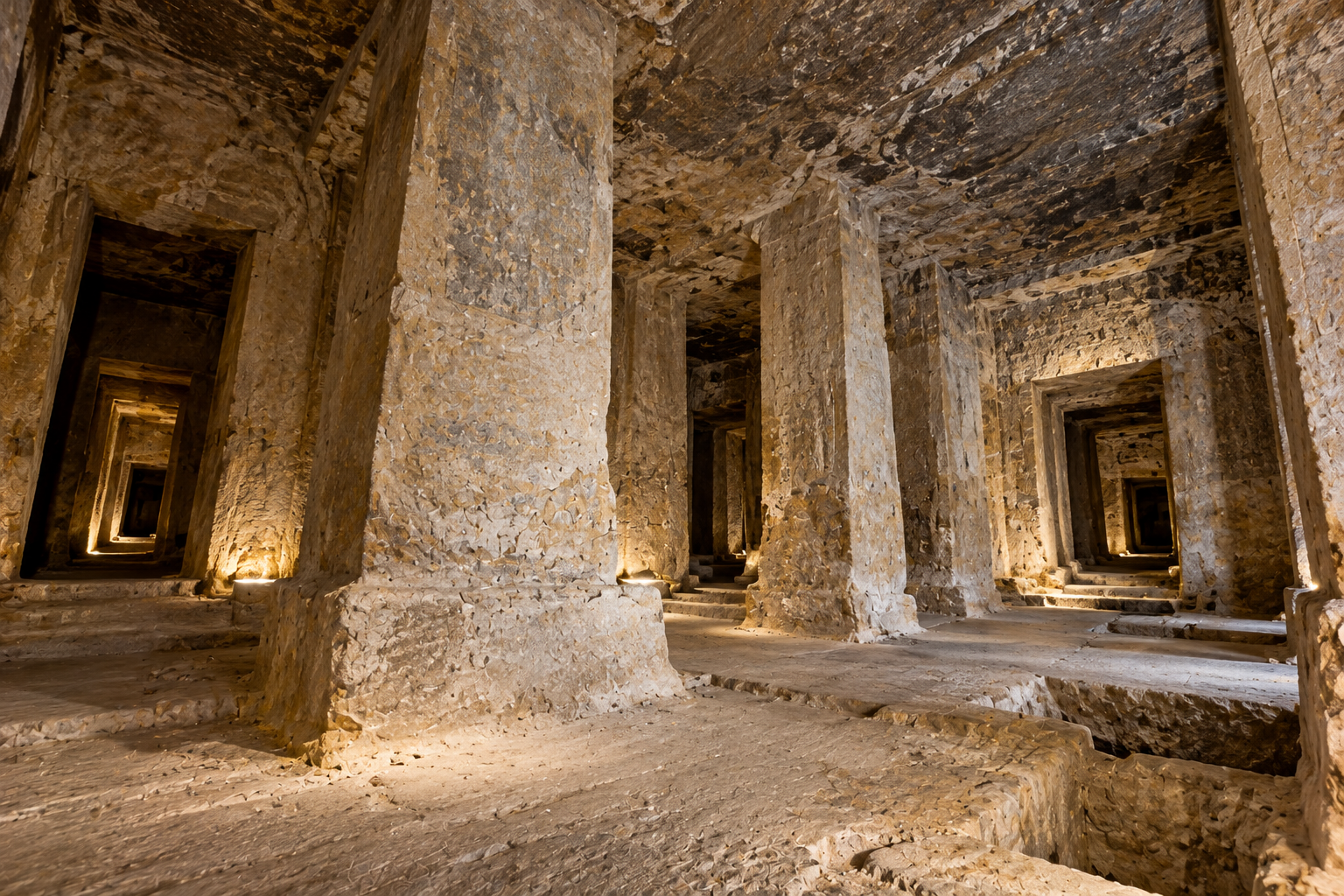
One of KV5’s most impressive architectural features is Chamber 3, a large hall supported by sixteen pillars.
The hall occupies a central position in the known complex.
Its size and structural arrangement distinguish it from the more confined spaces found elsewhere in the tomb.
Beyond this major hall, the plan becomes increasingly elaborate.
Passages lead toward groups of chambers arranged along different axes.
Some parts of the complex extend beneath other areas of the surrounding landscape.
The result is an underground layout that cannot be fully understood from a single photograph.
What Does the Original Archaeological Plan Show?
The official plan produced by the Theban Mapping Project is one of the best ways to appreciate the complexity of KV5.
It shows the relationship between the main halls, corridors, side rooms, and lower-level spaces.
Unlike an artistic reconstruction, an archaeological plan documents the measured arrangement of the excavated features.
View the archaeological floor plan prepared by the Theban Mapping Project, showing the extensive network of rooms and corridors.
View the Original KV5 Plan (PDF) Source: Theban Mapping Project. The linked plan is an original archaeological document, not an AI-generated reconstruction. Reproduction rights remain with the source.The plan also helps explain why counting rooms alone provides an incomplete picture of the tomb.
KV5 contains different types of spaces, and their relationships may be as important as their individual dimensions.
Was KV5 Built All at Once?
This is one of the most interesting unresolved questions about the tomb.
The enormous scale of KV5 raises questions about how its builders planned and executed the work.
Was the entire complex conceived as a single architectural project?
Or did the builders extend an existing tomb as additional burial requirements emerged?
Some archaeological interpretations have suggested that an earlier tomb may have been adapted or expanded for use by Ramesses II’s family.
The possibility of multiple construction phases is important because it could explain differences between parts of the complex.
What Would Archaeologists Look For?
Researchers examine several categories of evidence when investigating construction phases.
Changes in corridor alignment, differences in excavation techniques, architectural joins, decoration, and the relationship between rooms can all provide clues.
However, not every change in direction proves that a new phase of construction occurred.
Ancient builders could deliberately design complex routes within a single project.
That is why interpretations must be based on the combined architectural and archaeological evidence rather than the appearance of the plan alone.
Why Does Ramesses II’s Long Reign Matter?
Ramesses II ruled for approximately sixty-six years.
Such a long reign meant that several generations of his family could experience major changes during his lifetime.
Some princes died before their father, while others rose in the succession as older brothers died.
This unusual royal family history makes the question of KV5’s construction and use especially significant.
Yet the king’s long reign does not, by itself, prove exactly when each part of the tomb was excavated.
What Did Archaeologists Find Inside KV5?
KV5 did not yield a collection of intact royal treasures comparable to the famous discoveries in Tutankhamun’s tomb.
Its contents had been heavily disturbed.
Nevertheless, excavations produced important archaeological evidence.
Finds and surviving features include inscriptions, fragments of funerary equipment, pottery, architectural remains, and human remains.
Each category contributes to the interpretation of the complex.
Why Are Inscriptions So Important?
Inscriptions can connect an otherwise anonymous architectural space with identifiable historical individuals.
At KV5, evidence naming royal princes is fundamental to understanding the tomb’s association with the family of Ramesses II.
Decorative and religious features also provide clues about the funerary purpose of particular spaces.
However, damaged inscriptions can be difficult to read, and fragmentary evidence requires cautious interpretation.
What About the Osiris Figure?
KV5 includes a rock-cut representation of Osiris, the Egyptian god closely associated with death, regeneration, and the afterlife.
Its presence reinforces the funerary and religious character of the complex.
Osiris imagery was deeply meaningful in Egyptian burial traditions.
It should not be interpreted as evidence of a hidden temple or a secret cult without additional archaeological support.
Were Human Remains Found?
Human remains have been reported from the complex, but their presence does not resolve the identities of all the original occupants.
Robbery and the movement of debris complicated the archaeological context.
Even when human remains survive, linking them securely to a particular named prince can be difficult.
The tomb therefore preserves evidence of burial activity without providing a complete list of confirmed individual interments.
Why Did KV5 Disappear Beneath Debris?
KV5’s disappearance from modern understanding was largely a consequence of its physical condition.
The Valley of the Kings is a desert environment, but it can experience intense rainfall.
When storms occur, water can move rapidly through the surrounding valleys and carry sediment and stone debris.
Low-lying tomb entrances and passages are particularly vulnerable.
KV5 accumulated large quantities of material over time.
This debris obstructed access and concealed the extent of the underground complex.
Did Ancient Tomb Robbers Enter KV5?
Evidence indicates that KV5 was disturbed in antiquity.
Robbery affected the original contents and contributed to the difficulty of interpreting the surviving material.
But robbery was not the only destructive force.
Flooding, sediment accumulation, and the deterioration of rock surfaces also affected the tomb.
These different processes can overlap, making it difficult to reconstruct the precise sequence of damage in every chamber.
Why Is Conservation Difficult?
Excavating a large rock-cut tomb is not simply a matter of removing debris.
Archaeologists must also consider the stability of the surrounding limestone, the condition of pillars and ceilings, and the preservation of fragile decorated surfaces.
Scientific studies of KV5 have examined geological conditions and structural risks.
The engineering challenges are significant because the tomb extends through a large underground volume with interconnected spaces.
Preserving the complex requires understanding both its ancient architecture and the natural forces that have affected it since construction.
How Does KV5 Compare With Tutankhamun’s Tomb?
KV5 and Tutankhamun’s tomb, KV62, are both located in the Valley of the Kings, but they tell very different archaeological stories.
KV62 is famous for the extraordinary survival of its funerary equipment when Howard Carter entered the tomb in 1922.
KV5 is famous primarily for its enormous architecture and its association with several royal princes.
| Feature | KV5 | KV62 |
|---|---|---|
| Principal association | Sons of Ramesses II | Tutankhamun |
| Dynasty | Nineteenth Dynasty | Eighteenth Dynasty |
| Layout | Extensive network of chambers and corridors | Relatively compact tomb |
| Major modern breakthrough | Recognition of its scale in 1995 | Discovery of the tomb in 1922 |
| Preservation of contents | Heavily disturbed and damaged | Large quantities of funerary equipment survived |
| Main archaeological importance | Royal family burials and complex tomb architecture | Royal funerary objects and burial practices |
The comparison reveals why archaeological significance cannot be measured by the quantity of gold recovered.
KV5 contributes to our understanding of royal family burial practices and the engineering of large underground tomb complexes.
KV62 provides unusually rich evidence of royal funerary equipment.
Both are important, but for different reasons.
The broader story of Deir el-Medina and the royal tomb builders adds another perspective by examining the specialized workers who helped create the monuments of the Theban necropolis.
What Is Still Unknown About KV5?
Despite decades of research, several questions remain unresolved.
Archaeologists continue to distinguish between the parts of the tomb that have been documented and interpretations that remain provisional.
Three uncertainties are particularly important.
1. How Many Princes Were Actually Buried There?
KV5 is associated with several sons of Ramesses II, but the exact number of original burials is not securely established.
The existence of numerous chambers does not provide a reliable count of individuals.
2. Was the Entire Complex Planned From the Beginning?
The relationship between different architectural sections raises questions about construction phases.
Determining whether the tomb was progressively expanded requires detailed study of its structure, decoration, and archaeological context.
3. What Was the Function of Every Chamber?
Some rooms may have served burial-related purposes, while others may have accommodated equipment or ritual activities.
Not every space has yielded enough evidence for a definitive interpretation.
KV5 was an extraordinary royal funerary complex associated with sons of Ramesses II. Its enormous scale is documented, but the precise use of every chamber and the identities of all its occupants cannot yet be established.
Evidence and Interpretation: What Can We Say With Confidence?
| Claim | Assessment | Explanation |
|---|---|---|
| KV5 is associated with sons of Ramesses II. | Well supported | Inscriptions and archaeological evidence connect the complex with members of the royal family. |
| The tomb contains more than 150 corridors and chambers. | Published archaeological description | Major publications report this scale, although counts have varied with exploration and classification. |
| Every chamber belonged to a different prince. | Not established | The function of each room cannot be determined from the number of rooms alone. |
| KV5 was completely unknown until 1995. | Incorrect | Its entrance and initial chambers had been explored in the nineteenth century. |
| All of KV5 was constructed in a single phase. | Unresolved | The construction history remains a subject of architectural interpretation. |
| KV5 contained intact golden treasures when rediscovered. | Unsupported | The complex had been heavily disturbed and damaged. |
Frequently Asked Questions About KV5
What is KV5 in the Valley of the Kings?
KV5 is a large underground tomb complex in Egypt’s Valley of the Kings, associated with several sons of the pharaoh Ramesses II.
Why is KV5 so large?
Its size is generally explained by its use as a royal family burial complex. However, the function of every chamber and the complete construction history are not fully understood.
How many rooms are in KV5?
Published archaeological accounts describe more than 150 corridors and chambers. The exact reported count has varied as the complex has been investigated.
Who discovered KV5?
Its entrance was known to nineteenth-century explorers, including James Burton. Kent Weeks and the Theban Mapping Project revealed its extraordinary extent during investigations culminating in the 1995 breakthrough.
Who was buried in KV5?
The tomb is associated with several sons of Ramesses II. Archaeological evidence identifies connections with individual princes, but a complete list of confirmed burials is not available.
Was Ramesses II buried in KV5?
No. Ramesses II had his own royal tomb, KV7, in the Valley of the Kings. KV5 is associated with his sons.
Is KV5 larger than Tutankhamun’s tomb?
Yes. KV5 is vastly more extensive architecturally than KV62, the comparatively small tomb of Tutankhamun.
Did archaeologists find treasure in KV5?
Excavations recovered important archaeological material, but the tomb had been extensively disturbed. It did not yield an intact treasure assemblage comparable to Tutankhamun’s burial.
Is KV5 open to tourists?
KV5 has generally been treated as an archaeological and conservation site rather than a regular tourist tomb. Visitors should consult the official Egyptian antiquities authorities for current access arrangements.
What is the most important discovery at KV5?
The recognition of its enormous interconnected layout transformed the understanding of royal family burial practices in the Valley of the Kings.
Final Thoughts
The mystery of KV5 is not simply that it contains an astonishing number of rooms.
It is that the tomb’s architecture raises questions about how Ramesses II’s family prepared for death across one of the longest reigns in Egyptian history.
Its corridors and chambers suggest an ambitious funerary project, but the surviving evidence does not permit every architectural feature to be matched with a particular prince or ritual purpose.
That uncertainty is part of what makes KV5 important.
It demonstrates how much information can remain hidden even at a site that has been known to explorers for generations.
In 1995, the breakthrough was not the discovery of a forgotten golden treasure.
It was the realization that a familiar entrance led into an extraordinary underground complex whose true scale had escaped earlier investigation.
Today, KV5 stands as a reminder that the Valley of the Kings still has more to reveal—not necessarily through spectacular objects, but through the careful study of architecture, inscriptions, human remains, and the difficult work of archaeological preservation.
Research Sources
- Theban Mapping Project — KV5: Sons of Ramesses II. Tomb documentation, architectural information, and research resources.
- Theban Mapping Project — Original KV5 Archaeological Plan. Detailed floor plan showing corridors, chambers, and structural features.
- Kent R. Weeks — KV5: A Preliminary Report on the Excavation of the Tomb of the Sons of Rameses II in the Valley of the Kings. American University in Cairo Press, 2000.
- Hemeda, S. — Engineering Failure Analysis and Design of Support System for Ancient Egyptian Monuments in Valley of the Kings, Luxor, Egypt. Geoenvironmental Disasters, 2018. Geological and structural analysis of KV5.
- Theban Mapping Project — Official Website. Maps and archaeological documentation of the Theban necropolis.
