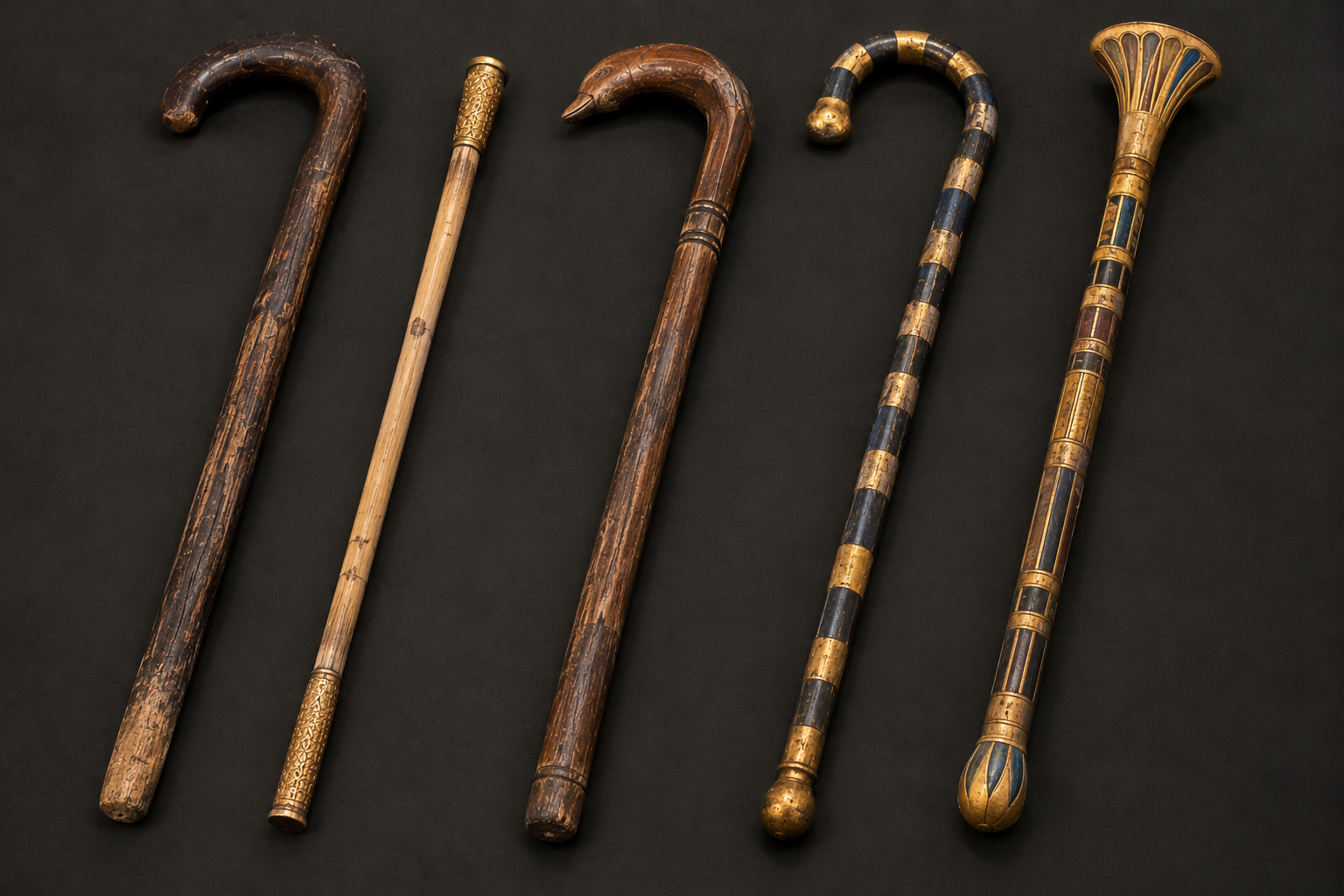

More than 130 complete and fragmentary sticks and staffs were found inside Tutankhamun’s tomb. For a king who died at about nineteen years old, that number seems extraordinary. It has also helped create one of the most persistent images of the young king: Tutankhamun as a physically fragile ruler who depended on walking sticks to move.
There may be a real story about mobility hidden within the collection. Some sticks have been discussed as objects that show evidence of use, and modern medical research on Tutankhamun’s mummy has proposed abnormalities that could have affected his ability to walk comfortably. But the archaeological evidence is more complicated than the popular version of the story.
The objects from KV62 were not simply 130 medical canes. They included sticks, staffs, ceremonial objects, richly decorated royal pieces, simple reeds, and other forms with different possible purposes. Some represented authority. Some carried powerful royal imagery. Some may have been personal possessions. And some may indeed have served a practical function. Understanding why so many were buried with Tutankhamun requires separating those possibilities rather than forcing the entire collection into a single explanation.
Quick Context
- King: Tutankhamun
- Dynasty: Eighteenth Dynasty
- Period: New Kingdom
- Tomb: KV62, Valley of the Kings
- Discovery: 1922
- Age at death: Approximately 19 years
- Collection: More than 130 complete and fragmentary sticks and staffs of different forms
- Functions: Practical, ceremonial, symbolic, royal, and possibly mobility-related depending on the individual object
- Materials: Wood and reed were used alongside gold, silver, inlay, bark, and other decorative materials in particular examples
- Medical question: Some researchers have proposed that Tutankhamun experienced impaired mobility
- Key caution: The number of sticks alone does not prove that the king required more than 130 walking aids
More Than 130 Sticks Inside One Tomb
The number is striking enough to dominate almost every discussion of Tutankhamun’s sticks.
More than 130 complete and fragmentary examples of different shapes, sizes, and designs were recovered from KV62.
They were not all identical, and they were not all discovered together as though someone had assembled a single collection of walking aids beside the king.
Sticks and staffs occurred in different parts of the tomb and belonged to different object groups. Carter’s records contain numerous individual catalogue numbers for them, while other objects were grouped together.
Some were relatively plain. Others were covered or mounted with precious materials. Some had curved or forked forms. Others carried elaborate decoration or small figures.
This variety is the first clue that the famous number can be misleading.
If 130 modern medical canes were found beside one person, it would be reasonable to ask why that individual needed so many.
KV62 presents a different archaeological problem.
Ancient Egyptian sticks and staffs could perform practical, ceremonial, symbolic, and status-related functions. A royal burial could preserve several of those categories at once.
More than 130 does not mean more than 130 medical walking aids. The number refers to a diverse archaeological collection of complete and fragmentary sticks and staffs with different forms and possible functions.
Were They All Walking Sticks?
No.
This is the most important distinction in the entire story.
Carter’s excavation records and later catalogues distinguish a wide range of sticks, staves, sceptres, maces, and related objects. Some belonged unmistakably to royal or ceremonial contexts rather than serving as simple supports for walking.
There were even stick-like objects elsewhere in the tomb that belonged to completely different functional categories.
In the Annex, for example, Carter described a group of short single-sticks that he interpreted as weapons used for attack and defense. These were not walking canes at all.
That does not mean such weapons should simply be added to a count of Tutankhamun’s walking sticks. Quite the opposite. Their presence demonstrates why terminology matters.
An elongated wooden object in KV62 cannot be classified as a mobility aid simply because it looks vaguely like a stick.
Shape, construction, decoration, context, inscriptions, and evidence of use all have to be considered.
The popular phrase “Tutankhamun’s walking sticks” simplifies a much broader collection. Some objects may have assisted movement, but others belonged to ceremony, royal display, symbolism, or entirely different activities.
Why Ancient Egyptian Kings Carried Staffs
To understand the collection, we have to remove one modern assumption: carrying a staff does not automatically mean someone has difficulty walking.
Sticks and staffs had a long history as markers of rank and authority in ancient Egypt.
Officials and elite individuals could be represented holding staffs, while royal regalia included specialized forms whose meaning went far beyond physical support.
A staff could make authority visible.
Its length, material, decoration, and shape could distinguish it from an ordinary branch or practical cane. In royal contexts, precious metal and elaborate workmanship could turn a familiar object into an unmistakable sign of status.
This is especially important for Tutankhamun because his tomb contained examples whose construction makes a purely practical explanation inadequate.
Some were not objects we should imagine the king leaning on while moving through the palace.
They belonged to the visual and ceremonial language of kingship.
Some Were Clearly Ceremonial
The burial chamber provides particularly strong evidence.
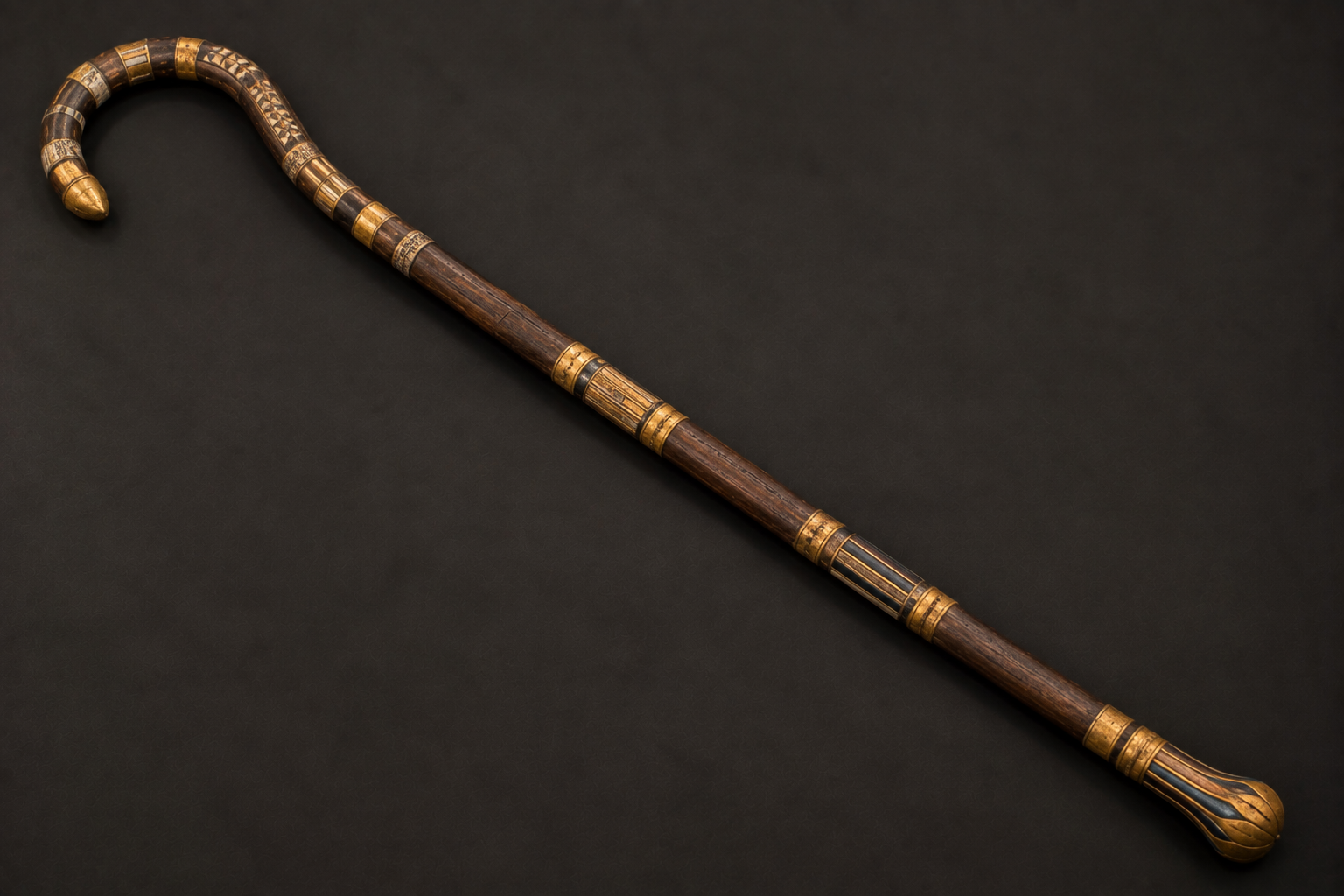
Among the equipment placed around the great nested shrines were ceremonial objects that included sticks, staves, bows, and related royal equipment.
Some of the most remarkable examples were gold and silver sticks associated with small figures of the young king.
Arthur Mace recorded the unwrapping of five sticks during the second excavation season and noted that the figures on the gold and silver examples clearly represented a young boy.
Carter interpreted highly elaborate examples from this part of the burial equipment as belonging to ceremonial and processional use.
That context matters enormously.
A gold or silver staff associated with a royal figure is evidence for kingship and ceremony before it is evidence for impaired mobility.
Even if Tutankhamun experienced difficulty walking in daily life, it would be incorrect to reinterpret every royal staff through that medical possibility.
The objects had their own functions.
A staff can support a body, but in ancient Egypt it could also represent the authority of the person holding it.
Some Were Surprisingly Simple
The contrast between Tutankhamun’s elaborate staffs and his simpler sticks is one of the most fascinating features of the collection.
Carter object 229 is a particularly memorable example.
Arthur Mace described it as a common reed bound with gold at either end. An inscription associated with it states that the reed had been cut by the king himself.
The object is intriguing precisely because the basic material is so ordinary.
Why decorate a simple reed with precious metal?
The inscription gave the excavation team an explanation: this apparently humble object was connected directly with the king.
We should still distinguish the inscription’s statement from independently documented biography. We cannot travel back to witness Tutankhamun cutting the reed.
But the ancient inscription tells us how the object was presented and remembered within the royal collection.
Its importance apparently came not from the rarity of the reed itself, but from its association with the king.
This offers a useful warning against measuring archaeological importance by material value alone.
A plain reed could carry a deeply personal royal association, while a far more expensive gold object might have been made specifically for ceremony.
A Personal Object Does Not Have to Be Luxurious
The same principle appears elsewhere in Tutankhamun’s burial.
KV62 is famous because of its gold, but many of its most revealing objects are made from ordinary materials: linen, plant fibers, leather, wood, reed, and foodstuffs.
They connect the burial to the material world in which the king had lived.
This is why the broader collection of Tutankhamun’s everyday objects can sometimes bring us closer to royal life than the most spectacular treasures.
Did Tutankhamun Actually Use Any of Them?
This is where the archaeological and medical questions begin to overlap.
Some sticks have been interpreted as showing evidence consistent with use.
That possibility is significant.
If a stick was genuinely used rather than simply manufactured and placed in the burial, details such as abrasion, worn surfaces, damage around a lower end, or changes around the grip could potentially preserve part of its history.
But use is not the same as medical dependence.
A person can use a stick without requiring it to walk.
A king can carry one during a ceremony.
A staff can be handled repeatedly as a sign of office.
A cane can have practical value during travel or outdoor activity without functioning as a permanent mobility aid.
For this reason, evidence that an object was used must be separated from the question of how it was used.
The Evidence of Wear
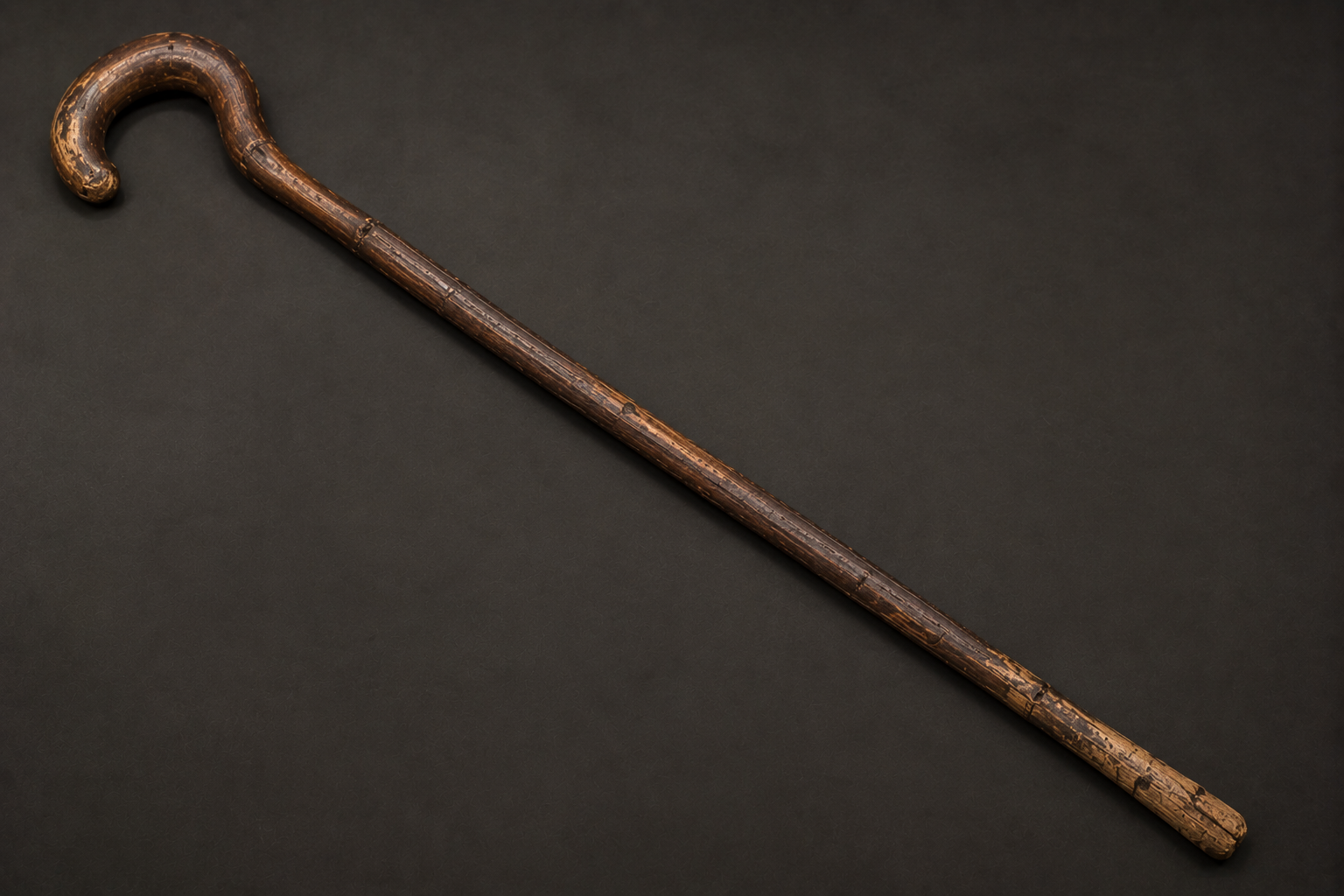
Wear is one of the most tempting forms of evidence in the collection because it seems to preserve direct physical activity.
A lower tip repeatedly placed against the ground may become abraded.
A handle may develop smoother areas where it was gripped.
Repairs can suggest that an object was valued enough to remain in service after damage.
Repeated stress can alter joints, bindings, or decorative surfaces.
But ancient wear has to be distinguished from everything that happened later.
These objects spent more than three thousand years inside a tomb.
They experienced burial conditions, pressure from surrounding objects, deterioration of organic materials, excavation, handling, early conservation, transport, storage, and later museum care.
Some of the sticks were already fragile when Carter’s team encountered them. His excavation records document repair and conservation work on individual examples, including an ivory-and-ebony veneered stick repaired during the excavation.
This means a mark on a stick cannot simply be labeled “Tutankhamun’s wear.”
Researchers have to ask whether it resulted from manufacture, ancient use, burial damage, excavation, deterioration, or later intervention.
Wear can strengthen the case that a stick was used, but it does not automatically reveal the identity of the user or the reason the stick was carried.
Why the Sticks Became Part of the Health Debate
The walking-stick interpretation became much more influential when researchers began combining the objects with evidence from Tutankhamun’s body.
A major medical study published in 2010 examined Tutankhamun and other royal mummies using CT imaging and genetic analysis. The researchers proposed several findings relevant to the young king’s health, including abnormalities affecting his feet.
The study suggested that these conditions could have impaired his ability to walk and treated the presence of canes showing signs of use as supporting archaeological evidence.
That produced an extremely compelling modern narrative.
A young king with foot problems.
Numerous sticks in his tomb.
Some showing apparent use.
Put together, the pieces seem to fit.
But archaeological interpretation requires another question:
How much does each piece of evidence actually prove?
The anatomical evidence needs to be evaluated medically.
The sticks need to be evaluated archaeologically.
The footwear needs to be evaluated separately.
Only then should researchers ask how strongly those independent lines of evidence support one another.
What Tutankhamun’s Feet May Tell Us
The 2010 study proposed abnormalities in Tutankhamun’s feet that could have made walking painful or difficult.
This is important evidence, but it does not turn every stick in KV62 into a medical device.
The two questions are related without being identical.
A king with impaired mobility could still possess ceremonial staffs.
He could still own symbols of authority.
He could still be buried with objects selected for royal and funerary reasons rather than personal physical necessity.
Likewise, finding ceremonial staffs does not prove that none of the simpler sticks were used for support.
Both possibilities can exist in the same tomb.
This is the key to understanding the collection without forcing the evidence toward either extreme.
We do not have to choose between “every stick was a walking aid” and “none of them had anything to do with mobility.”
The archaeological record is capable of preserving several functions at once.
Do the Sticks Prove Tutankhamun Had a Disability?
No. Not by themselves.
The number of sticks is not a diagnosis.
The existence of wear is not a diagnosis.
Even a practical cane associated with the king would not, on its own, tell us the exact nature or severity of a medical condition.
At the same time, it would be equally misleading to dismiss the entire mobility question simply because staffs could symbolize status.
The responsible conclusion lies between those extremes.
Some of Tutankhamun’s sticks may have served practical purposes, and evidence from his body has given researchers legitimate reasons to investigate impaired mobility. But the collection as a whole cannot be explained as medical equipment.
Tutankhamun’s 130-plus sticks are not 130 pieces of medical evidence. They are a collection shaped by kingship, craftsmanship, symbolism, burial, and possibly personal mobility.
What His Sandals Add to the Debate
There is another source of evidence sitting much closer to Tutankhamun’s feet: his footwear.
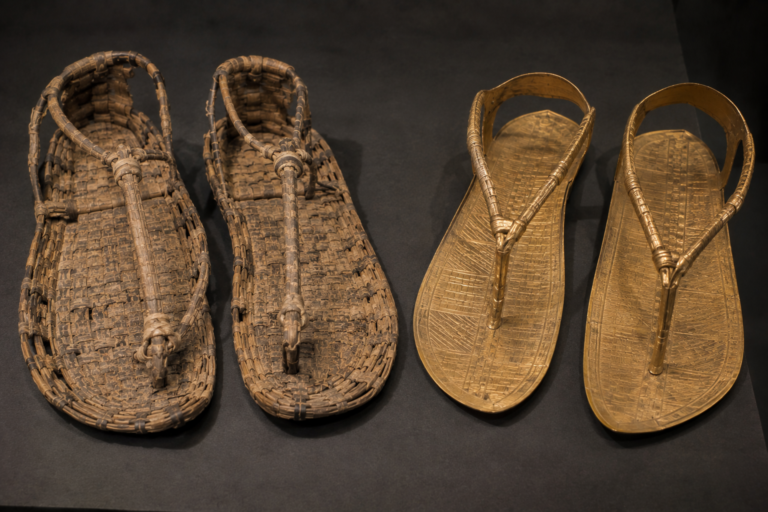
KV62 preserved roughly three dozen pairs of footwear together with additional individual pieces, ranging from practical plant-fiber and leather forms to the extraordinary sheet-gold funerary sandals placed directly on the mummy.
Because footwear interacts physically with the feet, researchers can examine it for patterns of wear and asymmetry.
Specialist study of the footwear has complicated attempts to reconstruct a pronounced limp from the archaeological objects alone. Clear, consistent asymmetrical wear that would independently demonstrate such a gait has not been established across the collection.
That does not prove Tutankhamun walked normally.
It does not overturn medical evidence by itself.
But it provides an important counterweight to the simplistic argument that “many sticks must mean a severe walking disability.”
As explored in what Tutankhamun’s sandals reveal about the king, footwear can preserve evidence of use while still leaving major questions about mobility unresolved.
The sticks and sandals therefore work best when studied together without asking either collection to prove more than it can.
Sticks Decorated With Egypt’s Enemies
Some of Tutankhamun’s sticks move us decisively away from medicine and into royal symbolism.
Several examples incorporate captive figures associated with foreign peoples traditionally represented as enemies of Egypt.
One of the best-known decorated sticks uses bound captive figures as part of the handle design.
The imagery belongs to a much wider tradition of Egyptian kingship.
Foreign enemies could be represented beneath the king’s feet, under furniture, on royal equipment, or in other positions that visually expressed domination and control.
These were not casual portraits of individual prisoners.
They belonged to a symbolic language in which the king was presented as overcoming threats and maintaining order.
Placing captives on a staff made that message physical.
The king did not simply look at an image of defeated enemies.
He could hold the symbol of their submission in his hand.
Holding the Enemy in His Hand
The captive figures on Tutankhamun’s sticks become even more interesting when compared with other objects from his tomb.
Some of his decorated sandals also incorporated images of traditional foreign enemies beneath the king’s feet.
The visual idea is similar, but the physical relationship changes.
On the sandals, the king symbolically stood above his enemies.
On a decorated stick, he could hold them within his grasp.
Both belonged to a much broader royal language in which Egypt’s king was presented as controlling hostile forces and preserving order.
This comparison also demonstrates why an elaborate decorated stick cannot automatically be interpreted as a mobility aid.
Its imagery had a political and royal function independent of whether the object could physically support a person.
For archaeologists, therefore, decoration is evidence of function just as wear can be.
A worn tip may suggest physical contact with the ground. A captive carved into a handle tells us something entirely different about how the object communicated royal authority.
The same royal idea could appear on different objects. Enemies beneath Tutankhamun’s sandals and captive figures incorporated into his staffs both transformed objects associated with the king’s body into expressions of royal dominance.
The Craftspeople Behind the Collection
The variety of Tutankhamun’s sticks also reveals a remarkable range of craftsmanship.
A simple reed required relatively little transformation compared with an elaborate royal staff, but other examples demanded several specialized skills.
Wood had to be selected for its strength, shape, grain, or appearance.
Shafts could be cut, straightened, shaped, polished, joined, or covered.
Curved handles required careful control of form.
Decorative surfaces could incorporate bark, precious metal, inlay, veneer, and other materials.
Some objects combined several techniques on a single shaft.
Carter described richly decorated sticks and batons that demonstrate just how far ancient craftspeople could transform wood and other relatively ordinary materials. Gold bands, patterned surfaces, contrasting veneers, and carefully constructed handles turned functional forms into elite objects.
That complexity also creates conservation problems.
Wood, metal, adhesive, bark, ivory, and other materials do not age in the same way. A composite staff can therefore become structurally unstable as different components shrink, crack, loosen, or deteriorate at different rates.
The object may look solid in a photograph while actually depending on careful support.
The Material Could Be Part of the Message
Material choice mattered beyond simple decoration.
A plain reed associated with the king could become important because of its personal connection.
A staff covered with gold could communicate status.
An object incorporating foreign or exotic materials could reflect access to resources moving through royal networks.
Fine craftsmanship itself was another expression of wealth.
Royal luxury did not depend only on the intrinsic value of gold or silver. It also depended on the labor and expertise required to transform raw materials into objects suitable for the king.
The sticks preserve more than Tutankhamun’s image. They preserve the skill of anonymous craftspeople who shaped the material world around him.
From Simple Reed to Gold and Silver
Few object groups from KV62 demonstrate the range of royal material culture as clearly as the sticks and staffs.
At one end were relatively simple organic objects.
At the other were elaborate ceremonial pieces incorporating precious materials.
Between those extremes were numerous variations in shape, decoration, construction, and likely function.
This range helps explain why the collection became so large.
We should not imagine Tutankhamun choosing between more than 130 nearly identical canes every morning.
The objects belonged to several overlapping categories.
Some could have been personal possessions.
Some may have had practical value.
Others represented rank or authority.
Some belonged to ceremony and procession.
Still others acquired significance through inscriptions, decoration, or their relationship with the royal burial.
| Object Type | Possible Function | Useful Evidence | What We Should Not Assume |
|---|---|---|---|
| Practical stick or cane | Support, movement, or other everyday use | Construction, grip, lower tip, repairs, possible wear | That every practical-looking stick was medically necessary |
| Royal staff | Status and authority | Form, context, decoration, royal associations | That it was primarily a walking aid |
| Ceremonial or processional staff | Formal royal occasions | Precious materials, figures, excavation context | That signs of handling prove mobility use |
| Decorated captive-handle stick | Royal symbolism and status | Captive imagery and craftsmanship | That the decoration has a medical meaning |
| Simple reed cane | Personal, practical, or symbolic | Construction and inscription | That the inscription reveals exactly how often it was used |
| Fragmentary stick or staff | Sometimes uncertain | Surviving material, decoration, context, associated records | That its original function can always be reconstructed |
Why So Many Different Sticks Were Buried With Him
There is probably no single answer.
That may be the most important conclusion of the entire collection.
Some objects represented kingship.
Some were appropriate for ceremony.
Some may have been possessions connected with Tutankhamun during life.
Some may have served practical purposes.
And if the young king experienced difficulty walking, some may also have provided physical support.
These explanations are not mutually exclusive.
A royal cane could be practical and prestigious at the same time.
A staff could be handled during life and later selected for burial.
A simple object could become significant because it had been associated personally with the king.
An elaborate object could be created primarily for royal display or ceremony.
The tomb brought all of these histories together.
Burial Was About Provision, Not Minimalism
KV62 was filled with objects intended to equip the dead king on an extraordinary scale.
Furniture, clothing, sandals, weapons, chariots, food, containers, jewelry, ritual equipment, and countless other objects were placed inside the tomb.
Redundancy was not unusual within such a burial assemblage.
Multiple examples of an object type should therefore not automatically be explained through practical necessity.
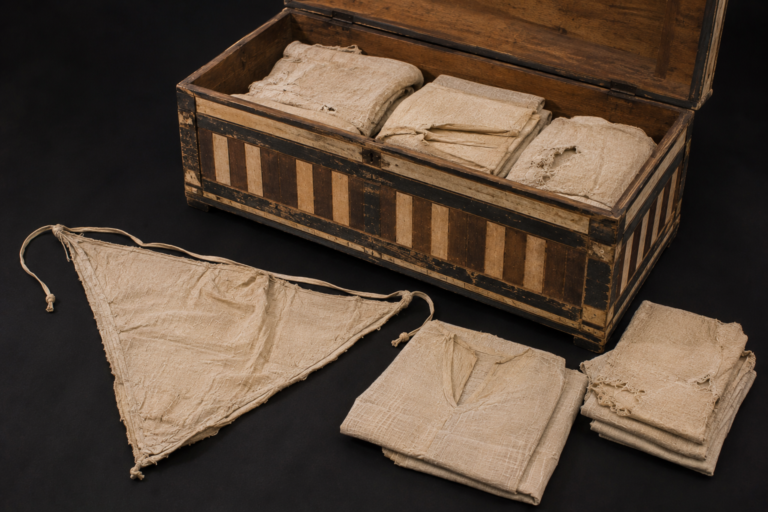
Tutankhamun had more than 140 linen loincloths in the burial collection, for example. That does not mean he needed to wear 140 loincloths at once.
Similarly, a large number of sticks does not mean the king required dozens of mobility aids simultaneously.
Quantity can instead reflect wealth, provision, status, personal possessions, ceremony, and the scale of royal burial equipment.
Where the Sticks Were Found Also Matters
Archaeological context is essential when trying to understand function.
An object found among ceremonial equipment around the burial shrines carries a different context from a practical-looking cane stored elsewhere.
A group found together may have been assembled for a particular reason.
An object wrapped in linen may preserve evidence about how it was prepared for burial.
This is why Howard Carter’s documentation remains crucial.
Once an object is removed from the tomb and displayed alone in a museum, its original surroundings disappear from view.
A visitor sees a staff.
The excavation archive can reveal where it stood, what objects surrounded it, whether it was wrapped, how it was numbered, and what the excavation team observed when it was removed.
Those records are part of the evidence, not merely paperwork associated with the discovery.
The process is explored more fully in how Howard Carter catalogued the objects from Tutankhamun’s tomb.
Harry Burton’s Photographs Preserve Evidence Too
Written records are only one part of the archive.
Harry Burton’s photographs preserve the appearance of many objects during excavation and documentation, including sticks and staffs from the tomb.
For a composite object, an early photograph can be particularly valuable.
Wood may crack.
Bindings can loosen.
Decoration can shift.
Fragile inlay may require later stabilization.
An image taken close to the time of excavation can therefore preserve an earlier physical state that no longer exists in exactly the same form.
Photographs can also help researchers understand how objects were grouped and positioned before removal.
This is why Harry Burton’s photographic record of Tutankhamun’s discovery remains scientifically useful more than a century later.
Why a Stick Can Be Harder to Interpret Than It Looks
A walking stick seems like an uncomplicated object.
It has a shaft.
It may have a handle.
It can touch the ground.
But archaeological interpretation becomes difficult precisely because those features can serve more than one purpose.
A long shaft can support the body.
It can also create an imposing visual presence during a procession.
A curved handle can improve grip.
It can also provide a surface for elaborate royal decoration.
A worn lower end can result from contact with the ground, but that does not necessarily reveal whether the object was used every day, occasionally, ceremonially, or by one specific person.
The object therefore has to be studied as a combination of evidence rather than identified from one feature alone.
Material, dimensions, balance, decoration, wear, inscription, archaeological position, photographs, and conservation history can all contribute to interpretation.
The Medical Story Is Only One Part of the Collection
The possibility that Tutankhamun had difficulty walking deserves serious discussion because it is based on real attempts to interpret his physical remains and archaeological possessions together.
But it should not consume the entire story of the sticks.
If we reduce all 130-plus objects to evidence of disability, we lose much of what makes the collection valuable.
We lose the ceremonial staffs.
We lose the royal symbolism.
We lose the captive imagery.
We lose the contrast between simple reed and precious metal.
We lose the craftsmanship.
And we lose the evidence for how familiar objects could carry several meanings within the royal court and burial.
The medical question is therefore important, but it is only one layer.
A useful archaeological rule: an interpretation should explain the evidence without erasing its diversity. Tutankhamun’s sticks are too varied to be explained convincingly by a single medical theory.
What the Sticks Cannot Tell Us
Despite the extraordinary size of the collection, there are several questions it cannot answer with certainty.
We cannot identify every stick that Tutankhamun personally carried.
We cannot determine exactly how frequently he used any particular cane.
We cannot diagnose the severity of a mobility problem from the objects alone.
We cannot assume that every worn surface resulted from the king’s hands or movement.
We cannot assume that every stick-like object had the same function.
And we cannot reconstruct the precise reason why each individual object was selected for KV62.
Even inscriptions require context.
If an inscription associates an object closely with Tutankhamun, that evidence is valuable, but it does not automatically provide a complete history of the object’s use.
Archaeology often works through probabilities rather than absolute biographies.
Why the Collection Matters
Tutankhamun’s sticks matter because they connect several different dimensions of ancient Egyptian life within one object category.
They connect the body with movement.
They connect practical objects with royal status.
They connect ordinary materials with extraordinary craftsmanship.
They connect political imagery with objects that could actually be held.
And finally, they connect the world of the living king with the equipment prepared for his burial.
The simplest stick and the most elaborate staff do not tell the same story.
That difference is exactly what makes the collection valuable.
Frequently Asked Questions
How many walking sticks were found in Tutankhamun’s tomb?
More than 130 complete and fragmentary sticks and staffs of different shapes, sizes, and designs were found in KV62. It is important not to interpret this entire number as 130 medical walking aids.
Were all of Tutankhamun’s sticks used for walking?
No. The collection included objects with practical, ceremonial, symbolic, and royal functions. Some elaborate staffs were associated with ceremony and status rather than ordinary walking.
Did Tutankhamun need a cane?
Researchers have proposed that abnormalities affecting Tutankhamun’s feet may have impaired his mobility, and some sticks have been interpreted as showing signs of use. However, no individual object can by itself establish exactly how dependent he was on a cane.
Did Tutankhamun have a disability?
Modern studies have proposed physical conditions that may have affected Tutankhamun’s feet and mobility. Interpretations of his health should be based on medical evidence together with archaeological evidence rather than on the number of sticks alone.
Did any of Tutankhamun’s walking sticks show wear?
Some sticks have been described as showing evidence consistent with use. Wear must still be distinguished from damage caused by burial, deterioration, excavation, handling, and conservation.
Why did ancient Egyptian kings carry staffs?
Staffs could represent authority, rank, ceremony, and royal identity. Carrying one therefore did not automatically indicate difficulty walking.
Why were some of Tutankhamun’s staffs made with precious materials?
Gold, silver, fine veneers, inlays, and other decorative materials could transform a staff into an elite or ceremonial object appropriate to royal status and burial.
Why did some sticks show foreign captives?
Captive figures belonged to a wider tradition of royal imagery in which the king was shown dominating Egypt’s traditional foreign enemies. Incorporating them into a staff turned the object into a physical expression of royal control.
Did Tutankhamun personally use all the sticks?
No evidence demonstrates that he personally used every example. Some may have been possessions from life, while others were ceremonial, symbolic, royal, or selected specifically as part of the burial equipment.
What were Tutankhamun’s walking sticks made from?
The collection used a variety of materials. Wood and reed appear alongside objects decorated or constructed with precious metals, veneers, bark, inlays, and other materials depending on the individual stick or staff.
What do Tutankhamun’s sandals reveal about his ability to walk?
Specialist study of his footwear has not established clear, consistent asymmetrical wear across the collection that independently proves a pronounced limp. This does not prove normal mobility, but it shows why the sticks and medical evidence must be interpreted cautiously.
Why were so many sticks placed in Tutankhamun’s tomb?
There was probably no single reason. The collection appears to combine royal status, ceremony, symbolism, personal possessions, funerary provision, craftsmanship, and potentially practical use. Some objects may also have had a mobility-related function.
Final Thoughts
More than 130 sticks and staffs sounds like a medical clue.
And for some objects, mobility may indeed be part of the story.
But once the collection is examined closely, the simple explanation begins to break apart.
Some sticks may have been used practically.
Others were elaborate symbols of royal authority.
Some were appropriate to ceremony and procession.
One seemingly ordinary reed carried an inscription connecting it personally with the king.
Other staffs transformed Egypt’s traditional enemies into figures held beneath the royal hand.
The medical evidence surrounding Tutankhamun makes it reasonable to ask whether he sometimes needed support while walking. What it does not justify is turning every stick in KV62 into a medical cane.
The real collection is far more interesting than that.
It preserves mobility and ceremony, ordinary materials and precious metals, personal associations and royal symbolism within the same remarkable group of objects.
Some may have supported the young king’s body.
Others represented his authority.
And together, they show why a single object as simple as a stick can carry several completely different meanings inside a royal tomb.