
When Howard Carter and his team began opening the boxes inside Tutankhamun’s tomb, they encountered treasures far more fragile than gold. Folded inside some of those containers were pieces of ancient clothing, including remarkably simple linen garments that had survived for more than three thousand years.
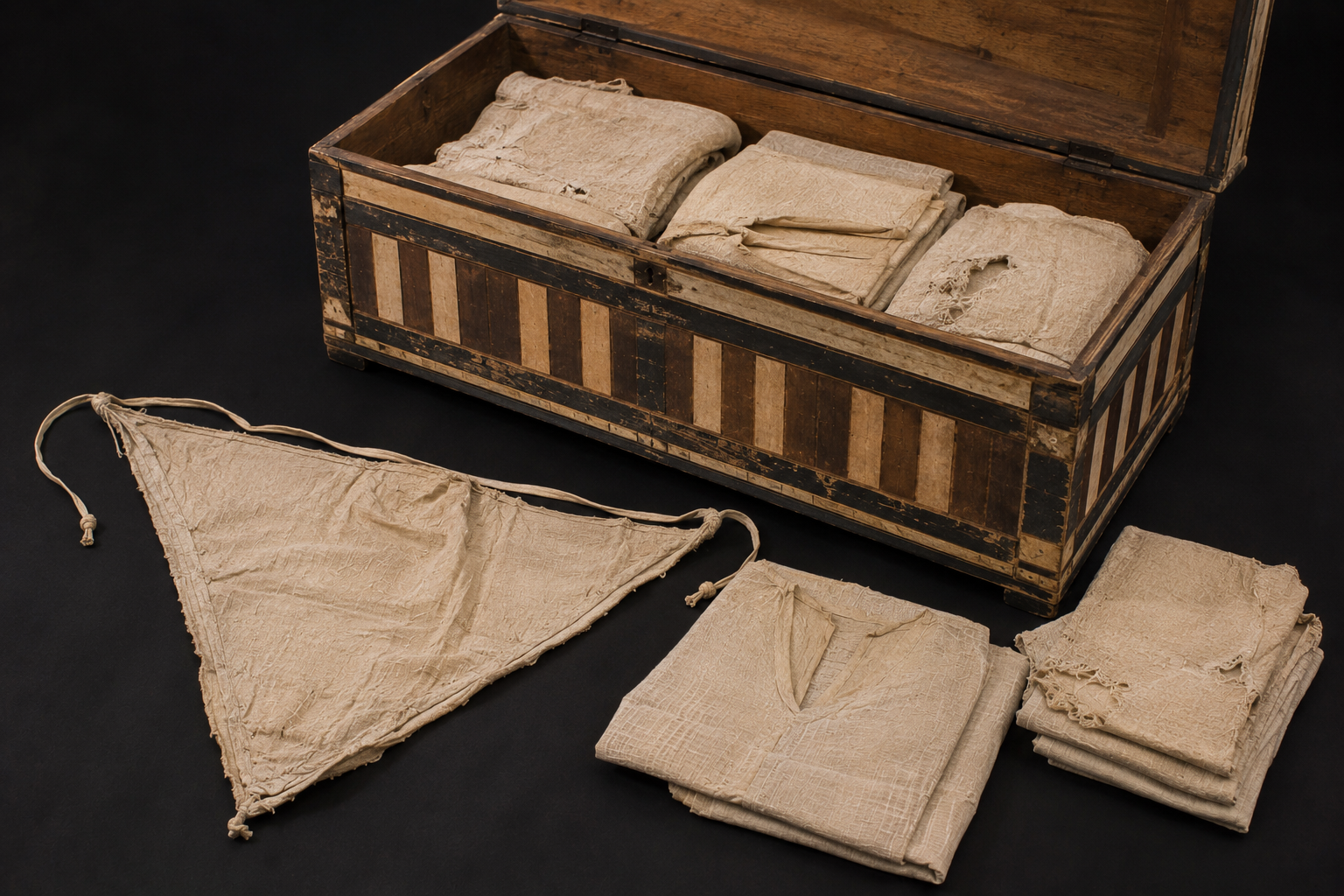
Among them were more than 140 triangular loincloths. In at least one example photographed by Harry Burton, the creases left when the linen had been folded in antiquity were still visible. It is a small detail, but an extraordinary one: a fold made by ancient hands survived inside the tomb long after the people who packed the clothing had disappeared.
These textiles offer a different way to approach Tutankhamun. They cannot reconstruct his personality or prove that he personally wore every garment placed in KV62. What they can do is reveal an unusually intimate material world of linen, weaving, clothing, storage, royal craftsmanship, and burial preparation surrounding a young Egyptian king more than 3,300 years ago.
Quick Context
- King: Tutankhamun
- Dynasty: Eighteenth Dynasty
- Period: New Kingdom
- Tomb: KV62, Valley of the Kings
- Discovery: 1922
- Excavation director: Howard Carter
- Principal clothing material: Linen
- Loincloths: More than 140 were found among boxes of folded clothing
- Other textiles: Garments, coverings, headwear, wrappings, and other textile objects formed part of the wider burial assemblage
- Important distinction: Clothing from the tomb should not automatically be assumed to have been personally worn by Tutankhamun
A Royal Wardrobe Hidden Among the Gold
The popular image of Tutankhamun’s tomb is dominated by precious materials. Gold, gemstones, gilded furniture, elaborate jewelry, ceremonial objects, and the famous burial equipment understandably attract most of the attention.
Yet KV62 also contained objects whose value was very different.
There was linen.
Some of it belonged to the complex preparations surrounding the burial. Some was associated with clothing and other textile objects. Boxes contained folded garments, preserving a category of material that is much more vulnerable to decay than gold or stone.
This is what makes Tutankhamun’s clothing so important. Textiles can disappear almost completely from the archaeological record. Moisture, microorganisms, insects, repeated handling, light, and simple mechanical weakness can destroy organic fibers over time.
The survival of substantial textile material in and around Tutankhamun’s burial therefore gives researchers something exceptional: physical evidence for the fabrics and clothing forms that existed in the royal world of the late Eighteenth Dynasty.
These clothes also change the scale of the story.
A monumental statue presents a king as a ruler. A gold mask presents him within a carefully constructed funerary identity. A simple piece of clothing belongs to the scale of the human body.
Its dimensions, seams, folds, fibers, and signs of use or damage can preserve information that monumental objects cannot.
Tutankhamun’s tomb did not preserve only the image of a king. It preserved parts of the material world that surrounded a human body.
How Much Clothing Was Found in Tutankhamun’s Tomb?
There is no useful reason to reduce the entire textile collection to a single dramatic number. The material from the tomb included different categories of textiles with different functions, and not every surviving piece should be classified simply as an item from Tutankhamun’s personal wardrobe.
One number, however, is particularly striking and securely documented.
More than 140 triangular loincloths were found among boxes of folded clothing inside the tomb.
That quantity immediately challenges the modern tendency to imagine royal clothing only in terms of elaborate ceremonial dress.
The loincloth was one of the most basic forms of ancient Egyptian clothing. It was not exclusively royal. People across different levels of Egyptian society could wear this type of garment, either by itself or beneath other clothing.
Finding so many examples within Tutankhamun’s burial assemblage therefore brings an ordinary category of Egyptian clothing into an extraordinary archaeological context.
There were also other forms of textile material connected with clothing, covering, burial preparation, and the mummy itself. That broader collection has to be interpreted carefully because a textile placed inside a royal tomb could have served many different purposes.
Important: “Textiles from Tutankhamun’s tomb” and “clothes personally worn by Tutankhamun” are not interchangeable categories. The burial contained clothing, but it also contained linen used for wrapping, covering, padding, and other funerary purposes.
Why Linen Dominated Tutankhamun’s World
To understand the clothing, we first need to understand linen.
For ancient Egyptians, linen was one of the fundamental textiles of daily life. It was produced from flax, a plant whose fibers could be processed, spun into thread, and woven into fabric.
The finished material could vary greatly in quality. Linen was not simply one uniform type of cloth. The fineness of the thread, density and quality of the weave, finishing, dimensions, and workmanship could all affect the character and value of the finished textile.
Producing it required a long chain of skilled labor.
Flax had to be cultivated and harvested. Fibers had to be separated and prepared. Thread had to be spun. The thread then had to be woven, after which the cloth could be cut, sewn, folded, decorated, stored, or used for another purpose.
A seemingly simple linen garment therefore represents considerably more labor than its appearance suggests.
For a royal household, access to exceptionally fine textiles was itself a form of wealth. Luxury did not always require heavy gold decoration. Fine fabric produced through highly skilled work could communicate status in a quieter way.
Linen also had uses far beyond clothing. It could serve as bedding, coverings, bags, wrapping material, and eventually as material connected with mummification and burial.
This versatility is essential when examining Tutankhamun’s textile collection. A piece of linen has to be understood through its construction and archaeological context rather than identified as clothing merely because it is fabric.
More Than 140 Loincloths
Few objects make Tutankhamun’s clothing feel more immediate than the loincloths.
The basic form was remarkably simple. The surviving examples are triangular pieces of linen. When worn, two ends could be wrapped around the hips while the third passed between the legs toward the front, where the ends were secured.
It was practical clothing rather than an object designed primarily to impress.
That simplicity is exactly what makes the large group from KV62 so interesting.
More than 140 examples suggest that the burial assemblage included a substantial supply of this basic garment. Yet the number should not be turned into an unsupported claim about Tutankhamun wearing each individual piece.
What the group securely demonstrates is that ordinary clothing forms were included alongside some of the most elaborate objects in the royal burial.
The Creases Were Still There
One of Harry Burton’s photographs records a loincloth that had been unfolded for documentation.
Across the fabric, the old fold lines remained visible.
Those creases are easy to overlook. Archaeologically, however, they are fascinating because they preserve evidence of how the textile had physically rested before it was opened during the excavation.
The cloth had not survived as an abstract museum object. It had survived folded.
That means the photograph preserves two histories at once: the ancient textile itself and traces of the way it had been stored.
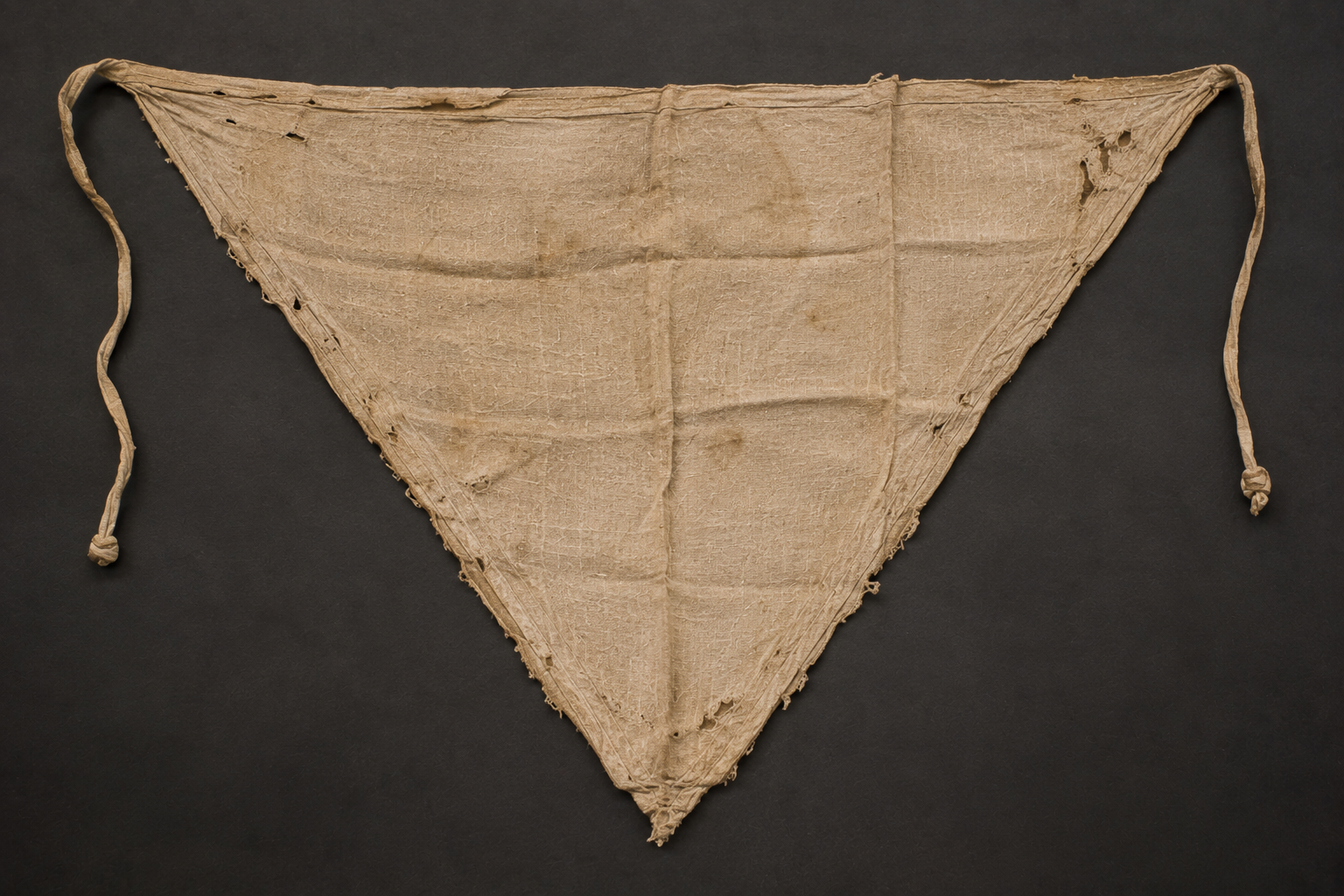
This is one of those moments when an apparently modest object can feel more immediate than a masterpiece of gold.
The fold is not a royal symbol. It is the physical consequence of someone handling a piece of cloth.
Did Tutankhamun Actually Wear These Clothes?
This is the most tempting question and one of the easiest to answer too confidently.
Some clothing from the burial may well have formed part of Tutankhamun’s wardrobe. Museum discussions of the loincloths, for example, have treated them as part of the king’s clothing collection and likely underwear.
But archaeology rarely allows us to move from “found in his tomb” to “personally worn by him” for every individual garment.
Researchers have to consider several kinds of evidence.
Size may indicate whether a garment could plausibly fit a particular body.
Wear may suggest that an object had been used before burial.
Repairs can demonstrate that a textile had a useful life rather than being made only to be deposited in a tomb.
Inscriptions may connect a textile with a person, date, institution, or particular context.
Archaeological location can help establish whether a textile was stored as clothing, placed with the mummy, used as packing, or associated with another object.
None of these clues should automatically be treated as absolute proof of personal use.
A royal household contained many people, and objects could have complicated histories before reaching a tomb. Some could be reused. Others could be specially prepared for burial. A textile might also be associated with the king without ever having been worn by him.
This distinction is central to understanding Tutankhamun’s everyday objects and what they reveal about his life. The most reliable story comes from allowing the evidence to set the limits.
Clothes in Different Sizes Raise an Interesting Question
Textile size can create one of the most intriguing possibilities in the Tutankhamun story: could some surviving pieces preserve clothing from different stages of his short life?
There is evidence that makes the question worth asking, but not enough to turn it into a simple biography of his childhood wardrobe.
An especially interesting comparison comes from KV54, the small deposit discovered in the Valley of the Kings in 1907 and later recognized as material associated with Tutankhamun’s embalming and funeral.
Among the linen from this separate cache were head cloths. One small example has been discussed as possibly having belonged to Tutankhamun when he was a child. Crucially, that interpretation remains a possibility rather than a proven fact.
KV54 should also not be confused with KV62. It was a separate deposit containing material associated with the king’s embalming and funeral, including linen, natron, pottery, and other remains.
This distinction is useful because it demonstrates how easily attractive stories can outrun the evidence.
Size is evidence, not a biography. A child-sized textile associated with Tutankhamun may raise the possibility of earlier personal use, but dimensions alone cannot prove who wore it or exactly when it was used.
What Did a Young Egyptian King Wear?
Modern popular culture often presents an Egyptian king as permanently dressed in elaborate ceremonial clothing, covered with jewelry and surrounded by gold.
Ancient evidence presents a more varied picture.
Royal dress depended on context.
A king could be represented in formal regalia designed to communicate authority. Ceremonial settings demanded particular visual identities. Religious and state occasions could require clothing and insignia different from what would be practical in less formal situations.
At the same time, linen remained fundamental.
Loincloths, kilts, tunic-like garments, shawls, head coverings, belts, and other textile forms belonged to the broader clothing traditions of ancient Egypt. The royal versions could differ in quality, decoration, symbolism, and workmanship, but kings still inhabited the same basic material culture of woven cloth.
This matters when we try to imagine Tutankhamun outside monumental art.
The ceremonial king shown defeating enemies or appearing before sacred figures was a constructed royal image. It was not necessarily a literal record of what he wore through an ordinary day.
The surviving textiles from the burial help restore some of that missing complexity.
Royal Clothing Was Not Always Covered in Gold
One of the most misleading assumptions about ancient Egyptian royalty is that luxury must always have looked spectacular.
Fine linen could be valuable without appearing extravagant to modern eyes.
The quality might be visible in exceptionally fine threads, careful weaving, finishing, decoration, or the sheer amount of skilled labor required to produce the cloth.
This makes ancient textiles particularly interesting for understanding wealth.
Gold announces its value immediately. Linen requires us to look more carefully.
The raw material had to pass through agricultural and craft processes before it became usable fabric. Producing large quantities of high-quality cloth required land, labor, organization, and skilled workers.
A royal wardrobe therefore represented economic resources even when individual garments appeared visually simple.
Royal luxury was not always something that glittered. Sometimes it was woven into the quality of a thread.
The Linen Skull-Cap Found With Tutankhamun’s Mummy
One textile object associated directly with Tutankhamun’s body was a delicate skull-cap documented during the examination of the mummy.
Carter’s records describe it as being made from fine, cambric-like linen. Its decoration included tiny beads, creating a much more elaborate object than an undecorated piece of everyday cloth.
The skull-cap is important for two reasons.
First, its archaeological position connects it directly with the king’s mummy rather than simply with a storage box elsewhere in the tomb.
Second, it demonstrates how extremely fine linen could be combined with decorative materials to create an object suitable for the royal burial.
Its condition also illustrates the vulnerability of ancient textiles. The fabric was already fragile, and parts of the textile had deteriorated.
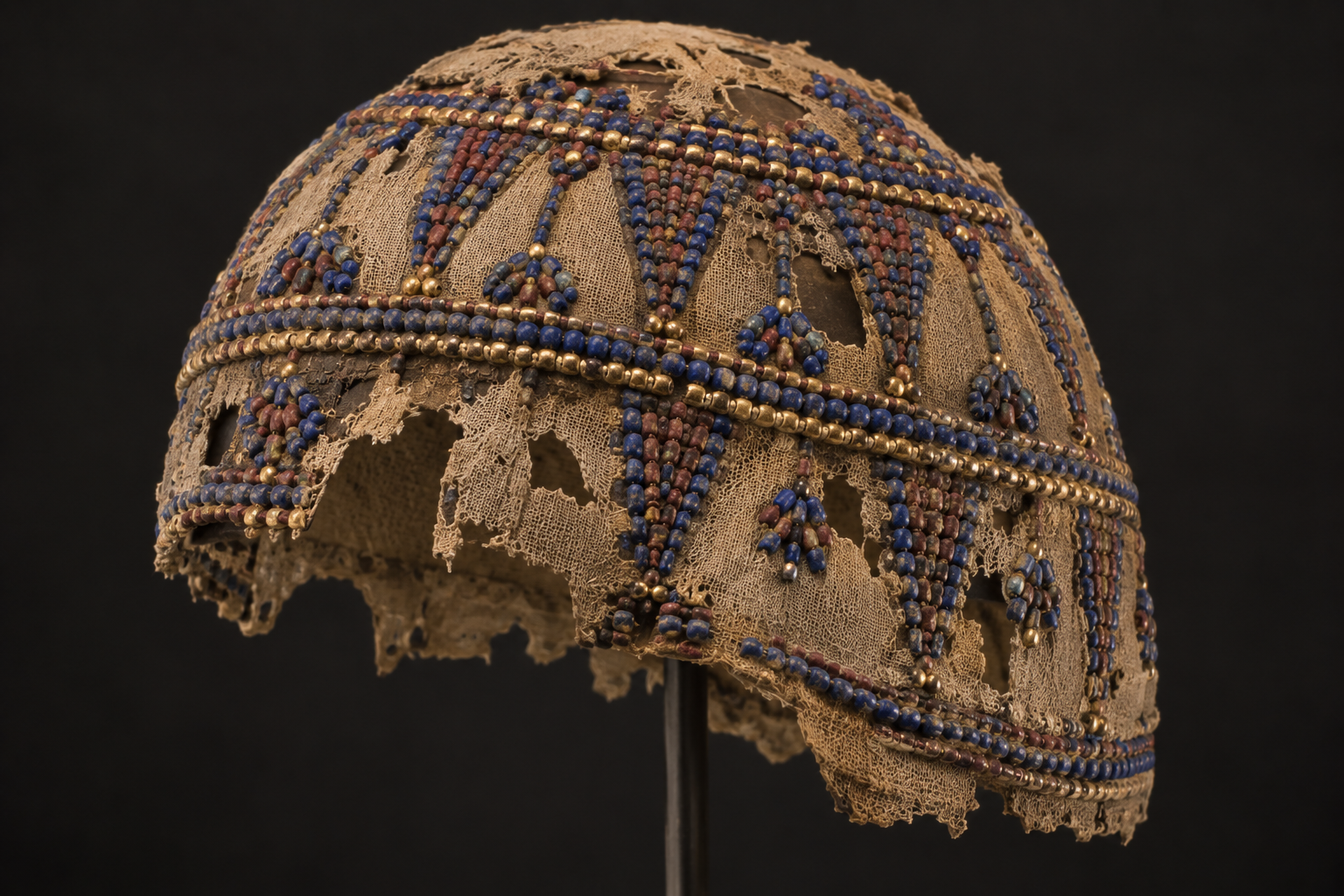
The object also reminds us that “Tutankhamun’s clothes” is a broad modern label. A textile associated with the mummy belongs to a different archaeological context from a folded loincloth stored in a box.
That difference matters.
Clothing and Mummy Wrappings Were Different Things
Perhaps the most important distinction in any discussion of Tutankhamun’s textiles is the difference between clothing and the linen used during mummification.
The king’s mummy was wrapped in linen as part of an elaborate funerary process. Other linen could be used as padding, coverings, or material associated with burial equipment.
Those textiles should not automatically be counted as items from a wardrobe.
The separate embalming cache from KV54 makes this especially clear. It contained linen and other materials connected with the preparation and funeral of Tutankhamun. Some linen bore inscriptions including dates from his reign, while other pieces represented material associated with embalming.
Ancient linen could also have more than one life.
A piece of fabric might begin as clothing or household cloth and later be reused in a funerary context once it was no longer suitable for its original purpose. Other bandages could be woven specifically for mummification.
So when we encounter linen associated with Tutankhamun, the correct first question is not simply “What did he wear?”
It is:
What was this particular piece of linen made to do?
Three categories should remain separate: garments associated with the royal wardrobe, textiles used in the preparation or wrapping of the mummy, and other cloth used to cover, pad, pack, or protect objects within the burial.
Why Were Clothes Buried With Tutankhamun?
Clothing belonged naturally within the larger logic of Egyptian royal burial.
Tutankhamun was not buried with a single symbolic object. KV62 contained an enormous range of equipment: furniture, food provisions, weapons, chariots, containers, jewelry, clothing, and other objects.
Together, these objects participated in preparing the king for continued existence after death.
But it would be misleading to imagine the tomb simply as a storage room filled with everything Tutankhamun had owned during life.
Burial assemblages were selected and organized according to funerary needs. Practical forms could acquire funerary meanings. Some objects might have histories of real use, while others were produced specifically for the burial.
Clothing sits directly inside this complexity.
Garments belonged to ordinary human existence because bodies need clothing. Yet textiles could also play important roles in funerary transformation, wrapping, protection, and burial preparation.
The clothes from KV62 therefore connect two worlds that cannot always be separated neatly: the material world of the living royal court and the carefully prepared world of the royal dead.
Was Ancient Linen Reused?
Yes, and this is an important part of the story.
Linen was valuable. Producing it required resources and labor, so old cloth did not necessarily become useless simply because it was no longer suitable as clothing or household fabric.
Evidence from Egyptian burials shows that worn linen could be reused during mummification. The material associated with Tutankhamun’s embalming cache is particularly useful for understanding this practice.
Some cloth associated with embalming could come from previously used sheets or clothing. Other bandages, however, could be manufactured specifically for funerary use.
This means that signs of wear on linen do not automatically prove that Tutankhamun himself wore it.
A reused textile might have passed through several stages before finally becoming part of the archaeological record.
That complicated history is precisely what makes textiles valuable evidence. They can preserve traces not just of manufacture, but also of use, repair, washing, reuse, and burial.
How Did Linen Survive for More Than 3,000 Years?
The survival of Tutankhamun’s textiles can seem almost impossible.
Linen is organic. Unlike gold or stone, its fibers can weaken, break, decay, or disappear entirely.
The environment of the Egyptian desert helped.
Dry conditions can dramatically slow many forms of organic deterioration. Once the tomb was closed, the textiles were also protected from many of the environmental changes that exposed objects experience above ground.
Darkness reduced light damage. The enclosed environment limited repeated human handling. The burial itself physically sheltered the objects for most of their history.
But survival should never be confused with perfect preservation.
By the time Carter’s team encountered the textiles, many were already fragile. Fibers could be brittle. Areas could be missing. Some cloth had been affected by substances used in the burial. Simply unfolding an ancient textile could create risks that had not existed while it remained undisturbed.
The opening of the tomb therefore marked the beginning of a new preservation problem.
An object that had remained in one environment for thousands of years suddenly had to survive excavation, documentation, conservation, transport, storage, and eventually display.
Why Ancient Textiles Are So Difficult to Preserve
Ancient linen can look deceptively stable in a photograph. In reality, surviving fibers may have lost much of their original strength.
A textile can remain recognizable while becoming extremely vulnerable to movement. Folds create areas of stress. Weak fibers can split under their own weight. Edges may fragment. Previously repaired sections can react differently from untreated areas, and changes in humidity can cause expansion and contraction that are almost invisible until damage occurs.
This is why textile conservation depends so heavily on support and controlled handling.
Modern conservators often try to reduce physical stress rather than make an object look new. A fragile piece may be supported on a stable surface, examined under magnification, photographed carefully, and moved as little as possible.
The goal is not to erase every crease or restore ancient linen to a bright white appearance. Those changes can destroy evidence.
A stain, fold, worn edge, repair, or broken thread may be part of the object’s history.
This challenge became particularly important as Tutankhamun’s collection was studied, moved, stored, and prepared for modern museum display. Organic materials such as linen, leather, and wood required very different treatment from gold or stone.
The broader conservation story is explored in how Tutankhamun’s treasures were preserved for more than a century, where textiles are among the materials that best demonstrate why survival after excavation can be as demanding as survival inside the tomb.
Preservation does not mean making ancient fabric look new. Modern conservation aims to stabilize what survives while protecting evidence such as old folds, stitching, wear, repairs, and original surface condition.
Harry Burton’s Photographs Preserved Fragile Details
Some of the most important evidence for Tutankhamun’s clothing survives not only in the textiles themselves, but also in photographs.
Harry Burton, the principal photographer working on the excavation, documented objects during one of the most difficult archaeological projects of the twentieth century.
His photographs recorded the tomb before objects were removed, but he also photographed individual finds under more controlled conditions after they had been taken from the chambers.
This was especially important for textiles.
A fragile garment can change every time it is unfolded, moved, supported, conserved, or displayed. Burton’s images preserve earlier states of objects that later handling could never reproduce exactly.
The photograph of an unfolded linen loincloth is a good example. The visible creases record how the textile had been folded, while the photograph freezes that condition at a particular moment during the excavation.
For researchers today, the image is therefore more than an illustration.
It is archaeological documentation.
Burton’s contribution to the excavation is explored in more detail in Harry Burton’s photographic record of Tutankhamun’s discovery. His work is particularly valuable for objects whose physical condition has changed during the century since excavation.
What the Clothes Reveal About Ancient Egyptian Craftsmanship
A finished garment hides most of the work required to produce it.
Before a piece of linen reached Tutankhamun’s royal environment, an entire chain of production had already taken place.
Flax had to be cultivated. Harvesting had to occur at the appropriate stage. Fibers had to be extracted and prepared. Thread had to be spun. Looms had to be set up. Weavers had to maintain tension and consistency across long stretches of cloth.
Only then could the textile be transformed into clothing or another finished object.
Fine linen required particular skill because thinner threads and denser, more controlled weaving demanded greater precision.
Decoration added further stages.
Some textiles could incorporate embroidery, woven patterns, beads, colored elements, fringes, or specialized finishing. A decorated head covering such as the skull-cap associated with Tutankhamun’s mummy required coordination between textile production and additional decorative work.
The clothes therefore reveal something that royal inscriptions rarely emphasize: the palace depended on craftspeople.
Royal luxury was produced through labor.
Simple Clothing Could Still Require Expert Work
Even a loincloth should not be dismissed as a primitive piece of fabric.
The simplicity of its shape does not mean the linen itself was simple to produce.
Fine thread, regular weaving, strong edges, and careful finishing all required experience.
The difference between an ordinary textile and an elite-quality one could be embedded in details that modern viewers barely notice.
This is why close examination matters more than spectacular appearance.
The People Missing From the Story
We know Tutankhamun’s name because he was king.
We know Howard Carter because he led the excavation.
We know Harry Burton because his photographs preserved the discovery.
But the people who made most of the clothing are anonymous.
We do not know the names of the farmers who grew the flax used in a particular garment.
We do not know who spun the thread.
We do not know who worked the loom, finished the cloth, decorated a head covering, folded the garments, or packed them into boxes before the tomb was sealed.
Yet their work survives.
Every regular thread preserves skilled control. Every finished edge records a decision. Every carefully folded textile carries evidence of handling by people whose biographies have disappeared.
This creates an important contrast in the archaeology of kingship.
The ruler’s identity is monumentalized, while the people who made his material world often remain invisible.
Objects can partially restore that imbalance.
Tutankhamun’s name survived in gold, but much of the world around him was made by anonymous hands working with linen.
A Wardrobe Is Also an Economic System
Royal clothing was not only a matter of appearance. It also depended on agriculture, labor, storage, administration, and distribution.
Producing large quantities of linen meant producing large quantities of flax.
That required land and workers.
Transforming those fibers into cloth required further specialist labor, and storing completed textiles required organized facilities.
A royal wardrobe was therefore part of a much larger economic system connected with estates, workshops, storerooms, palace administration, and temple institutions.
This becomes especially important when we consider quantity.
More than 140 loincloths are not simply 140 pieces of fabric. Collectively, they represent raw material, agricultural production, spinning, weaving, finishing, transport, storage, and organization.
The clothes from KV62 therefore reveal not only what people could wear, but also the resources required to maintain a royal household.
What Color Were Tutankhamun’s Clothes?
This question sounds simple, but the surviving evidence requires caution.
Natural linen ranges from pale cream to beige and can become darker or more discolored through age, burial conditions, staining, and conservation history.
Ancient Egyptian clothing is often shown as brilliant white in modern reconstructions. Clean, pale linen was certainly important, but modern illustrations can exaggerate uniform whiteness.
Some textiles could also be decorated with colored elements, woven patterns, beads, embroidery, or other additions.
What survives today may not perfectly reproduce the appearance of a garment when it was new.
Dyes can fade. Fibers darken. Decorative elements disappear.
For that reason, archaeologists cannot simply look at the present color of a 3,000-year-old textile and assume that this is exactly how the garment appeared in Tutankhamun’s lifetime.
How Clothing Could Change From Practical to Funerary
The distinction between daily life and burial becomes particularly interesting when familiar clothing forms are reproduced or transformed for funerary use.
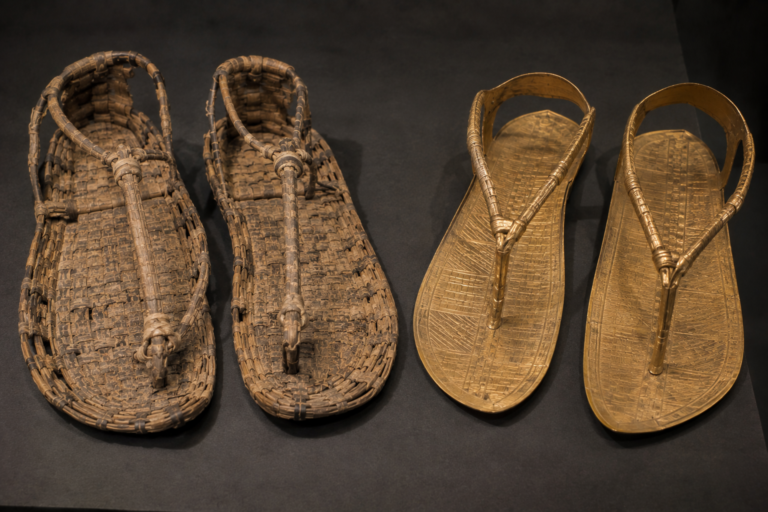
Tutankhamun’s sandals provide an excellent parallel.
Some footwear in the tomb was made from practical materials associated with real sandals, while the gold sandals placed on the mummy reproduced the form of footwear in a material unsuitable for ordinary walking.
Textiles could move through similar conceptual boundaries.
A piece of clothing could have a practical history before burial. Another garment might be produced specifically for funerary use. Ordinary linen could be reused in embalming. Familiar forms could therefore enter the tomb through very different routes.
This is why the entire burial cannot be reconstructed as though Carter had simply opened Tutankhamun’s bedroom wardrobe.
KV62 was a prepared royal tomb, not an untouched palace storeroom.
The Storage of Clothing Matters
How a textile was stored can tell us almost as much as what the textile was.
Folded clothes placed inside boxes indicate organization.
The existence of fold lines can reveal how fabric was compressed or arranged. Groups of similar items may show that certain categories were stored together.
Containers also protected textiles physically, although the pressure of other objects or long periods of compression could create damage of its own.
During excavation, documenting these relationships was crucial.
Once objects were separated from their original containers, some archaeological information could never be reconstructed from the artifact alone.
This is why Carter’s detailed cataloguing of the objects from KV62 remains so important. Object cards, photographs, plans, and excavation notes help modern researchers reconnect individual finds with their original archaeological context.
Clothing Could Also Carry Identity and Status
Clothing does more than cover the body.
It can communicate age, occupation, rank, gender, occasion, wealth, and institutional role.
That was true in ancient Egypt as well.
Royal costume in formal imagery was carefully controlled because dress helped communicate kingship. Particular crowns, headdresses, kilts, jewelry, and ceremonial elements signaled authority and context.
But the garments inside Tutankhamun’s tomb remind us that identity also operated through less spectacular materials.
The quality of linen could signal wealth. Fine workmanship could distinguish elite production. Decoration could transform a simple textile form into something appropriate for the royal court.
This means we should not divide ancient clothing too simplistically into “plain everyday clothes” and “luxury royal clothes.”
Status could exist inside the fabric itself.
What the Tomb Cannot Reconstruct
Despite the remarkable survival of textiles, Tutankhamun’s complete wardrobe is lost.
The clothes in KV62 represent only what was selected, preserved, and eventually discovered.
Garments worn regularly during life may have worn out long before his death.
Some textiles may have remained elsewhere in the palace or royal storerooms.
Others could have been reused, given away, altered, or discarded.
Organic materials that once existed may simply have decayed.
The archaeological collection is therefore not a complete inventory of everything Tutankhamun ever wore.
It is a surviving sample shaped by burial practice, preservation, and historical chance.
Archaeological survival is selective. The garments found in KV62 tell us what entered and survived in the tomb, not the complete history of Tutankhamun’s wardrobe during his lifetime.
What Tutankhamun’s Clothes Cannot Tell Us
Clothing feels personal, which makes it especially easy to overinterpret.
The surviving textiles cannot reliably tell us Tutankhamun’s favorite color.
They cannot identify his favorite garment.
They cannot reconstruct exactly what he wore on an ordinary morning in the palace.
They cannot prove that every piece found in his tomb once touched his body.
Even differences in size do not automatically provide a chronological sequence of his childhood and adolescence.
What they can reveal is more secure and ultimately more useful.
They show that fine linen formed an important part of the royal material environment.
They preserve examples of garment construction.
They reveal storage practices.
They demonstrate the enormous amount of skilled labor hidden behind apparently simple clothing.
They also document the way textiles could move between daily, ceremonial, and funerary contexts.
| Textile Type | Possible Function | What It Can Reveal |
|---|---|---|
| Loincloths | Basic clothing or undergarments | Garment form, linen quality, construction, storage, and clothing practices |
| Garments | Everyday, elite, or ceremonial clothing | Royal wardrobe traditions and textile craftsmanship |
| Shawls and coverings | Dress, covering, or other practical use | Weaving, dimensions, finishing, and textile use |
| Head coverings | Dress or funerary equipment | Fine linen construction and decorative techniques |
| Mummy wrappings | Funerary preparation | Embalming and royal burial practices |
| Textile covers and padding | Protection, packing, or funerary use | How burial equipment was prepared and protected |
| Reused linen | Secondary practical or embalming use | The economic value and multiple lives of ancient textiles |
Why These Clothes Matter More Than They Look
Gold is designed to endure.
Linen is not.
That difference changes the way we should think about rarity.
A gold object can survive burial with much of its basic material intact. A textile depends on a much narrower range of environmental conditions. Organic fibers can disappear completely, leaving no obvious trace that a garment ever existed.
When ancient linen survives, it preserves information that monumental objects cannot replace.
It preserves scale.
It preserves construction.
It can preserve stitching, folds, wear, repairs, decoration, and sometimes the traces of storage.
In the case of Tutankhamun, those details help us move beyond the image of a king surrounded entirely by precious metal.
They reveal a royal environment built just as much from plant fibers and human labor as from gold.
Frequently Asked Questions
What clothes were found in Tutankhamun’s tomb?
The burial contained substantial textile material, including folded clothing and more than 140 triangular loincloths, along with other garments, head coverings, textile accessories, mummy wrappings, and cloth used in funerary preparation. Not every textile should be classified as personal clothing.
Did Tutankhamun’s actual clothes survive?
Clothing associated with his burial survived, and some pieces may have belonged to his wardrobe or been used before burial. However, archaeologists cannot prove personal use for every individual garment found in KV62.
What were Tutankhamun’s clothes made from?
Linen, produced from flax, was the principal textile material. Its quality could vary from relatively simple cloth to extremely fine fabric requiring highly skilled spinning and weaving.
How many loincloths were found in Tutankhamun’s tomb?
More than 140 triangular loincloths were found among boxes of folded clothing in the burial assemblage. They are among the clearest examples of basic clothing forms preserved in KV62.
Did Tutankhamun wear linen?
Linen was fundamental to ancient Egyptian clothing and formed the main textile material in the burial collection. Some garments may have been part of Tutankhamun’s wardrobe, although individual use cannot always be demonstrated.
Did Tutankhamun wear white clothes?
Fine pale linen was characteristic of ancient Egyptian clothing, but surviving textiles have changed through age and burial. Their modern color does not necessarily reproduce exactly how they looked when new, and some clothing could include decoration or colored elements.
Were children’s clothes associated with Tutankhamun?
Small textile items associated with Tutankhamun have prompted discussion about possible childhood use, including material from the separate KV54 embalming cache. Size alone, however, cannot prove that the young king personally wore a particular piece.
What did ancient Egyptian kings wear?
Royal clothing varied by context. Kings could wear linen kilts, loincloths, tunic-like garments, shawls, belts, head coverings, ceremonial dress, and formal regalia. Monumental images emphasize official royal appearance and do not represent every aspect of ordinary clothing.
Why were clothes placed in Tutankhamun’s tomb?
Clothing formed part of the extensive equipment prepared for the king’s burial and continued existence after death. Some textiles may have had practical histories before burial, while others were connected specifically with funerary preparation.
How did Tutankhamun’s clothes survive for more than 3,000 years?
The dry Egyptian environment and the protected conditions inside the sealed tomb helped slow organic decay. Even so, many surviving textiles were extremely fragile when discovered and required careful conservation.
Are Tutankhamun’s mummy wrappings the same as his clothes?
No. Mummy wrappings were part of the embalming and funerary process. They should be distinguished from garments stored as clothing, although ancient linen could sometimes be reused for different purposes.
Can the clothes tell us what Tutankhamun was like as a person?
Only indirectly. The textiles can reveal his royal material environment, clothing technology, craftsmanship, burial preparation, and possibly aspects of use. They cannot reliably establish his personality, preferences, or favorite clothes.
Final Thoughts
The clothes found with Tutankhamun do not have the visual power of his gold mask, but they preserve something the mask cannot.
They preserve the scale of ordinary human life.
A piece of linen had to be grown from flax, spun, woven, finished, handled, folded, stored, and eventually placed within the burial.
More than three thousand years later, some of those actions can still be detected in the material itself.
The most striking example may be one of the simplest: an old crease across a linen loincloth.
Someone folded that fabric in antiquity.
We do not know that person’s name. We cannot reconstruct the exact moment. We cannot even prove that Tutankhamun himself had worn that particular piece.
But the fold survived.
And in a collection famous for gold, that fragile line in ancient linen may be one of the quietest and most human traces of the world that surrounded the young king.