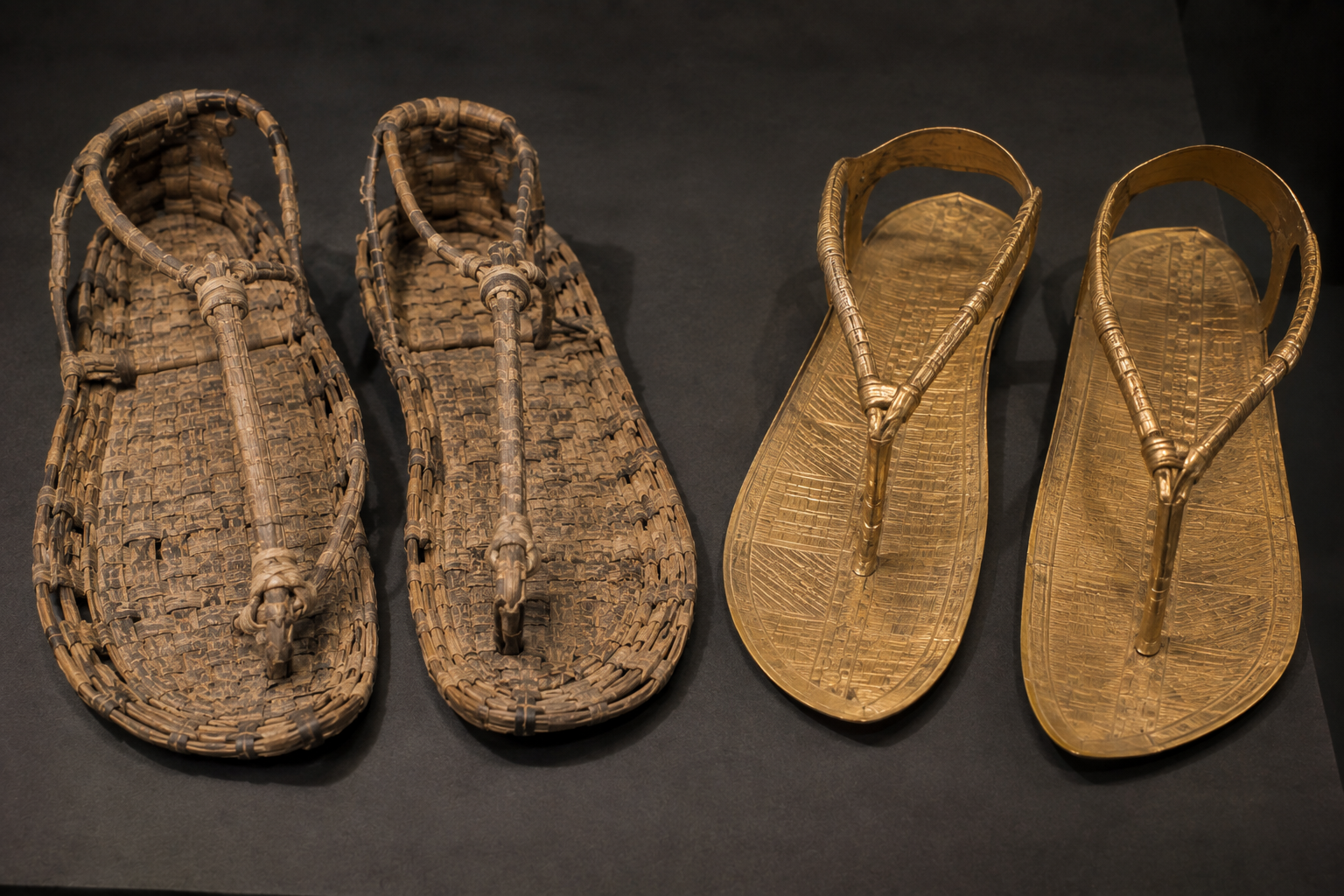

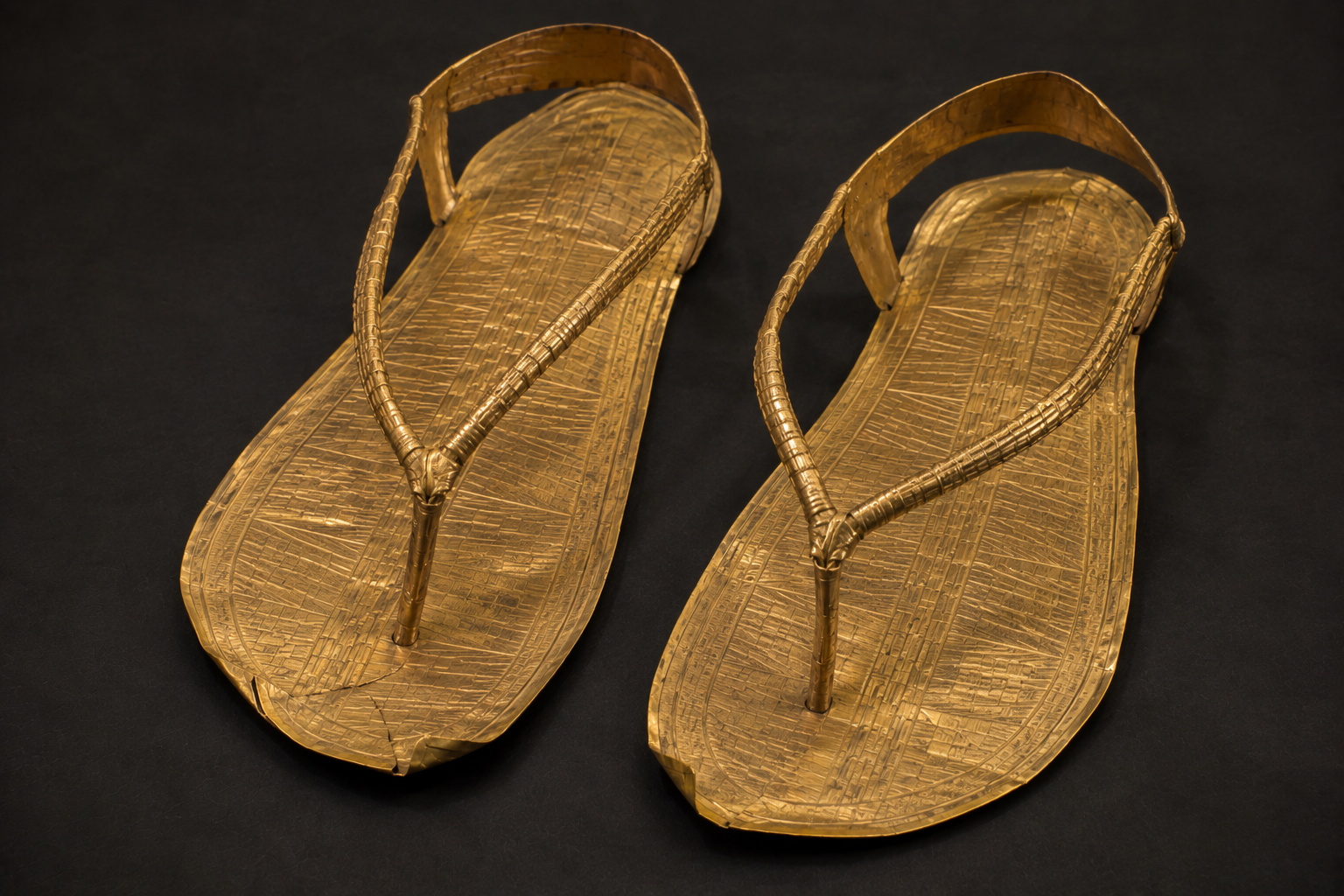
Tutankhamun was buried wearing sandals he could never have walked in. Made from thin sheets of gold, they were placed directly on the young king’s feet before his body was wrapped. Their form resembled real Egyptian footwear, but their material belonged to a very different world: the carefully prepared world of royal burial.
Elsewhere in the tomb, however, were sandals made from materials associated with actual footwear, including plant fibers and leather. The entire collection was remarkably varied. Tutankhamun was buried with roughly three dozen pairs of footwear, together with more than a dozen individual pieces, ranging from relatively practical forms to exceptionally elaborate creations.
Together, these objects tell a richer story than the famous gold pair alone. They reveal how ancient Egyptian sandals were constructed, how ordinary forms could become royal objects, how craftsmen combined different materials, and how dangerous it can be to use footwear as simple proof of Tutankhamun’s health or personal habits. In one tomb, the humble sandal connected daily life, royal status, craftsmanship, and death.
Quick Context
- King: Tutankhamun
- Dynasty: Eighteenth Dynasty
- Period: New Kingdom
- Tomb: KV62, Valley of the Kings
- Discovery: 1922
- Footwear collection: Approximately 35 pairs plus more than a dozen individual pieces
- Materials: The collection included plant-fiber, leather, and highly elaborate footwear, as well as the famous sheet-gold funerary sandals
- Gold sandals: Carter object 256.ll
- Position: Directly on the mummy’s feet
- Recorded sandal length: Approximately 29.5 cm
- Recorded length of the mummy’s right foot: Approximately 24.2 cm
- Key distinction: The gold sandals were funerary objects, not practical shoes for walking
A Shoe Collection Hidden Inside KV62
When people imagine the objects discovered in Tutankhamun’s tomb, footwear rarely comes first.
The gold mask, nested coffins, jewelry, chariots, furniture, weapons, and ceremonial objects dominate the modern image of KV62. Yet the tomb also preserved an unusually rich collection of footwear.
This matters because sandals belong much closer to the human body than many monumental objects do.
A throne communicates royal status. A ceremonial object may express authority or burial beliefs. A sandal has to interact physically with a foot.
Its sole has to support the wearer. Its straps have to hold it in place. Its materials have to bend or resist pressure. If it was actually used, repeated movement may eventually affect its shape and surface.
That makes footwear potentially valuable evidence for ancient daily life.
But Tutankhamun’s collection is particularly interesting because not all of it belongs to the same functional category. Some footwear resembles objects that could serve practical purposes. Other pieces are so elaborate that function and symbolism become intertwined. And the gold sandals placed on the mummy were not practical footwear at all.
The collection therefore cannot be interpreted simply as the contents of the king’s shoe closet transferred unchanged into his tomb.
Inside Tutankhamun’s tomb, the same basic object could belong to everyday life, royal display, or burial.
How Many Sandals Were Found With Tutankhamun?
Modern research on Tutankhamun’s footwear describes a surprisingly large collection: approximately 35 pairs, together with more than a dozen individual pieces.
That figure includes different forms and materials, which is why the collection is more informative than a simple count might suggest.
It also creates an immediate interpretive problem.
Does a large quantity of footwear mean Tutankhamun personally wore all of it?
No.
Objects in a royal tomb could arrive there through different histories. Some may have been used during life. Others may have been specially prepared or selected for burial. Elaborate objects could carry symbolic functions that went beyond ordinary use.
Condition also varies. An apparently functional sandal is not automatically proof of personal use by the king, just as an unworn object does not necessarily tell us when it was made or why it was selected.
This is the same distinction that matters when examining the clothes found inside Tutankhamun’s tomb. Archaeological association is powerful evidence, but it does not turn every object into a documented personal possession.
Important: “Found in Tutankhamun’s tomb” does not automatically mean “worn by Tutankhamun during life.” Construction, condition, wear, archaeological context, and function all have to be considered.
Most Were Nothing Like the Gold Sandals
The fame of Tutankhamun’s burial can create the impression that his footwear was dominated by gold.
It was not.
The broader collection included sandals made using organic materials such as plant fibers and leather, alongside much more elaborate examples incorporating precious or decorative materials.
This range is important because it shows that “royal footwear” was not one fixed category.
A woven sandal and a sheet-gold funerary sandal could share a recognizable basic form while being completely different in function.
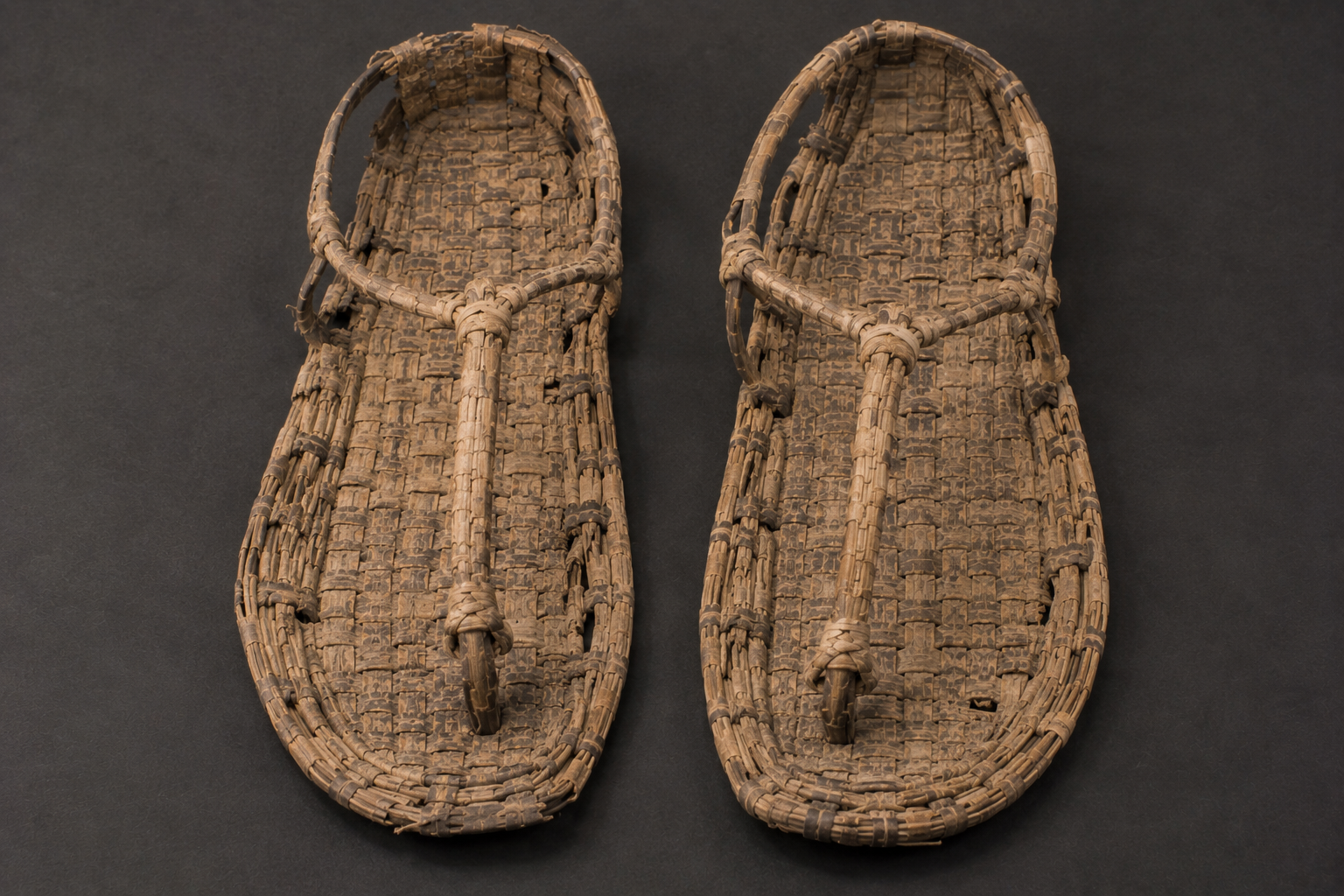
Plant-fiber footwear belonged to a long Egyptian tradition. Surviving New Kingdom examples from other contexts show that sandals could be constructed from combinations of materials including papyrus, palm leaf, grass, and reeds. The precise materials and construction varied between examples.
Leather offered another technological approach. It could be cut and shaped rather than woven, and elaborate leather footwear could become a surface for complex decoration.
At the farthest end of the spectrum were the gold sandals placed with Tutankhamun’s mummy.
They looked like sandals.
But they were not shoes in the practical sense.
How Ancient Egyptian Sandals Were Made
Some ancient Egyptian sandals demonstrate how much engineering can be hidden inside an apparently simple object.
A plant-fiber sole had to be strong enough to separate the foot from the ground while remaining sufficiently flexible for movement. Fibers could be bundled, woven, plaited, or sewn together depending on the construction method.
Straps then had to secure the sole to the foot.
A common arrangement involved a front strap associated with the area between the toes and additional straps connected toward the sides or rear of the sandal. Construction varied, and surviving footwear shows that ancient Egyptian craftspeople developed more than one solution to the same practical problem.
Comparative New Kingdom footwear illustrates the range of available materials particularly well. Sandals from the tomb of Yuya and Tjuyu, Tutankhamun’s great-grandparents, were made from plaited grass and reeds, with straps of split papyrus.
Such examples are useful comparisons, but they should not be used to claim that every woven sandal in Tutankhamun’s collection had exactly the same composition.
The broader lesson is more important.
Ancient Egyptian sandals could turn inexpensive plant material into carefully engineered footwear through skilled preparation and construction.
What a Practical Sandal Can Reveal
Practical footwear can preserve several different kinds of archaeological evidence.
Construction reveals technology.
The arrangement of fibers shows how a sole was built. Strap attachments reveal how the sandal was secured. Repairs can potentially show that keeping an object in service was worthwhile.
Wear can be even more intriguing.
If a sandal was repeatedly used, friction and pressure may affect particular parts of the sole or straps. Organic materials can deform. Surfaces can become abraded. Structural weaknesses can develop where the same areas were repeatedly stressed.
But this evidence has limits.
Ancient footwear has also undergone more than three thousand years of aging, burial, excavation, conservation, storage, and handling. Damage visible today is not automatically ancient wear.
Researchers therefore have to distinguish between manufacture, use, deterioration, excavation damage, and later changes whenever possible.
This is why sandals are so valuable but also so easy to overinterpret.
A worn sandal can provide evidence of use, but wear alone does not identify the wearer. Even an object from a royal tomb needs additional evidence before it can be treated as something personally worn by the king.
Did Tutankhamun Actually Wear His Sandals?
Some footwear from the tomb belongs to types that were capable of practical use, and researchers have examined the collection for evidence of wear.
That makes it reasonable to discuss the possibility that some pieces belonged to Tutankhamun’s wardrobe during life.
It does not make every pair his documented personal footwear.
A royal household was a complex environment. Objects could be produced in workshops, stored, transferred, repaired, reused, or prepared for ceremonial and funerary purposes.
The tomb itself was also a burial assemblage rather than an ordinary domestic room.
This distinction becomes particularly obvious when we compare practical sandals with the pair found directly on the mummy.
Those gold sandals leave almost no ambiguity about their primary function.
They were made for burial.
The Gold Sandals Were Different
During the examination and unwrapping of Tutankhamun’s mummy in 1925, Carter’s team encountered an extraordinary set of objects associated directly with the king’s body: gold finger and toe stalls and a pair of gold sandals.
Carter catalogued the group as object 256.ll.
His record describes the sandals as being made from sheet gold. The soles were worked so that their surface imitated the appearance of rushwork, while details on the straps imitated cord.
This is the key to understanding them.
The craftsmen did not invent a completely new form of royal footwear simply because they were working in gold.
Instead, they reproduced features of real sandals in a material that transformed their function.
The Metropolitan Museum of Art’s documentation of Harry Burton’s photographs makes the distinction explicit: the gold sandals were created specifically for burial and would have been impossible to walk in normally.
They were representations of functional footwear rather than functional footwear themselves.
Why Make Sandals From Gold?
The answer becomes clearer when we stop treating the gold sandals as luxury versions of ordinary shoes.
Their purpose was different.
Tutankhamun’s burial equipment repeatedly transformed recognizable objects and forms through precious materials and exceptional craftsmanship. Objects associated with the body, clothing, jewelry, protection, status, and royal identity all participated in the carefully constructed burial.
The gold sandals fit within that wider system.
Their shape retained a connection with footwear from life, but practical requirements no longer controlled the choice of material.
A sandal normally has to survive repeated bending, pressure, abrasion, and contact with the ground.
A thin sheet-gold funerary sandal did not.
It needed to function within the burial.
This difference explains why describing them simply as “Tutankhamun’s gold shoes” can be misleading. The phrase sounds as though the young king walked around his palace wearing them.
The archaeological evidence tells a much more interesting story.
The form came from the world of the living. The material and function belonged to the royal burial.
The Sandals Were Placed Directly on the Mummy
Carter’s object card records the position of the gold sandals with remarkable simplicity: upon the feet.
They were not stored in a box elsewhere in the tomb.
They were physically incorporated into the treatment of Tutankhamun’s body before the mummy was completely wrapped.
The gold finger and toe stalls associated with the same catalogue group were likewise placed directly on the digits. Carter recorded that the individual fingers and toes had first been wrapped in fine linen before the gold stalls were fitted.
This context makes the sandals fundamentally different from footwear discovered elsewhere among the burial equipment.
Their archaeological position is itself evidence of function.
They belonged to the prepared royal body.
Why Were the Gold Sandals Folded?
One of the most revealing details in Carter’s record is also one of the least spectacular.
Parts of the gold sandals had been folded.
Carter noted that the heels, edges, and toe areas of the soles had been turned over so that the sandals would not occupy too much space while the mummy was being wrapped.
This detail is extraordinary because it shows the practical realities behind an elaborate royal burial.
The sandals were precious funerary objects, but they still had to fit within a physical arrangement of feet, linen wrappings, jewelry, amulets, and other elements surrounding the mummy.
The burial team adapted the objects to that constraint.
For modern viewers, the folds can initially look like damage or deformation. Carter’s record provides the crucial context: at least some of that distortion was connected with the ancient wrapping process itself.
This is exactly why his documentation remains so important. As explored in Carter’s catalogue of the objects from Tutankhamun’s tomb, measurements and observations recorded during excavation can preserve information that the object alone may not explain.
A Gold Copy of an Everyday Shoe
The gold sandals preserve a fascinating contradiction.
They are extraordinary objects made from precious metal, yet their design deliberately imitates a much more ordinary technology.
Carter observed that the soles were chased to resemble rushwork. The straps were treated to resemble cord.
Harry Burton’s photographs make that relationship easier to understand because the gold footwear can be compared with plant-fiber sandals from the wider tomb collection.
The Metropolitan Museum of Art similarly notes that their shape mimics footwear made from plant material and used in life.
This means the gold pair did not reject everyday material culture.
It preserved its form.
A familiar object was translated into another material for another purpose.
That transformation is one reason Tutankhamun’s sandals are so informative. They connect ordinary technology with royal funerary practice in a way that a completely abstract ceremonial object could not.
The Sandals Decorated With Egypt’s Enemies
Not all of Tutankhamun’s remarkable footwear depended on gold.
Some elaborate sandals incorporated complex decoration, including images of foreign enemies beneath the king’s feet.
This was not simply decoration for decoration’s sake.
Egyptian royal imagery repeatedly represented the king as victorious over foreign enemies and as the defender of order. Placing enemy figures beneath royal feet turned the physical relationship between foot and ground into a political image.
The concept could therefore work on two levels at once.
A sandal remained recognizable as footwear, while its decoration participated in the visual language of kingship.
But again, function needs to be handled carefully.
The presence of elaborate sandals in the tomb does not prove that Tutankhamun regularly walked through the palace wearing every decorated pair. Some may have had ceremonial, symbolic, elite, or funerary significance beyond ordinary footwear.
The safest conclusion is also the more interesting one: ancient Egyptian craftspeople could transform the surface beneath a king’s feet into another place where royal authority was expressed.
Do the Sandals Prove Tutankhamun Had Trouble Walking?
This question has become especially important because discussions of Tutankhamun’s health are often connected with the large number of walking sticks and other objects in his tomb.
Footwear has also entered that debate.
Modern study of the collection has noted the absence of clear asymmetrical wear across Tutankhamun’s footwear. That observation has been used to question the idea that the sandals preserve straightforward evidence of a pronounced limp.
But the conclusion must remain carefully limited.
The sandals do not provide a medical diagnosis.
The absence of obvious asymmetrical wear does not prove that Tutankhamun had perfect mobility or no health problems. Likewise, the mere presence of many sandals cannot demonstrate a walking impairment.
Health questions require multiple forms of evidence, including examination of the mummy and skeletal remains, and even those interpretations can be debated as methods and evidence are reassessed.
What the footwear can tell us: researchers can examine construction, wear, symmetry, dimensions, repairs, and deformation. What it cannot do by itself: establish a definitive diagnosis of Tutankhamun’s health or mobility.
What Wear Patterns Can and Cannot Tell Us
Wear patterns are attractive evidence because they seem to bring us directly into contact with an ancient wearer.
Sometimes they can.
Repeated pressure may alter a sole. Straps can stretch or weaken. Particular areas may become more abraded than others.
If similar patterns appear consistently across securely associated footwear, researchers can ask whether they reflect repeated movement or aspects of how the footwear was used.
But several questions must come first.
Is the apparent wear genuinely ancient?
Was the sandal actually worn?
Can the wearer be identified?
Could deformation have resulted from storage in the tomb?
Could excavation or later conservation have changed the object’s shape?
Without those questions, a worn surface can quickly become the basis for a story the evidence cannot support.
Tutankhamun’s sandals are therefore useful precisely because they teach us to separate observation from interpretation.
Why Sandal Size Is Not Enough
Measurements can seem like the simplest path from an ancient sandal to the person who wore it.
In practice, they are more complicated.
Carter recorded the gold funerary sandals at approximately 29.5 centimeters in length, while the right foot of Tutankhamun’s mummy was recorded at approximately 24.2 centimeters.
That difference does not mean the sandals were “too large” in the modern sense.
They were not ordinary fitted shoes. They were funerary objects made from thin sheet gold, and parts of them were folded during the wrapping of the mummy.
Using those measurements to calculate a modern shoe size would therefore be misleading.
The same caution applies to other ancient footwear.
A sandal sole may extend beyond the foot. Straps may affect how it was worn. Organic materials can shrink, deform, split, or change shape over thousands of years.
Measurements are valuable archaeological data, but they need context.
A sandal length is not automatically a modern shoe size. Construction, function, deformation, and the relationship between the foot and the sole all have to be considered.
Were Ancient Egyptian Sandals Made for a Left and Right Foot?
Ancient Egyptian footwear did not follow one single construction system across all periods and materials.
Some sandals could appear broadly symmetrical, especially when viewed without the foot inside them. Other examples were shaped or constructed in ways that created differences between the two sides.
Strap placement, sole construction, material, and wear could all affect the final shape.
This makes it risky to impose modern footwear expectations on the archaeological material.
A modern shoe is usually strongly shaped for one foot before it is ever worn. Ancient sandals could depend more heavily on the flexibility of the sole and the arrangement of straps.
Repeated use could then create further differences as the sandal adapted to the body and movement of its wearer.
For Tutankhamun’s collection, the important point is not whether every pair looked exactly like modern left and right shoes.
It is that Egyptian craftspeople had multiple technical solutions for keeping footwear secure and functional.
Were Egyptians Always Barefoot?
No.
Ancient Egyptian art sometimes shows people without footwear, while other scenes and archaeological finds clearly demonstrate the use of sandals.
Both images belong to reality.
Whether someone wore sandals could depend on social setting, activity, environment, status, and historical period.
Footwear itself could also communicate status. A simple plant-fiber sandal and an elaborately decorated royal example occupied very different positions within the material culture of Egypt.
This is why the question “Did Egyptians wear sandals?” is too broad to be useful on its own.
The better questions are:
Who was wearing them?
Where?
For what activity?
And what kind of sandals were they?
The Craftspeople Behind Tutankhamun’s Footwear
Every surviving sandal preserves evidence of someone else’s work.
Plant materials had to be collected and prepared before they could be woven or bound into a sole.
Leather required an entirely different process of preparation, cutting, shaping, and joining.
Decorated footwear could demand additional specialists capable of working with leather, beads, glass, faience, precious materials, or complex surface designs.
The gold funerary sandals required metalworkers who understood how to shape thin sheet gold while imitating the appearance of woven plant material.
That imitation is itself evidence of technical observation.
The craftspeople making the gold pair had to understand what real sandals looked like well enough to reproduce their visual language in metal.
Royal objects therefore preserve not only wealth, but knowledge.
Behind every finished sandal was a chain of decisions about material, structure, appearance, and function.
Tutankhamun’s sandals tell us about the king, but they also preserve the skill of people whose names were never recorded.
The Materials Tell Different Stories
One of the strengths of Tutankhamun’s footwear collection is the contrast between materials.
Plant fibers speak to availability, flexibility, weaving, and practical construction.
Leather reflects another craft tradition based on cutting, shaping, stitching, and surface treatment.
Decorative materials could add visual status and symbolic meaning.
Gold removed the object from ordinary function almost entirely.
The same basic object category could therefore carry very different meanings depending on what it was made from.
| Footwear Type | Material | Likely Role | What It Can Reveal |
|---|---|---|---|
| Woven sandals | Plant fibers | Practical footwear | Fiber preparation, weaving, construction, possible wear, and everyday footwear technology |
| Leather sandals | Leather | Practical or elite footwear | Leatherworking, stitching, shaping, decoration, and possible use |
| Elaborately decorated sandals | Mixed materials | Elite, ceremonial, symbolic, or funerary | Royal imagery, specialist craftsmanship, and status |
| Gold funerary sandals | Sheet gold | Burial | The transformation of practical forms into royal funerary equipment |
| Single or damaged pieces | Various | Uncertain | Construction methods, preservation, and potentially object histories |
Footwear Was Part of a Larger Royal Wardrobe
The sandals make the most sense when viewed alongside the rest of Tutankhamun’s clothing.
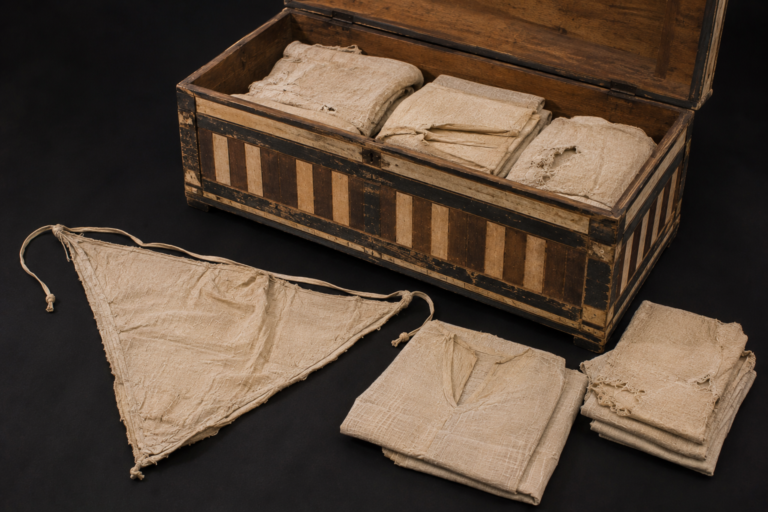
KV62 preserved more than 140 linen loincloths, additional garments, head coverings, and other textiles alongside footwear.
Together, these objects show that the royal burial contained far more than spectacular ceremonial equipment.
It also contained the material forms associated with dressing the body.
Clothing and footwear therefore form one of the strongest links between the king as a monumental figure and the king as a human being who inhabited a physical body.
The difference is that the tomb also transformed those ordinary needs.
A loincloth could be folded into a box.
A sandal could be woven from plant fibers.
But footwear could also be recreated in gold and placed directly on the mummy.
The same basic world of clothing moved between life and burial.
One Tomb Preserved Different Worlds of Footwear
Tutankhamun’s collection becomes most revealing when its contrasts are kept intact.
It would be easy to focus only on the most elaborate pieces.
But the humble and luxurious examples explain each other.
Without real woven sandals, the imitation rushwork on the gold pair loses much of its meaning.
Without the gold pair, it is harder to see how an everyday form could be transformed for royal burial.
Without the decorated footwear, we might miss how the surface of a sandal could also become a place for political imagery.
Without the worn or practical examples, the collection would tell us much less about actual footwear technology.
KV62 preserved all of these levels together.
That is what makes the collection exceptional.
Why Footwear Matters to Archaeologists
Shoes and sandals rarely dominate museum galleries, but archaeologically they can be extraordinarily informative.
They combine technology with the human body.
A vessel can reveal storage or consumption.
A weapon can reveal craftsmanship and military technology.
A sandal may preserve direct mechanical relationships with movement.
Its sole interacts with the ground.
Its straps interact with skin.
Its construction has to account for balance, pressure, and flexibility.
This does not mean footwear tells us everything about its wearer.
It means that when the evidence is preserved well enough, it can answer questions that other object categories cannot.
What Preservation Can Change
Organic footwear is especially vulnerable after excavation.
Plant fibers can become brittle.
Leather can dry, stiffen, crack, or distort.
Composite decorations may contain materials that react differently to changing humidity and temperature.
An object that survived inside the tomb for thousands of years can therefore become more vulnerable once its environment changes.
This is why modern conservation emphasizes stability rather than trying to make ancient sandals look new.
Wear, deformation, broken fibers, staining, and ancient repairs may all contain evidence.
Removing or disguising them can erase part of the object’s history.
The conservation challenges surrounding such materials are closely connected with the broader story of how Tutankhamun’s treasures have been preserved since their discovery.
Harry Burton Preserved Another Version of the Sandals
Many people know Tutankhamun’s objects through modern museum photographs.
But Harry Burton’s excavation photographs preserve something different.
They show objects much closer to the moment of discovery and documentation.
For fragile footwear, that matters.
Plant fibers, leather, straps, and damaged areas can change through conservation and handling. A photograph taken during the excavation may preserve an earlier arrangement or condition that is no longer physically recoverable.
The gold sandals also benefited from Burton’s documentation because their deformation and position could be interpreted alongside Carter’s written records.
This relationship between object card and photograph is one of the strongest features of the Tutankhamun archive.
It is also why Harry Burton’s photographs of Tutankhamun’s discovery remain archaeological evidence rather than simply historical images.
What Tutankhamun’s Sandals Cannot Tell Us
The footwear is rich in evidence, but it has clear limits.
It cannot identify Tutankhamun’s favorite pair.
It cannot tell us exactly how many sandals he personally wore during life.
It cannot establish how far he normally walked each day.
It cannot convert a sandal length directly into a reliable modern shoe size.
It cannot prove that every damaged area represents ancient wear.
It cannot establish a medical diagnosis on its own.
And the gold funerary sandals cannot be treated as examples of shoes the king walked in while alive.
Those limitations do not weaken the archaeological value of the collection.
They make the conclusions more precise.
The strongest interpretation is often the narrowest one. Tutankhamun’s footwear can reveal materials, construction, decoration, burial practice, and some evidence of use without being turned into a complete biography of how the king walked or dressed every day.
Why These Sandals Matter
The sandals from Tutankhamun’s tomb sit at an unusual intersection of daily life and royal ideology.
They are familiar objects.
Almost everyone understands what footwear is supposed to do.
That familiarity makes the gold pair especially powerful.
We immediately recognize their form as sandals, and we immediately understand why thin sheet gold changes their function.
The craftsmen relied on that recognition.
They reproduced the visual language of woven footwear while transforming the object into something appropriate for burial.
The practical and funerary worlds therefore remained connected.
The gold sandals did not abandon the everyday form.
They preserved it.
Frequently Asked Questions
How many sandals were found in Tutankhamun’s tomb?
Modern specialist studies describe approximately 35 pairs of footwear together with more than a dozen individual pieces. The collection includes different materials and types, so not every item had the same function.
Did Tutankhamun actually wear the sandals found in his tomb?
Some practical footwear may have been used during life, and researchers have examined the collection for wear. However, not every pair can be proven to have been personally worn by Tutankhamun.
Were Tutankhamun’s sandals made of gold?
Only some were. The famous funerary pair placed on the mummy was made from thin sheet gold, while the broader footwear collection included plant-fiber, leather, and elaborately decorated examples.
Could Tutankhamun walk in his gold sandals?
No. The gold sandals were created specifically for burial and were not practical footwear for ordinary walking.
What were Tutankhamun’s practical sandals made from?
The collection included organic footwear made using plant fibers and leather. Ancient Egyptian sandals more generally could use materials such as papyrus, palm, grass, reeds, and leather, although the exact construction varied from one object to another.
Why were gold sandals placed on Tutankhamun’s mummy?
They formed part of the royal funerary equipment placed directly on the body. Their form imitated real sandals, but their material and function belonged to the burial rather than ordinary life.
How big were Tutankhamun’s gold sandals?
Carter recorded them at approximately 29.5 centimeters long. The mummy’s right foot was recorded at approximately 24.2 centimeters. Because the sandals were funerary objects, this should not be converted directly into a modern shoe size.
Why were parts of the gold sandals folded?
Carter recorded that the heels, edges, and toe areas had been folded so that the sandals would occupy less space within the mummy wrappings.
Did Tutankhamun have leather sandals?
Leather footwear formed part of the broader collection from KV62, including elaborate examples that demonstrate sophisticated leatherworking and decoration.
Did his sandals show signs of wear?
Researchers have examined parts of the footwear collection for wear and deformation. Some evidence may relate to use, but damage must be distinguished from burial deformation, aging, excavation, and later conservation.
Do Tutankhamun’s sandals prove he had difficulty walking?
No. Footwear alone cannot diagnose a mobility problem. Studies of the collection have noted the absence of clear consistent asymmetrical wear, but this does not prove perfect health or settle broader medical debates about Tutankhamun.
Why did some sandals show enemies beneath the king’s feet?
Royal imagery could place defeated foreign enemies under the king’s feet as a symbolic expression of royal dominance and the defeat of threats to Egypt. Decorative footwear could incorporate this same visual idea.
What did ancient Egyptian sandals look like?
Designs varied, but many had relatively flat soles secured by simple strap systems. They could be made from plant fibers or leather, while elite and funerary examples could use much more elaborate decoration and materials.
Final Thoughts
A woven sandal and a gold sandal can look like versions of the same object.
Archaeologically, they belong to very different worlds.
The woven form helps us understand how ancient Egyptians solved a practical problem: protecting and securing the foot using available materials and skilled craftsmanship.
The gold pair shows what happened when that familiar form entered a royal burial.
Its woven appearance was recreated in sheet metal. Its straps became gold. Its practical purpose disappeared, but its identity as a sandal remained.
Even the folded edges preserve part of that burial process, showing how the object had to be physically adapted to fit within Tutankhamun’s mummy wrappings.
That small detail may be one of the best clues to the larger story.
Tutankhamun’s tomb was not divided neatly into objects from life and objects from death.
The two worlds overlapped.
And few objects demonstrate that overlap more clearly than the sandals placed beneath the feet of the young king.