
More than 3,000 years after Tutankhamun’s burial, archaeologists found something inside his tomb that gold could not replace: real food.
There were bread loaves, baskets containing fruits and seeds, meat provisions, and pottery jars that had once held wine. Some of the wine containers carried written dockets recording information such as the year, the source of the wine, and the person responsible for its production. These apparently ordinary objects preserve an extraordinary record of agriculture, food preparation, storage, administration, and royal burial in New Kingdom Egypt.
But they also raise an important question. Were these really the foods Tutankhamun enjoyed during his life, or were they selected because they belonged in a royal burial? The evidence can tell us a great deal about the world around the young king, but much less about his personal tastes than is sometimes assumed.
Quick Context
- King: Tutankhamun
- Dynasty: Eighteenth Dynasty
- Period: New Kingdom
- Tomb: KV62, Valley of the Kings
- Actual food preserved: Yes
- Bread: Yes
- Fruit and seeds: Yes
- Meat provisions: Yes
- Wine: Yes
- Wine jars: About two dozen are commonly identified as provisions for the burial, while Carter’s wider account of pottery wine jars in the Annex records a larger group including broken vessels
- Food baskets: Carter described 116 baskets of fruit in the Annex, with additional baskets elsewhere in the tomb
- Recorded plant foods: Included grapes, dates, nabakh or Christ’s-thorn fruit, mandrake, melon seeds, and doum fruit
- Wine dockets: Could record a regnal year, place or estate of origin, and vintner
- Key caution: Food buried with Tutankhamun does not automatically reveal his favorite foods or complete everyday diet
Real Food Survived Inside KV62
When people imagine the contents of Tutankhamun’s tomb, they usually think first of gold, jewelry, statues, furniture, and the famous burial mask.
Yet KV62 also preserved objects that were far more ordinary in ancient life.
Some were edible when they entered the tomb.
Actual bread survived.
Fruits and seeds survived.
Containers associated with meat provisions were documented.
Wine jars remained, together with inscriptions that could identify their contents and production history.
This organic material is archaeologically valuable precisely because it is fragile.
Gold can survive burial with relatively little chemical change. Food cannot.
Plant tissues dry out.
Fats deteriorate.
Leather and basket fibers become brittle.
Liquids disappear.
Insects, microorganisms, moisture, oxygen, and temperature changes can destroy organic remains long before an archaeologist sees them.
The exceptionally dry conditions of the Theban region helped preserve material that would have disappeared in many other environments.
Tutankhamun’s tomb preserved a burial menu, not a complete record of the young king’s everyday diet.
That distinction will remain important throughout this article.
A food item found inside a royal tomb is evidence of what was selected for burial.
It is not automatically evidence of what the king ate every morning, what he preferred at dinner, or what he considered his favorite food.
Where Was the Food Found?
The food provisions were not arranged as a single preserved royal pantry.
They appeared in different parts of the tomb and in several types of containers.
The Annex is especially important.
When Howard Carter’s team investigated this small side chamber, they encountered extraordinary disorder. Baskets, pottery jars, calcite vessels, furniture, boxes, gaming objects, sandals, weapons, and many other objects had been crowded together.
Carter described objects stacked several feet deep in parts of the chamber.
The archaeological context suggests that the Annex had originally received organized groups of burial equipment, but ancient disturbance and the crowded nature of the deposition complicated the arrangement archaeologists eventually encountered.
Food baskets and wine jars were among the objects caught in this dense mass.
Carter’s published reconstruction described nearly forty pottery wine jars placed toward the northern end of the Annex, followed by heavy stone vessels and 116 baskets of fruit, with additional furniture piled around or above them.
Some jars were broken.
Some baskets were crushed.
Fragile organic materials had deteriorated.
Yet enough survived for the excavation team to identify a remarkable range of provisions.
Why do different numbers sometimes appear for Tutankhamun’s wine jars? Modern summaries often refer to about two dozen wine jars placed with the burial, while Carter’s description of the Annex mentions nearly forty pottery wine jars in that area, including a wider archaeological group with damaged and broken vessels. The numbers describe the evidence in different ways and should not simply be treated as contradictory counts.
The Bread Found in Tutankhamun’s Tomb
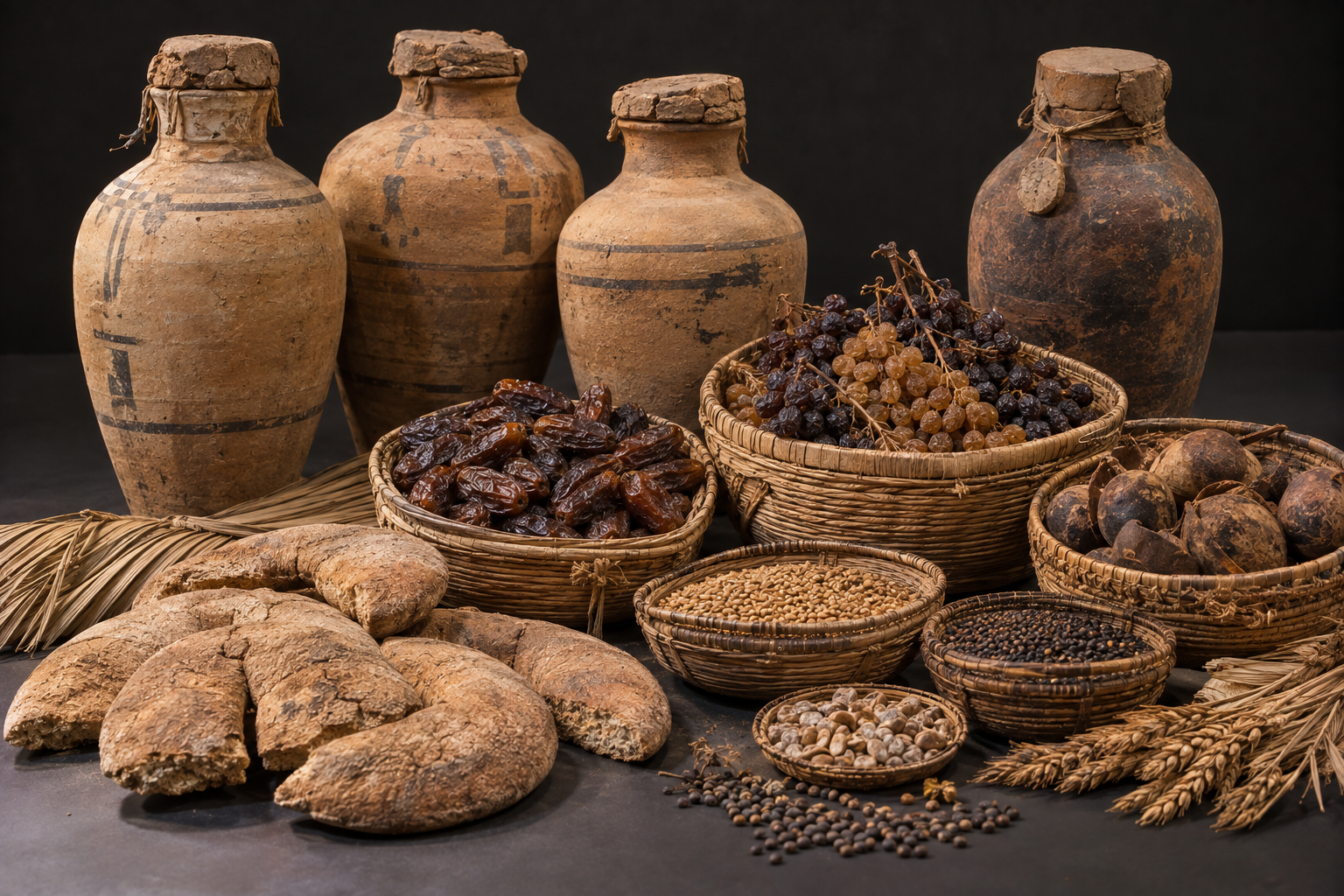
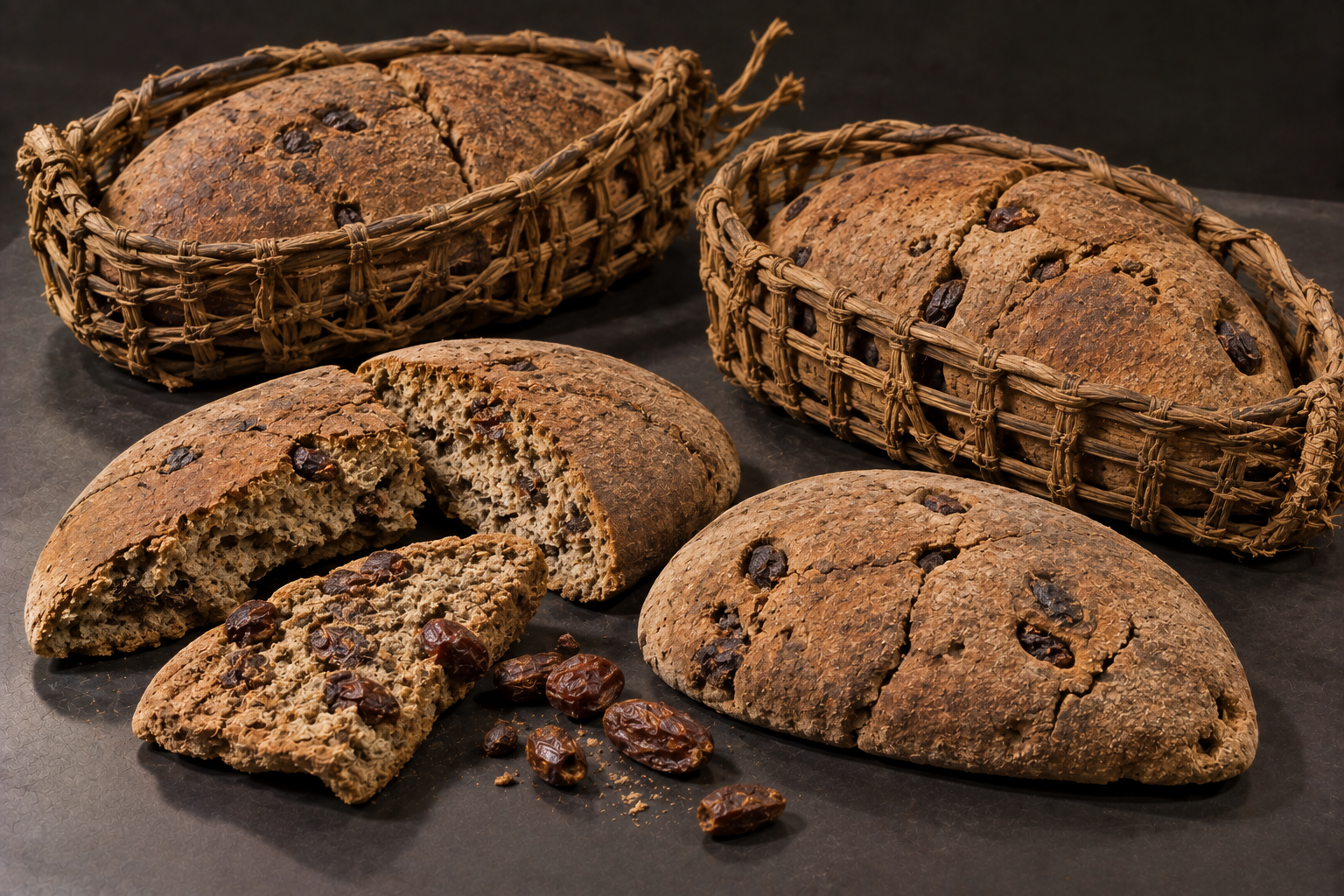
Among the most recognizable food remains were actual bread loaves.
Several surviving examples have a distinctive semicircular form.
Some contained pieces of fruit from the Christ’s-thorn plant, commonly associated with the fruit known as nabakh.
This immediately makes the bread more informative than a simple dried loaf.
It shows that bread could incorporate other plant ingredients rather than consisting only of a plain cereal preparation.
Some loaves were associated with unusual open-weave structures made from rushes. These may have functioned as holders, although their precise purpose is not completely certain.
That uncertainty is worth preserving.
Archaeological objects do not always arrive with an obvious modern equivalent, and a visually plausible explanation is not necessarily the correct one.
The bread also reminds us how different preservation can be across materials.
What survives today is desiccated archaeological material, not bread preserved in anything like its original fresh condition.
Its value now lies in the evidence it preserves about ingredients, preparation, burial practice, and ancient food culture.
More Than 100 Baskets of Food
The scale of the food provisions becomes clearer when we move from individual loaves to the baskets.
Carter recorded 116 baskets of fruit in the Annex, and his discussion suggests that the total could be still larger if related examples elsewhere in the tomb are included.
These were not 116 identical containers filled with one product.
The baskets varied in form and contained different kinds of plant material.
Carter’s records mention fruits and seeds including grapes, dates, mandrake, nabakh, melon seeds, and doum fruit.
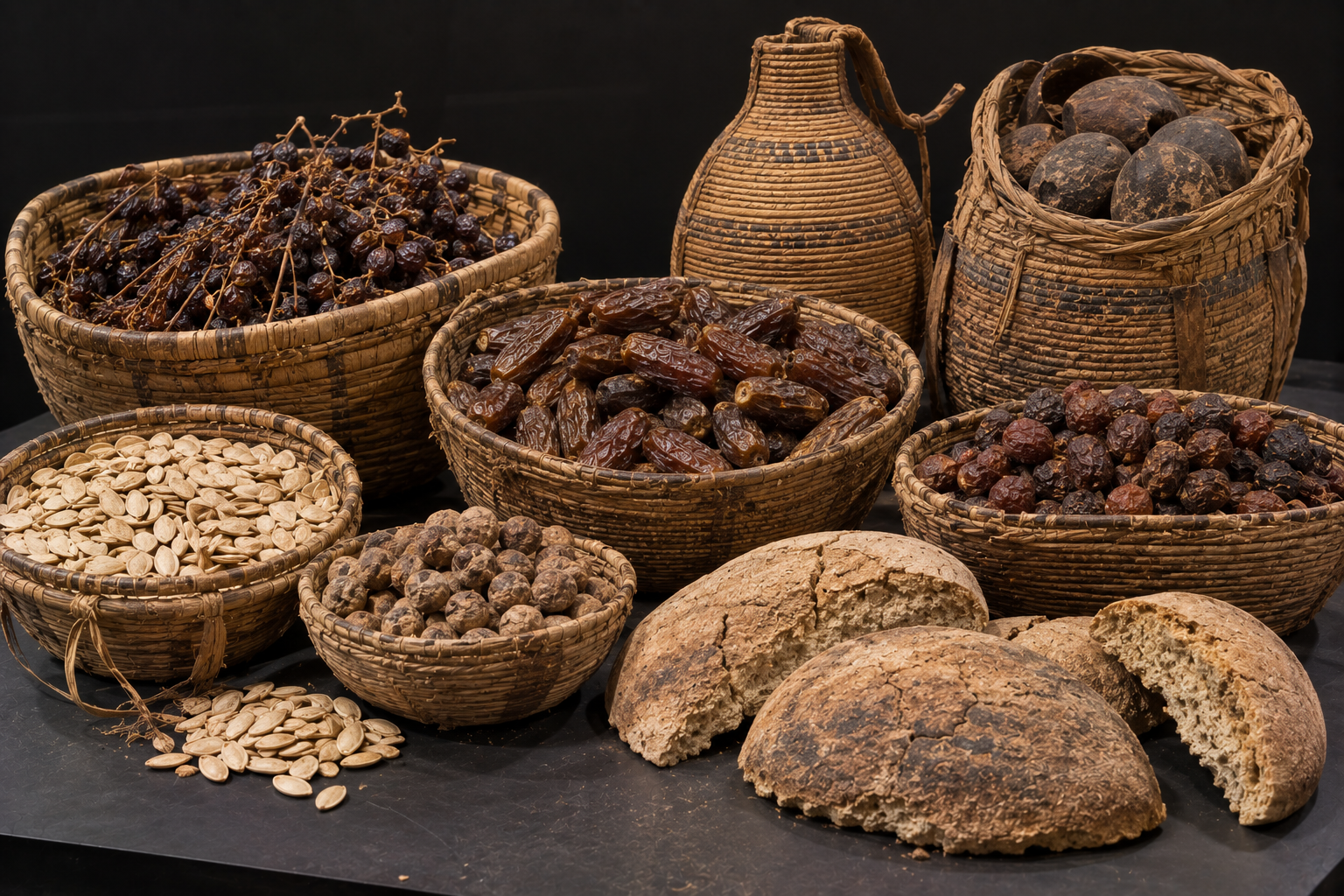
The baskets themselves deserve attention.
Before modern boxes, plastics, and industrial packaging, woven plant fibers provided lightweight containers that could be made in many shapes and sizes.
A basket could hold dry produce while remaining relatively easy to carry.
Its construction required knowledge of suitable plant materials and weaving techniques.
So even the container tells a story.
The fruit reveals agriculture and food selection.
The basket reveals storage, transport, and craft.
The burial context reveals why both were ultimately preserved together.
Carter recorded 116 baskets of fruit in the Annex. Their contents included several different plant foods, making the group one of the most revealing collections of organic provisions from the tomb.
Grapes, Dates and Other Fruits
Grapes and dates are among the easiest items for a modern reader to recognize.
Both also fit naturally into the agricultural landscape of ancient Egypt.
Grapes had an obvious relationship with wine production, but grapes themselves could also be consumed as fruit and preserved by drying.
Dates offered another durable source of food.
Drying fruit reduces its moisture content, slowing many processes that cause fresh produce to spoil. In an already arid environment, dried plant foods could remain stable far longer than fresh fruit.
For burial, this made them practical provisions.
But it would be a mistake to transform that practicality into a personal story without evidence.
The presence of dates does not prove that dates were Tutankhamun’s favorite snack.
The presence of grapes does not prove that he personally ate grapes from the surviving baskets.
The archaeological statement is simpler and stronger: these foods were deliberately included among the provisions assembled for his burial.
Nabakh: The Fruit Found Inside Some Bread
One of the less familiar foods for many modern readers is nabakh, the fruit associated with the Christ’s-thorn tree.
It is particularly interesting in KV62 because the fruit was not found only as a separate plant provision.
Pieces were also documented in surviving bread.
That provides direct evidence for combining plant ingredients in prepared foods.
It also gives archaeologists something more useful than an artistic scene showing bread on a table.
The ingredient is physically present in the surviving food itself.
This is one reason archaeological food remains can be so valuable. They allow researchers to move from representations of food toward the materials ancient people actually prepared and deposited.
Doum Fruit and Other Plant Foods
Doum fruit came from the doum palm, a distinctive palm native to parts of northeastern Africa.
Its inclusion adds another element to the botanical variety preserved in the tomb.
Melon seeds, mandrake, grapes, dates, nabakh, and doum fruit together show that the burial provisions were not limited to one staple crop.
That does not mean the baskets reproduce an ordinary meal.
Instead, they preserve selected products from a much larger agricultural economy.
To produce that variety, people had to cultivate or gather plants, harvest them at appropriate times, process or dry them where necessary, move them into storage, place them in containers, and eventually allocate some of them to the royal burial.
A dried fruit in KV62 therefore sits at the end of a surprisingly long chain of human activity.
Was Meat Found in Tutankhamun’s Tomb?
Yes. Meat provisions formed another part of the food placed in the tomb.
Carter described oviform wooden cases containing a variety of meats beneath one of the great animal-shaped couches in the Antechamber.
He believed that these cases would more naturally have belonged with provisions in the Annex, but that they had ended up in the Antechamber during the final stages of filling the tomb.
This is useful evidence because it demonstrates that the burial provisions were not limited to bread, fruit, seeds, and wine.
Animal foods were represented as well.
Again, however, burial context must not be confused with a daily menu.
Meat was a significant provision, particularly in elite and funerary contexts, but the surviving cases cannot tell us how often Tutankhamun personally ate a particular cut or which meats he preferred during life.
The evidence tells us more securely about royal provisioning than personal taste.
Wine Inside Tutankhamun’s Tomb
If the food baskets reveal agricultural variety, the wine jars reveal something else: an unexpectedly detailed system of production and record keeping.
Wine was clearly important enough to be included among Tutankhamun’s burial provisions in substantial quantities.
Modern museum discussions commonly refer to about two dozen wine jars placed in the tomb, while Carter’s broader archaeological account of the Annex described nearly forty pottery wine jars in that chamber, including damaged and broken material.
The most remarkable feature is not simply that wine had been stored inside them.
It is what was written on some of the jars.
Hieratic dockets could preserve information about the wine’s production.
In that sense, the pottery container became both storage vessel and written record.
That transforms these containers into valuable historical documents.
A decorated gold object can tell us about royal craftsmanship.
A wine docket can tell us about an agricultural product moving through an organized economic system.
A wine jar from Tutankhamun’s tomb could preserve more than a drink. Its inscription could preserve a year, a place, and the person responsible for making it.
The Ancient Wine Dockets
Calling these inscriptions “wine labels” is useful because it immediately explains their basic function to a modern reader.
But they were not labels in the modern commercial sense.
The information was written directly on the pottery vessel in hieratic script.
These dockets could record details that are strikingly familiar to anyone who has examined a modern wine bottle.
They might identify the year of production.
They could identify the estate or geographic source.
They could include the person responsible for producing the wine.
Nearly all of the roughly two dozen wine jars discussed by The Metropolitan Museum of Art include the names of the chief vintners.
This is particularly revealing because it moves the evidence beyond the king.
The jar does not simply announce that something belonged to Tutankhamun.
It preserves traces of the people and institutions responsible for producing a royal commodity.
What Did the Wine Dockets Record?
The surviving dockets were not all identical, but together they could preserve several categories of information.
A typical record might include a regnal year, the type or quality of the wine, the estate or place from which it came, and the name of a vintner.
Carter recorded examples dated to different years.
One docket, for example, referred to wine associated with the estate of Tutankhamun and named a chief vintner.
The wording matters because ancient Egyptian dating did not work like a modern printed year such as 1325 BCE.
The docket might instead identify the wine as belonging to a particular year of the reigning king.
That means a humble pottery jar could carry chronological information.
When multiple jars are compared, those dates can become useful evidence for both production and administration.
Why the Vintner’s Name Mattered
The appearance of vintners’ names is one of the most human details in the collection.
Wine production required specialized knowledge.
Grapes had to be cultivated and harvested.
The juice had to be extracted.
Fermentation had to be managed.
The finished product had to be transferred into vessels, stored, and identified.
Recording a responsible vintner linked a named individual with the product.
That suggests an organized system in which provenance mattered.
It also hints at accountability and distinctions between batches of wine.
We should not turn this into a modern winery with contemporary branding and marketing practices.
But the underlying administrative principle is recognizable: information about a product was important enough to travel with the container.
Did Ancient Egyptian Wine Have a Vintage?
In an important sense, yes.
Wine dockets could record the year in which the wine was produced.
But an Egyptian vintage did not appear as a BCE date.
It was normally connected to the regnal year of the king.
A docket might therefore refer to a numbered year of Tutankhamun’s reign.
This system was practical because the king’s reign provided an administrative chronological framework.
For archaeologists, such inscriptions can be extremely useful.
They potentially connect a physical object to a particular period within a reign.
They can also show that wines from different production years were selected for the burial.
That makes the jars more than containers.
They become dated archaeological evidence.
How Were the Wine Jars Sealed?
Producing wine was only part of the problem.
It also had to be stored.
Pottery is naturally porous, and a wine container had to limit evaporation, contamination, and unwanted exposure while still dealing with the behavior of a fermented liquid.
Carter’s notes describe wine jars with large clay or mud sealing masses covering their mouths and necks.
Rush material was used around the closure, and seal impressions could be applied to the outer sealing.
The vessel therefore combined pottery, plant material, and clay into a storage system.
Carter also discussed resinous coatings associated with the interiors of pottery vessels, which could help reduce the problems caused by porous ceramic surfaces.
These details reveal the wine jar as a piece of food technology.
Its shape, surface, closure, and coating all mattered.
Even after the wine itself disappeared, those technological choices remained visible to archaeologists.
Did Any Wine Survive as Liquid?
No bottle of liquid wine emerged from KV62 ready to be opened after more than three millennia.
That popular image misunderstands what archaeological preservation usually looks like.
The original liquid did not survive as drinkable wine.
Instead, evidence comes from the vessels, their inscriptions, seals, archaeological context, and surviving residues.
That distinction is important whenever ancient food discoveries are described in dramatic terms.
“Wine found in Tutankhamun’s tomb” means that archaeologists have strong evidence for wine stored in the burial.
It does not mean that Carter discovered intact jars full of liquid suitable for tasting.
Can We Tell What Kind of Wine It Was?
The written dockets can reveal important information about origin, date, and production, but they do not automatically answer every question a modern wine drinker might ask.
Modern chemical analysis of ancient residues can sometimes identify biomarkers associated with grape wine and can provide additional information about ancient beverages.
But claims about the exact color, flavor, sweetness, or modern-style category of every wine from Tutankhamun’s tomb require specific evidence from the individual vessel.
It is therefore safer not to imagine a modern tasting list of red and white wines based only on the ancient labels.
The strongest evidence concerns production, provenance, chronology, and administration.
Wine Was More Than a Drink
The wine jars connect Tutankhamun’s tomb with a world extending far beyond the Valley of the Kings.
Before a jar could reach the burial, grapes had to grow somewhere.
That required agricultural land, workers, water management, and seasonal knowledge.
The grapes then had to be harvested and processed.
The wine had to ferment.
Potters had to produce storage vessels.
Other workers sealed them.
Scribes or trained personnel recorded the dockets.
The jars were stored, transported, selected, and eventually carried into KV62.
One wine vessel therefore links agriculture, craft production, administration, transportation, royal estates, and burial practice.
This is why apparently ordinary objects can sometimes tell us as much about an ancient society as spectacular royal treasures.
Why Put Real Food in a Royal Tomb?
Food and drink were deliberately included in Egyptian burials because continued sustenance remained important within Egyptian ideas about existence after death.
This practice was not limited to Tutankhamun or even to kings.
Food offerings appear in many Egyptian funerary contexts.
For a royal burial, however, the scale and variety could be extraordinary.
Tutankhamun’s tomb included actual provisions alongside containers, representations, equipment, and other objects associated with maintaining the king’s status and needs beyond ordinary life.
Bread supplied a basic staple.
Fruit and seeds represented agricultural produce.
Meat provided another category of food.
Wine supplied a carefully produced beverage associated with estates and specialist labor.
The result was not simply a symbolic picture of abundance.
Real organic materials were physically placed inside the tomb.
That deliberate choice is why fragments of ancient food could still be studied thousands of years later.
Real Food, Models and Representations
The Egyptians did not rely on only one method of providing food within a burial.
Real provisions could be placed in the tomb, but food could also appear through models, containers, offering equipment, and representations.
Tutankhamun’s burial preserves an especially interesting example of the relationship between the real and the represented: a model granary that contained actual grain.
The object reproduced an agricultural storage facility on a small scale, yet its compartments were not purely symbolic. Real grain was placed inside them.
That combination is important.
It shows that the distinction modern viewers sometimes make between a “symbolic model” and a “real provision” can be too simple.
One object could operate on both levels.
The granary represented stored agricultural abundance while physically containing the agricultural product it represented.
The same broader principle helps us understand why Tutankhamun’s tomb contained such a varied collection of provisions.
Actual food, storage vessels, models, and images could contribute different elements to the burial without needing to perform exactly the same function.
Was This Tutankhamun’s Everyday Diet?
No complete daily menu for Tutankhamun can be reconstructed from the food in KV62.
This is one of the most important limits of the evidence.
Burial assemblages are selected.
Someone decided what should enter the tomb.
Those choices were influenced by funerary practice, availability, status, symbolism, tradition, and the practical organization of the burial.
That is very different from recording everything a person normally ate.
Tutankhamun could certainly have encountered many of the same types of food during life. Bread, fruit, wine, meat, and other agricultural products belonged to the wider food culture of New Kingdom Egypt.
But that does not mean the surviving objects form a representative sample of his breakfast, lunch, and dinner.
The distinction becomes even more important when comparing a king with the wider population.
Royal burial provisions came from an elite environment with access to substantial agricultural resources and specialized products.
They should not be treated as a direct description of what every Egyptian ate.
Found in Tutankhamun’s tomb does not mean eaten regularly by Tutankhamun. The surviving food tells us directly what was selected for his burial. Reconstructing his personal daily diet requires additional evidence.
Were These Tutankhamun’s Favorite Foods?
Claims about Tutankhamun’s “favorite foods” should be treated with particular caution.
A basket of dates does not tell us whether he loved dates.
A wine jar does not prove that he personally drank that wine.
A bread loaf does not identify his preferred recipe.
Meat placed in the tomb does not reveal his favorite cut.
The problem is one of attribution.
Archaeologists know where these objects were found and can study what they contain, how they were prepared, and how they were deposited.
But personal preference is a different kind of claim.
To identify a favorite food securely, we would need evidence that connects Tutankhamun himself with repeated preference for that specific food.
The burial does not provide that evidence.
This does not make the food less interesting.
It makes the questions we ask of it more precise.
Instead of asking only, “What did King Tut like to eat?” we can ask much stronger questions about how food was produced, stored, labeled, transported, selected, and placed inside a royal tomb.
Could Tutankhamun Have Eaten These Foods During Life?
Many of the food types represented in the burial were certainly available in the world in which Tutankhamun lived.
Bread was a major staple.
Grapes and dates were familiar agricultural products.
Wine was produced on estates and consumed in elite contexts.
Meat was available, particularly within wealthy households and institutional settings, although access and frequency varied greatly across Egyptian society.
So it would be unreasonable to imagine that the burial foods had no relationship at all to foods known during Tutankhamun’s lifetime.
The caution concerns the individual surviving items.
A loaf made for burial may never have been part of a living meal.
A jar selected for KV62 may have come from royal stores without ever being opened for Tutankhamun.
A basket of fruit could represent a familiar food category while still being assembled specifically for funerary use.
The category may belong to everyday life even when the particular archaeological object belongs entirely to burial.
What the Food Reveals About Agriculture
The provisions from KV62 connect the tomb with fields, orchards, vineyards, palms, storage facilities, workshops, and estates far beyond the Valley of the Kings.
Every loaf began with agriculture.
Grain had to be grown, harvested, processed, ground, mixed, and baked.
Every wine jar began with vines.
Grapes had to be cultivated, harvested, pressed, fermented, stored, and transported.
Dates and other fruits had their own growing and harvesting cycles.
Basketry depended on suitable plant fibers.
Meat provisions depended on animal husbandry, slaughter, preparation, and preservation.
The tomb therefore preserves the final products of multiple agricultural systems.
These products also reveal planning.
A royal burial could not be provisioned by suddenly gathering random foods at the tomb entrance.
Goods had to be available within stores and administrative networks.
Containers had to be prepared.
Food had to be selected and packed.
Some products, particularly wine, had histories extending back years before Tutankhamun’s death.
The burial provisions therefore connect a single event, the king’s funeral, with longer cycles of agricultural production.
What the Baskets Reveal About Storage and Transport
The food itself receives most of the attention, but the baskets are evidence too.
A woven basket is a technology.
It transforms flexible plant material into a lightweight container capable of holding and moving goods.
Different shapes can suit different contents.
Open structures permit airflow.
Handles or narrow necks can make containers easier to carry or secure.
Broad baskets can accommodate larger quantities of produce.
The presence of more than 100 fruit baskets in the Annex therefore tells us something about the practical side of burial provisioning.
Food did not simply appear inside KV62.
It had to be packaged and transported.
The baskets are part of that logistical story.
What the Wine Reveals About Administration
The wine dockets take us even further.
A fruit basket can preserve its contents.
A labeled wine jar can preserve information about the organization that produced those contents.
Consider the chain represented by one jar.
Grapes were grown on land connected with an estate.
Workers cultivated and harvested them.
Other workers processed the grapes.
A vintner supervised or took responsibility for the wine.
A potter produced the container.
The wine was transferred and sealed.
Information was written on the jar.
The vessel entered storage.
Eventually it was selected and transported to Tutankhamun’s tomb.
A docket recording a year, source, and vintner connects several stages of that chain.
This is why the inscriptions are so important.
They transform pottery into administrative evidence.
The wine jars reveal a system behind the burial: vineyards, estates, vintners, potters, scribes, storage, transport, and royal administration.
Why Provenance Mattered
If wine were treated as a completely anonymous liquid, there would be little reason to record where it came from or who was responsible for producing it.
The dockets demonstrate that distinctions mattered.
Different production years mattered.
Different estates or locations mattered.
The identity of the vintner could matter.
This does not mean ancient Egyptian consumers behaved exactly like modern wine buyers.
But it does show an organized concern with provenance and production.
For historians, that information is invaluable because it provides a glimpse of an economic system through objects originally intended to store a drink.
Wine Jars as Historical Documents
The most visually spectacular objects from Tutankhamun’s tomb were often made to communicate royal status.
A pottery wine jar seems modest beside them.
Yet a written docket can sometimes preserve information that a gold object cannot.
A gold ornament may reveal materials, techniques, iconography, and royal names.
A wine docket can potentially identify a production year, an estate, a product, and an individual responsible for it.
In other words, it preserves relationships between people, places, goods, and time.
This is one of the reasons archaeologists study ordinary-looking containers so carefully.
The value of an archaeological object is not determined by how expensive its material was.
What the Wine Jars Reveal About Time
The regnal years written on wine jars are particularly useful because they connect agricultural production with royal chronology.
An ancient Egyptian docket did not need to say “this wine was made in 1327 BCE.”
It could identify the year according to the reign of the king.
This was a practical administrative system in a society where official dating was organized around rulership.
For modern researchers, these dated containers can help reconstruct the sequence of production represented in the tomb.
They also make one point very clear.
The burial was assembled from objects with different histories.
Not everything inside KV62 was created at the same moment.
A wine produced in an earlier regnal year had already existed for some time before being selected for the burial.
The tomb therefore brought together objects of different ages into one final archaeological context.
What Happened to the Food After the Tomb Was Sealed?
Once KV62 was closed, the food entered an environment completely different from the one in which it had been produced.
No one replenished it.
No one opened the jars for normal consumption.
No one replaced deteriorating baskets.
The organic materials slowly changed.
Moisture escaped.
Plant tissues dried.
Fats and proteins chemically altered.
Some materials became brittle.
Some disappeared almost completely.
Others survived in recognizable form.
The dry environment helped enormously, but preservation was never perfect.
This is why archaeologists must distinguish between an ancient food as originally deposited and the archaeological material surviving today.
How Did Food Survive for More Than 3,000 Years?
Egypt’s dry climate is one of the main reasons organic archaeological materials can survive there so remarkably well.
Microorganisms responsible for decay generally require favorable environmental conditions, including moisture.
When material becomes extremely dry, many destructive biological processes slow dramatically.
KV62 also provided a protected underground environment after it was sealed.
These conditions allowed some bread, fruit, seeds, basket fibers, wood, textiles, leather, and other organic materials to survive for more than three millennia.
But “survive” does not mean “remain unchanged.”
An ancient grape is not a fresh grape frozen in time.
A loaf is not fresh bread.
The original wine is not waiting inside a jar to be poured.
The materials have undergone enormous physical and chemical changes.
What remains is archaeological evidence.
Could Anyone Eat the Food Today?
No responsible archaeological interpretation treats Tutankhamun’s food as something to taste.
Its value is scientific and historical.
The food has spent more than three thousand years undergoing chemical alteration and environmental exposure.
It may also have encountered microorganisms, insects, dust, conservation materials, handling, and other sources of contamination during its long history.
More importantly, consuming even a tiny archaeological sample would destroy evidence.
Modern analysis can potentially investigate plant species, preparation techniques, residues, microscopic structures, and chemical composition.
An ancient food sample is therefore closer to an irreplaceable scientific archive than to an old meal.
Ancient food is evidence, not preserved cuisine. Its archaeological value comes from the information retained in its ingredients, structure, residues, context, and associated containers.
Why Food Can Be as Important as Gold
Gold tells us about wealth, craftsmanship, trade, royal display, and technology.
Food answers different questions.
A seed can identify a plant.
A loaf can preserve evidence of ingredients and preparation.
A basket can reveal plant-fiber technology.
A meat provision can reveal animal resources and funerary provisioning.
A wine jar can preserve agricultural and administrative information.
Together, these objects bring us closer to systems that supported life in ancient Egypt.
That is why the everyday objects found inside Tutankhamun’s tomb can sometimes reveal aspects of his world that monumental royal objects cannot.
The ordinary and the spectacular answer different historical questions.
KV62 is extraordinary partly because it preserved both.
What the Food Cannot Tell Us
The food and wine from Tutankhamun’s tomb provide unusually rich evidence, but their limitations are just as important as their discoveries.
They cannot reconstruct every meal Tutankhamun ate.
They cannot securely identify his favorite food.
They cannot prove that he personally drank the wine from every jar.
They cannot show that every surviving provision had been part of ordinary royal meals before his death.
They cannot be used as a direct description of the diet of all ancient Egyptians.
They cannot tell us that everything originally placed in the tomb survived.
And they cannot turn a burial assemblage into a complete record of everyday life.
| Evidence | What It Can Reveal | What It Does Not Prove |
|---|---|---|
| Bread loaves | Ingredients, preparation and burial provisioning | Tutankhamun’s favorite bread |
| Fruit and seeds | Plant foods selected for the royal burial | The king’s complete daily diet |
| More than 100 food baskets | The scale, variety, packaging and transport of provisions | That every item was intended as an ordinary meal |
| Meat provisions | Animal foods formed part of the burial supplies | How frequently Tutankhamun ate meat during life |
| Wine jars | Wine production, storage and funerary provisioning | That Tutankhamun personally drank every wine |
| Wine dockets | Production year, provenance and vintner information | That ancient labeling worked exactly like modern commercial branding |
| Model granary containing grain | Real agricultural produce and representation could appear together | The precise amount of grain consumed by the king |
| Royal burial context | Food and drink were deliberately selected as provisions for Tutankhamun | The ordinary diet of every social group in ancient Egypt |
What the Food Really Reveals
Once we stop trying to turn the burial provisions into Tutankhamun’s personal menu, the evidence becomes more interesting rather than less.
The bread reveals food preparation.
The fruit reveals agricultural diversity.
The baskets reveal storage and transport technology.
The meat cases reveal organized provisioning.
The wine reveals vineyards, fermentation, pottery, sealing, storage, and administration.
The dockets reveal people.
A named vintner is a rare reminder that the objects surrounding a king depended on individuals whose work normally receives far less attention than the ruler himself.
Behind every royal provision was a chain of labor.
Farmers grew crops.
Gardeners and vineyard workers cared for plants.
Harvesters gathered produce.
Bakers prepared bread.
Wine specialists managed production.
Potters made jars.
Basket makers produced containers.
Scribes recorded information.
Storehouse workers managed supplies.
Other people transported those goods to the Valley of the Kings.
The food in KV62 therefore preserves part of the enormous human system that supported the Egyptian court.
Frequently Asked Questions
What food was found in Tutankhamun’s tomb?
The burial contained several types of food provisions, including bread, fruits, seeds, meat, and wine. Carter’s records mention grapes, dates, nabakh, mandrake, melon seeds, doum fruit, and numerous baskets of provisions.
Was real food found inside Tutankhamun’s tomb?
Yes. Actual organic food remains were found in KV62. These were not simply paintings or models of food, although models and representations were also included in the burial.
Was bread found in Tutankhamun’s tomb?
Yes. Actual bread loaves survived, including semicircular examples containing fruit from the Christ’s-thorn plant, associated with nabakh fruit.
How many baskets of food were found?
Howard Carter described 116 baskets of fruit in the Annex, with related baskets elsewhere in the tomb potentially increasing the broader total.
What fruits were found in Tutankhamun’s tomb?
Recorded plant provisions included grapes, dates, nabakh or Christ’s-thorn fruit, mandrake, melon seeds, and doum fruit, among other botanical materials.
Was meat found in Tutankhamun’s tomb?
Yes. Carter documented meat provisions in specially shaped wooden cases in the Antechamber, showing that animal foods formed part of the burial supplies alongside bread, fruit, and wine.
Was wine found in Tutankhamun’s tomb?
Yes. Numerous pottery jars associated with wine were found in the tomb. Some carried hieratic dockets recording details about the wine’s production.
How many wine jars were found?
Modern museum summaries commonly discuss about two dozen wine jars placed with Tutankhamun, while Carter’s archaeological description of the Annex mentions nearly forty pottery wine jars in that area when a broader group, including damaged and broken vessels, is counted.
What was written on Tutankhamun’s wine jars?
Wine dockets could include information such as the production year, estate or geographic origin, type or quality of wine, and the name of the vintner responsible for it.
Did ancient Egyptian wine have a vintage?
Wine could be identified by a production year, but the date was expressed using the regnal year of the king rather than a modern BCE date.
Did the wine jars name the winemaker?
Many of the wine dockets included the name of a vintner or chief vintner, providing unusually direct evidence for people involved in wine production.
Did liquid wine survive inside the jars?
Not as drinkable liquid wine. Archaeologists rely on the vessels, inscriptions, seals, residues, and archaeological context to identify and study the ancient contents.
Was this Tutankhamun’s favorite food?
There is no secure evidence that the food placed in KV62 represents Tutankhamun’s personal favorites. The objects tell us directly about burial provisioning, not personal preference.
Why was food placed in Tutankhamun’s tomb?
Food and drink were included as provisions within Egyptian burial practices. In Tutankhamun’s case, real food was placed alongside many other objects intended to maintain royal status and provision the king after death.
How did food survive for more than 3,000 years?
The extremely dry Egyptian environment and the protected conditions inside the tomb slowed many processes of organic decay. The food still changed dramatically, but some desiccated material survived in recognizable form.
Final Thoughts
The food from Tutankhamun’s tomb is easy to overlook beside gold, jewelry, chariots, and royal furniture.
But it preserves a different kind of history.
A dried grape connects the tomb with a vineyard or cultivated landscape.
A date connects it with agricultural production and storage.
A loaf preserves the work of ancient bakers.
A woven basket preserves the knowledge of craftspeople who transformed plant fibers into containers.
A meat case reveals the organization required to provision a royal burial.
And a wine jar can connect a single object with a production year, an estate, a vintner, a potter, a sealing system, storage, transport, and finally the tomb of a king.
None of this gives us Tutankhamun’s favorite dinner.
That question asks more of the evidence than the burial can provide.
What survives is arguably more valuable.
The food and wine of KV62 reveal the network that stood behind royal life: agriculture, vineyards, workshops, storage facilities, skilled producers, administrators, transport, and the people responsible for preparing an extraordinary burial.
More than three thousand years later, the meal itself is gone.
But the system that produced it can still be reconstructed from what remained inside the tomb.