
Imagine descending a staircase cut into the rock of the Valley of the Kings and standing before a doorway that had remained hidden beneath debris for centuries. Beyond it was not an empty chamber or a disturbed collection of broken objects. It was an entire royal world compressed into a few small rooms.
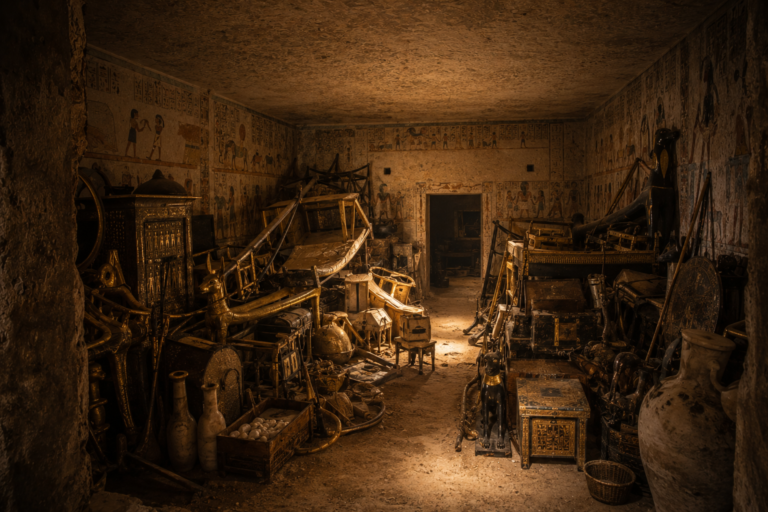
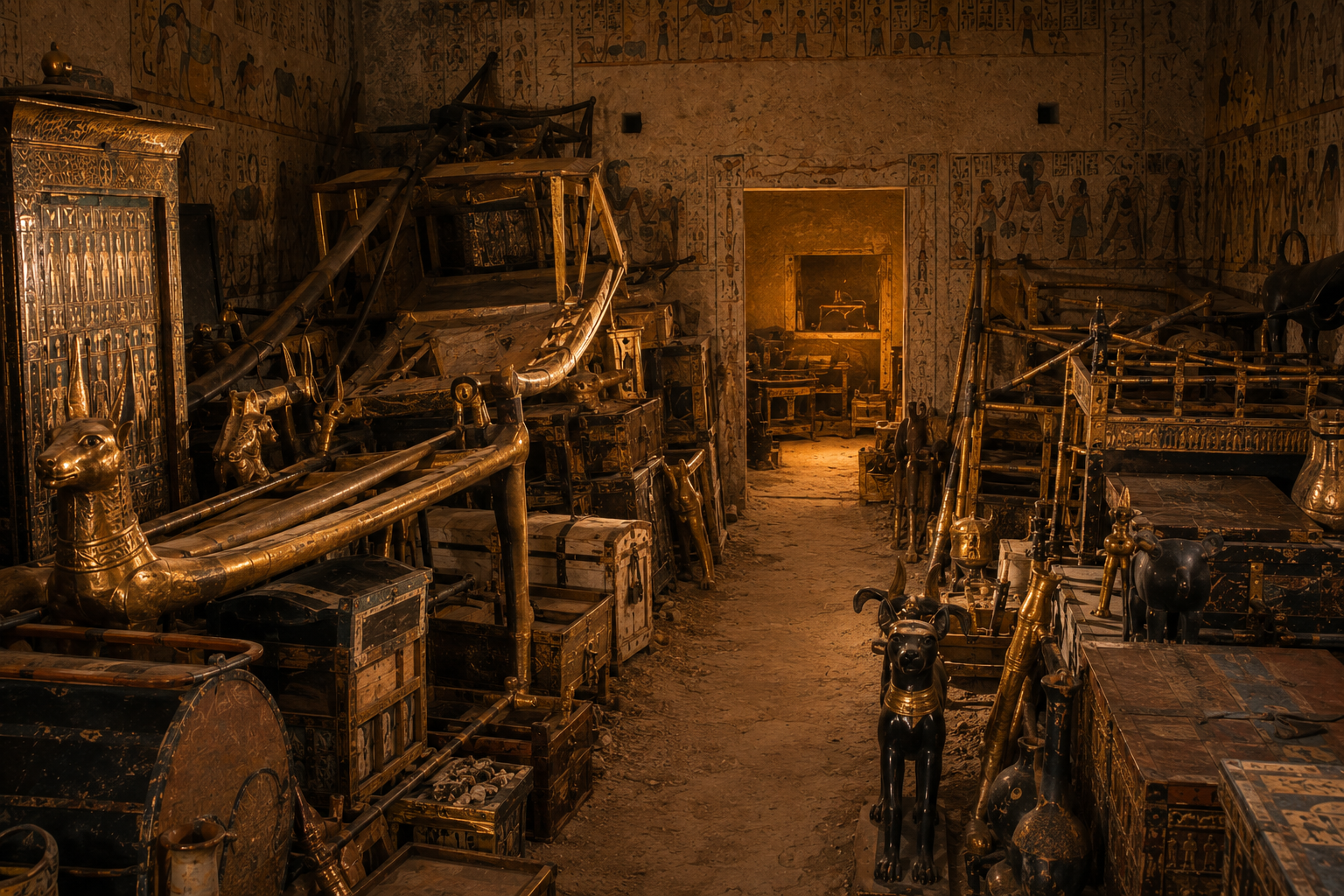
Gilded beds towered above decorated chests. Dismantled chariots leaned against the walls. Black guardian statues stood beside a sealed entrance. Baskets, vessels, clothing, weapons, furniture, and ritual objects filled almost every available space.
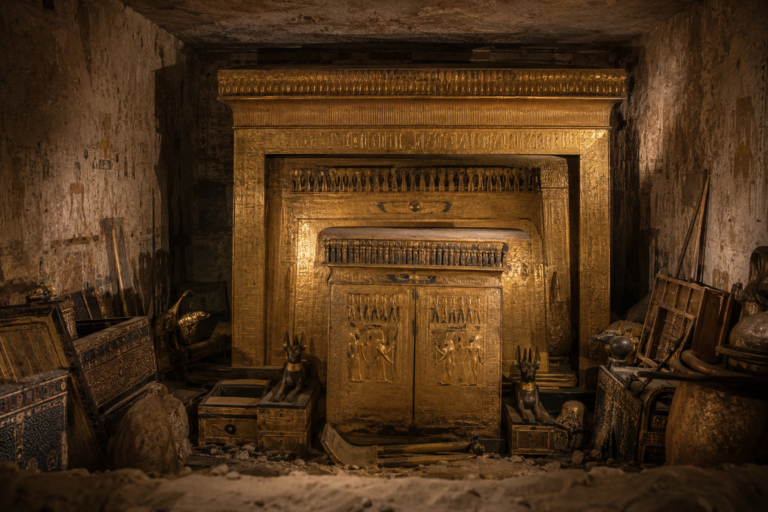
Behind another wall waited the burial chamber, where monumental gilded shrines surrounded the stone sarcophagus of Tutankhamun. The tomb became famous for its gold, but its deeper secrets lie in the way its chambers, objects, images, and sealed doorways worked together to prepare a young king for eternity.
Tutankhamun’s tomb, known as KV62, is often described as nearly intact. That does not mean it had remained completely untouched since antiquity. Evidence indicates that robbers entered the tomb not long after the burial, disturbed parts of its contents, and were followed by officials who restored order and resealed the entrances.
What makes the discovery extraordinary is that the tomb escaped the extensive destruction and repeated robbery that affected many other royal burials in the Valley of the Kings. When Howard Carter’s excavation team entered it in 1922, thousands of objects still remained within their ancient funerary setting.
Quick Context
Pharaoh: Tutankhamun
Dynasty: Eighteenth Dynasty
Tomb number: KV62
Location: Valley of the Kings, west of Luxor
Discovery: November 1922
Excavator: Howard Carter, with the support of Lord Carnarvon
Main spaces: Entrance corridor, antechamber, annex, burial chamber, and treasury
Why it matters: The tomb preserved an exceptionally complete royal burial assemblage from Egypt’s New Kingdom.
Why Tutankhamun’s Tomb Is Different
Tutankhamun was not one of ancient Egypt’s longest-ruling or most militarily powerful kings. His reign lasted only about a decade, and he died while still young. Yet his name became more famous than those of pharaohs who built larger monuments, ruled for far longer, or led major campaigns.
The reason is preservation.
Most royal tombs in the Valley of the Kings were robbed in antiquity. Valuable metals were removed, coffins were damaged, royal mummies were displaced, and funerary equipment was scattered or destroyed. Some surviving tombs retain spectacular wall paintings, but only fragments of their original contents remained inside them.
KV62 was different. Although ancient intruders had entered it, most of its burial equipment was still present when the tomb was excavated. This gave archaeologists something extraordinarily rare: the opportunity to study thousands of objects together in the environment for which they had been selected.
A decorated chair could be examined beside the chests, clothing, and ceremonial equipment that once surrounded it. Chariot components remained close to other objects associated with royal travel and display. Shrines, coffins, amulets, statues, and ritual vessels could be understood as parts of one connected burial system rather than as isolated museum pieces.
This context is what makes the tomb more important than the financial value of its gold.
An object removed from its archaeological setting can still be beautiful, but much of its story becomes harder to reconstruct. Inside KV62, the position of each item helped reveal how the burial had been organised, what officials considered essential, and how practical possessions were combined with religious protection.
The compact size of the tomb also contributed to its unforgettable appearance. Instead of long corridors and numerous decorated halls, visitors encountered a small group of chambers filled almost to their limits. The result looked less like a monumental palace carved underground and more like a royal household and sacred treasury packed tightly behind sealed doors.
That crowded arrangement created many of the tomb’s visual mysteries. Why were chariots dismantled? Why did ceremonial beds dominate the antechamber? Why were two dark royal statues positioned beside the sealed burial chamber? Why were food containers and everyday supplies placed in a separate annex?
Each question leads beyond the simple idea of treasure and into the structure of ancient Egyptian funerary belief.
The Entrance That Changed Archaeology
By the beginning of the twentieth century, the Valley of the Kings had already been explored extensively. Many archaeologists believed that few major discoveries remained. Howard Carter disagreed.
Carter had worked in Egypt for years and knew that the short-lived king Tutankhamun had been buried somewhere in the royal valley. Objects bearing Tutankhamun’s name had already been found in the area, but the location of the king’s tomb remained uncertain.
After several excavation seasons, the search entered what was expected to be its final stage. On 4 November 1922, workers uncovered the upper edge of a step beneath the remains of ancient workmen’s huts near the entrance to the tomb of Ramesses VI.
Further clearing revealed a descending staircase cut into the bedrock. At its base stood a blocked doorway bearing ancient seals.
The discovery was promising, but it did not immediately prove that the tomb belonged to Tutankhamun. Carter ordered the entrance protected and sent word to Lord Carnarvon, who had financed the excavation.
When the excavation resumed later that month, the team passed through the first blocked doorway and entered a descending corridor filled with stone and debris. The filling suggested that the passage had been deliberately closed, but signs also indicated that ancient intruders may once have forced their way inside.
At the far end of the corridor was a second sealed doorway. Behind it waited the chamber that would transform Tutankhamun from a relatively obscure pharaoh into one of the most recognisable figures in history.
The First View Through the Doorway
A small opening was made in the upper section of the second doorway. Warm air escaped from the sealed space. A light was passed through the gap, revealing unfamiliar shapes in the darkness.
As the interior gradually became visible, the chamber appeared crowded with gilded furniture, animal-shaped ceremonial beds, chests, statues, vessels, and dismantled chariots. The objects were not arranged like exhibits in a modern gallery. They overlapped, leaned against one another, and filled the room from floor level to high against the walls.
The first chamber did not contain the king’s coffin. Instead, it acted as a densely packed threshold between the entrance corridor and the more sacred spaces deeper inside the tomb.
Two life-sized black statues of the king stood near another sealed doorway. Their position marked the route into the burial chamber, but the full structure of the tomb was not yet understood.
Other doorways led toward smaller rooms containing additional supplies and funerary equipment. What first appeared to be one crowded treasure chamber was actually the beginning of a connected burial complex.
The tomb’s fame often compresses the discovery into a single dramatic moment, but archaeology continued long after the doorway was opened. Fragile textiles, wooden furniture, gilded surfaces, food remains, and objects assembled from multiple materials had to be stabilised before they could be transported safely.
Every decision mattered because the original positions of the objects contained evidence. Once removed, that spatial information could never be recreated with complete certainty.
The Four Main Chambers Inside Tutankhamun’s Tomb
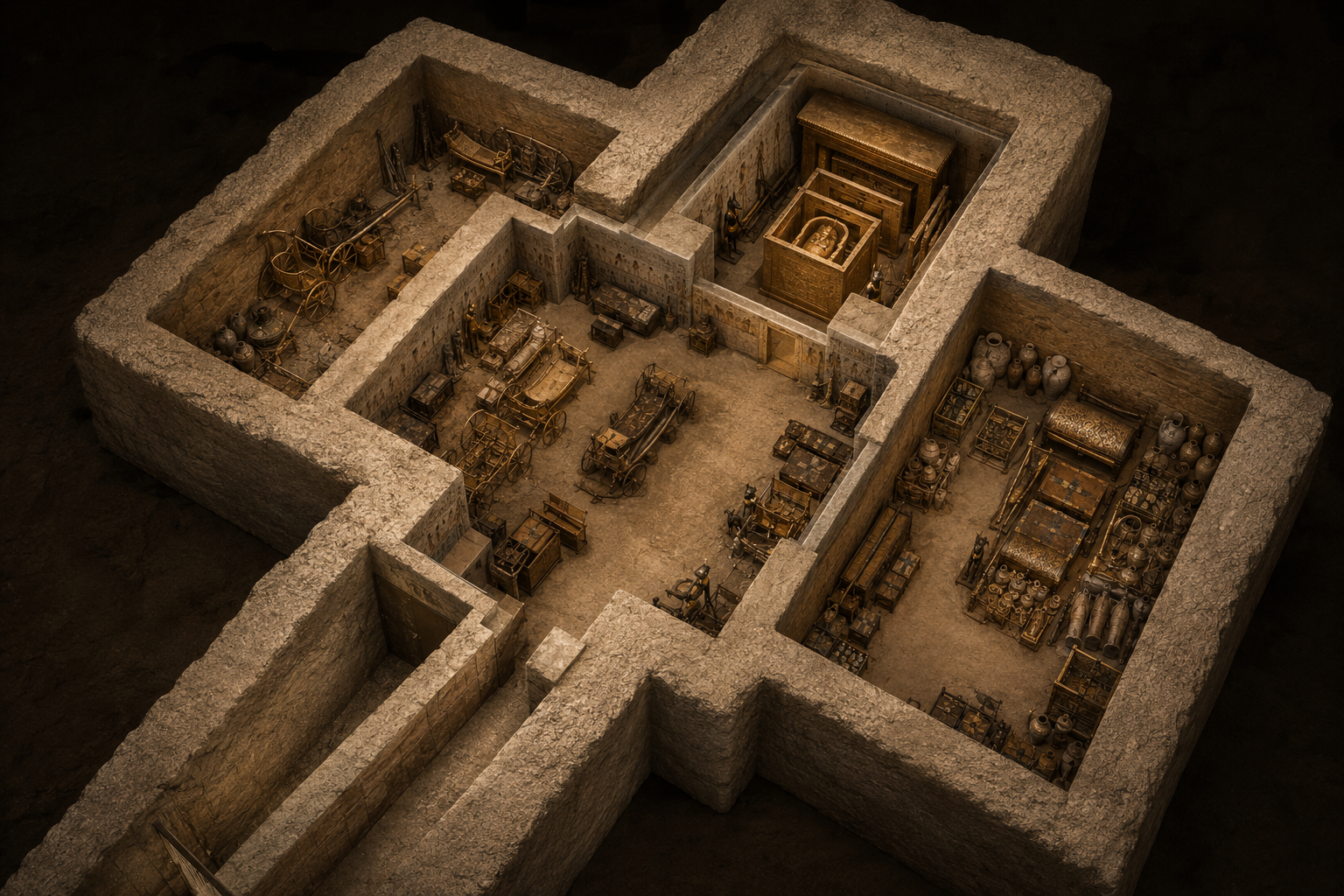
Although Tutankhamun’s tomb is often described as having four main chambers, its full arrangement also included the entrance staircase and the descending corridor. Beyond that corridor lay the antechamber, with the annex opening from one side and the burial chamber positioned behind a sealed doorway. The treasury connected directly to the burial chamber.
The plan was compact, but each room had a distinct role. The chambers were not simply storage spaces divided by chance. Together, they formed a sequence that moved from practical supplies and royal possessions toward the increasingly sacred centre of the burial.
| Chamber | Main Contents | Probable Role |
|---|---|---|
| Antechamber | Ceremonial beds, chariots, furniture, chests, statues, and vessels | Held major items connected with royal life, movement, status, and funerary preparation |
| Annex | Food, wine, oils, baskets, containers, and everyday supplies | Stored provisions and practical equipment for the king’s continued existence |
| Burial Chamber | Gilded shrines, quartzite sarcophagus, nested coffins, mummy, and funerary mask | Protected the king’s body and formed the sacred centre of the tomb |
| Treasury | Canopic shrine, Anubis shrine, boats, statues, chests, and ritual objects | Contained equipment associated with protection, regeneration, and the king’s journey after death |
The organisation of the rooms reflected both religious priorities and the practical limitations of the tomb. Large objects had to pass through narrow entrances. Chariots were taken apart. Furniture was stacked or placed close together. Containers filled corners and spaces beneath larger pieces.
Some objects seem to have been positioned with clear symbolic purpose, while others were packed into the available room under the pressure of preparing a royal funeral. This mixture of ritual order and physical crowding is one of the tomb’s most revealing features.
A Journey Toward the Sacred Centre
The arrangement of KV62 becomes clearer when viewed as a movement inward.
The entrance corridor led first to the antechamber, where many of the largest and most immediately recognisable possessions were stored. From there, a smaller opening gave access to the annex, which contained supplies and containers linked to food, drink, oils, and daily needs.
The sealed doorway guarded by the two royal statues led into the burial chamber. This was the only main room whose walls were decorated with painted funerary scenes. Beyond it stood the treasury, where some of the most sacred objects connected with bodily preservation and ritual protection were placed.
This gradual progression increased the sense of separation from the outside world. The deeper a person moved into the tomb, the closer they came to the king’s body and the religious equipment surrounding it.
The Crowded Antechamber
The antechamber created the first unforgettable view inside Tutankhamun’s tomb. It was the largest room in KV62, yet it was so densely filled that moving through it required careful planning.
Its contents included ceremonial beds shaped with animal forms, dismantled chariots, decorated chests, stools, chairs, vessels, baskets, and other pieces of royal furniture. Many objects were stacked, placed beneath larger items, or pressed close against the walls.
The appearance was dramatic, but the room was not simply chaotic.
The largest pieces occupied the central and rear areas, while smaller objects filled the remaining spaces. Some arrangements had been disturbed by ancient robbers, and later officials appear to have restored parts of the chamber before resealing the tomb. That intervention may explain why certain objects were no longer positioned exactly as they had been during the original burial.
The Ceremonial Beds
Three large funerary beds dominated the chamber. Their sides were shaped as powerful animals and composite creatures associated with protection, transformation, and the dangerous forces surrounding death and rebirth.
These beds were not ordinary palace furniture placed underground merely for comfort. Their forms connected the sleeping or resting body with ritual regeneration. The dead king was expected to awaken into a transformed state, and the beds helped express that passage.
Their large scale also demonstrates the practical challenge faced by the burial team. Objects made for royal ceremony had to be manoeuvred through narrow corridors and doorways before being placed inside a chamber with little space to spare.
The Dismantled Chariots
Several chariots were placed inside the tomb in disassembled form. Their wheels, frames, and other components were arranged so that the vehicles could fit within the limited space.
Chariots represented far more than transportation. During the New Kingdom, they were linked with royal ceremony, hunting, military power, and the public image of the pharaoh. Their inclusion ensured that Tutankhamun retained movement and authority in the next world.
The fact that they were dismantled did not reduce their symbolic effectiveness. Egyptian funerary belief did not require every object to remain ready for immediate physical use in the modern sense. The parts preserved the complete identity and purpose of the chariot.
The Golden Throne and Royal Furniture
Among the best-known objects associated with the antechamber was Tutankhamun’s decorated throne. Its imagery presents the king and Queen Ankhesenamun in an intimate palace scene, offering a rare glimpse of royal life beyond formal images of warfare and ceremony.
Furniture throughout the chamber reflected different aspects of kingship. Some pieces were practical. Others were ceremonial. Many combined daily function with sacred symbolism.
Chairs, stools, footrests, and chests recreated the environment of a royal residence. Their presence suggested that Tutankhamun would continue to sit, dress, receive service, store possessions, and exercise authority after death.
Decorated surfaces also carried political messages. Images of defeated enemies beneath the king’s feet transformed an ordinary action such as sitting or walking into a symbolic victory over disorder.
The Two Black Guardian Statues
Near the sealed doorway into the burial chamber stood two life-sized statues of Tutankhamun. Their dark surfaces, gilded details, staffs, and royal clothing gave them a powerful presence within the crowded room.
The figures faced the antechamber while standing on either side of the entrance to the king’s burial chamber. Their placement made them appear to guard the doorway and protect the sacred space beyond it.
The black colour carried important associations in Egyptian thought. It could suggest the fertile soil of the Nile Valley, regeneration, and rebirth. The statues were therefore not simply dark portraits of the king. Their appearance connected royal identity with the promise of renewed life.
They also created a striking threshold. Everything before them belonged to the outer chamber of possessions and equipment. Everything behind them moved closer to the preserved body of the king.
The Burial Chamber
The burial chamber was the sacred centre of KV62. It differed immediately from the other rooms because its walls were decorated with painted scenes connected to Tutankhamun’s funeral, transformation, and entry into the afterlife.
Yet the painted walls were only the outermost part of an extraordinary protective system.
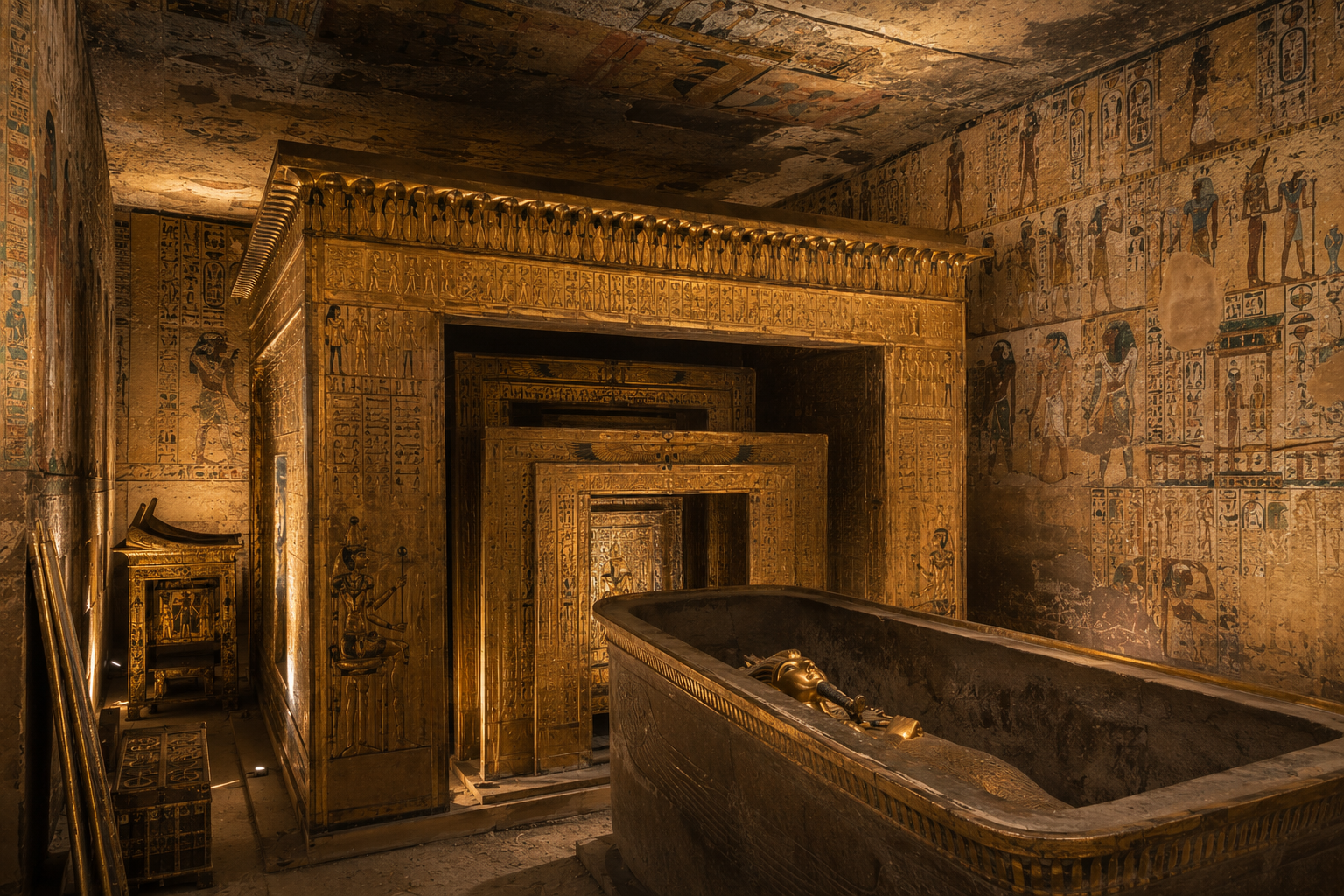
Most of the room was occupied by four large gilded wooden shrines placed one inside another. They filled the chamber so completely that only narrow spaces remained between the outer shrine and the walls.
Inside the shrines stood a quartzite sarcophagus. Within that sarcophagus were three anthropoid coffins nested together. The innermost coffin contained the mummified body of Tutankhamun, whose head and shoulders were covered by the famous funerary mask.
The arrangement created a sequence of barriers around the king. Each layer offered physical protection while also adding sacred images, inscriptions, materials, and divine associations.
Why the Shrines Filled Almost the Entire Room
The outermost shrine was assembled inside the burial chamber because it was too large to pass through the doorway in completed form. Once constructed, it transformed the room into a sacred enclosure around the sarcophagus.
The repeated use of nested layers reflected an Egyptian preference for reinforced protection. A single coffin might preserve the body, but several coffins within a stone sarcophagus and multiple shrines created a far stronger physical and magical defence.
Each layer also marked a step closer to the king. The outer shrine separated the burial from the chamber walls. The inner shrines enclosed the sarcophagus. The coffins reproduced the human form of the ruler. The mask preserved his ideal face at the innermost centre.
This sequence turned the body into something hidden, protected, and increasingly sacred.
The Painted Walls
The burial chamber’s wall paintings are relatively simple when compared with the extensive decoration found in some other royal tombs. Their limited scale may reflect the short period available to prepare Tutankhamun’s burial.
The scenes nevertheless addressed essential moments in the king’s transformation.
One wall shows Tutankhamun’s successor, Ay, performing the Opening of the Mouth ceremony. This ritual was intended to restore the deceased king’s ability to breathe, speak, see, hear, and receive offerings in the afterlife.
Other scenes connect Tutankhamun with Osiris and show him entering the company of divine beings. The imagery did not merely record the funeral. It helped make the transformation effective.
The paintings therefore worked together with the coffins, shrines, amulets, and rituals. Every part of the chamber repeated the same central message: Tutankhamun had not simply died. He was being changed into an eternal royal being.
The Stone Sarcophagus
At the centre of the shrines stood the quartzite sarcophagus. Its heavy stone construction provided a durable barrier around the nested coffins.
Protective goddesses were carved at its corners, their wings extending around the structure as though embracing and guarding the king. This combination of stone strength and divine imagery united physical and magical protection.
The lid did not perfectly match the body of the sarcophagus and was made from a different stone, suggesting that the burial equipment may have been adapted under time pressure. Such details support the idea that the unexpected death of the young king forced officials to complete the funeral using available materials and objects.
Adaptation did not make the sarcophagus less sacred. Once it had been prepared, inscribed, assembled, and used within the proper rituals, it became an effective part of the burial.
The Treasury
Beyond the burial chamber lay a smaller room that Carter called the treasury. Its name is understandable because it contained some of the tomb’s most sacred and visually powerful objects. Yet the room was not a treasury in the modern sense of a place used simply to store wealth.
Its contents were closely connected with bodily preservation, ritual protection, divine assistance, and the king’s journey into the afterlife.
The treasury was less crowded than the antechamber, but its arrangement was highly significant. Objects were positioned around the canopic shrine, which protected the embalmed internal organs removed from Tutankhamun’s body during mummification.
The room also contained model boats, shabti figures, chests, statues, and the famous shrine associated with Anubis. Together, these objects supported the king at a stage when physical preservation alone was not enough. He also needed protection, movement, service, and magical regeneration.
The Canopic Shrine
One of the central objects in the treasury was a gilded wooden shrine containing the alabaster canopic chest. Four protective female figures stood around the shrine with their arms extended, guarding the sacred contents within.
The canopic chest held four miniature coffins intended for Tutankhamun’s internal organs. During mummification, these organs were treated separately because preserving the complete body was essential to continued existence after death.
The organs were not considered disposable remains. They formed part of the king’s physical identity and therefore required their own containers, protection, inscriptions, and sacred guardianship.
The surrounding figures created an image of constant defence. Their bodies faced outward, while their arms embraced the shrine behind them. The arrangement made the entire structure appear protected from every direction.
The Anubis Shrine
Near the entrance to the treasury stood a black jackal figure resting upon a gilded shrine. The figure represented Anubis, the deity closely associated with embalming, cemeteries, and the protection of the dead.
Its placement was striking. Positioned near the passage from the burial chamber, the shrine appeared to guard the room and watch over the sacred equipment stored inside.
The black surface of the figure carried associations with regeneration and the fertile soil of Egypt, while the gilded details linked it with divine radiance and royal status.
Anubis played a central role in funerary belief because the body had to be protected during the dangerous transition between death and rebirth. His presence reinforced the idea that Tutankhamun was under divine guardianship throughout that transformation.
Model Boats for the Next World
The treasury also contained model boats. These objects reflected the importance of river travel in both Egyptian life and religious belief.
Boats transported people and goods along the Nile, carried royal processions, and appeared in funerary journeys. In religious thought, the sun itself travelled across the sky and through the underworld in a divine vessel.
Providing boats for Tutankhamun ensured that movement remained possible after death. He could travel through the sacred landscape, accompany divine beings, and complete the journeys required for rebirth.
The models did not need to function as full-sized vessels. Through ritual symbolism, a smaller representation could preserve the identity and purpose of the complete object.
Shabtis and Eternal Service
Numerous shabti figures were placed inside the tomb to serve Tutankhamun in the afterlife. These human-shaped figures were intended to respond if the deceased was called upon to perform work.
Some carried tools associated with agricultural labour. Others were equipped as overseers. Their presence created an organised workforce that could act on behalf of the king.
This idea reflected the continuation of social order beyond death. Tutankhamun remained a ruler. He was not expected to abandon his royal position and perform ordinary labour himself.
Shabtis therefore combined magic with administration. Their inscriptions activated them, while their different forms suggested a structured group of workers and supervisors prepared to answer the king’s needs.
The Annex
The annex was a small side chamber opening from the antechamber. Unlike the burial chamber and treasury, it contained many objects associated with supplies, storage, food, drink, oils, and daily practical needs.
Its appearance was extremely crowded. Baskets, jars, vessels, boxes, and other containers were stacked and placed closely together. Ancient robbery had disturbed parts of the chamber, making its original arrangement difficult to reconstruct completely.
The annex may look less impressive than the rooms filled with gilded shrines and royal statues, but it reveals one of the most important truths about the burial.
Ancient Egyptians expected eternal life to require practical support.
Food for Eternity
The tomb contained provisions intended to prevent the king from experiencing hunger. Meat, grain products, fruit, wine, and other supplies were represented or physically included among the burial goods.
Food offerings were a central part of Egyptian funerary practice. The dead were believed to receive nourishment through real provisions, ritual offerings, spoken formulas, and images of food.
Placing actual supplies inside the tomb created an immediate source of sustenance. Religious rituals and offering texts could then renew that nourishment indefinitely.
For Tutankhamun, royal abundance had to continue after death. The annex therefore functioned partly like a storeroom prepared for a household that was expected never to run out of essential supplies.
Wine, Oils, and Containers
Wine jars and other vessels were not empty decorations. Some containers recorded details about their contents, including information connected with production or origin.
These inscriptions give historians valuable evidence about storage, administration, and elite consumption during the late Eighteenth Dynasty.
Oils and ointments also had practical and ritual importance. They could be used for anointing, personal care, religious ceremonies, and the treatment of the body.
The containers themselves reveal the range of materials used by Egyptian craftspeople. Pottery, stone, wood, basketry, and other substances were selected according to function, value, and symbolic meaning.
Why Everyday Objects Mattered
The objects from the annex make Tutankhamun’s burial feel less like an abstract religious monument and more like a carefully supplied residence.
The king needed more than a coffin and a funerary mask. He required food, drink, clothing, oils, tools, containers, and familiar possessions.
These items demonstrate that eternal life was imagined as a continuation of identity and activity. Tutankhamun would still have needs. The burial team attempted to anticipate those needs and provide for them before the tomb was sealed.
Why Was Tutankhamun’s Tomb So Small?
Visitors familiar with the enormous monuments of Egypt are often surprised by the modest size of KV62.
Tutankhamun was a pharaoh, yet his tomb is much smaller than several other royal tombs in the Valley of the Kings. Its corridors are short, its chambers are compact, and only the burial chamber received painted decoration.
This contrast has produced one of the tomb’s most persistent questions: was KV62 originally intended for Tutankhamun?
There is no single answer accepted without debate, but several features suggest that the young king’s unexpected death affected the burial preparations.
A Death That Came Too Soon
Tutankhamun died while still young, after ruling for approximately a decade. A large royal tomb could require years of excavation, decoration, and preparation.
If his death occurred before a planned tomb was ready, officials would have needed to organise the funeral within the limited period allowed for mummification and burial.
KV62 may have been an unfinished or repurposed tomb available at the time. Its small scale and unusual plan have led researchers to suggest that it might not originally have been designed for a king.
The tomb’s compact layout would explain why large objects were dismantled and why so much equipment was packed tightly into the chambers.
Was the Tomb Reused?
Some scholars have proposed that KV62 may have begun as a non-royal tomb or a burial intended for another member of the royal family. Its plan differs from the larger, more elaborate tombs prepared for several New Kingdom kings.
However, the original purpose of the tomb cannot be established with absolute certainty. What is clear is that it was adapted successfully for a royal burial.
The burial chamber was decorated, monumental shrines were assembled within it, and thousands of objects were brought into the surrounding rooms. Whatever the tomb’s first intended use, it became Tutankhamun’s protected eternal residence.
Evidence of Rushed Preparation
Several details within the burial have been interpreted as signs of limited preparation time. Some objects appear to have been adapted, reinscribed, or selected from existing royal resources.
The mismatch between parts of the sarcophagus may also indicate that available materials were used to complete the burial quickly.
These adaptations should not be mistaken for poor workmanship. Egyptian royal workshops were capable of modifying objects while preserving their religious and ceremonial effectiveness.
The funeral officials faced a practical problem: a king had died, and every necessary category of burial equipment had to be prepared before interment.
Why It Survived for More Than 3,000 Years
Tutankhamun’s tomb is often called intact, but the evidence tells a more complicated story.
Ancient robbers entered KV62 on at least one occasion, probably not long after the burial. They disturbed objects, opened containers, and removed some portable valuables.
Officials later entered the tomb, restored part of the arrangement, and resealed the damaged entrances. After that, the location gradually disappeared beneath debris and later activity in the valley.
The Tomb Was Hidden by Accident
One of the most important factors in the tomb’s survival was its position beneath the entrance area of the later tomb of Ramesses VI.
As work continued in the valley, debris accumulated over the staircase leading to KV62. Huts used by ancient workers were later built above part of the buried entrance.
This covering helped hide the tomb from subsequent generations of robbers.
Unlike grand entrances that remained visible or could be rediscovered easily, the staircase of KV62 effectively vanished beneath the altered landscape.
Why the Robbers Did Not Empty It
The ancient intruders appear to have entered the outer chambers but did not remove most of the burial equipment. Their visit may have been brief, interrupted, or focused on small objects that could be carried away quickly.
Large pieces of furniture, shrines, chariots, and coffins were difficult to remove through the narrow corridor. Some valuable materials were also attached to objects too large or fragile to transport easily.
The burial chamber itself remained protected behind sealed barriers, and the nested shrines created further obstacles around the king’s body.
After officials resealed the tomb, the hidden entrance reduced the chance of another major robbery.
Preservation Was Not Perfect
Although the tomb survived with an extraordinary number of objects, time still affected its contents.
Wood dried and cracked. Textiles became fragile. Organic materials deteriorated. Gilded surfaces loosened. Oils and resins changed chemically. Some objects had already been damaged or displaced during ancient intrusions.
The excavation team therefore faced a conservation challenge as serious as the archaeological one. Many objects could not simply be lifted and carried away. They required treatment before movement.
The survival of the tomb depended not only on ancient concealment but also on careful modern documentation and conservation after its discovery.
The Objects That Tell Hidden Stories
One of the greatest misconceptions about Tutankhamun’s tomb is that it is simply a collection of beautiful artifacts. Gold naturally attracts attention, but the true importance of the burial lies in what those objects reveal about ancient Egyptian civilization.
Every chest, chair, statue, vessel, and piece of jewelry tells a story that extends far beyond the life of one young king. Together, they provide historians with an exceptionally detailed picture of how Egypt functioned during the late Eighteenth Dynasty.
The tomb acts almost like a time capsule, preserving evidence of royal craftsmanship, religious belief, international trade, court ceremony, and everyday life.
Royal Craftsmanship
The furniture alone demonstrates extraordinary technical skill. Carpenters combined different types of wood, craftsmen covered surfaces with gold leaf, and artists decorated objects with colored glass, faience, ebony, ivory, and semi-precious stones.
Many joints remain remarkably precise despite surviving for more than three thousand years. Folding stools, ceremonial chairs, beds, chests, and boxes reveal that Egyptian furniture was both functional and highly sophisticated.
These objects were not made by anonymous workshops producing identical pieces. Each reflects careful planning and highly specialized craftsmanship.
Evidence of International Trade
The burial also reveals how connected Egypt had become with neighboring regions.
Materials such as cedar wood from the Levant, ebony from Africa, ivory, precious stones, glass, and imported luxury goods demonstrate that the Egyptian court participated in extensive international exchange.
Although Tutankhamun ruled for only a short period, his tomb reflects the wealth accumulated by one of the most powerful kingdoms of the Late Bronze Age.
Trade supplied not only valuable materials but also artistic ideas, diplomatic gifts, and exotic resources that became part of royal life.
Religion in Everyday Life
Modern visitors often separate religious objects from ordinary possessions, but the Egyptians did not always make that distinction.
A decorated chair could display divine symbolism. Jewelry might function as both personal ornament and magical protection. A chest could store clothing while also carrying scenes expressing royal authority.
Religion surrounded daily life rather than existing apart from it.
This explains why practical household objects appear beside sacred statues and ritual equipment throughout Tutankhamun’s tomb. Together they formed a complete world rather than separate categories of “ordinary” and “religious” belongings.
The Story Behind Every Scratch
Historians also study the condition of individual objects.
Wear marks on furniture, repairs to wooden frames, alterations to inscriptions, and traces of use can reveal whether an object belonged to Tutankhamun during his lifetime or was produced specifically for the funeral.
Even damage caused by ancient robbers has archaeological value because it helps reconstruct what happened after the burial was sealed.
Every object therefore tells several stories at once:
| Object Type | What It Reveals |
|---|---|
| Furniture | Royal craftsmanship, palace life, woodworking techniques |
| Jewelry | Religious symbolism, elite fashion, precious materials |
| Weapons | Royal authority, ceremonial traditions, military symbolism |
| Food and containers | Diet, agriculture, storage methods, funerary offerings |
| Shrines and statues | Religious beliefs and divine protection |
| Chariots | Technology, ceremony, transportation, royal display |
For archaeologists, this combination of evidence is far more valuable than the market price of the materials themselves.
Are There Still Hidden Chambers?
Few questions surrounding Tutankhamun’s tomb have attracted more public attention than the possibility of hidden chambers concealed behind its walls.
The idea gained worldwide attention after Egyptologist Nicholas Reeves suggested that subtle features visible on high-resolution scans of the burial chamber might represent blocked doorways leading to additional rooms.
One proposal even suggested that those hypothetical spaces could relate to the burial of Queen Nefertiti.
The theory generated enormous interest because discovering another sealed royal chamber would rank among the greatest archaeological finds of modern times.
Radar Surveys
Several teams carried out radar investigations inside the burial chamber in an effort to test the hypothesis.
Some early interpretations appeared to support the possibility of hidden spaces, while later surveys reached different conclusions.
As additional studies were completed using improved methods, no clear archaeological evidence confirmed the existence of undiscovered chambers directly behind the decorated walls.
The differing results demonstrate one of the realities of scientific research: new technology does not always produce immediate agreement.
What Do Archaeologists Think Today?
Today, most specialists consider the existence of additional chambers behind the painted walls to be unproven.
This does not mean further discoveries in the Valley of the Kings are impossible. Archaeology constantly develops through new excavation, improved recording methods, and better analytical technology.
However, responsible interpretation requires separating exciting possibilities from established evidence.
Even without additional chambers, KV62 continues to produce new information. Modern imaging, conservation science, and material analysis reveal details that were impossible to study when the tomb was first excavated a century ago.
What Tutankhamun’s Tomb Reveals Today
More than one hundred years after its discovery, Tutankhamun’s tomb remains one of archaeology’s most important sources of information.
Its significance is measured not by the amount of gold it contained but by the completeness of the royal world preserved inside it.
The tomb reveals how ancient Egyptians designed furniture, produced jewelry, organized workshops, practiced religion, prepared royal funerals, preserved the body, and imagined eternity.
It also reminds us that archaeology is about context rather than isolated masterpieces.
The famous golden mask is extraordinary, but it becomes even more meaningful when understood alongside the shrines, coffins, guardian statues, chariots, food offerings, clothing, tools, and thousands of other objects that surrounded it.
Together they tell a single story.
They show how a civilization believed a king should cross the boundary between life and death while preserving his identity, authority, and place within the divine order.
Frequently Asked Questions
How many chambers are inside Tutankhamun’s tomb?
The tomb contains four principal chambers: the antechamber, the annex, the burial chamber, and the treasury, all connected by a short entrance corridor.
Why is Tutankhamun’s tomb so famous?
Unlike most royal tombs in the Valley of the Kings, it survived with an exceptional quantity of its original burial equipment still inside, providing archaeologists with an unparalleled view of a New Kingdom royal burial.
Was Tutankhamun’s tomb completely untouched?
No. Ancient robbers entered the tomb shortly after the burial, but officials later restored much of the damage and resealed the entrances. Most of the funerary equipment remained inside until its discovery in 1922.
Why was the tomb so small?
Many Egyptologists believe Tutankhamun’s unexpected death required a rapid burial, and the available tomb was adapted for royal use. Although relatively compact, it successfully accommodated the equipment required for a pharaoh’s burial.
Are there really hidden chambers behind the walls?
At present, there is no conclusive archaeological evidence confirming additional hidden chambers behind the decorated walls of the burial chamber.
Can visitors still enter Tutankhamun’s tomb?
Yes. Visitors to the Valley of the Kings can enter KV62, although many of its original treasures, including the famous funerary mask, are now displayed in museums to help preserve them.
Final Thoughts
When people imagine Tutankhamun’s tomb, they often picture gold.
Gold certainly played an important role, but it was only one part of a far greater story.
Behind the sealed doorway of KV62 lay an entire royal world carefully assembled by priests, craftsmen, artists, officials, and embalmers. Every chamber had a purpose. Every object belonged to a larger plan. Every protective layer reflected the belief that death marked a beginning rather than an end.
That is why Tutankhamun’s tomb continues to fascinate the world.
It is not simply the richest royal burial ever discovered.
It is one of the clearest windows ever opened into the beliefs, skills, and imagination of ancient Egypt.