
Before he became the face of ancient Egypt, Tutankhamun was a child growing up inside a royal family shaken by one of the most dramatic religious experiments in Egyptian history. He inherited no peaceful golden age. He inherited a kingdom whose temples, priesthoods, capital, and relationship with its gods had been transformed within a single generation.
He became pharaoh when he was only about nine years old and ruled for less than a decade. By the standards of Egypt’s great military conquerors and monumental builders, his reign was brief. Yet the discovery of his tomb thousands of years later would make this young king more famous than rulers who commanded larger armies, raised taller monuments, and governed for many decades.
Tutankhamun was a pharaoh of Egypt’s Eighteenth Dynasty who ruled during the late fourteenth century BCE. He came to the throne as a child after the religious upheaval associated with Akhenaten. During his reign, the royal court restored traditional temples and cults, abandoned the exclusive elevation of the Aten, and returned royal support to deities such as Amun. Tutankhamun died at about nineteen, but the later discovery of his richly furnished tomb transformed him into the world’s most recognizable pharaoh.
- Growing Up During Egypt’s Greatest Religious Revolution
- How a Child Became Pharaoh
- Restoring the Old Gods
- Life Inside the Royal Court
- A King With Only Nine Years to Rule
- The Mystery of His Death
- The Tomb That Changed Archaeology Forever
- Why Tutankhamun Became More Famous Than Greater Pharaohs
- Final Thoughts
- Frequently Asked Questions
Growing Up During Egypt’s Greatest Religious Revolution
Tutankhamun entered the world during a period when Egypt’s royal court was breaking with traditions that had developed over centuries. The pharaoh Akhenaten had elevated the solar deity Aten above Egypt’s established gods and redirected royal patronage away from older religious institutions. Temples associated with Amun lost influence, divine names were attacked in some monuments, and the royal residence moved to a newly founded city called Akhetaten, now known as Amarna.
For a child inside the palace, this was not simply a theological dispute. Religion shaped almost every public expression of kingship. It influenced royal names, temple festivals, art, architecture, government resources, and the ceremonial relationship between the pharaoh and the gods. Changing religion therefore meant changing the visible language through which Egyptian kings justified their authority.
The exact details of Tutankhamun’s earliest years remain difficult to reconstruct. Evidence strongly connects him to the Amarna royal family, and Akhenaten is widely identified as his father. The identity of his mother is less certain. Scientific investigations have contributed important evidence about his family relationships, but connecting every mummy to a securely known historical name remains more complicated than a simple family tree might suggest.
Even his original name reflected the world into which he was born. He was first called Tutankhaten, commonly understood as “the living image of Aten.” That name placed the young prince inside the religious system promoted by Akhenaten. Later, when the royal court restored older traditions, the name changed to Tutankhamun—“the living image of Amun.”
The change was only a few letters in modern transcription, but its political and religious meaning was enormous. It signaled that the monarchy was no longer defining itself primarily through Aten. The god Amun, whose temples had once stood near the center of Egypt’s religious and economic life, was returning to royal favor.
Tutankhamun’s two royal names preserve the central transformation of his lifetime. Tutankhaten connected him to the Aten-centered court of Amarna, while Tutankhamun publicly associated his kingship with the restored worship of Amun.
His childhood may therefore have unfolded between two competing visions of Egypt. One was the revolutionary court created by Akhenaten. The other was the older religious order supported by powerful temples, priesthoods, regional traditions, and generations of royal practice. By the time the boy reached the throne, the experiment at Amarna was already losing its hold on the kingdom.
How a Child Became Pharaoh
Tutankhamun became king at approximately nine years of age. The precise sequence of rulers immediately before him remains one of the difficult questions of the late Eighteenth Dynasty, but it is clear that he inherited a fragile political situation while still too young to govern without experienced adults around him.
Egyptian kingship carried immense responsibilities. The pharaoh was expected to preserve maat—the ideal of order, justice, balance, and proper relationship between the human and divine worlds. He authorized temple building, appointed officials, received foreign tribute, directed military activity, and appeared as the ritual protector of Egypt.
A nine-year-old could hold the sacred title of king, but the daily machinery of government required administrators, scribes, priests, military commanders, and senior courtiers. Tutankhamun’s reign was therefore shaped by influential officials who possessed far more experience than the young pharaoh.
Two figures are especially important. Ay, a senior courtier with deep connections to the royal establishment, appears prominently in the period and would later succeed Tutankhamun as pharaoh. Horemheb, a powerful military commander, also gained exceptional authority and eventually became king after Ay. Their exact influence over individual decisions during Tutankhamun’s childhood cannot always be measured, but the political experience surrounding the young ruler was substantial.
Tutankhamun was married to Ankhesenpaaten, one of Akhenaten’s daughters. As the court moved away from Aten-centered religion, her name became Ankhesenamun. Their marriage helped preserve continuity within a royal family whose succession had become uncertain.
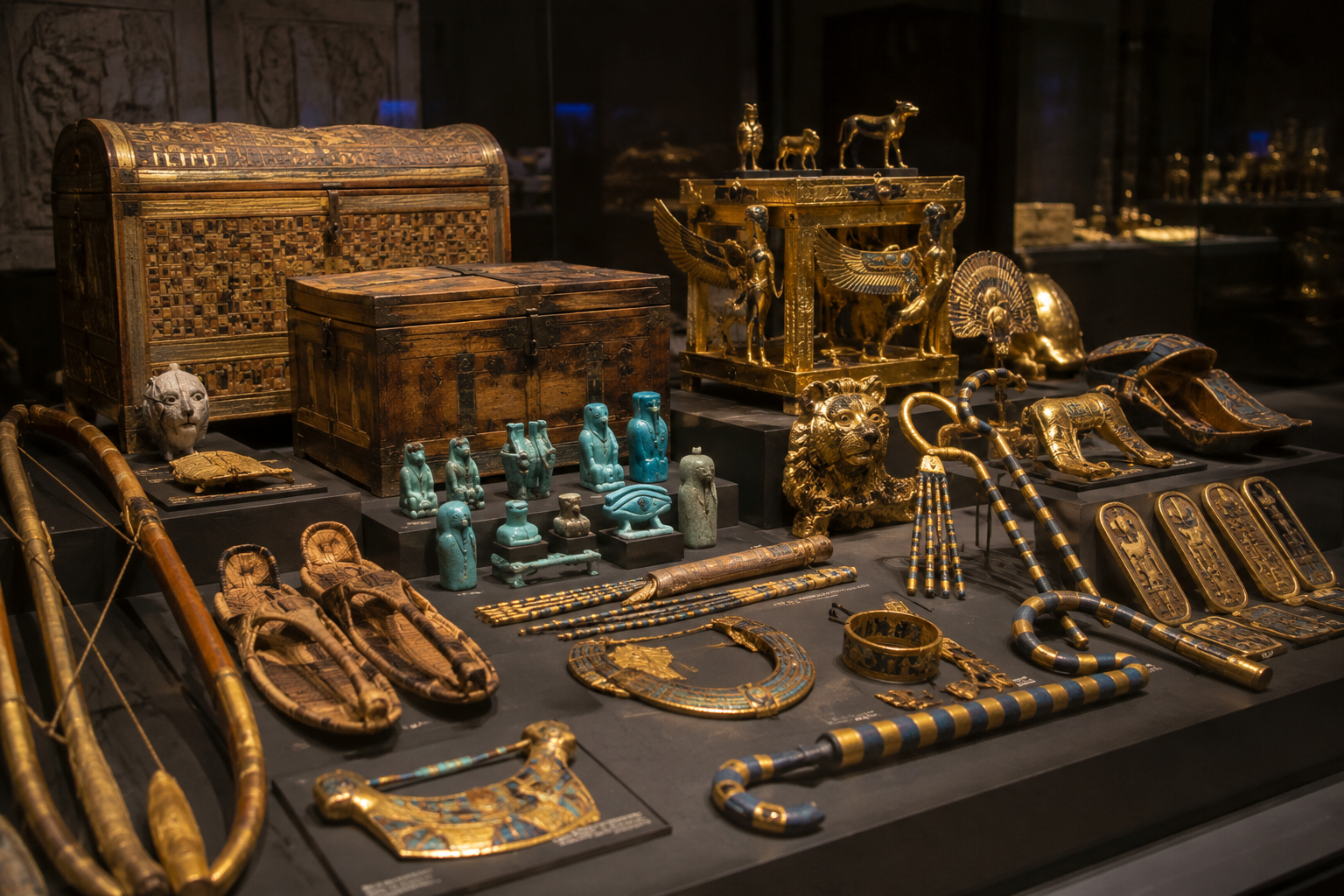
The objects associated with Tutankhamun show how completely the institution of kingship surrounded the child. Ceremonial furniture, jewelry, weapons, clothing, chariots, ritual objects, and images of deities all communicated royal identity. Even when the person wearing the crown was young, the symbols around him presented the pharaoh as powerful, divinely protected, and capable of maintaining order.
| Royal Figure | Position During the Period | Historical Importance |
|---|---|---|
| Tutankhamun | Child pharaoh | Presided over the restoration of traditional religious institutions after the Amarna Period. |
| Ankhesenamun | Royal wife | Connected Tutankhamun to Akhenaten’s immediate royal family and shared the court’s change of religious names. |
| Ay | Senior court official | Held significant authority and later succeeded Tutankhamun as pharaoh. |
| Horemheb | Military commander | Became one of Egypt’s most powerful officials and eventually ruled as pharaoh. |
Restoring the Old Gods
The defining policy of Tutankhamun’s reign was the restoration of Egypt’s traditional religious order. The royal court moved away from the elevation of Aten that had dominated Akhenaten’s later years and renewed support for the temples, cults, and divine images connected with older gods.
This shift was recorded in what is commonly called the Restoration Stela. Its inscription describes temples in decline, sanctuaries neglected, and the gods no longer responding properly to Egypt. It then presents the young king as the ruler who repaired sacred places, restored divine images, supplied temple personnel, and renewed offerings.
Like other royal inscriptions, the text was designed to present the pharaoh as the source of order. It should not be read as a neutral modern report. Yet it remains powerful evidence for the public message of the reign: Egypt’s relationship with its traditional gods was being repaired, and Tutankhamun was the royal figure through whom that restoration was announced.
The king and queen changed their names, and the court gradually left Akhetaten. Memphis appears to have regained importance as a center of royal administration, while Thebes once again stood at the heart of Amun’s restored religious world. The change was not necessarily completed in a single dramatic day. Evidence suggests a transition in which older and newer religious elements briefly existed beside one another.
Tutankhamun’s building activity also supported the restoration. Work associated with his reign appeared at major religious centers, including Karnak and Luxor. Statues and ritual objects were commissioned, temple resources were renewed, and images of traditional deities returned to royal monuments.
The young king did not personally design every statue, inspect every workshop, or write every decree. Nevertheless, Egyptian royal ideology placed these acts under his authority. His name became the official name of restoration, regardless of how much practical direction came from senior advisers.
This is one reason Tutankhamun should not be dismissed as historically unimportant simply because he was young. His reign stood at a turning point. The policies issued in his name helped close the Amarna experiment and reconnected the monarchy with religious institutions that had supported Egyptian kingship for generations.
Life Inside the Royal Court
The royal court was more than a palace filled with luxury. It was the mobile center of Egyptian government—a world of audiences, reports, ceremonies, workshops, diplomatic gifts, religious observances, and competition for access to the king.
Tutankhamun would have been surrounded by tutors, scribes, attendants, priests, officials, guards, craftsmen, and members of the royal household. His education likely prepared him for ritual duties and the public expectations of kingship. He needed to recognize formal texts, understand royal ceremonies, participate in temple events, receive officials, and embody the controlled image expected of an Egyptian pharaoh.
The beautifully made objects from his burial reveal both ceremonial grandeur and private experience. Some items projected the king as a victorious ruler, defeating enemies and controlling chaos. Others were more personal: clothing, sandals, board games, containers, furniture, walking sticks, and objects designed for daily use.
Together they reveal the contrast at the center of Tutankhamun’s story. The official image showed an ideal king with divine strength. Behind that image stood a young person whose life was structured by ceremony, inherited political tensions, and the expectations of one of the ancient world’s most demanding institutions.
Royal life also depended on a much larger society beyond palace walls. Food, linen, furniture, metalwork, transport, temple equipment, and luxury goods required thousands of skilled workers and administrators. As seen in The Village Behind the Tombs, the creation of royal burial places depended on organized communities of craftsmen rather than anonymous labor alone.
The contrast between royal and ordinary life was immense, yet both worlds followed the rhythms of the Nile, agricultural production, religious festivals, and the daily work that kept Egyptian society functioning. The routines explored in Before Sunrise formed the wider human world from which palace supplies, temple offerings, and royal projects ultimately emerged.
Tutankhamun’s early reign cannot be understood as the story of a child ruling alone. He stood at the center of a sophisticated political system filled with experienced officials, priests, military leaders, and royal relatives. Yet his kingship was not meaningless. His name, image, and sacred authority gave legitimacy to the restoration that reshaped Egypt after Akhenaten.
For nearly nine years, the young pharaoh occupied the throne while Egypt rebuilt its relationship with its traditional gods and moved beyond the upheaval of Amarna. Then, before he could reach full adulthood, Tutankhamun died. His death left the royal succession uncertain—and began the sequence of events that would eventually place his name among the most famous in human history.
A King With Only Nine Years to Rule
Tutankhamun ruled for approximately nine years. That was enough time for the court to reverse much of the religious policy associated with Akhenaten, restore neglected temples, and re-establish royal support for Egypt’s traditional gods. It was not enough time for the young king to create the enormous architectural legacy left by rulers such as Khufu, Hatshepsut, or Ramesses II.
Even so, surviving evidence suggests that his reign was more active than the popular image of a passive child king implies. Building projects were carried out in his name, damaged divine images were restored, and royal monuments once again presented the pharaoh in the familiar company of gods such as Amun.
Some scenes also portrayed Tutankhamun as a warrior and hunter. Like other royal images, these were not necessarily records of events witnessed exactly as shown. Egyptian kings were represented according to an ideal: eternally youthful, physically powerful, victorious over enemies, and capable of defeating the forces of disorder.
Evidence from the period indicates that Egypt also remained involved in military affairs beyond its borders. Horemheb, the senior commander who later became pharaoh, held considerable authority. Campaigns and conflicts connected with Nubia and Egypt’s northern territories formed part of the political background of the reign, even when the young king was unlikely to have directed every operation personally.
The royal court was therefore balancing several responsibilities at once. It had to restore religious stability at home, protect Egypt’s international interests, manage powerful officials, and secure the future of the dynasty. Tutankhamun’s youth made the question of succession especially important.
A Royal Family Without a Surviving Heir
Two small mummified individuals found in Tutankhamun’s tomb are generally interpreted as stillborn daughters of the king and Ankhesenamun. Their presence adds a deeply personal dimension to the burial and suggests that the royal couple had no surviving child who could inherit the throne.
Without an established heir, Tutankhamun’s sudden death created a dangerous political gap. The Eighteenth Dynasty had already passed through years of disputed succession and religious upheaval. Now Egypt lost its young king before a stable new generation of the royal family could be secured.
Tutankhamun was not one of Egypt’s longest-ruling pharaohs, but his reign helped guide the monarchy away from the disruption of the Amarna Period. His historical importance rests less on conquest or giant monuments than on the restoration carried out under his royal authority.
The Mystery of His Death
Tutankhamun died when he was approximately eighteen or nineteen years old. No surviving historical account clearly explains the circumstances of his death, and this absence has encouraged generations of speculation.
For many years, dramatic theories suggested that the young king had been murdered. Damage visible in early images of the mummy was sometimes presented as evidence of a fatal blow to the head. Later examinations showed that some of this damage was more likely connected with the mummification process or the difficult removal of the body from its coffins in the twentieth century.
Modern medical studies have proposed several possible factors, including a leg injury, infection, malaria, and health problems associated with close royal family relationships. These findings have improved understanding of his physical condition, but they have not produced a universally accepted single cause of death.
The most historically responsible conclusion is therefore less dramatic than many popular documentaries suggest: Tutankhamun died young, probably after experiencing significant health difficulties, but the precise chain of events that caused his death remains uncertain.
His burial appears to have been prepared under pressure. The tomb eventually used for him was smaller than many royal tombs in the Valley of the Kings and may not originally have been planned for a pharaoh. Some funerary objects also appear to have been adapted, reassigned, or completed rapidly for the burial.
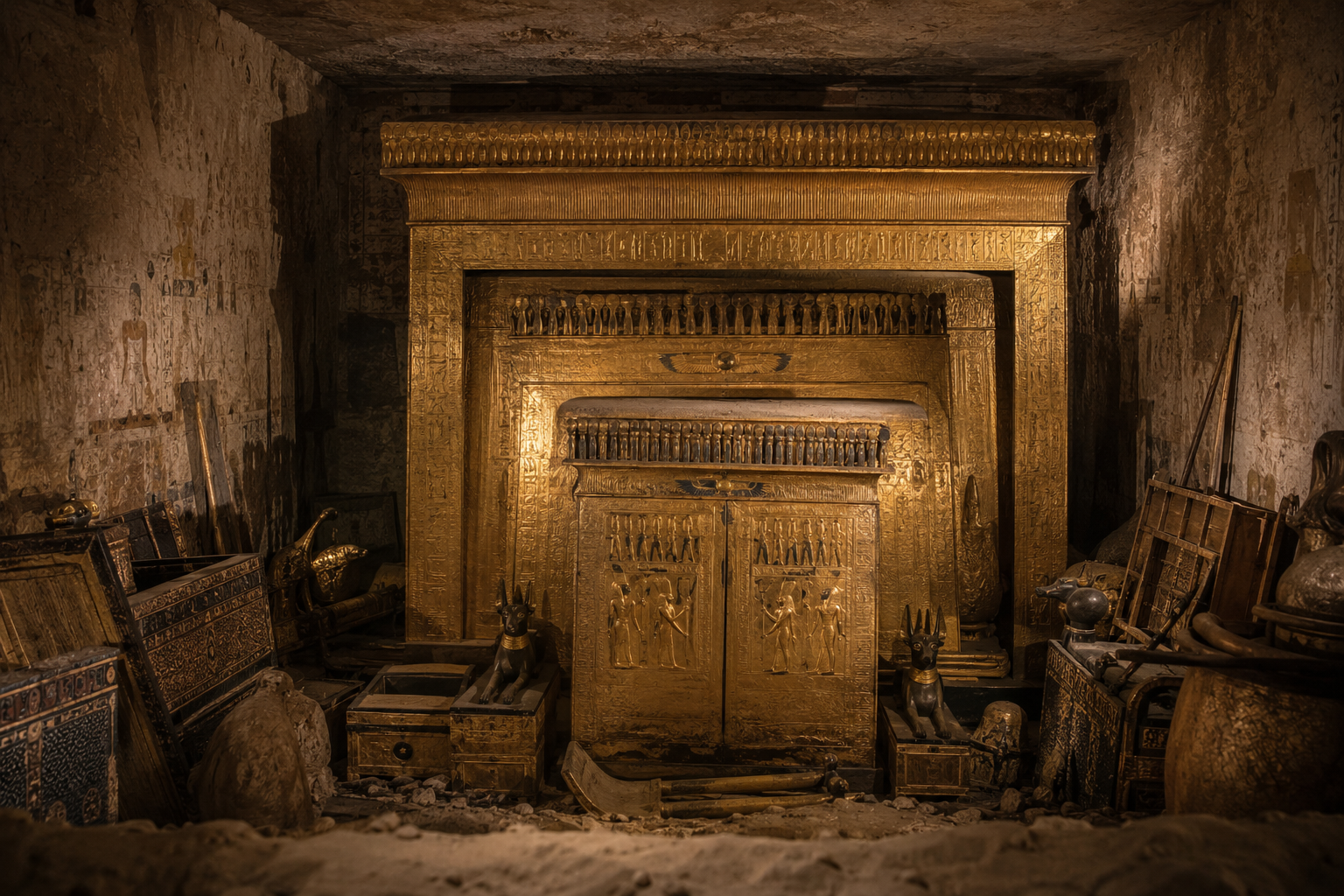
This does not mean that the funeral lacked royal magnificence. The burial chambers contained an extraordinary concentration of shrines, coffins, jewelry, ritual equipment, furniture, chariots, clothing, weapons, food, and objects intended to sustain and protect the king in the afterlife.
The Tomb That Changed Archaeology Forever
More than three thousand years after Tutankhamun’s burial, his name was known to specialists but remained unfamiliar to most of the world. His monuments had been overshadowed by those of more powerful kings, while later rulers had removed or reused parts of the Amarna royal legacy.
That changed in November 1922, when excavations in the Valley of the Kings uncovered a staircase descending into the rock. The work was directed by archaeologist Howard Carter and financed by George Herbert, the Fifth Earl of Carnarvon, but the discovery also depended on Egyptian foremen, excavators, guards, and workers whose contributions were essential.
The entrance was found beneath ancient workmen’s huts near the tomb of Ramesses VI. On November 4, the top of a cut staircase emerged. By the following day, a sealed doorway had been uncovered. The seals suggested that an important burial might still survive beyond it.
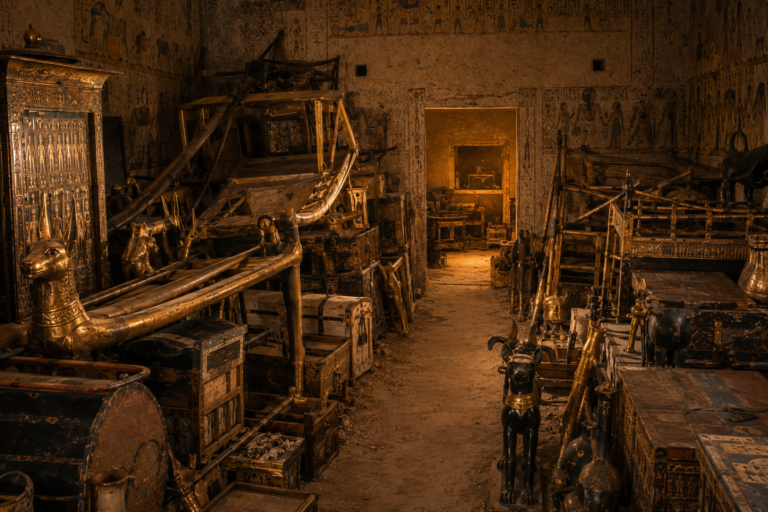
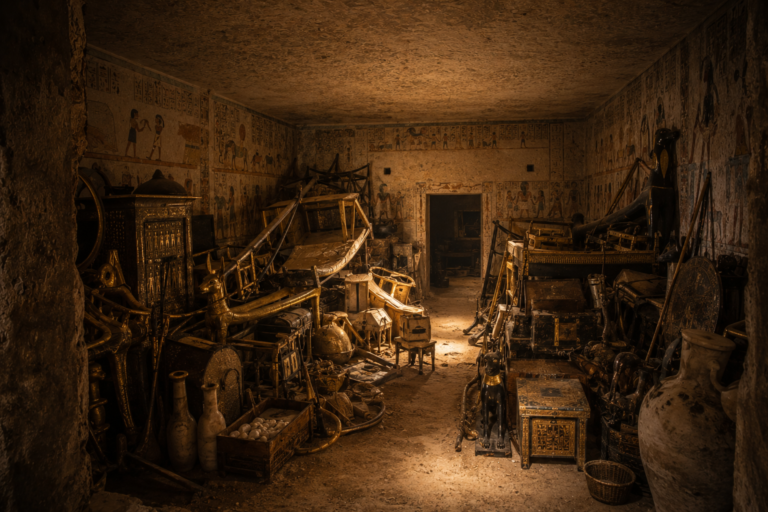
After the passage was cleared, Carter reached another sealed entrance. On November 26, he made a small opening and looked into a chamber crowded with unfamiliar shapes, gilded surfaces, ritual couches, boxes, chariots, and royal objects. The tomb was not completely untouched—evidence indicated limited ancient intrusion—but much of its burial equipment remained in place.
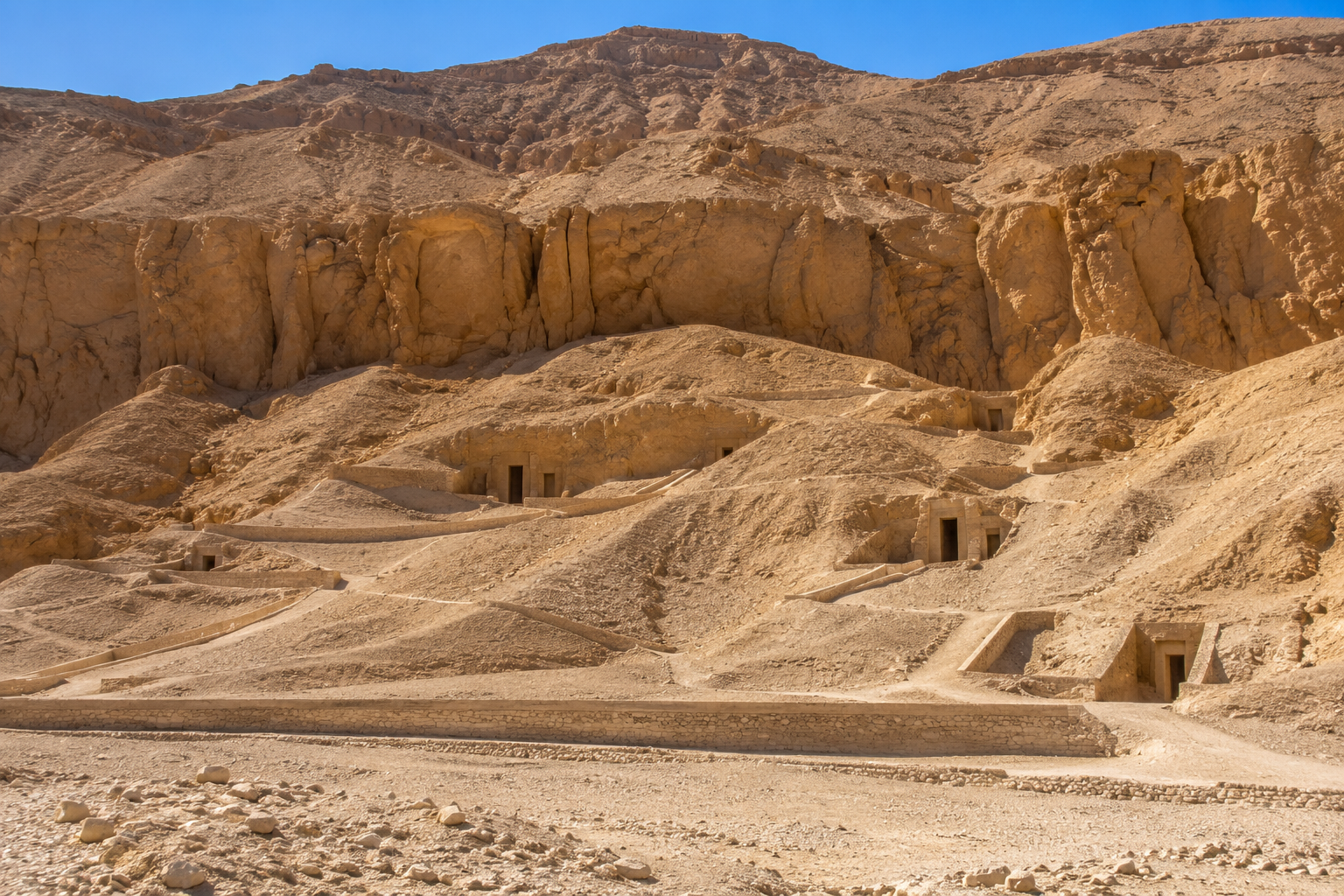
The tomb is known today as KV62. Compared with the long corridors and multiple chambers of some royal burials, it was relatively modest in size. Its importance came from the survival of its contents. Other royal tombs in the valley had been heavily robbed in antiquity, leaving archaeologists to reconstruct their original appearance from fragments.
Tutankhamun’s burial offered something different. Rooms were still filled with thousands of objects connected with royal life and death. They allowed researchers to study how furniture was arranged, how shrines surrounded the burial, how equipment was packed into the chambers, and how artistic workshops prepared objects for a royal funeral.
Documenting the tomb required years rather than days. Each object had to be photographed, numbered, described, conserved, and carefully removed. Photographer Harry Burton created a visual record that remains fundamental to the study of the excavation. Specialists in conservation, language, art, anatomy, and materials also contributed to the project.
The work transformed archaeological expectations. The tomb demonstrated how much information could be lost when excavation focused only on valuable objects rather than their original positions and relationships. Although the methods of the 1920s differ from modern archaeological practice, the extensive records produced by Carter’s team remain an exceptional historical archive.
Tutankhamun’s tomb was not the largest or most elaborately decorated royal tomb in the valley. Its importance came from the unusually rich survival of its burial equipment, which preserved a detailed material record of Eighteenth Dynasty kingship, craftsmanship, religion, and daily royal life.
Why Tutankhamun Became More Famous Than Greater Pharaohs
Tutankhamun was not Egypt’s greatest conqueror. He did not rule for sixty years, build the largest pyramid, establish a vast new capital, or leave temples across the country on the scale of Egypt’s most powerful monarchs.
His fame came from an unusual meeting of ancient history and modern media. The discovery occurred when newspapers, photography, cinema newsreels, and international travel could carry an archaeological story around the world with unprecedented speed.
The objects themselves were visually irresistible. Gold-covered shrines, elaborate jewelry, painted chests, ceremonial beds, statues, weapons, and the now-famous funerary mask created an image of ancient Egyptian royalty that the public could understand immediately.
The timing also mattered. After the destruction of the First World War, the discovery seemed to open a sealed world of beauty, mystery, and extraordinary craftsmanship. Egyptian-inspired designs entered fashion, jewelry, architecture, advertising, and cinema. Tutankhamun became not only an archaeological figure but a global cultural phenomenon.
Stories about a supposed “curse” added another layer of sensation after Lord Carnarvon died in 1923. Newspapers connected unrelated illnesses and deaths to the tomb, even though no convincing evidence demonstrated a supernatural pattern. The curse became a successful modern legend because it combined ancient burial, sudden death, hidden treasure, and fear of disturbing the dead.
The legend often distracted from the more meaningful story: the skill of the ancient craftsmen, the beliefs expressed through the burial, the work of the excavation team, and the historical world revealed by the objects.
The Mask That Replaced the Man
Tutankhamun’s golden funerary mask eventually became one of the most recognizable images associated with ancient Egypt. Its idealized face appears calm, youthful, and timeless. For millions of people, it became the face of the pharaoh himself.
Yet the mask can also hide the complexity of the person behind it. Tutankhamun lived during a political recovery after religious revolution. He became king as a child, occupied a court dominated by older officials, married within a fragile royal family, and died before reaching adulthood.
His story is not important merely because precious objects were placed around his body. It is important because those objects survived together and gave archaeology an unusually complete view of how Egyptian kingship was created through ritual, art, labor, and belief.
The royal monuments examined in The Mountain That Became a Pyramid show how Egyptian rulers had expressed permanence through architecture for more than a thousand years before Tutankhamun. His legacy followed a different path. His own tomb was comparatively small, but what survived inside it made him immortal in the modern imagination.
What His Tomb Revealed About Ancient Egypt
| Evidence From the Tomb | What It Helps Historians Understand |
|---|---|
| Nested shrines and coffins | The complex religious protection created around a royal burial. |
| Furniture and clothing | The materials, design, comfort, and craftsmanship associated with palace life. |
| Chariots, bows, and weapons | The importance of hunting, warfare, transport, and royal power in official identity. |
| Food, oils, and containers | The practical supplies believed necessary for continued existence in the afterlife. |
| Jewelry and amulets | The combination of wealth, divine symbolism, protection, and skilled metalworking. |
| Reused or modified objects | The urgency of the burial and the complicated royal succession after the Amarna Period. |
The tomb also changed how the public imagined ancient Egypt. Before 1922, many Egyptian monuments were known primarily through stone ruins, damaged statues, and objects removed from their original settings. KV62 presented a royal burial as a connected environment filled with color, texture, precious materials, and practical objects.
It showed that the ancient Egyptian afterlife was not imagined as an empty spiritual space. It was prepared through material abundance. The king was supplied with clothing, food, furniture, ritual protection, transportation, and symbols of authority because death was understood as a transformation rather than a complete ending.
Final Thoughts
Tutankhamun became famous because his tomb survived, but his life deserves attention beyond its treasures. He was a child born into religious revolution, a king surrounded by powerful advisers, and the royal symbol of Egypt’s return to traditional worship. His reign was short, his death remains uncertain, and his own achievements were later overshadowed. Yet the objects buried with him preserved an entire world that history had almost lost.
The golden mask made Tutankhamun instantly recognizable, but it cannot tell his complete story. Behind its ideal face was a young ruler living at the end of one of Egypt’s most turbulent royal experiments.
He did not become immortal through the length of his reign or the size of his monuments. He became immortal because a small tomb survived beneath the Valley of the Kings, waiting for the modern world to open its doors.
Frequently Asked Questions
How old was Tutankhamun when he became pharaoh?
Tutankhamun was approximately eight or nine years old when he came to the throne during Egypt’s Eighteenth Dynasty.
How long did Tutankhamun rule Egypt?
He ruled for about nine years, during the late fourteenth century BCE, before dying at approximately eighteen or nineteen years of age.
Why did Tutankhaten change his name to Tutankhamun?
The change reflected the royal court’s movement away from the Aten-centered religion associated with Akhenaten and the restoration of traditional worship, especially the cult of Amun.
Was Tutankhamun murdered?
There is no conclusive evidence that he was murdered. Modern examinations have suggested several possible health problems and injuries, but researchers have not established one universally accepted cause of death.
Who discovered Tutankhamun’s tomb?
The tomb was uncovered in November 1922 by an excavation directed by Howard Carter and financed by Lord Carnarvon. Egyptian foremen, excavators, workers, and guards played essential roles in the discovery and excavation.
Was Tutankhamun’s tomb completely untouched?
No. Evidence suggests that the tomb experienced limited intrusion in antiquity and was later resealed. However, an extraordinary amount of its royal burial equipment remained inside.
Why was Tutankhamun buried in a small tomb?
His unexpected death may have left insufficient time to complete a larger royal tomb. KV62 may originally have been intended for a person of lower status before being adapted for the young pharaoh.
Why is Tutankhamun more famous than other pharaohs?
His fame comes mainly from the 1922 discovery of his richly furnished tomb. International newspapers, photography, exhibitions, and the visual power of its objects transformed him into a global symbol of ancient Egypt.