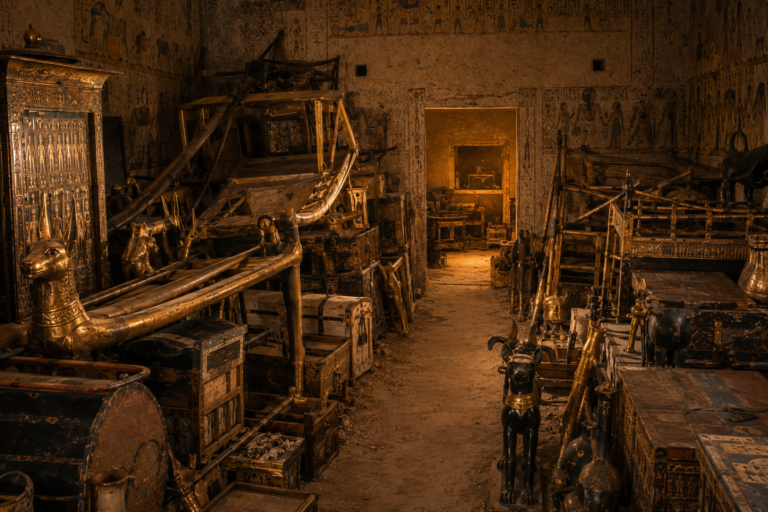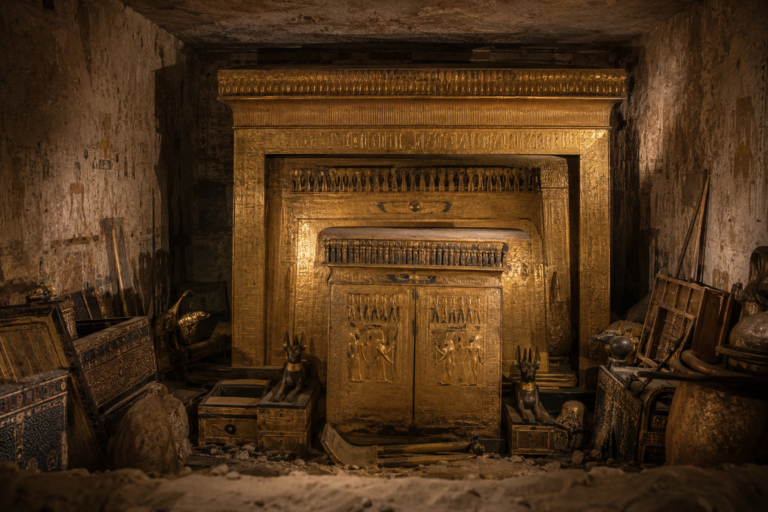
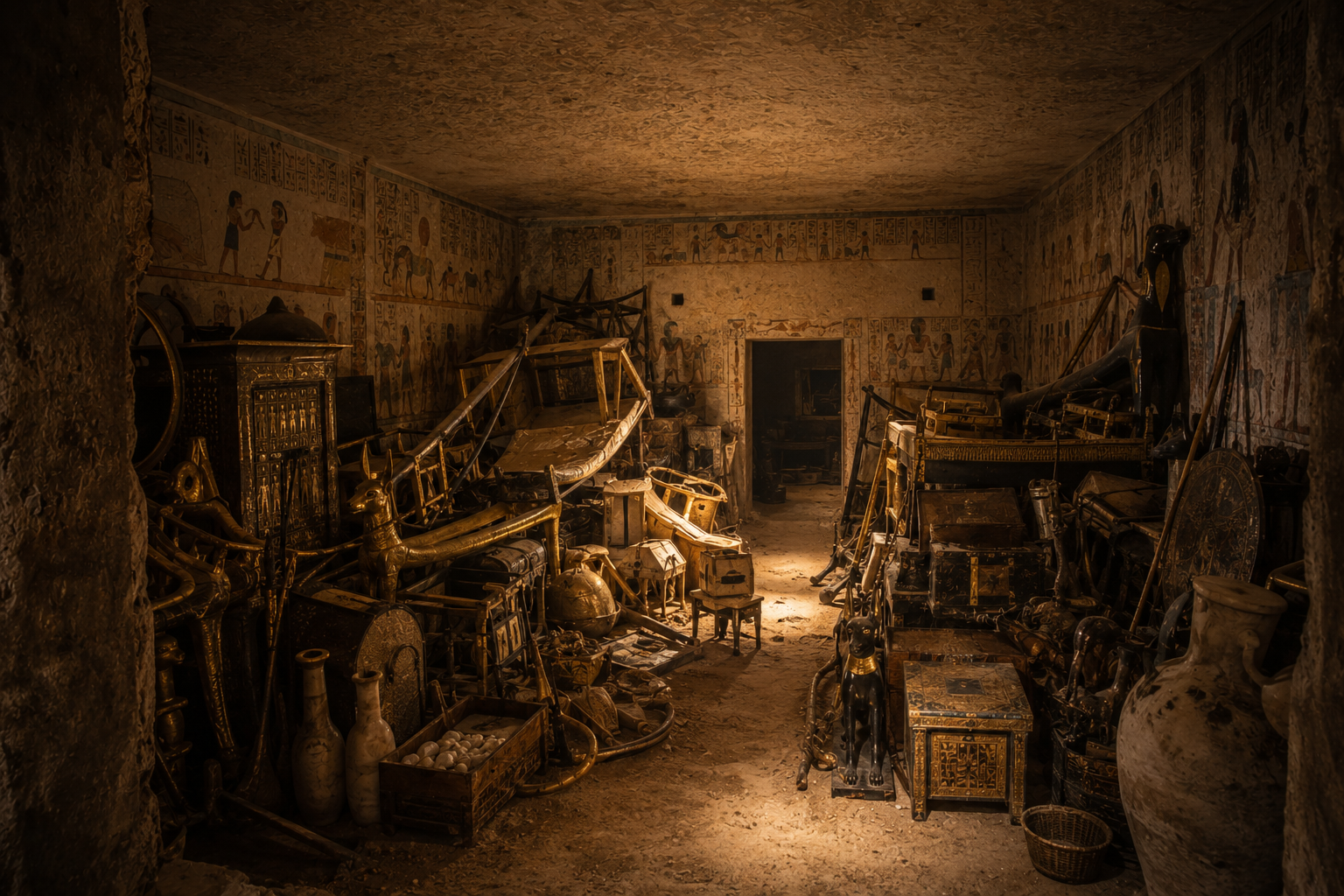

When the first doorway into Tutankhamun’s tomb was opened, the darkness did not reveal an empty chamber built around a single coffin. It revealed what looked like the remains of an entire royal household pushed underground: gilded beds, dismantled chariots, decorated chests, statues, weapons, clothing, baskets, vessels, and objects whose purposes were both practical and sacred.
To modern eyes, the crowded rooms of KV62 can look like an unimaginable treasury. Yet the people who prepared the burial did not place these objects inside simply to advertise the wealth of a dead king. They believed Tutankhamun would continue to exist in another form—and that eternity required preparation.
Tutankhamun had ruled for only a short time, and he died while still very young. Even so, his tomb contained an extraordinary concentration of royal possessions and funerary equipment. Some objects were intended to feed him. Others were meant to clothe, transport, defend, transform, or magically protect him. Together, they created a carefully supplied world in which the king could awaken, remain royal, and continue his journey beyond death.
Quick Context
Pharaoh: Tutankhamun
Dynasty: Eighteenth Dynasty
Reign: Approximately 1332–1323 BCE
Tomb: KV62 in the Valley of the Kings
Discovered: 1922
Why the objects were placed there: To preserve the king’s body and identity, sustain him, protect him from danger, maintain his royal authority, and equip him for continued existence in the afterlife.
The Tomb Was Built for Another Life
The central reason for the treasures begins with the ancient Egyptian understanding of death. A tomb was not designed merely as a place to dispose of a body. It was intended to protect the physical remains of a person while supporting the different spiritual elements that allowed identity and existence to continue.
For a king, this transformation carried exceptional importance. The pharaoh was not expected to enter the afterlife as an ordinary deceased person. He was meant to join the divine world, identify with Osiris, travel with the sun god, and preserve the sacred order that kingship represented.
This is why the body had to be mummified, named, protected, and surrounded by recognizable symbols. The king needed to remain Tutankhamun. His face, titles, possessions, clothing, images, and royal insignia all reinforced that identity.
The tomb therefore functioned as several things at once. It was a burial chamber, a ritual environment, a protected residence, a storehouse of provisions, and a symbolic model of the universe through which the dead king would travel.
The objects placed inside were not expected to remain meaningless in the darkness. Egyptian funerary belief allowed physical objects, images, words, and rituals to acquire continuing power. Food could sustain the deceased. A painted or carved figure could act. A written spell could protect. A royal image could preserve authority.
That idea changes the way the contents of KV62 should be viewed. A chair was not only an antique chair. It represented the ability to sit in comfort and authority. A chariot was not only an impressive vehicle. It preserved movement, royal display, and control. A bow was not simply a weapon. It could express protection and the king’s victory over hostile forces.
Even objects that appear ordinary today could carry more than one meaning. A pair of sandals might preserve a familiar possession from the king’s earthly life while also allowing him to walk in the world beyond. A container of food could be both a real provision and a ritual guarantee that hunger would never threaten him.
The Treasures Were More Than Displays of Wealth
The word treasure can be misleading. It encourages us to judge the contents of Tutankhamun’s tomb mainly by their modern financial value: how much gold they contain, how rare their materials are, or how much they might be worth today.
Ancient Egyptians certainly understood wealth and luxury. Gold, imported timber, fine linen, carved stone, glass, faience, and precious inlays all communicated status. A royal burial was expected to look royal. The quality of the materials and workmanship affirmed that Tutankhamun remained a king even after death.
But wealth was only one layer of meaning.
A single object could be valuable, practical, symbolic, and magical at the same time. A gilded bed provided an image of royal rest, displayed elite craftsmanship, carried sacred animal forms, and contributed to the king’s regeneration. A decorated chest could hold clothing or equipment while its images showed the king defeating enemies and restoring order.
The contents of the tomb can be understood through several overlapping purposes:
The Different Purposes of Tutankhamun’s Burial Goods
Physical protection: Coffins, shrines, wrappings, containers, and the sarcophagus helped guard the king’s body.
Magical protection: Amulets, divine figures, spells, and sacred symbols defended him against supernatural dangers.
Sustenance: Food, drink, vessels, baskets, and storage containers supplied nourishment.
Comfort: Beds, chairs, stools, clothing, sandals, and personal objects recreated elements of royal life.
Movement: Chariots and related equipment represented travel, mobility, and royal appearance.
Service: Shabti figures could perform work on the king’s behalf.
Identity and authority: Crowns, staffs, jewelry, images, and ceremonial objects preserved his status as pharaoh.
This is one reason the tomb contained such a wide variety of materials. Not everything was made of gold, nor was everything intended for ceremonial display. Archaeologists documented linen, leather, wood, stone, pottery, food remains, weapons, tools, baskets, gaming pieces, cosmetic equipment, and objects connected to daily life.
The burial was not a collection assembled according to modern museum categories. It was a functioning funerary environment in which every category met a different anticipated need.
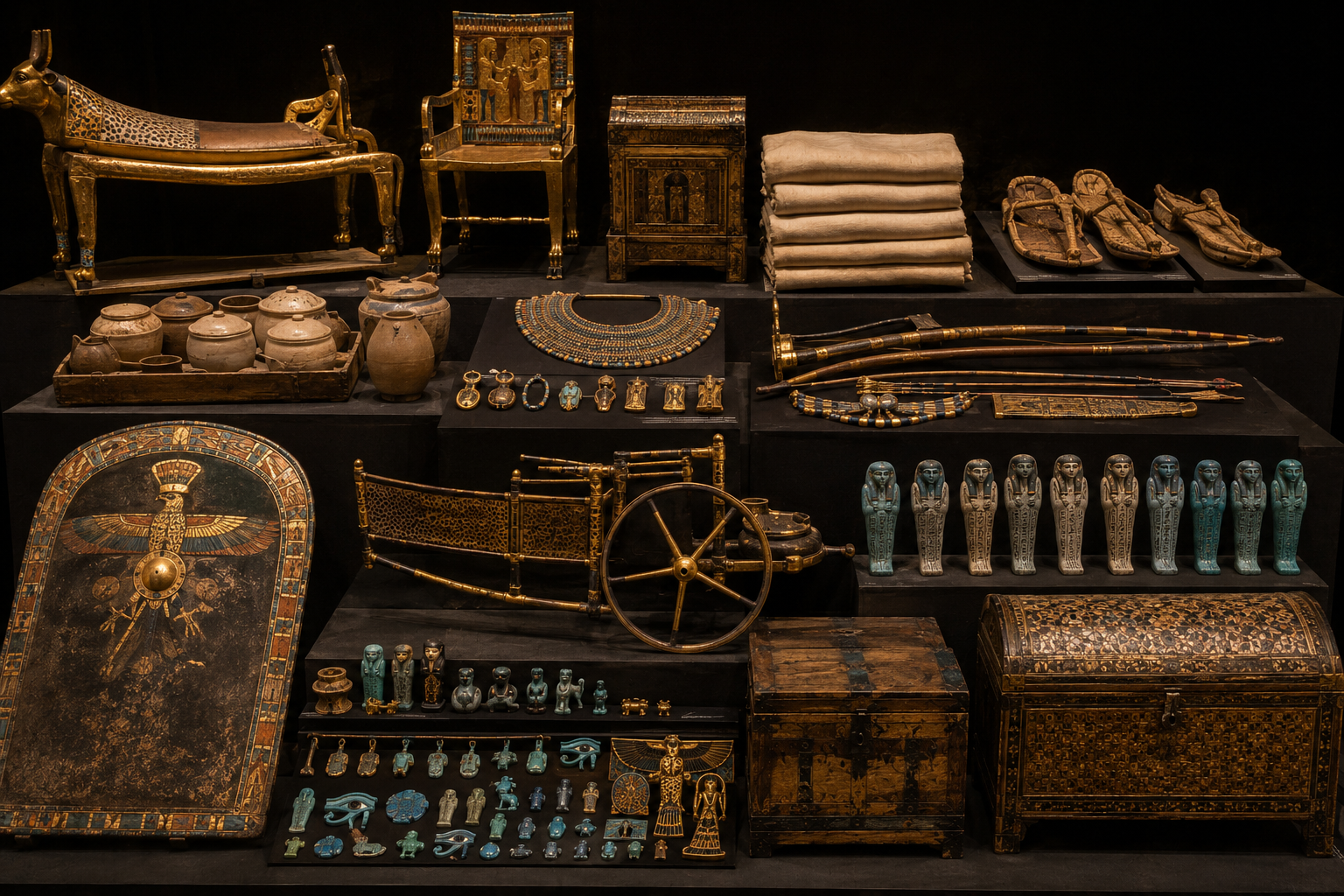
What Tutankhamun’s Treasures Were Meant to Do
| Type of Object | Examples | Purpose in the Afterlife |
|---|---|---|
| Protective objects | Amulets, divine figures, and magical symbols | Guard the king and help him overcome supernatural dangers |
| Royal symbols | Staffs, ceremonial objects, and images of kingship | Preserve Tutankhamun’s authority and identity as pharaoh |
| Personal belongings | Clothing, sandals, jewelry, and gaming objects | Continue familiar elements of royal and personal life |
| Food and drink | Wine, meat, fruit, grain, baskets, and vessels | Sustain the king and protect him from eternal hunger or thirst |
| Furniture | Beds, chairs, stools, and decorated chests | Recreate the comfort, order, and status of a royal residence |
| Transportation | Chariots and related equipment | Provide movement, ceremonial display, and symbolic travel |
| Weapons | Bows, arrows, shields, and blades | Protect the king and express victory over disorder |
| Funerary figures | Shabtis and statues of deities | Serve, assist, guide, or magically protect the deceased |
| Burial containers | Shrines, sarcophagus, coffins, and funerary mask | Preserve the body and surround it with sacred layers of protection |
The extraordinary number of objects also reflects the difference between royal and non-royal burial. Ordinary Egyptians could hope for survival after death, but few could command the labor, materials, workshops, and ritual resources available to the royal court.
Tutankhamun’s burial drew on a network of palace officials, priests, embalmers, artists, carpenters, metalworkers, textile makers, stone carvers, and administrators. The crowded tomb was therefore not only an expression of belief. It was also the result of a state capable of organizing a royal funeral under intense pressure.
Why Gold Mattered to the Ancient Egyptians
No material is more closely associated with Tutankhamun than gold. His funerary mask, inner coffin, jewelry, shrines, furniture, and many gilded surfaces created the dazzling impression that made the tomb famous around the world.
Yet gold mattered for reasons that went beyond its rarity.
Its bright color evoked sunlight. Its resistance to corrosion gave it an appearance of permanence. Unlike iron, copper, wood, or cloth, gold seemed almost untouched by time. These qualities allowed it to express ideas of divine flesh, solar power, endurance, and rebirth.
For a king entering eternity, those associations were especially powerful. Covering an object with gold could transform its appearance from something earthly into something radiant and sacred. A wooden shrine or throne might remain structurally made of timber, yet its gilded surface placed it visually within the world of the gods.
The use of gilding also allowed craftsmen to transform large surfaces. Entire shrines, beds, chests, statues, and ceremonial objects could shine with a golden appearance without requiring every component to be cast from solid gold.
The innermost coffin was exceptional because it was made from a massive quantity of gold. Its physical richness surrounded the king’s body at the most protected center of the burial. But even here, the purpose was not simply to place a fortune underground. The material reinforced the transformation of Tutankhamun from a dead human ruler into an eternal royal being.
Gold also helped unify objects that were made from different materials and perhaps at different times. A gilded surface could bring furniture, ritual equipment, shrines, and royal symbols into the same visual language of sacred kingship.
When the tomb was sealed, the gold was not positioned for human admiration. Much of it was hidden behind doors, within shrines, beneath wrappings, or inside chambers that were never supposed to be reopened. Its intended audience was not the modern visitor. Its power belonged to the divine and funerary world created around the king.
Food and Drink for an Eternal Journey
A king could possess gold, weapons, and sacred objects, but none of these removed one of the most basic needs imagined for continued existence: nourishment.
Food and drink had occupied an important place in Egyptian funerary practice for thousands of years. Offerings were presented at tombs, represented in images, named in texts, and placed physically beside the dead. The goal was to ensure that life beyond death would not be marked by hunger or thirst.
Tutankhamun’s burial included vessels, baskets, containers, wine jars, and preserved provisions. These were not random remains of a funeral feast. They belonged to a larger system in which food could continue to sustain the deceased through ritual transformation.
The Egyptians did not necessarily imagine the king eating decayed physical food forever in the same way a living person ate a meal. Through offerings and ritual power, the essential nourishment represented by the provisions could remain available to him.
Why Real Food Was Still Placed in the Tomb
If images and spoken offerings could provide nourishment, why place actual food underground?
Ancient Egyptian funerary practice often combined several layers of protection rather than relying on only one. Real provisions, written formulas, images, containers, and recurring temple offerings could all reinforce the same desired result.
Physical food gave the burial an immediate supply. Images could reproduce it magically. Texts could name it. Rituals performed outside the tomb could renew it. Each method strengthened the possibility that the deceased would never lack what was necessary.
Wine also carried more than a practical purpose. Jars could record information about their contents, origin, or production, while the drink itself belonged to elite consumption, ritual presentation, and celebration. Meat, grain, fruit, bread-related provisions, and other foods recreated the abundance expected in a royal household.
The result was not merely a pantry. It was a guarantee that Tutankhamun’s transformed existence would begin in a state of abundance rather than deprivation.
Clothing, Beds, and Furniture for Royal Life
Some of the most revealing objects in Tutankhamun’s tomb are not the famous symbols of kingship but the items connected to ordinary human needs: clothing, sandals, stools, beds, boxes, headrests, and personal equipment.
Their presence makes the burial feel unexpectedly intimate. Tutankhamun was not prepared only as a distant divine figure. He was also supplied as a person who would dress, rest, sit, travel, and inhabit a recognizable environment.
Fine linen was especially important. Clothing protected the body, expressed status, and preserved the appearance expected of the king. Different garments and textiles could provide choices suited to ritual, royal display, or daily comfort.
Sandals extended this preparation to movement. Some were practical, while others were elaborately decorated or ceremonial. Their imagery could carry political meaning, but their basic presence also reflected the simple idea that the king should not enter eternity barefoot and unequipped.
The furniture transformed the tomb into something resembling a compressed royal residence. Chairs and stools allowed the king to sit. Beds offered rest and regeneration. Chests protected clothing, jewelry, and valuable equipment. Headrests and personal objects recreated habits associated with life in the palace.
The Strange Animal-Shaped Beds
Among the most visually striking pieces were ceremonial beds shaped with powerful animal forms. These were not simply decorative attempts to make furniture look unusual. The animals could embody protection, rebirth, divine strength, and the dangerous forces through which the deceased had to pass.
A funerary bed could therefore operate on two levels. It resembled a familiar place of rest, but it also became a ritual platform connected to death and regeneration. The king did not merely sleep upon it. Symbolically, he could be restored and reborn.
This mixture of the familiar and the sacred appears throughout the tomb. A household object could be transformed by material, image, inscription, or ritual purpose without losing its recognizable function.
Some furnishings may have belonged to Tutankhamun during his lifetime, while others were made specifically for burial. The distinction is not always simple. Royal possessions could be repaired, adapted, reinscribed, or selected from palace stores when the funeral was prepared.
This matters because Tutankhamun’s death appears to have come before a long royal burial program could be completed in the way officials might have expected. The people responsible for the funeral may have drawn upon both newly produced funerary equipment and objects already available within the royal household.
Chariots, Bows, and Weapons for Travel and Protection
The presence of chariots, bows, arrows, shields, and blades inside the tomb has sometimes encouraged a dramatic picture of Tutankhamun as a warrior king. The objects certainly belonged to the visual and material world of royal power, but they must be interpreted carefully.
A weapon found in a tomb does not automatically prove that the king personally carried it in battle. Royal burials were designed around ideal kingship as well as individual biography.
The pharaoh was traditionally shown defeating enemies, controlling disorder, hunting dangerous animals, and defending Egypt. Weapons helped preserve that identity. They equipped the king to resist hostile forces in the next world just as royal imagery showed him overcoming threats in this one.
Bows and arrows could therefore be both practical objects and symbols of mastery. Shields represented defense. Blades could provide protection while expressing elite craftsmanship and royal access to valuable materials.
Why Chariots Were Placed Underground
Chariots were among the most technologically sophisticated vehicles of the New Kingdom. They were associated with warfare, hunting, ceremony, speed, and the public appearance of the king.
Placing chariot components inside Tutankhamun’s tomb ensured that movement remained available to him. In practical terms, the vehicles were dismantled so they could fit into the crowded chambers. Symbolically, however, they retained their complete purpose.
The king could still travel. He could still appear in royal splendor. He could still hunt, inspect, command, and move through the landscape of eternity.
Chariots also reinforced a larger message: death had not removed Tutankhamun’s ability to act. His tomb was filled with objects that preserved motion, service, authority, protection, and choice. He was not imagined as lying helplessly inside a sealed chamber. He was being equipped to awaken.
Shabtis: Servants for the Afterlife
Among the hundreds of remarkable objects discovered in Tutankhamun’s tomb were small human-shaped figures known today as shabtis. At first glance, they appear to be simple statues placed beside the king. In reality, they were among the most practical pieces of equipment prepared for eternity.
Ancient Egyptians believed that even in the afterlife, certain agricultural or ceremonial tasks might still be required. Rather than expecting the king to perform this labor himself, magical substitutes could answer in his place.
That was the purpose of the shabtis.
Many examples carry inscriptions instructing the figure to respond whenever the deceased was called upon to work. Instead of remaining lifeless decorations, they were intended to become active through ritual and sacred words.
For a royal burial, this idea reflected an important principle: a king should continue to rule, not become an ordinary laborer. The shabtis ensured that necessary work could still be completed while preserving the dignity of kingship.
Different tombs contained different numbers of these figures. Some burials included only a handful, while wealthy individuals and pharaohs could possess dozens or even hundreds arranged to serve throughout eternity.
The presence of shabtis also demonstrates how practical ancient Egyptian funerary thought could be. Eternal life was not imagined as an abstract spiritual state disconnected from everyday experience. It was envisioned as an ordered world where food was prepared, fields could be cultivated, journeys continued, and royal authority remained intact.
Amulets and Magical Objects That Protected the King
Not every danger facing Tutankhamun in the next world could be solved with food, furniture, or weapons. Ancient Egyptian religion described a landscape filled with unpredictable forces, divine beings, gates, guardians, and supernatural challenges.
Protection therefore became one of the central purposes of the burial equipment.
Amulets were carefully positioned within the mummy wrappings, placed inside coffins, or arranged among other funerary objects. Their value did not depend on their size. Many were only a few centimeters long, yet each represented a specific form of divine assistance.
Some symbolized healing and wholeness. Others represented rebirth, strength, stability, or divine guardianship. Scarabs, protective eyes, sacred knots, pillars, and other familiar forms all carried religious meanings that had developed over centuries.
Jewelry also served more than a decorative purpose. Necklaces, bracelets, rings, and pendants often combined precious materials with symbols believed to safeguard the wearer. Beauty and protection were not separate concepts. An object could fulfill both roles simultaneously.
Throughout the burial, magical protection was layered repeatedly. The body was wrapped. The wrappings held amulets. The mummy rested inside nested coffins. The coffins stood within a stone sarcophagus. The sarcophagus itself was enclosed by monumental gilded shrines.
Every layer strengthened the previous one.
This approach explains why Tutankhamun’s burial appears so crowded. Modern visitors often ask why so many similar objects were placed together. Ancient Egyptians asked a different question: why risk relying on only one form of protection when eternity itself depended upon success?
Why Tutankhamun Needed Several Coffins and Shrines
One of the most extraordinary features of Tutankhamun’s burial was its remarkable sequence of protective layers.
Before reaching the king’s mummy, anyone entering the burial chamber would have encountered enormous gilded wooden shrines that almost completely filled the room. Inside those stood the quartzite sarcophagus. Within the sarcophagus rested three anthropoid coffins placed one inside another, with the famous golden funerary mask covering the king’s head.
This arrangement was not excessive decoration. Each layer carried practical, religious, and symbolic significance.
The outer shrines created a sacred enclosure separating the burial from the outside world. The stone sarcophagus provided physical strength. The nested coffins protected the mummy while emphasizing the gradual movement toward the sacred center. Finally, the funerary mask preserved the eternal identity of the king.
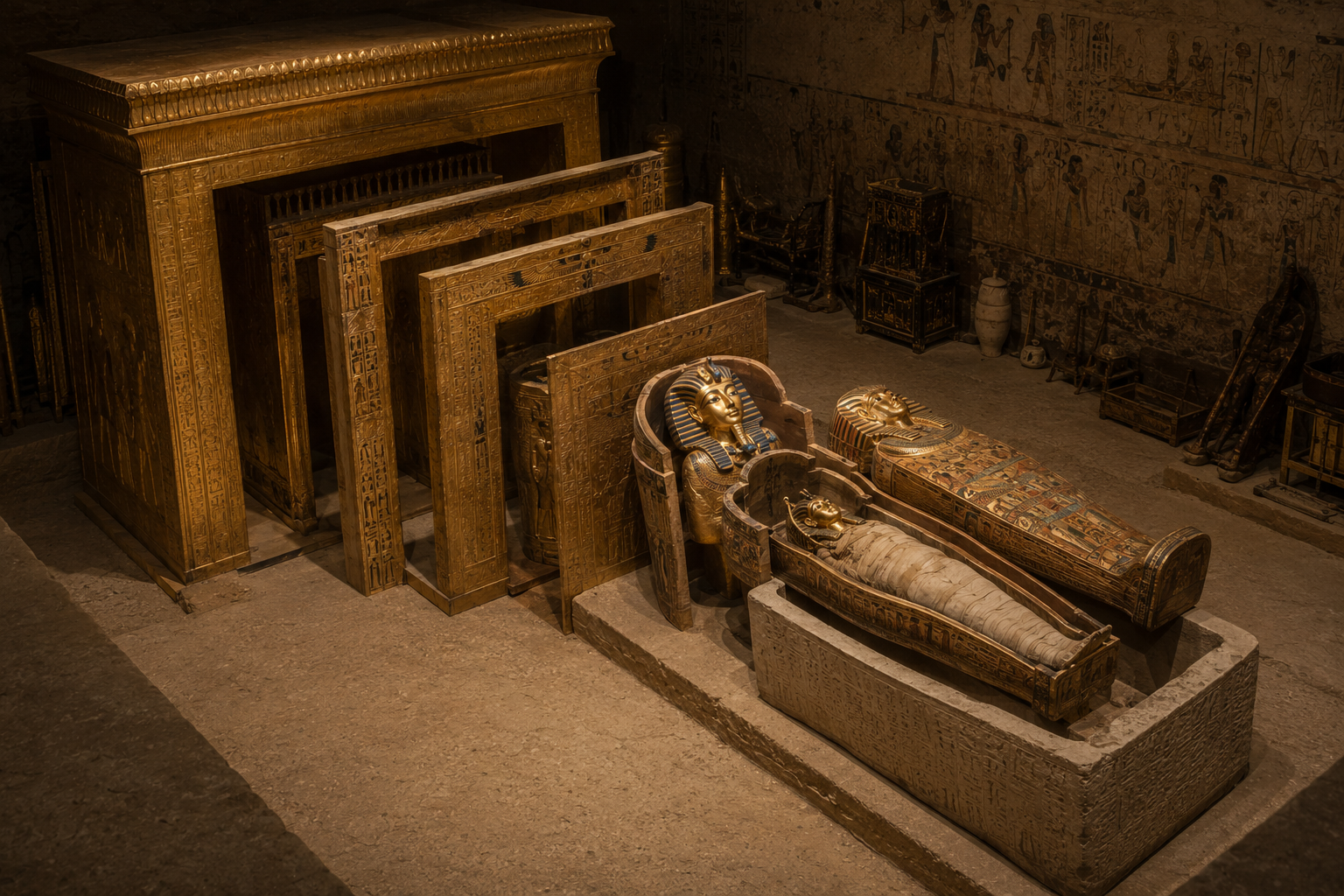
These successive barriers also reflected an important religious idea. The closer one moved toward the king, the more sacred the space became. The burial chamber was therefore organized almost like a series of increasingly protected sanctuaries.
Protection worked on several levels simultaneously:
| Protective Layer | Main Purpose |
|---|---|
| Outer gilded shrines | Create a sacred enclosure and separate the burial from the outside world. |
| Stone sarcophagus | Provide durable physical protection for the nested coffins. |
| Three anthropoid coffins | Surround and preserve the king through successive layers. |
| Golden funerary mask | Preserve the king’s eternal appearance and divine identity. |
| Mummy wrappings and amulets | Protect the body and strengthen magical defenses. |
Rather than asking why there were so many layers, it may be more useful to ask why there should have been fewer. If the survival of the king depended upon successful preservation, every additional layer increased security against both physical damage and supernatural danger.
Were All the Objects Made Specifically for Tutankhamun?
This question has fascinated Egyptologists for decades.
At first glance, it might seem obvious that every object discovered in KV62 was produced specifically for Tutankhamun’s funeral. The reality is probably more complex.
The young king died unexpectedly after a relatively short reign. Preparing a royal burial required enormous coordination involving workshops, priests, artists, carpenters, metalworkers, embalmers, and administrators. Time may not have allowed every object to be designed entirely from the beginning.
Researchers have identified evidence suggesting that some funerary equipment may have been modified, reinscribed, adapted, or drawn from existing royal resources before becoming part of Tutankhamun’s burial.
This should not be misunderstood as evidence of carelessness.
Ancient Egyptian workshops were highly skilled at adapting valuable objects while maintaining religious effectiveness. Reusing or modifying an item did not reduce its sacred function. Once incorporated into the royal burial through proper rituals, it became part of the king’s eternal equipment.
Some furnishings may even have been personal possessions from Tutankhamun’s lifetime. Others appear to have been created specifically for funerary purposes. Still others may represent inherited royal property or objects originally intended for different members of the royal family before being incorporated into the final burial.
This mixture actually makes the tomb even more valuable to historians because it preserves multiple aspects of life within the royal court instead of presenting only objects manufactured for a single funeral.
Why Was So Much Placed Inside Such a Small Tomb?
One of the first surprises visitors notice when studying the excavation photographs is how crowded Tutankhamun’s tomb appears.
Compared with several other royal tombs in the Valley of the Kings, KV62 is relatively modest in size. Yet it contained an astonishing quantity of burial equipment.
Furniture leaned against furniture. Chariots were dismantled to fit through narrow spaces. Chests occupied nearly every available area. Ritual objects filled gaps wherever room remained.
This apparent disorder should not be mistaken for carelessness. The burial still followed an overall religious plan, but available space was limited.
Many Egyptologists believe the tomb may not originally have been intended for a king, although the exact history of its construction continues to be discussed. Whatever its original purpose, the chamber that eventually received Tutankhamun’s burial had to accommodate an extraordinary amount of equipment.
The young king’s unexpected death may also have affected the pace of preparation. Rather than waiting years for a larger monument, officials completed the burial using the available tomb while ensuring that every essential category of funerary equipment accompanied the king.
As a result, modern archaeologists gained something remarkably rare: a royal burial preserved with much of its original arrangement still intact.
What the Treasures Reveal About Tutankhamun’s World
People often describe Tutankhamun’s tomb as the richest archaeological discovery ever made. While the quantity of gold is extraordinary, its greatest importance lies elsewhere.
The burial preserves an entire picture of royal life during Egypt’s Eighteenth Dynasty.
Its furniture reveals exceptional woodworking skills. Jewelry demonstrates advanced craftsmanship in gold, glass, and semi-precious stones. Chariots illustrate military and ceremonial technology. Clothing preserves information about textiles. Food remains reveal elite diets. Religious objects illuminate beliefs surrounding death and rebirth.
Taken together, these discoveries allow historians to reconstruct far more than the funeral of a single king. They offer a remarkably complete glimpse into palace life, royal workshops, religion, administration, international trade, and artistic achievement during one of Egypt’s most influential periods.
Ironically, Tutankhamun himself ruled for only a relatively short time and was probably not among Egypt’s most politically powerful pharaohs.
His worldwide fame exists because his burial survived with an unparalleled level of preservation.
Frequently Asked Questions
Why was Tutankhamun buried with so much gold?
Gold symbolized permanence, divine power, and the eternal nature of the gods. It also emphasized the king’s sacred status, although many impressive objects were gilded rather than made entirely from solid gold.
Was everything in Tutankhamun’s tomb made of gold?
No. Archaeologists discovered wood, linen, leather, pottery, stone, faience, glass, food remains, baskets, textiles, and many other materials alongside gilded objects and solid gold masterpieces.
Why were food and drink placed inside the tomb?
Ancient Egyptians believed the deceased would continue to require nourishment. Food offerings, containers, and ritual provisions helped sustain the king throughout eternity.
What were shabtis used for?
Shabtis were funerary figures intended to perform labor on behalf of the deceased whenever work was required in the afterlife.
Did Tutankhamun personally use every object found in his tomb?
Probably not. Some objects appear to have been personal possessions, while others were created specifically for the burial or adapted from existing royal equipment.
Why was Tutankhamun’s tomb so crowded?
KV62 was relatively compact, yet it had to contain the complete equipment necessary for a royal burial. Furniture, chariots, ritual objects, food, clothing, shrines, and funerary equipment were carefully arranged within the available space.
What makes Tutankhamun’s tomb so important?
Its exceptional preservation allows historians to study an almost complete royal burial from the New Kingdom, providing extraordinary insight into ancient Egyptian religion, craftsmanship, daily life, and royal ceremony.
Final Thoughts
When Howard Carter first looked through the small opening into Tutankhamun’s tomb, he saw what he famously described as “wonderful things.” More than a century later, those objects continue to captivate millions of people around the world.
Yet their greatest lesson is not about unimaginable wealth.
To the ancient Egyptians, these beds were still meant for resting. The food was still intended for nourishment. The chariots could still carry the king. The weapons could still defend him. The shabtis could still answer his call. The shrines could still protect his body. The gold still reflected divine eternity.
Modern visitors see one of history’s greatest collections of archaeological treasures. The people who sealed KV62 saw something entirely different.
They believed they were preparing a young king to live forever.