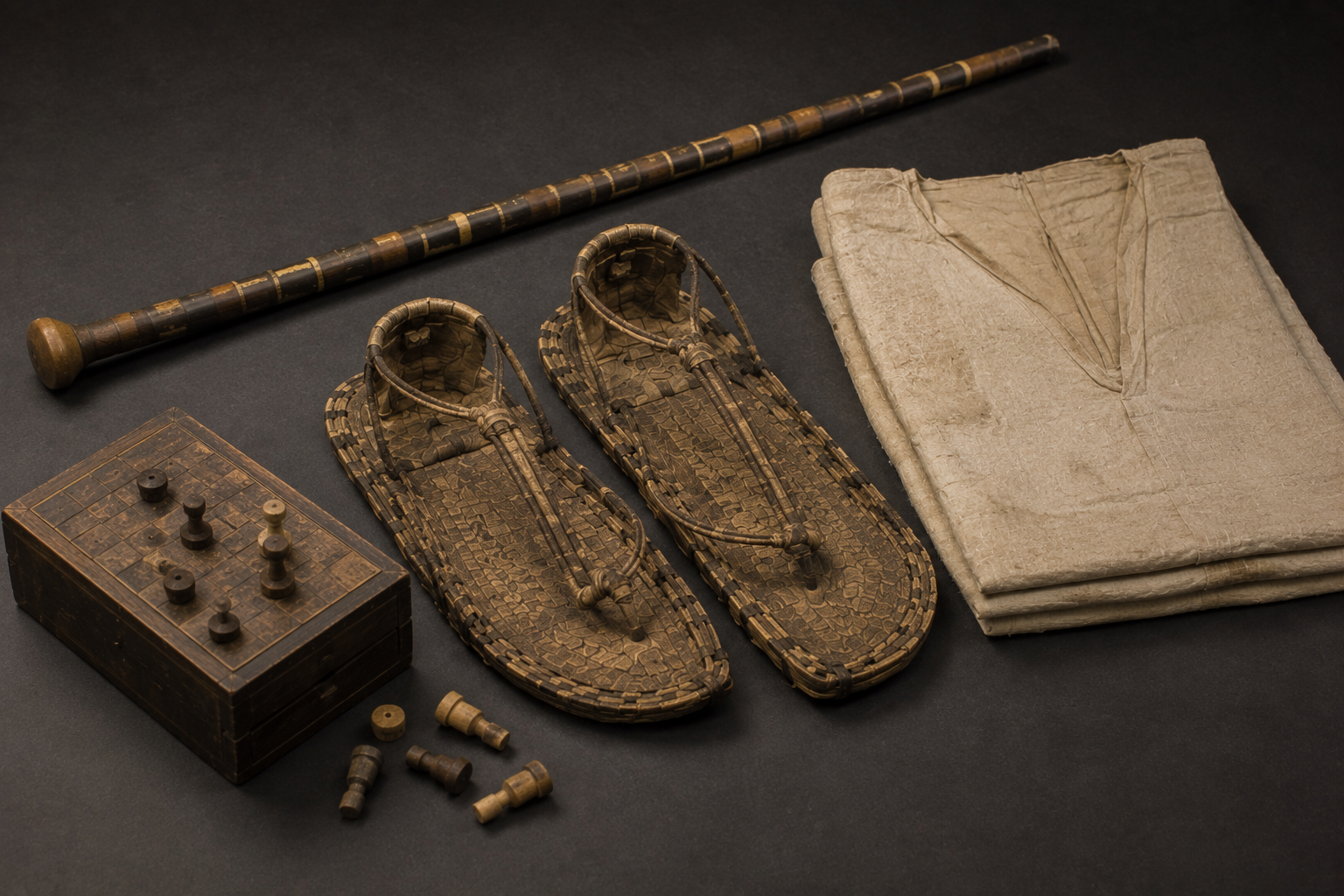

Forget Tutankhamun’s gold mask for a moment. Inside his tomb were objects that belonged to a much more familiar world: sandals woven from plant fibers, folded linen, walking sticks, bows and arrows, game equipment, furniture, boxes, food containers, and objects connected with everyday activities. They lack the immediate spectacle of solid gold, yet they can bring us remarkably close to life in the late Eighteenth Dynasty.
These objects matter because Tutankhamun is unusually difficult to know as a person. He died young, his reign was relatively short, and the surviving historical record tells us far less about his individual character than popular retellings sometimes suggest. The material discovered in KV62 gives us another kind of evidence: things made, stored, handled, packed, repaired, worn, or prepared for a royal burial more than 3,300 years ago.
But there is an important limit. Finding something in Tutankhamun’s tomb does not automatically prove that he personally used it during life. Some objects were clearly funerary. Others resemble practical possessions and may have belonged to the royal household or the king himself. The most revealing approach is therefore not to turn every artifact into a personal story, but to ask what the physical evidence can actually tell us.
Quick Context
- King: Tutankhamun
- Dynasty: Eighteenth Dynasty
- Reign: Approximately 1332–1323 BCE
- Tomb: KV62 in the Valley of the Kings
- Discovery: November 1922
- Excavation director: Howard Carter
- Collection: Thousands of recorded objects and components
- Everyday materials: Linen, leather, wood, plant fibers, metal, glass, faience, stone, and other materials
- Key caution: Objects placed in the tomb include both practical-looking possessions and equipment intended specifically for burial
Beyond the Gold Mask
Tutankhamun’s fame has always been dominated by exceptional objects. The gold mask, the nested coffins, gilded shrines, jewelry, and elaborately decorated furniture immediately communicate royal wealth. They are among the reasons the discovery became a global sensation.
Yet concentrating only on masterpieces creates a distorted picture of the tomb.
Howard Carter’s records preserve a far broader material world. KV62 contained objects connected with clothing, footwear, storage, hunting, transport, games, food, personal equipment, and many other activities. Some were magnificent. Others were surprisingly practical.
This mixture is what makes the collection so valuable for studying daily life. A royal burial was not a preserved palace bedroom, and we cannot simply treat it as one. But many of the objects reproduce, represent, or preserve things that belonged to the lived world of New Kingdom Egypt.
A woven sandal can reveal how footwear was constructed. A linen garment preserves evidence of spinning and weaving. A bow records woodworking and archery technology. A game box tells us something about recreation and cultural traditions. Furniture preserves joinery methods that would otherwise be difficult to reconstruct from paintings alone.
The tomb therefore provides more than an image of royal death. It preserves fragments of the material culture that surrounded royal life.
Gold tells us how magnificently a king could be buried. Everyday objects can tell us something about the world in which he lived.
Were These Really Tutankhamun’s Personal Belongings?
This is the question that should come before almost every claim about Tutankhamun’s “personal possessions.”
Some objects found in KV62 may have been used before the burial. Others were clearly made or adapted for funerary purposes. Still others are difficult to classify with certainty.
The distinction can sometimes be obvious.
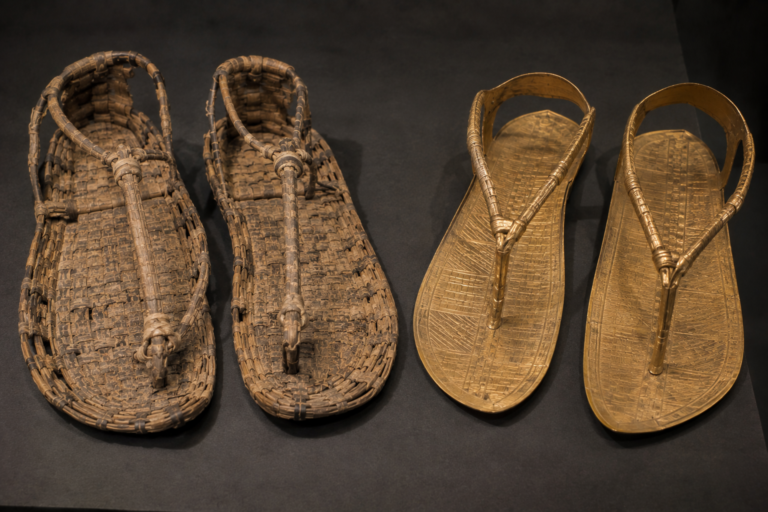
The gold sandals placed on Tutankhamun’s mummified feet were made from sheet gold. Carter’s documentation describes their soles as decorated to imitate woven rushwork and their straps as imitating cord. Their edges had even been folded to accommodate them within the mummy wrappings.
These were not ordinary walking shoes.
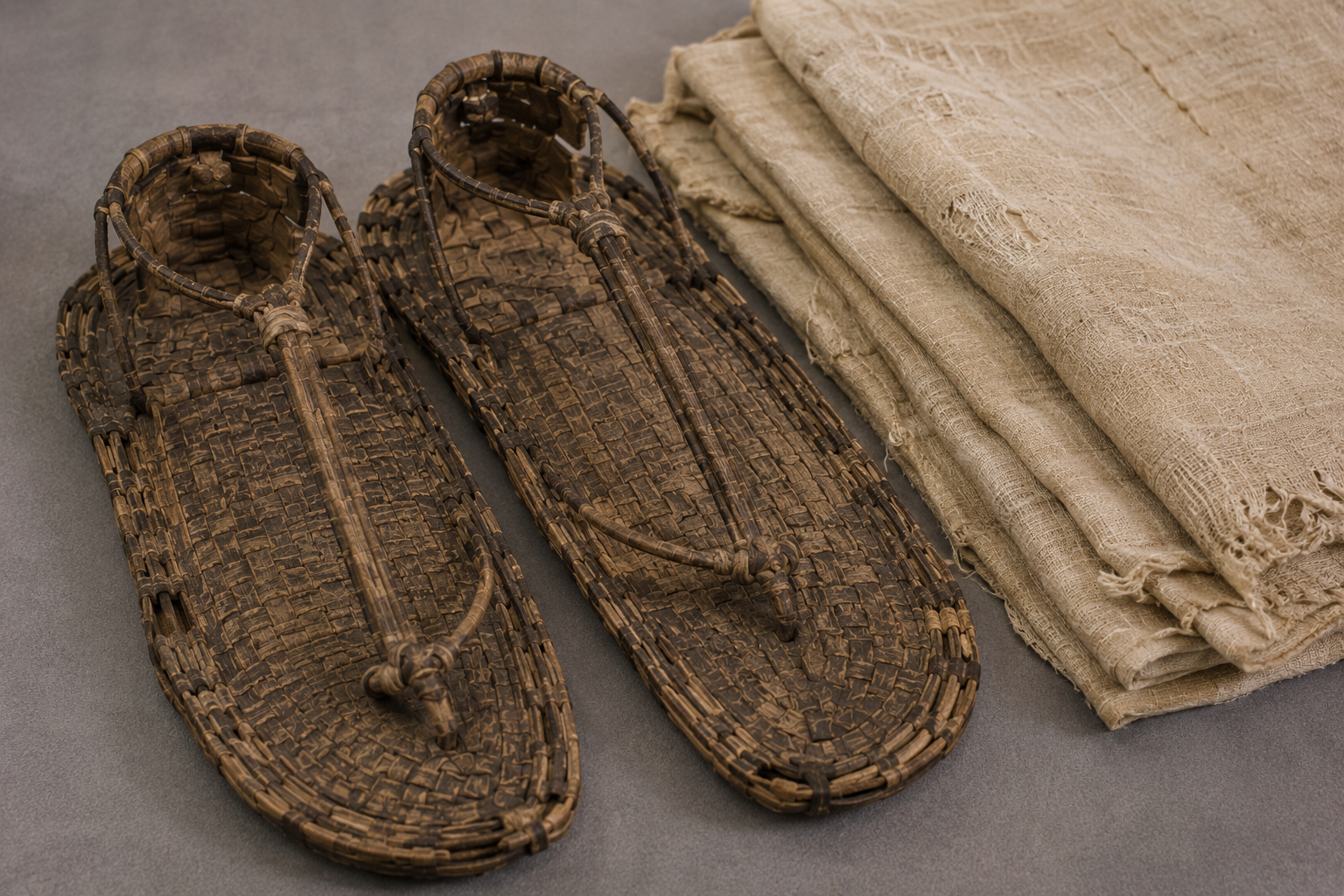
Other sandals from the tomb were made from materials associated with functional ancient Egyptian footwear, including woven plant material. Their construction belongs to a completely different practical tradition.
That contrast is extremely useful. Two objects can share the same basic form while serving very different purposes: one reflects footwear used in the living world, while another transforms that form into funerary equipment.
Found in the tomb does not always mean used by the king. Archaeologists must consider material, construction, wear, location, inscriptions, associated objects, and funerary context before deciding how an artifact may have functioned.
This caution becomes even more important with weapons, games, staffs, and chariots. Their presence can reveal what was considered appropriate equipment for a king in life and death, but it cannot automatically tell us how frequently Tutankhamun personally used each object.
Tutankhamun’s Clothes Bring Us Surprisingly Close to Him
Textiles rarely dominate museum displays because they cannot compete visually with gold and polished stone. Archaeologically, however, surviving ancient clothing can be extraordinary.
Linen was fundamental to clothing in ancient Egypt. Producing fine fabric required growing and processing flax, spinning fibers into thread, weaving the thread, finishing the cloth, and finally cutting, folding, or arranging it for use.
The quantity of textile material associated with Tutankhamun’s burial gives researchers an unusually rich body of evidence for elite clothing and textile production in the late Eighteenth Dynasty.
Among the garments and textile items were numerous loincloths. More than a hundred examples are associated with the burial collection, demonstrating how something visually modest can survive beside some of the most elaborate royal objects ever discovered.
The importance of these pieces is not their monetary value. Their dimensions, weave, stitching, folds, decoration, and condition can provide evidence about how clothing was manufactured and prepared.
Some garments have also encouraged discussion about whether items accumulated at different stages of the young king’s life. Size can be suggestive, but it must be interpreted carefully. A small garment does not automatically prove when or how Tutankhamun wore it, and burial assemblages can contain objects with complicated histories.
What the textiles unquestionably provide is something rare: surviving physical examples of the kinds of materials that existed within the royal environment rather than representations of clothing carved or painted on a wall.
His Sandals Were More Than Royal Decoration
Footwear provides one of the clearest examples of why material matters.
Ancient Egyptian sandals could be made from leather or woven plant materials such as papyrus and other fibers. Their basic construction could be practical and remarkably efficient: a woven sole protected the foot while straps secured the sandal in place.
Examples associated with Tutankhamun’s tomb range from practical-looking footwear to highly elaborate versions, demonstrating how the same familiar object could exist at very different levels of craftsmanship and symbolism.
The gold sandals found on the mummy represent the extreme end of that spectrum. They imitate functional footwear but were created specifically for burial. Their thin metal construction would not have served as normal shoes.
This distinction prevents an easy but misleading image of the king walking around his palace wearing solid gold sandals.
Instead, the burial sandals show how an everyday form could be transformed for a royal funerary context. The craftsmen retained recognizable features of real footwear while recreating them in precious material.
What Practical Sandals Can Reveal
Woven or leather footwear can potentially tell researchers much more about ordinary use.
The construction of the sole reveals weaving techniques. The position of straps reflects how the sandal was secured. Deformation can show how organic material changed with age, while wear may provide clues about use before burial.
Sandals are particularly powerful because they immediately collapse the distance between the modern viewer and the ancient wearer. Their purpose requires almost no explanation.
People more than three millennia ago still needed to protect their feet.
The materials and craftsmanship were different from modern footwear, but the underlying problem was exactly the same.
Why Wear and Repair Matter
For an archaeologist, damage is not always simply damage.
A worn surface can contain evidence. So can an ancient repair.
If a handle shows repeated abrasion where a hand would naturally grip it, that may suggest use. If footwear shows uneven wear in particular areas, researchers may investigate whether the pattern developed while it was worn. Repairs can demonstrate that an object was valued enough to maintain rather than discard.
But these clues require caution.
An artifact can acquire damage during burial, excavation, transport, early restoration, storage, or later handling. Deformation can result from pressure inside a crowded tomb rather than everyday use.
Researchers therefore compare different forms of evidence instead of relying on one mark.
Construction, archaeological position, historical photographs, Carter’s object cards, conservation records, material analysis, and the physical object itself can all contribute to the interpretation.
This is one reason the meticulous documentation of KV62 remains so valuable. The catalogue created during Carter’s excavation allows modern researchers to reconnect individual objects with observations recorded when they were first examined.
A useful rule: Wear can support an argument that an object was used, but wear alone does not identify who used it. Even an artifact bearing Tutankhamun’s name should not automatically be turned into a personal anecdote without additional evidence.
Games Inside the Tomb
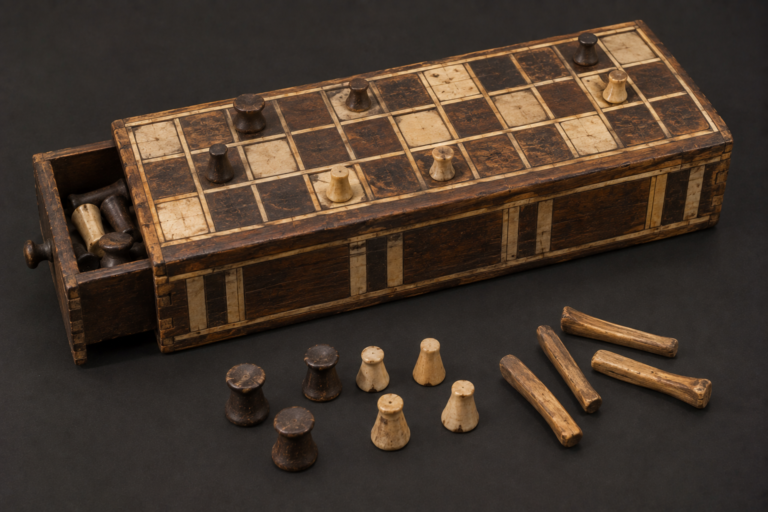
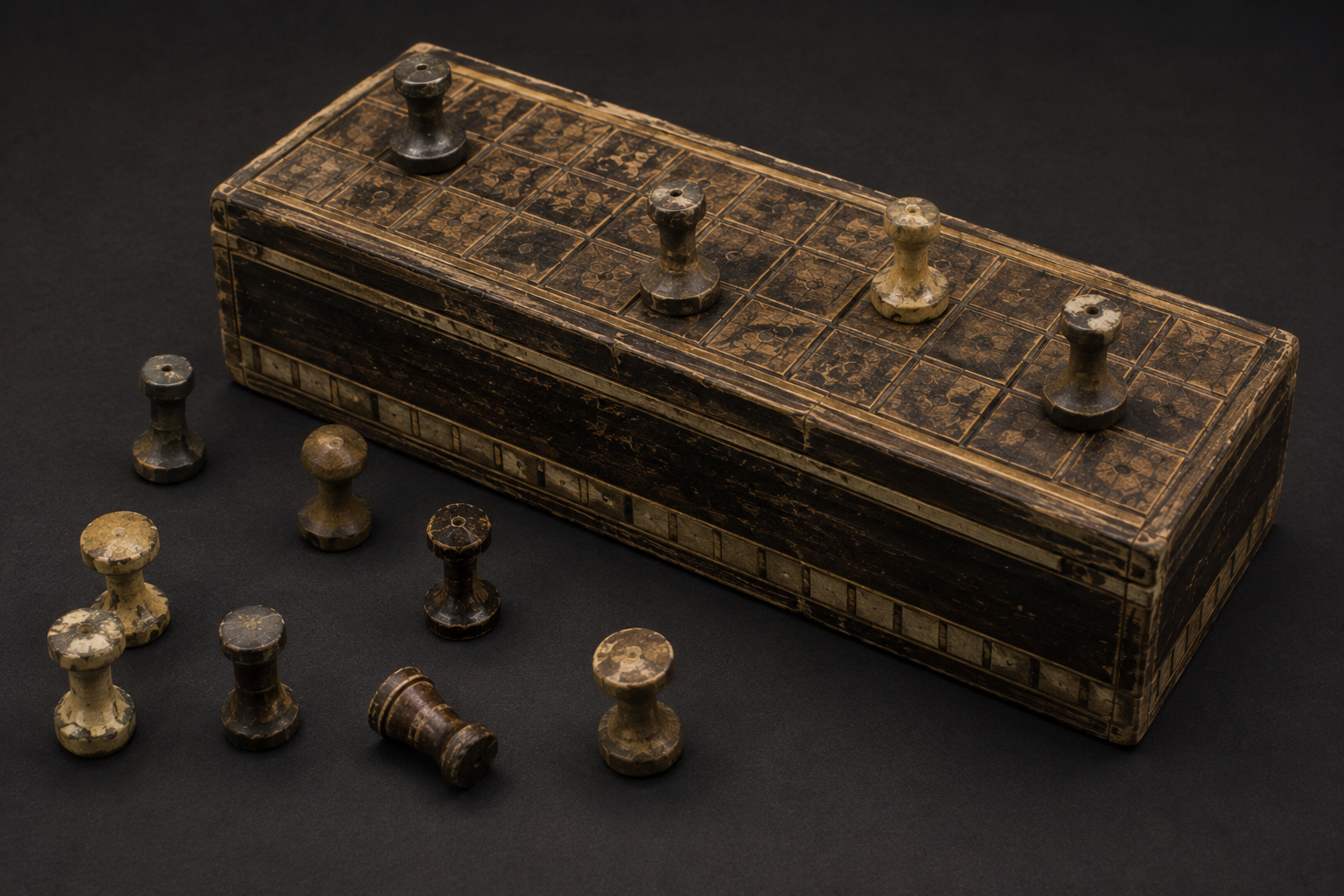
Among the objects associated with Tutankhamun’s burial were game boxes and gaming equipment, including examples connected with senet, one of ancient Egypt’s best-known board games.
At its simplest, senet was played on a board divided into thirty squares. Archaeological evidence for the game stretches across a long period of Egyptian history, and scenes and surviving equipment show that gaming formed part of Egyptian culture.
Finding game equipment in a royal tomb therefore seems to offer an appealing glimpse of Tutankhamun relaxing in the palace.
It is possible that games belonged to the recreational world familiar to him. But there is an important complication: senet acquired meanings connected with death and passage into the next world.
By the New Kingdom, representations of the game could appear in funerary contexts with significance extending beyond entertainment.
That means a senet board in a tomb cannot be treated simply as evidence of someone’s favorite hobby.
The object operates on more than one level. It reflects a genuine game played by living Egyptians, while its presence in a burial can also belong to funerary belief and symbolism.
A Tool for Making Fire
One of the less famous categories of equipment associated with the tomb brings us even closer to practical technology: fire-making.
Before matches or lighters, fire could be produced mechanically by generating enough friction to ignite suitable material. Ancient Egyptian fire-making equipment could use a wooden drill rotated against prepared holes in another piece of wood.
It is an unexpectedly ordinary technology to encounter within the burial assemblage of one of history’s most famous kings.
That is precisely why objects like this matter.
Royal life still depended on technologies that served basic human needs. Fire provided heat and light and played roles in food preparation, craft production, and ritual activities. The presence of fire-making equipment preserves evidence for the practical technologies behind those activities.
It does not mean Tutankhamun personally sat down every morning to make his own fire. Royal households depended on servants, craftspeople, officials, and specialists.
Instead, the object gives us evidence for the technological world around him.
Bows, Arrows, and Weapons
The burial also contained substantial weaponry and archery equipment.
Bows and arrows belonged to several overlapping worlds in New Kingdom Egypt. They could be practical weapons, hunting equipment, markers of elite skill, and symbols of royal power.
Egyptian kings were repeatedly represented using bows in scenes of warfare and hunting. Such images communicated strength and royal authority whether or not they documented a particular event literally.
This creates an interpretive problem when we turn to Tutankhamun.
The existence of bows, arrows, daggers, and chariots in his tomb does not by itself prove that the young king personally fought in battle.
Nor should every weapon be dismissed as purely symbolic.
The better question is what the collection tells us about the equipment, activities, and ideals associated with Egyptian kingship during his lifetime.
Archery was a real technology. Hunting was a genuine elite activity. Warfare was central to royal ideology. Tutankhamun’s burial equipment reflects that world even where his personal experience cannot be reconstructed with certainty.
The Famous Meteorite-Iron Dagger
One weapon deserves special attention: the iron dagger found with Tutankhamun’s mummy.
Modern scientific analysis has shown that the blade’s composition is consistent with meteoritic iron. That makes the dagger remarkable not because ancient Egyptians had somehow mastered large-scale iron production centuries ahead of their time, but because meteoritic iron provided a rare source of metallic iron before iron became widely used.
The dagger is therefore both a personal funerary object and evidence of extraordinary craftsmanship and material selection.
But even here, caution matters. The dagger’s presence with the king does not tell us how often, or even whether, he used it as a practical weapon during life.
Its archaeological importance does not depend on inventing that story.
What the Chariots Can and Cannot Tell Us
The chariots found in KV62 are among the most technically impressive objects associated with the burial.
Chariot construction demanded sophisticated woodworking. Wheels had to combine strength with relatively low weight. Axles, frames, bindings, leather elements, and other components had to work together as a functioning system.
Chariots could be associated with transport, hunting, ceremony, and warfare. They were also powerful markers of elite and royal identity.
Tutankhamun was depicted in dynamic scenes involving chariots, including imagery presenting him as a victorious king. But royal imagery followed conventions designed to communicate kingship and power.
It should not automatically be read as documentary photography carved or painted in ancient form.
The surviving chariots demonstrate that this technology belonged to Tutankhamun’s royal environment. Their construction can reveal remarkable information about New Kingdom craftsmanship.
What they cannot establish on their own is how often Tutankhamun drove them, which specific examples he personally used, or whether a particular chariot participated in warfare.
Evidence versus interpretation: A chariot in a king’s tomb proves the importance of chariot equipment within the burial assemblage. It does not, by itself, provide a biography of the king’s experiences.
Why Were There So Many Walking Sticks?
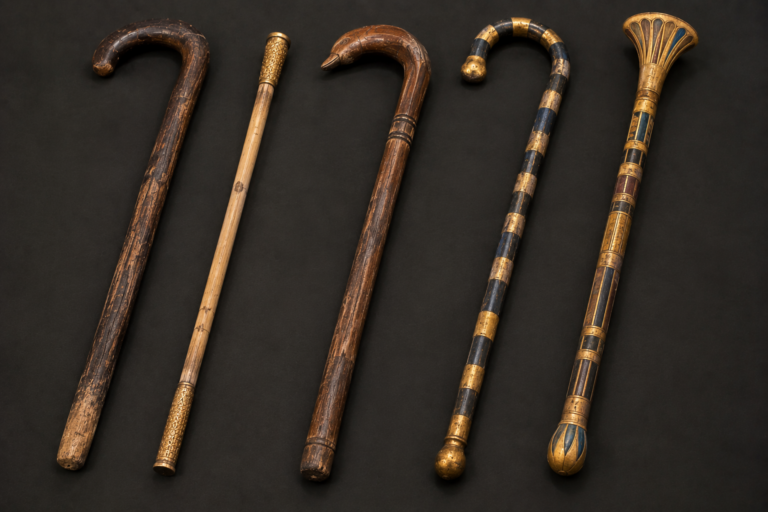
The large collection of staffs, sticks, and related objects from Tutankhamun’s tomb has generated enormous interest, particularly because modern discussions of the king’s health often connect them with theories about impaired mobility.
The archaeological picture is more complicated.
Ancient Egyptian staffs and sticks could have practical, ceremonial, symbolic, and status-related functions. Carter himself described groups of ceremonial maces, sticks, staves, bows, and elaborately decorated batons among the burial equipment.
Some were clearly too elaborate to interpret as ordinary walking aids. Certain examples were made from precious materials or decorated in ways consistent with ceremonial display.
Others may have had practical functions.
This means that counting the sticks and concluding that Tutankhamun must have needed all of them to walk would be an oversimplification.
Modern medical studies of the king’s remains have produced hypotheses about his physical condition, and possible mobility problems have been discussed. Those questions should be evaluated using skeletal, genetic, archaeological, and contextual evidence together rather than treating the presence of sticks as a diagnosis.
The sticks themselves tell us something important regardless: carrying staffs was deeply embedded in the visual and material language of status and authority in ancient Egypt.
Whether a particular example supported a young king’s body, marked his position, served a ceremonial role, or combined several functions has to be assessed object by object.
Tutankhamun’s belongings can show us the world around him. They cannot tell us every thought or experience of the person who lived inside that world.
Furniture Made the Tomb Feel Like a Royal Household
Furniture is one of the clearest ways the objects from KV62 connect royal burial with the material world of daily life. Chairs, stools, beds, couches, chests, and other pieces reproduced forms that belonged to houses and palaces, even when their decoration or purpose was specifically royal or funerary.
These objects reveal a great deal about New Kingdom craftsmanship. Wood had to be selected, shaped, joined, reinforced, decorated, and sometimes covered with gilding, veneers, inlays, leather, textiles, or painted surfaces. Complex furniture could therefore represent the work of several specialists rather than a single craftsman.
The construction itself can be as informative as the decoration. Joints show how carpenters created strength without modern screws or industrial adhesives. Curved elements demonstrate sophisticated shaping. Woven seats preserve techniques using fibers or leather. Decorative surfaces show how craftsmen combined expensive and ordinary materials to create objects suitable for a royal environment.
Some pieces are particularly intimate because their basic function is instantly recognizable. A bed is still a bed. A stool is still something designed to support a seated person. A storage chest solves the same fundamental problem today that it solved more than three millennia ago: keeping possessions organized and protected.
But once again, recognizable function does not prove personal use. Some furniture may have belonged to the king’s living environment, while other pieces could have been prepared, adapted, or selected specifically for burial.
Why Royal Furniture Matters Beyond Tutankhamun
Wood rarely survives as well as stone in Egyptian archaeology. Entire buildings have disappeared, and much domestic furniture survives only through fragments, representations, or exceptional burials.
KV62 therefore preserves an unusually rich sample of high-status furniture from the late Eighteenth Dynasty.
Even when researchers cannot prove that a particular chair stood in Tutankhamun’s palace, its construction can still reveal what elite Egyptian workshops were capable of producing during his reign.
The tomb is therefore valuable not only for reconstructing one king’s possessions, but also for understanding the craftsmen who created the material environment of the royal court.
Boxes Full of a Life
Some of the most revealing objects in Tutankhamun’s tomb were containers.
Chests, boxes, baskets, jars, and other storage objects filled the chambers. Their importance becomes clearer when we stop viewing them only as decorated artifacts and ask what they were designed to hold.
Containers organize a household. They separate clothing from jewelry, tools from food, valuable possessions from ordinary supplies. They also preserve relationships between objects that might otherwise appear unrelated.
During the excavation, opening a box could reveal another miniature archaeological context inside the larger tomb.
A container might hold textiles, jewelry, equipment, fragments, or several different kinds of objects. Carter’s team therefore had to document not only the container itself but also the arrangement and identity of what was inside it.
These groups are valuable because they can preserve associations. A loose sandal found somewhere in a chamber tells one story. Footwear stored together with clothing inside a container can provide a different kind of context.
The crowded annex was particularly important in this respect. It contained a dense mixture of baskets, vessels, boxes, food provisions, clothing-related material, and other objects. The apparent disorder makes interpretation difficult, but it also emphasizes how much practical material was placed in the burial alongside ceremonial equipment.
Why containers matter: In archaeology, what was inside a box can be more informative than the box’s decoration. Contents preserve associations between objects that may help reveal storage, preparation, and burial practices.
Food and Drink for Eternity
Tutankhamun’s tomb also contained provisions connected with food and drink. These objects remind us that Egyptian burial preparation extended beyond jewelry, furniture, and ritual equipment.
Food was necessary for life, and ancient Egyptian funerary belief extended that necessity into the next world. A royal burial could therefore include supplies intended to sustain the king after death.
Containers associated with wine, oils, and other provisions form part of this larger system. Meat offerings and plant products were also prepared for burial.
These finds can provide evidence about elite consumption, food production, storage, labeling, and the organization of royal provisioning.
But there is another interpretive trap here.
Finding wine in the tomb does not prove that Tutankhamun personally preferred a particular wine. Finding a certain food does not identify his favorite meal.
Funerary provisioning followed cultural expectations and ritual requirements as well as practical ideas about sustenance. The contents therefore tell us more securely about royal burial preparation and elite food culture than about individual taste.
Labels Can Reveal More Than Flavor
Jar inscriptions and administrative markings can sometimes preserve information about the origin, date, producer, or contents of a commodity. This kind of evidence is particularly valuable because it connects everyday material with the economic and administrative structures behind the royal household.
A vessel of wine was not simply a drink. Someone cultivated grapes, processed them, stored the product, recorded information, transported the container, and eventually selected it for burial.
The object therefore preserves traces of an entire production system.
What Everyday Objects Reveal About Craftsmanship
The less spectacular objects from KV62 reveal one of the most important truths about Tutankhamun’s world: royal life depended on an enormous network of skilled workers.
A sandal required knowledge of plant fibers or leather. Linen depended on flax processing, spinning, and weaving. A bow required carefully selected wood and precise shaping. Furniture demanded carpentry, joinery, surface preparation, and decoration. Chariots combined multiple technologies in one complex machine.
The king may dominate the historical story, but thousands of hands made the objects that surrounded him.
Many of those craftspeople remain anonymous.
Their work nevertheless survives in small technical decisions. A tight woven pattern. A carefully cut joint. A repaired edge. A precisely shaped arrow shaft. A decorative inlay fitted into wood. These details preserve skill more directly than royal inscriptions do.
This is another reason everyday objects matter. They shift attention away from kings alone and toward the wider society that made royal life possible.
| Object | What It May Reveal | What It Does Not Prove |
|---|---|---|
| Clothing | Textile production, garment construction, size, and elite wardrobe practices | That every garment was personally worn by Tutankhamun |
| Sandals | Footwear design, weaving, leatherwork, and differences between practical and funerary footwear | That all sandals in the tomb were used in everyday life |
| Games | Gaming traditions and the cultural importance of senet | That senet was Tutankhamun’s favorite pastime |
| Weapons | Archery technology, royal equipment, hunting, and military symbolism | That the king personally used each weapon in battle |
| Chariots | Advanced woodworking, transport technology, and elite royal activities | That every chariot was personally driven by Tutankhamun |
| Walking sticks | Status, ceremonial practice, craftsmanship, and possible practical use | A medical diagnosis by themselves |
| Furniture | Royal woodworking, joinery, domestic forms, and workshop skill | That every piece once stood in Tutankhamun’s palace |
| Food containers | Royal provisioning, storage, production, and funerary preparation | Tutankhamun’s personal favorite foods or drinks |
The Most Human Objects Are Often the Least Valuable
There is something revealing about the way visitors respond to Tutankhamun’s collection. Gold naturally attracts the eye. It communicates wealth immediately and survives with a visual brilliance that many organic materials cannot match.
But the objects that make the king feel closest are often much quieter.
A worn sandal has the dimensions of a human foot.
A folded piece of linen preserves the work of ancient hands.
A game board evokes people sitting opposite one another and moving pieces across squares.
A walking stick fits into a hand.
A stool, a box, or a bed belongs to categories of objects that remain familiar in modern life.
These artifacts reduce the psychological distance created by royal titles and monumental art. They remind us that ancient kings inhabited physical bodies and material spaces. They dressed, moved, sat, travelled, stored possessions, and lived within environments filled with ordinary objects as well as ceremonial ones.
That does not make Tutankhamun ordinary. His material world was extraordinarily privileged, and many of the objects from KV62 represent elite craftsmanship unavailable to most Egyptians.
But familiarity makes the ancient world easier to understand.
Sometimes the shortest distance between the modern world and ancient Egypt is not a gold mask, but an object whose purpose we recognize immediately.
Can Objects Tell Us What Tutankhamun Was Really Like?
Only to a point.
Objects are powerful historical evidence, but they do not provide direct access to personality.
A game board cannot prove Tutankhamun enjoyed games. Weapons cannot establish that he was personally warlike. Fine clothing does not reveal whether he cared about fashion. Walking sticks cannot independently diagnose a medical condition. Food offerings cannot tell us his favorite meal.
These interpretations become tempting because people naturally want to turn material evidence into biography.
Responsible archaeology works in the opposite direction. It begins with what can be observed and then asks how far the evidence allows us to go.
From Tutankhamun’s everyday objects, we can reconstruct aspects of the material environment surrounding royalty in the late Eighteenth Dynasty. We can study textile production, footwear, weapons, transport, storage, furniture, games, food provisioning, and craftsmanship.
In some cases, signs of use, sizing, inscriptions, archaeological context, or repairs may strengthen the possibility that an object had a personal history before burial.
But certainty varies from object to object.
This distinction does not make the collection less interesting. It makes it more valuable because it separates the historical Tutankhamun from the modern stories invented around him.
What We Can Say With Confidence
The burial preserves an exceptionally broad selection of objects connected with royal material culture.
Some forms clearly derive from practical items used in life, even when particular examples were made specifically for burial.
The collection demonstrates extraordinary specialization among ancient Egyptian craftspeople.
It also confirms that royal burial preparation attempted to provide much more than symbols of authority. Clothing, furniture, transport equipment, food, games, weapons, and practical forms were incorporated into the king’s funerary world.
What We Should Treat as Interpretation
Claims about Tutankhamun’s favorite activities, personality, private preferences, and personal use of individual objects require stronger evidence.
Even apparently intimate objects can have complicated histories. They could have been produced for him, inherited, adapted, stored within the royal household, selected for burial, or made specifically for funerary purposes.
That uncertainty is not a weakness in the archaeological record. It is part of understanding it accurately.
Evidence first: The strongest stories about Tutankhamun begin with what the objects actually preserve and make clear where interpretation begins.
Frequently Asked Questions
What personal belongings were found in Tutankhamun’s tomb?
KV62 contained clothing, sandals, furniture, walking sticks and staffs, weapons, game equipment, chariots, containers, jewelry, and many other objects associated with royal life. However, not every item can be proven to have been personally used by Tutankhamun before burial.
Did Tutankhamun actually wear the clothes found in his tomb?
Some textiles may have belonged to his wardrobe or had histories of use before burial, but it is not possible to prove that Tutankhamun personally wore every surviving garment. Size, construction, wear, inscriptions, and archaeological context all have to be considered.
How many loincloths were found in Tutankhamun’s tomb?
The burial collection included more than one hundred loincloths, with published museum discussions commonly noting more than 140 examples. Their survival provides unusually rich evidence for ancient Egyptian textile production and royal clothing.
Did Tutankhamun wear gold sandals in everyday life?
The gold sandals found on his mummy were funerary objects made from sheet gold and designed to imitate the form of woven footwear. They were not practical everyday walking shoes.
Were real sandals found in Tutankhamun’s tomb?
Yes. The burial included footwear made from materials associated with practical ancient Egyptian sandals, including woven plant fibers and leather, alongside more elaborate funerary examples.
Were games found inside Tutankhamun’s tomb?
Yes. Game boxes and gaming equipment were among the burial objects, including examples associated with senet. However, senet also had funerary significance by the New Kingdom, so its presence does not simply prove that gaming was Tutankhamun’s favorite hobby.
Why were so many walking sticks found with Tutankhamun?
Staffs and sticks could have practical, ceremonial, symbolic, and status-related functions. Some examples may have been used practically, but the number found in the tomb cannot by itself establish a specific medical condition.
Were chariots found inside Tutankhamun’s tomb?
Yes. Several chariots and chariot components were included in the burial collection. They provide important evidence for New Kingdom vehicle construction, royal transport, hunting, ceremony, and military symbolism.
Did Tutankhamun use a dagger made from a meteorite?
An iron dagger with a blade whose composition is consistent with meteoritic iron was found with Tutankhamun’s mummy. Its placement establishes its close association with the burial, but it cannot prove how, or whether, the king used it during everyday life.
What everyday objects were found in KV62?
The tomb contained practical-looking objects connected with clothing, footwear, furniture, storage, games, archery, transport, food, fire-making, and other activities, in addition to explicitly ceremonial and funerary equipment.
Can Tutankhamun’s belongings tell us about his personality?
Only indirectly and with considerable caution. Objects can reveal his material environment and the cultural expectations surrounding Egyptian kingship, but they cannot reliably establish personal preferences, emotions, or character without additional evidence.
Why are ordinary objects from the tomb so important?
They preserve evidence about materials and activities that monumental inscriptions often overlook. Textiles, footwear, games, furniture, and tools can reveal ancient technologies, craftsmanship, storage, clothing, transport, and aspects of daily life.
Final Thoughts
Tutankhamun’s gold transformed him into one of the most recognizable figures from the ancient world. But gold alone tells only part of his story.
The quieter objects from KV62 reveal a world of woven fibers, leather straps, carved wood, folded linen, arrows, game pieces, furniture, containers, food supplies, and technologies designed to solve ordinary human problems.
Some of these objects may once have been part of Tutankhamun’s life. Others were created or adapted for his burial. Many sit somewhere between certainty and interpretation, requiring researchers to examine materials, wear, context, inscriptions, and the records left by Carter’s team.
That caution matters because Tutankhamun has accumulated more than a century of modern storytelling. The temptation is always to make the artifacts say more than they actually can.
The objects themselves tell a better story.
They reveal the craftsmanship of the people who surrounded the royal court, the technologies available in the late Eighteenth Dynasty, the material expectations of kingship, and the extraordinary effort devoted to preparing a young king for burial.
And occasionally, among all that royal complexity, something extraordinarily simple survives: a woven sandal, a piece of linen, a game board, or the worn surface of a familiar object.
The closer we look at those ordinary things, the less Tutankhamun becomes only an image behind a gold mask, and the more clearly we can see the material world in which a young Egyptian king once lived.