
Estimated reading time: 13 minutes
A child born beside the Nile did not enter a silent world. The first sounds of life came from a house already full of movement: grain being handled, pottery jars shifting, animals outside the doorway, water carried from the river, and adults preparing for another day under the Egyptian sun. Long before that child could understand gods, kings, fields, or tombs, the world was first experienced through the home.
Childhood in ancient Egypt was not one single story. A child born to a farming family lived differently from the child of a scribe, a craftsman, or an elite official. Yet most children grew up close to the same forces that shaped Egyptian life for thousands of years: family, food, work, religion, the Nile, and the expectation that one day they would take their place inside the adult world. If Before Sunrise followed the rhythm of daily life, Bread and Dust explored the food that sustained it, and The House Beside the Nile opened the door to the family home, this article looks at the children who grew up inside that world.
Ancient Egyptian childhood combined care, play, learning, responsibility, and preparation for adulthood. Some children received formal education, especially those connected to scribal or elite families, but most learned through family, household work, farming, craft skills, and daily observation. Archaeological evidence, toys, tomb scenes, texts, and settlement remains all help us understand how children lived.
- A Child Is Born Beside the Nile
- The First Years of Life
- Family Before Everything
- Toys Made for Small Hands
- Learning the World Around Them
- Did Every Child Go to School?
- Boys, Girls, and Daily Responsibilities
- Growing Into Adult Life
- Childhood and Religion
- What Archaeologists Have Discovered
- Final Thoughts
- Frequently Asked Questions
A Child Is Born Beside the Nile
For most ancient Egyptians, birth happened far from palaces. It happened in homes, among women, relatives, household objects, and the practical concerns of family life. The newborn child entered a world where survival was never taken for granted. Childhood could be joyful, but it was also fragile. Illness, poor harvests, accidents, and difficult living conditions made early life uncertain.
This does not mean ancient Egyptian parents loved their children less than parents do today. Quite the opposite appears in many forms of evidence. Children were named, protected, represented in art, buried with care when they died young, and surrounded by amulets, household beliefs, and family attention. The emotional world of ancient Egypt was not cold. It was deeply human.
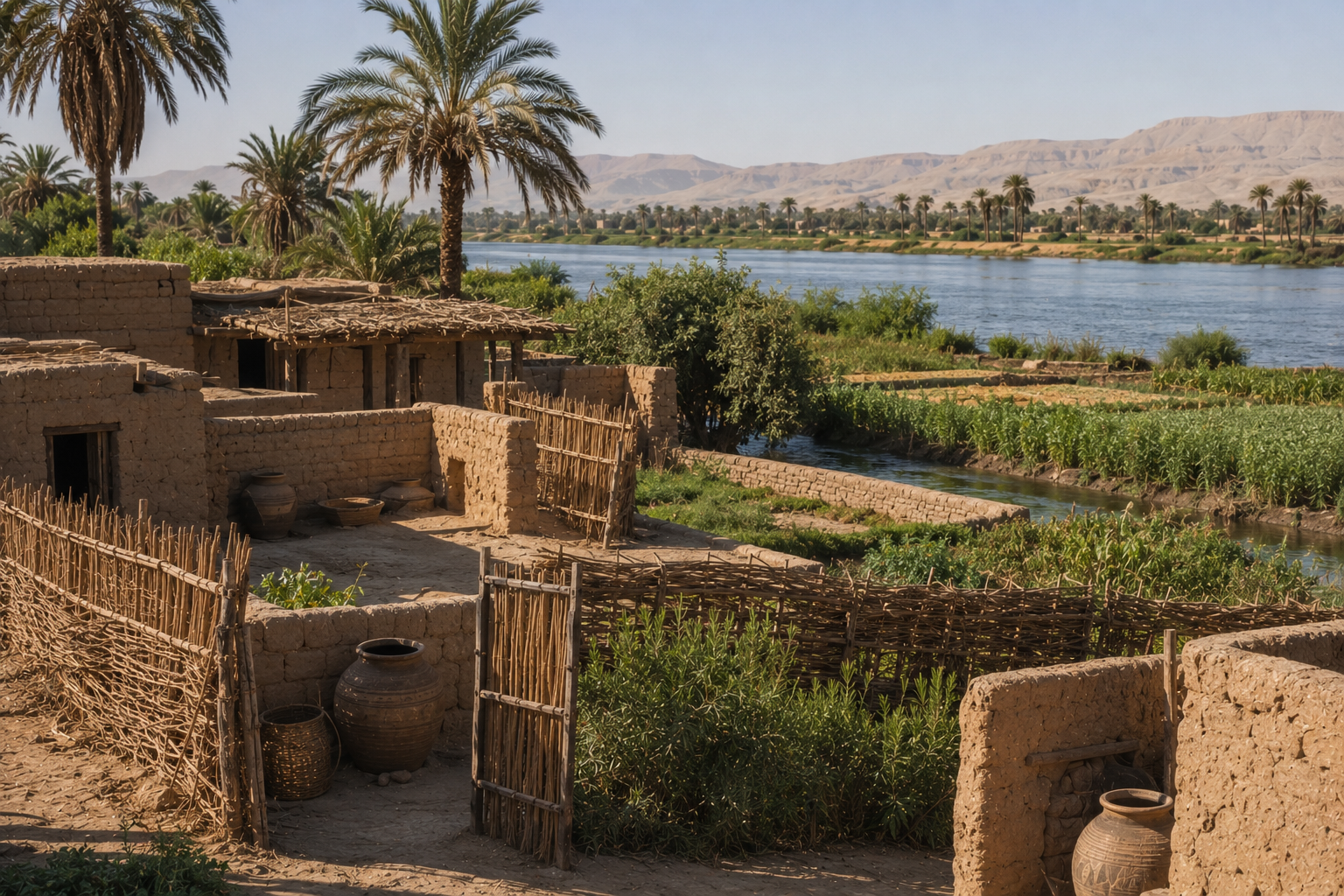
The Nile shaped even this first stage of life. It fed the fields that fed the mother. It supplied the mud that built the family home. It created the landscape in which the child would grow. A baby born beside the river was born into a civilization that depended on cycles: flood, planting, harvest, heat, night, dawn, and renewal.
From the beginning, the household mattered most. Before a child met a teacher, priest, or official, the child met the family. The home was the first universe. Its smells, sounds, textures, and routines became the foundation of memory.
The First Years of Life
The earliest years were spent close to the household. A small child watched more than they worked. They watched grain being prepared, food being cooked, older siblings moving through chores, adults repairing tools, and neighbors passing through village streets. Ancient Egyptian children learned before anyone formally taught them.
A child would have known the feel of mud-brick walls, reed mats, pottery vessels, baskets, wooden objects, and dust beneath bare feet. They would have seen animals, fields, riverbanks, boats, and seasonal changes long before they understood the larger meaning of agriculture.
In ordinary families, childhood was not separated from adult life. Children were present while adults worked. They learned the rhythm of mornings, meals, heat, rest, and evening return. They absorbed responsibility slowly, first by watching, then by helping, and finally by being expected to contribute.
There was tenderness, but there was also expectation. In a society where survival depended on labor, every member of the household eventually mattered. A child could play, but play existed beside preparation for work.
This is one of the most important differences between modern childhood and ancient childhood. Ancient Egyptian children had imagination and toys, but they also grew up closer to economic reality. They saw how food was made. They saw how water was carried. They saw how tools were used. They saw that every object in the home had a purpose.
Family Before Everything
The family was the center of childhood in ancient Egypt. It was not simply a group of people living under one roof. It was the structure that taught identity, work, religion, memory, and social behavior.
Inside the home, children learned where they belonged. They learned who held authority, who prepared food, who worked in the fields, who handled tools, who stored grain, and who told stories about ancestors. A family home was not only a shelter. It was a school of daily life.
In The House Beside the Nile, we explored how the ancient Egyptian home worked as a living space, workplace, kitchen, storeroom, and place of rest. For a child, that same house was also a map of the world. The courtyard, roof, doorway, storage jars, and cooking area all carried meaning.
Children learned through repetition. They saw bread prepared again and again. They saw adults leave for work and return at dusk. They saw religious gestures, household routines, and seasonal changes. They learned what belonged inside the home and what belonged outside it.
Extended family may also have played an important role. Grandparents, older siblings, aunts, uncles, and neighbors could all influence a child’s world. Ancient Egyptian society valued continuity between generations. A child was not merely an individual. They belonged to a family line, a household, a village, and a larger social order.
To understand childhood in ancient Egypt, we should not begin with schools. We should begin with the home. For most children, family life was the first and most important form of education.
Toys Made for Small Hands
Archaeology gives us one of the most touching windows into ancient childhood: toys. Small objects made for play remind us that children in ancient Egypt were not only future workers, scribes, farmers, wives, craftsmen, or officials. They were children.
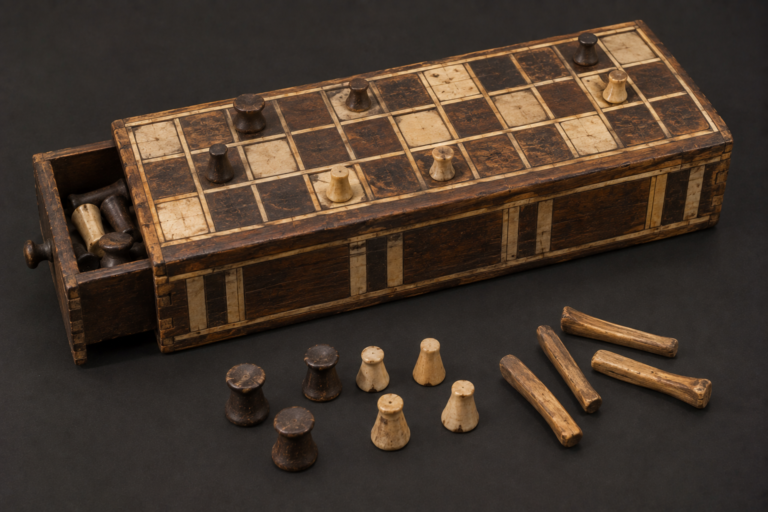
Some toys were simple. Others were carefully made. Archaeologists have found dolls, balls, carved animals, miniature objects, and game pieces. These items reveal play, imagination, imitation, and learning. A child might copy adult life using small household objects. A carved animal could turn the surrounding world into a story. A ball could create movement, competition, and laughter.
Toys also show us that childhood left physical traces. Unlike royal statues or temple walls, toys are intimate. They belong to hands, not monuments. They show a side of ancient Egypt that is quiet, domestic, and deeply human.
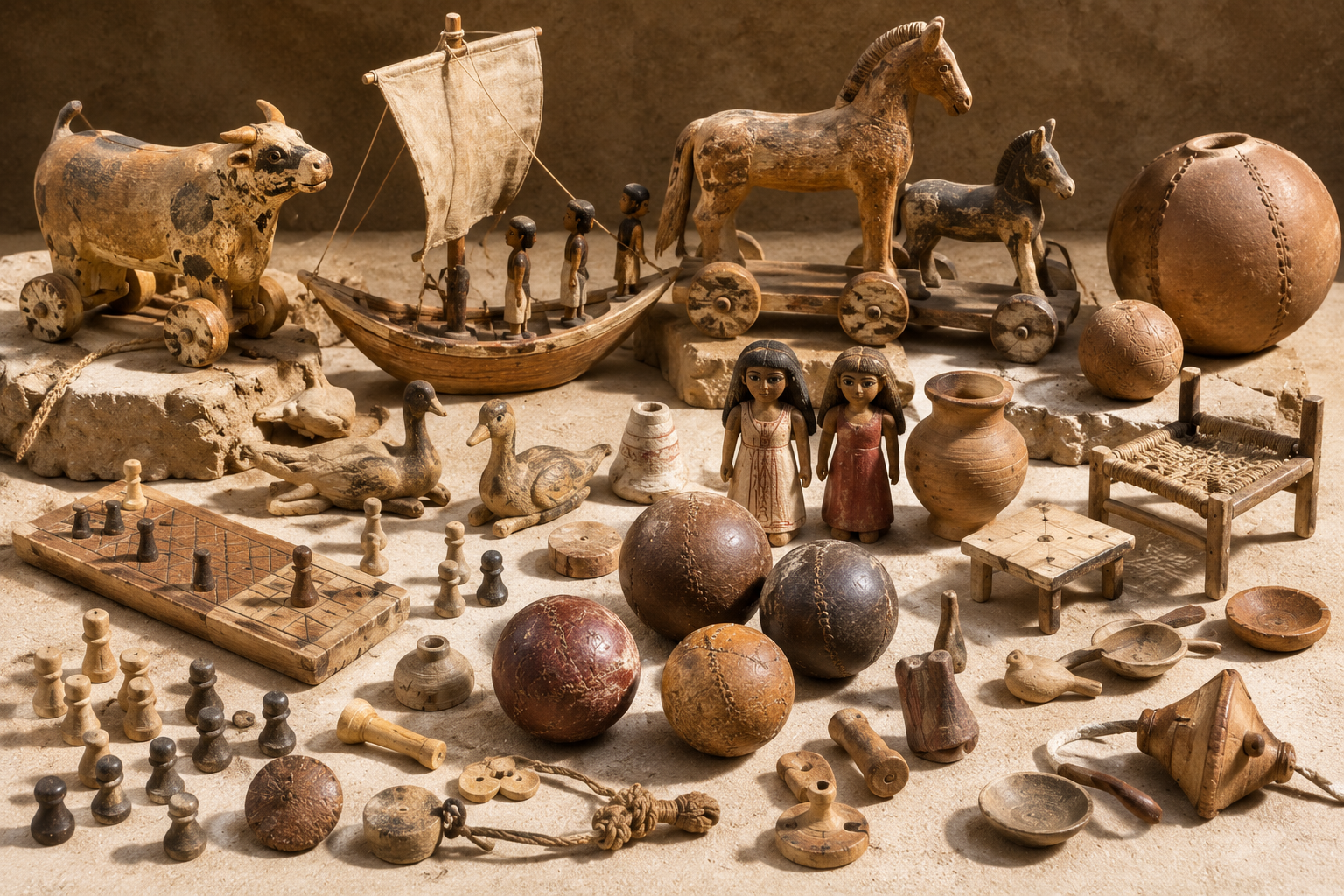
Play was not separate from learning. A toy animal could teach a child about the creatures around them. A miniature tool could imitate adult work. Games could teach patience, strategy, or coordination. Even when children played, they were practicing how to understand the adult world.
There is something powerful about this evidence. A pyramid can make ancient Egypt feel distant. A child’s toy can make it feel close.
Learning the World Around Them
Not all learning in ancient Egypt happened in formal schools. In fact, for most children, learning began through daily observation. A child watched how adults behaved, how food was prepared, how tools were handled, and how work changed from season to season.
A farmer’s child learned the field before reading a text. A craft worker’s child learned materials, tools, and hand movements. A child in a household learned how grain became bread, how jars stored food, and why nothing useful should be wasted. This connects directly with the world described in Bread and Dust, where food was not just something eaten but something produced through repeated labor.
Learning was therefore practical. It was embedded in life. Children were surrounded by lessons even when no one called them lessons.
They learned by carrying small items. They learned by watching older siblings. They learned by listening to adults. They learned through mistakes. They learned by being corrected. The ancient Egyptian home and village were full of teachers, but many of them did not hold official titles.
This type of learning created continuity. Skills passed from one generation to the next not only through written instruction but through hands, habits, memory, and repetition.
Did Every Child Go to School?
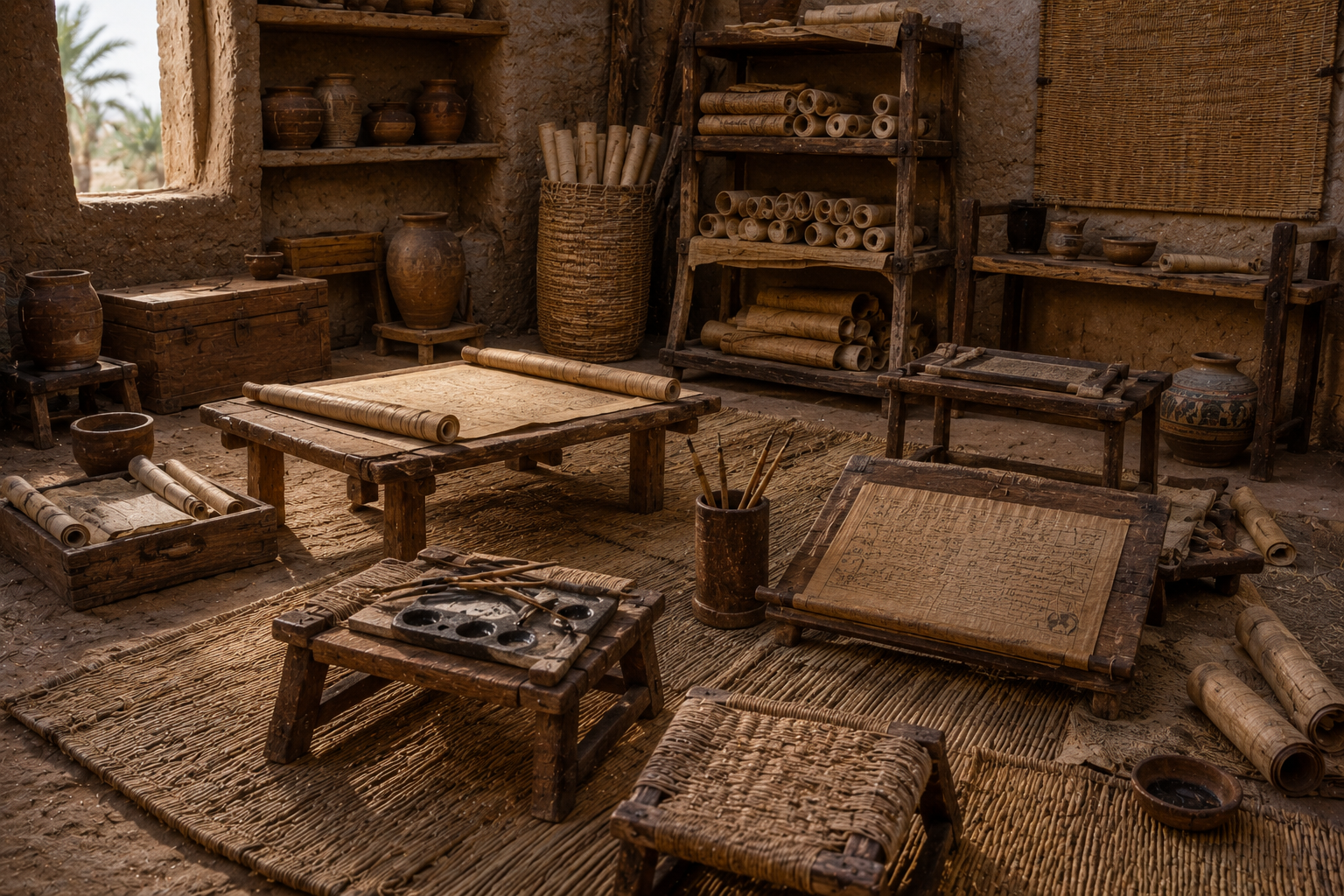
One of the biggest misconceptions about ancient Egypt is that every child attended school in the same way children do today. Archaeological evidence tells a different story. Formal education existed, but it was limited. Most children learned through daily life, while only a smaller number—especially boys from families connected to administration, temples, or professional scribes—received systematic instruction in reading and writing.
Learning to become a scribe demanded years of practice. Students copied signs repeatedly, memorized vocabulary, and learned to write on pieces of limestone, wooden writing boards, and eventually papyrus. Their tools were simple but effective: reed pens, ink palettes, and carefully prepared writing surfaces.
For the majority of Egyptian children, however, education looked very different. A farmer’s child learned agriculture. A potter’s child watched clay become vessels. A carpenter’s child became familiar with wood and tools long before adulthood. Skills were transferred from one generation to another through observation and participation.
This practical education helped preserve Egyptian society for centuries. Every household became a classroom. Every field became a lesson. Every workshop became a place where experience passed naturally from older hands to younger ones.
Boys, Girls, and Daily Responsibilities
Although boys and girls shared many experiences during early childhood, their responsibilities gradually became more specialized as they grew older. Expectations reflected the practical needs of the household rather than strict educational systems.
Boys often accompanied fathers or older relatives into fields, workshops, or administrative environments, depending on the family’s occupation. They learned farming techniques, animal care, construction skills, fishing methods, or specialized crafts through direct experience.
Girls frequently remained closer to the household, where they observed food preparation, weaving, spinning, storage management, childcare, and other domestic responsibilities. These skills were essential for maintaining family life and required years of practice to master.
Yet these differences should not be exaggerated. Ancient Egyptian households functioned through cooperation. Everyone contributed according to age, ability, and circumstance. Children of both sexes grew up understanding that their work supported the survival of the entire family.
The transition into responsibility happened gradually. There was rarely a single moment when childhood ended. Instead, each year brought new expectations and greater participation in the life of the household.
Growing Into Adult Life
Ancient Egyptian childhood was ultimately preparation for adulthood. Every lesson learned at home, every skill practiced in the field, every tool observed in a workshop, and every family tradition contributed to that transition.
Young people did not suddenly become adults overnight. They grew into adult responsibilities through continuous participation in family life. A future farmer learned beside experienced farmers. A future artisan watched skilled hands shape wood, stone, or clay. A future scribe copied texts until writing became second nature.
This apprenticeship model created remarkable continuity. Techniques, traditions, and practical knowledge survived because they were transmitted directly rather than relying only on written instruction.
Many of the objects displayed in museums today were created by craftspeople who first learned their skills as children standing quietly beside experienced relatives. Their education happened through thousands of hours of careful observation and repeated practice.
The result was a society where knowledge remained deeply connected to family, occupation, and community.
Childhood and Religion
Religion surrounded Egyptian children from birth. Protective amulets, household rituals, festivals, temple processions, and family beliefs formed part of everyday life. Children grew up seeing religion woven naturally into ordinary routines rather than separated from them.
Parents hoped the gods would protect their families from illness, accidents, and misfortune. Protective symbols sometimes accompanied children, while household shrines and religious customs reinforced a sense of security and continuity.
Children also witnessed seasonal festivals that connected communities with the gods, the Nile, and the agricultural calendar. These celebrations helped young Egyptians understand their place within a much larger world of tradition and belief.
Rather than treating religion as something distant, Egyptian society integrated it into daily existence. A child could see prayers before meals, offerings in temples, religious symbols inside homes, and festivals in village streets. Faith became part of growing up.
What Archaeologists Have Discovered
For many years, historians knew far more about kings than children. Fortunately, archaeology has changed that picture. Excavations at settlements such as Deir el-Medina, Amarna, and other ancient communities have uncovered evidence that reveals surprisingly personal details about childhood.
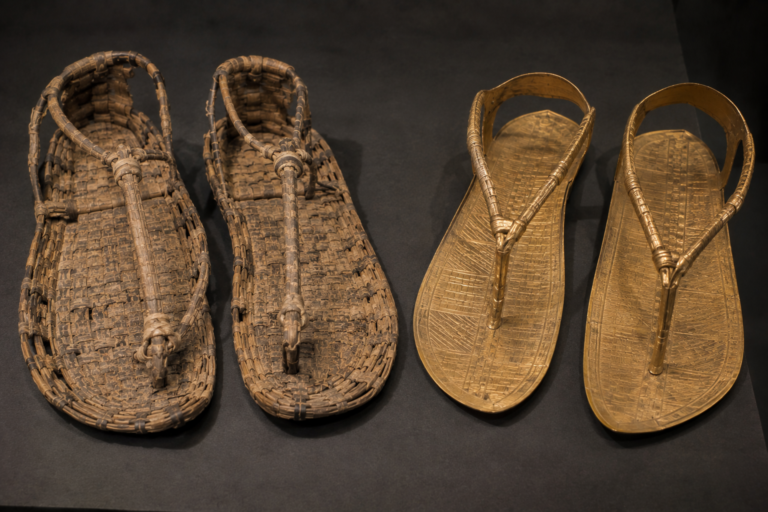
Simple wooden dolls, carved animals, leather balls, board games, miniature furniture, writing exercises, sandals, clothing fragments, household objects, and children’s burials all help researchers reconstruct the lives of young Egyptians.
Written texts also provide valuable clues. School exercises, letters, administrative records, and artistic scenes preserve glimpses of education, family relationships, and daily routines. None of these sources tells the entire story on its own, but together they create a remarkably detailed picture.
Perhaps the most powerful discoveries are the ordinary ones. A worn toy. A child’s footprint preserved in dried mud. A beginner’s writing exercise. These are not spectacular treasures like golden masks or colossal statues, yet they reveal something equally important: ancient Egypt was filled with ordinary families raising ordinary children.
These discoveries remind us that history is not only the story of rulers. It is also the story of countless children whose names have been forgotten but whose lives shaped the civilization we continue to admire today.
Ancient Egyptian childhood was built around family, responsibility, curiosity, and gradual learning. Most children never entered royal courts or temple libraries, yet they became the farmers who fed the kingdom, the builders who raised its monuments, the craftsmen who filled its tombs with beautiful objects, and the parents who passed their knowledge to the next generation. Looking beyond the famous pharaohs allows us to see ancient Egypt in a more human way. Every civilization depends on children who grow into adults capable of carrying traditions forward. Egypt was no different. If Before Sunrise introduced the rhythm of an ordinary day, Bread and Dust explored the meals that sustained it, and The House Beside the Nile opened the door to the family home, then Born Beside the River completes the picture by revealing how the next generation learned to become part of one of history’s greatest civilizations.
Frequently Asked Questions
What was childhood like in ancient Egypt?
Most children grew up within family households, learning through observation, play, and gradually increasing responsibilities. Their daily lives revolved around home, family, work, and community.
Did ancient Egyptian children go to school?
Some children, particularly those preparing to become scribes or officials, attended formal schools. Most, however, learned practical skills from parents and relatives.
What toys did ancient Egyptian children play with?
Archaeologists have discovered wooden dolls, carved animals, leather balls, miniature household objects, board games, and other toys that demonstrate children enjoyed play alongside learning.
At what age did children begin working in ancient Egypt?
Children gradually took on responsibilities as they grew older, helping families with age-appropriate tasks before eventually learning adult occupations.
How did boys and girls grow up differently?
While both learned through family life, boys often trained in farming, crafts, or administration, while girls commonly learned household management, food preparation, weaving, and childcare. These roles could vary depending on family circumstances.
How do archaeologists know about childhood in ancient Egypt?
Evidence comes from settlement excavations, children’s toys, school exercises, tomb paintings, household objects, written records, and burials that provide valuable insights into everyday family life.