
Estimated reading time: 13 minutes
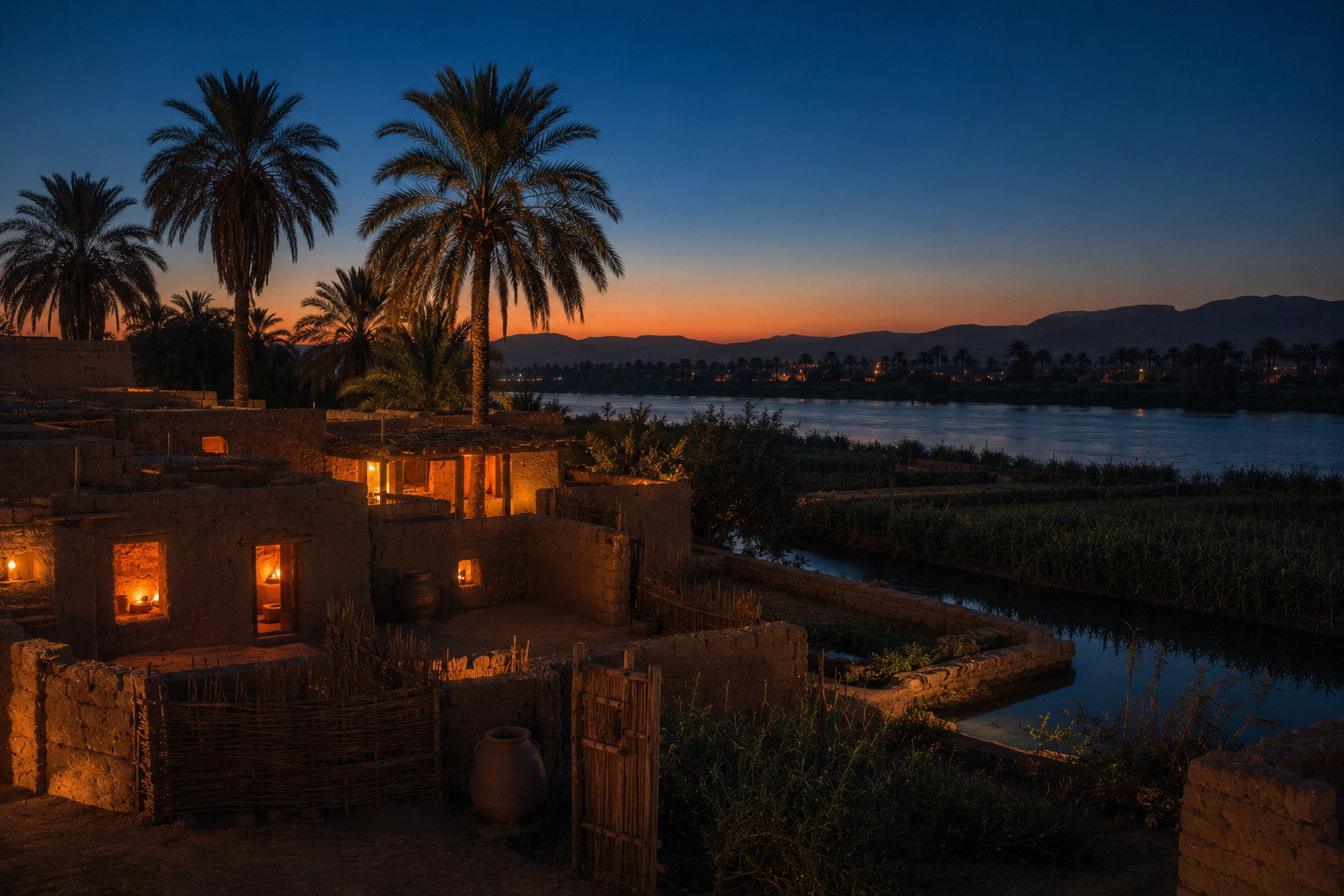
The last rays of sunlight slipped behind the western desert, and for a brief moment the Nile reflected shades of gold, orange, and deep blue. The fields grew quieter. Boats moved more slowly toward the shore. Farmers gathered their tools, craftsmen closed their workshops, and smoke began to rise from the ovens inside mud-brick homes. Ancient Egypt had not gone to sleep. It was simply entering another part of its day.
Most stories about ancient Egypt end when the work is finished. The monuments stand silent, the workers disappear, and history seems to pause until the next sunrise. Yet for millions of ordinary Egyptians, evening was one of the most important parts of daily life. Families reunited, meals were shared, lamps were lit, rooftops filled with cool air, and conversations continued beneath a sky filled with stars. If Before Sunrise explored the beginning of the day, this article follows the quiet hours that came after the last light faded from the Nile.
Nightfall transformed ancient Egyptian villages. Daily labor came to an end, oil lamps illuminated homes, rooftops became comfortable gathering places, and families prepared for another sunrise. Archaeological discoveries—from lamps and hearths to rooftops and household objects—allow historians to reconstruct how ordinary Egyptians experienced life after dark.
- When the Sun Slipped Behind the Nile
- Returning Home
- The Evening Meal
- Lighting the Darkness
- Life After Sunset
- Sleeping Above the Heat
- Night, Stars, and Belief
- Keeping Watch
- Dreams in Ancient Egypt
- What Archaeologists Found After Dark
- Final Thoughts
When the Sun Slipped Behind the Nile
The end of the Egyptian day was not measured by clocks. It was measured by the sun. As daylight slowly disappeared behind the western horizon, people naturally adjusted their activities. Heat softened, shadows stretched across fields, and the intense pace of work finally began to slow.
Along irrigation canals, the final tasks of the afternoon came to an end. Farmers gathered simple tools before walking back toward their villages. Fishermen secured boats along the riverbank. Potters covered unfinished vessels. Bakers removed the last loaves from their ovens. The sounds of labor gradually gave way to the quieter sounds of family life.
This daily transition repeated itself thousands of times over countless generations. Every evening connected one day to the next. The cycle felt predictable because it depended on nature itself rather than mechanical schedules.
Unlike the brightly illuminated cities of the modern world, darkness arrived quickly in ancient Egypt. Once the sun disappeared, natural light faded rapidly. Evening therefore encouraged people to return home before true darkness settled across the Nile Valley.
For many Egyptians, sunset marked not the end of life, but the beginning of family time.
Returning Home
The road home was one of the most familiar journeys in ancient Egypt. Men returned from fields and workshops carrying the dust of the day on their clothing. Children who had spent hours helping adults or playing around the village slowly gathered near their homes. The atmosphere changed from productive labor to shared domestic life.
Inside each mud-brick house, preparations were already underway. As explored in The House Beside the Nile, Egyptian homes were designed around practical family life. Storage jars, ovens, courtyards, rooftops, and workspaces all became active once again as evening approached.
Unlike monumental temples built to inspire awe, ordinary homes existed to support routine. They protected families from heat, stored precious grain, sheltered possessions, and provided the setting for conversations that archaeology can only hint at today.
Returning home also meant returning to familiar people. Grandparents, parents, children, and neighbors formed the social heart of Egyptian villages. Meals were rarely hurried. Even simple food became more meaningful because it was shared.
For children, evening often meant listening rather than speaking. They watched adults discuss work, crops, weather, family concerns, and plans for the following day. Without realizing it, they continued learning long after the day’s physical work had ended.
The Evening Meal
Food brought the household together. Bread remained the center of nearly every meal, accompanied by beer, vegetables, fish, fruit, or other foods available during the season. Although wealthy Egyptians enjoyed greater variety, ordinary families depended upon reliable staples that could feed everyone.
The smells filling the home would have been familiar after generations of repetition. Fresh bread, warm grain, roasted vegetables, and simple cooking fires created an atmosphere that marked the day’s conclusion.
Many of these foods have already been explored in Bread and Dust, where we followed the journey from harvested grain to freshly baked bread. During the evening meal, all of that labor finally reached its purpose. Grain became nourishment, and work became shared experience.
Meals were also moments of conversation. Family members reflected on the day’s events while preparing for tomorrow’s responsibilities. Stories passed naturally between generations. Advice, humor, and practical knowledge all traveled across the dinner space without written instruction.
In many ways, these quiet family meals preserved Egyptian society as effectively as royal decrees or monumental architecture.
Lighting the Darkness
As daylight disappeared, homes relied upon one of humanity’s oldest technologies: the oil lamp. These small objects transformed darkness into usable living space. Their light was modest compared with modern electricity, but it extended the day just enough for conversation, household work, and evening routines.
Ancient Egyptian lamps evolved over many centuries, but their purpose remained remarkably consistent. Filled with oil and fitted with simple wicks, they produced a warm glow rather than brilliant illumination. Families learned to organize evening activities around limited light rather than flood every room with brightness.
This softer environment changed how people experienced night. Shadows moved across mud-brick walls. Pottery jars reflected flickering light. Rooms became quieter, smaller, and more intimate than they had appeared during the day.
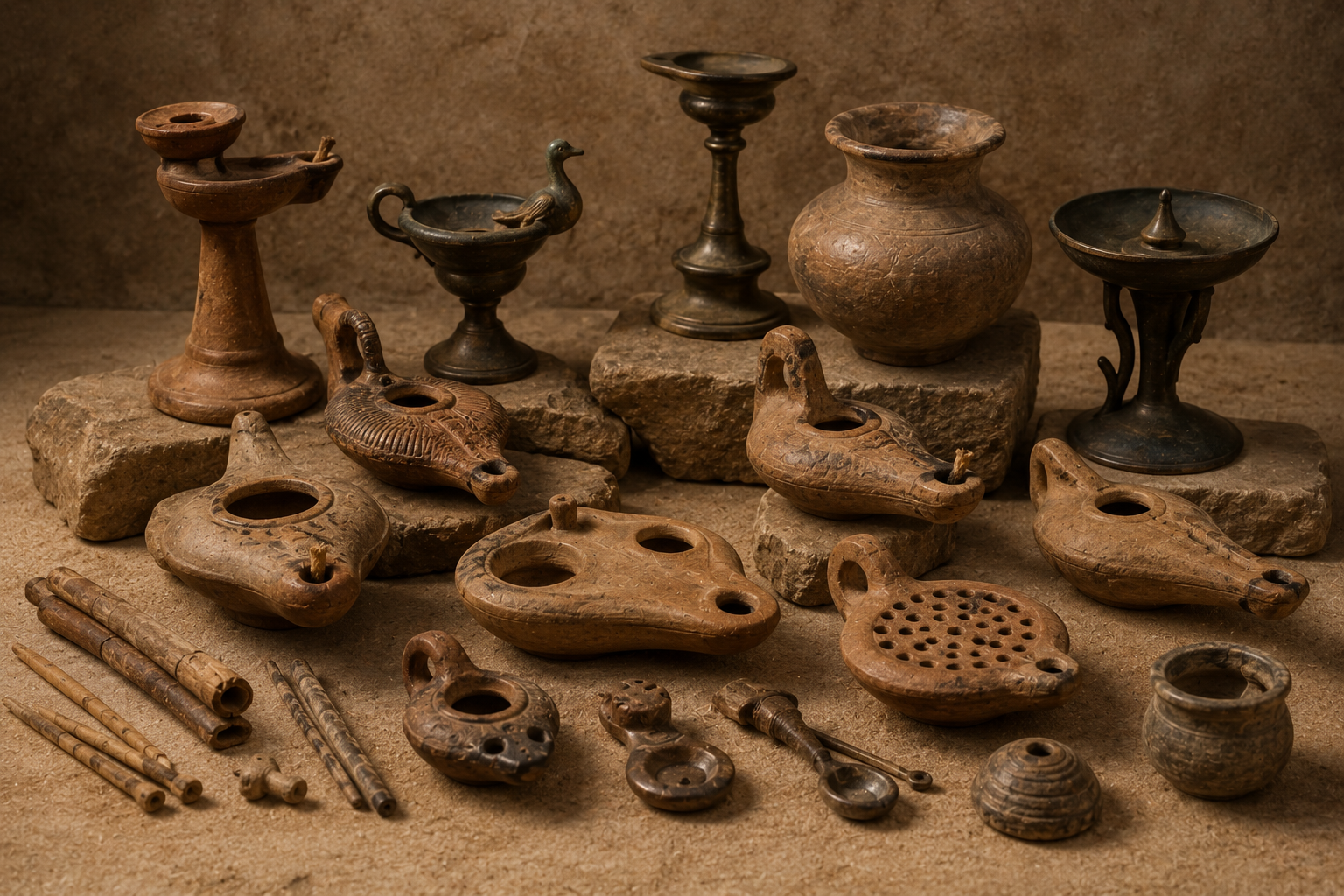
Archaeologists regularly discover ceramic lamps, fragments of lighting vessels, soot marks, and other evidence showing how widespread these objects were. Although humble in appearance, they made ordinary life after sunset possible.
The gentle light of an oil lamp reminds us that ancient Egyptian evenings were experienced differently from our own. Darkness was not completely defeated. It was simply held back long enough for another peaceful evening beside the Nile.
Life After Sunset
The village became quieter after the evening meal, but it did not become silent. Without the constant movement of farming and craftwork, different sounds emerged. Wind moved through date palms. Water flowed quietly along irrigation canals. Insects filled the darkness with steady rhythms, while distant animals occasionally interrupted the stillness.
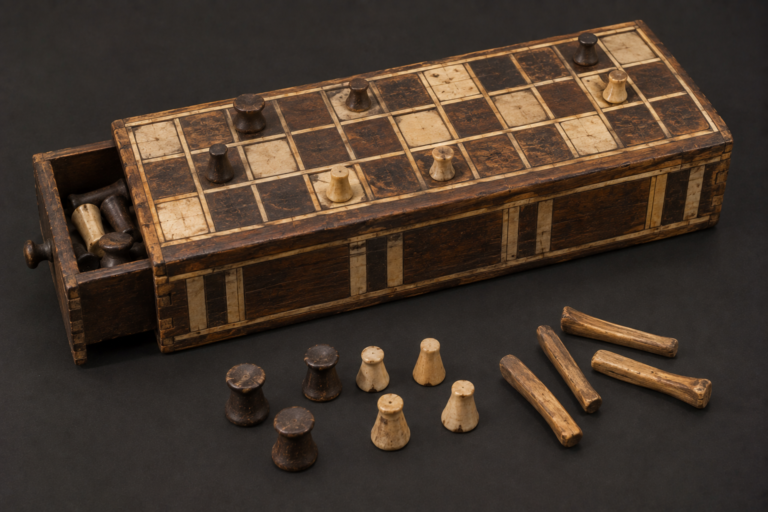
Inside the home, families remained together. Some household tasks continued beneath the light of small oil lamps. Clothing might be repaired, baskets woven, tools inspected, or grain prepared for the following morning. These activities were rarely rushed. Evening encouraged a slower pace than the intense hours of daylight.
Children gathered close to parents and grandparents. Stories, practical advice, family memories, and religious traditions were passed naturally from one generation to the next. Long before written history reached most ordinary people, knowledge survived through conversation.
For many Egyptians, these quiet hours were among the few moments when the entire household could simply be together. The day’s work had ended, tomorrow’s responsibilities had not yet begun, and the home became the center of family life once again.
Sleeping Above the Heat
Ancient Egyptian architecture reflected a deep understanding of climate. Thick mud-brick walls reduced daytime heat, but during the hottest months many families found an even more comfortable place to spend the night: the rooftop.
Flat roofs served several purposes throughout the day, yet after sunset they often became open-air living spaces. As the desert cooled, gentle breezes crossed the rooftops, making them far more pleasant than enclosed rooms that had absorbed heat throughout the afternoon.
Sleeping outdoors beneath the stars required no elaborate furniture. Woven mats, simple bedding, and headrests provided practical comfort. Families could rest while enjoying cooler air and an open view of the night sky.
This practice also reminds us that ancient Egyptian homes extended beyond their interior rooms. As discussed in The House Beside the Nile, rooftops formed an important part of domestic architecture rather than being unused structural surfaces.
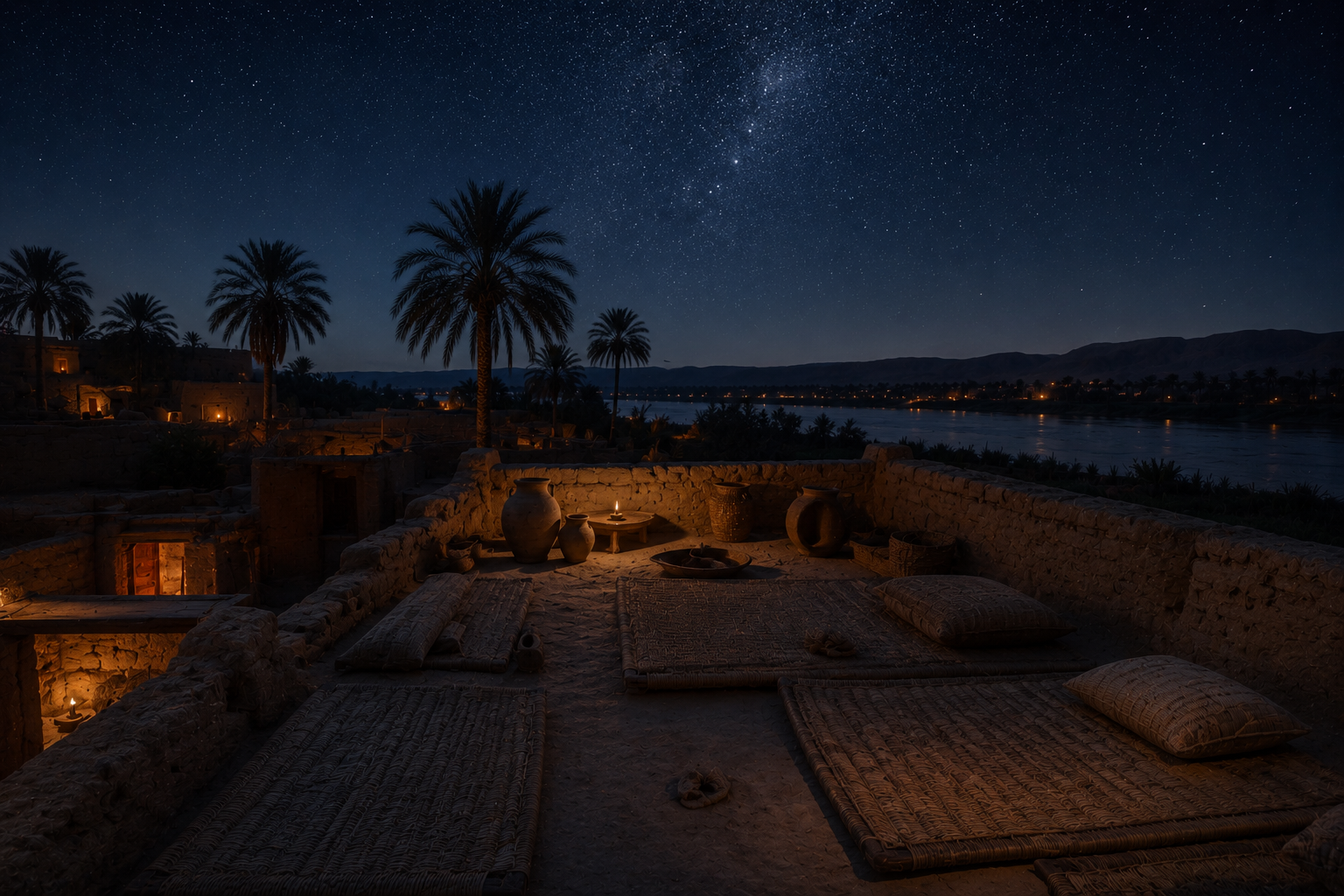
From these rooftops, Egyptian families could watch constellations slowly move across the sky while the Nile flowed quietly below. Night became an experience shaped by nature rather than artificial light.
Night, Stars, and Belief
Darkness held practical challenges, but it also carried spiritual meaning. Ancient Egyptians observed the movement of stars with great attention. The heavens influenced religious beliefs, temple orientation, calendars, and ideas about life beyond death.
For ordinary villagers, however, the night sky was both beautiful and familiar. Every clear evening offered the same constellations that had guided generations before them. Children grew up recognizing patterns above the Nile just as naturally as they recognized fields beside it.
The setting sun itself held symbolic importance. Egyptian belief associated the sun’s nightly journey with renewal and rebirth. Morning represented victory over darkness, a cycle repeated every single day.
These beliefs did not remove the practical realities of night, but they gave them deeper meaning. Sunset was never simply the disappearance of light. It became part of a larger understanding of the universe.
Keeping Watch
Although most villagers rested after sunset, not everyone slept immediately. Some responsibilities continued through the night. Animals required attention. Boats needed securing. Valuable supplies had to remain protected. Certain settlements likely maintained watch over entrances or important storage areas.
The night also demanded awareness. Without modern lighting, movement became slower and more cautious. Paths that felt familiar during daylight could become difficult after dark. Oil lamps illuminated only small areas, encouraging people to remain close to home.
Despite these limitations, archaeological evidence suggests Egyptian villages adapted successfully to nighttime conditions. Their routines evolved around available light rather than attempting to overcome darkness completely.
This rhythm created a society closely connected to natural daylight. Unlike modern cities that operate twenty-four hours a day, ancient Egyptian communities followed the changing light of the sun.
Dreams in Ancient Egypt
Sleep carried more than physical importance. Dreams fascinated ancient Egyptians and sometimes held religious significance. Certain dreams were interpreted as meaningful messages, while temple traditions occasionally associated dreams with divine communication.
Written texts from different periods reveal that dreams could be discussed, interpreted, and even recorded. Although ordinary families may not have possessed elaborate dream manuals, the belief that dreams mattered was widespread enough to appear in Egyptian culture.
For most people, however, sleep primarily meant recovery. Farmers would rise before dawn. Bakers would light ovens again. Children would wake to another day of learning through observation and participation. Rest prepared the body for the demands of tomorrow.
The quiet hours of the night therefore connected directly to the first light explored in Before Sunrise. One day ended only so another could begin.
What Archaeologists Found After Dark
The archaeology of nighttime is surprisingly rich. Excavations across Egypt have uncovered oil lamps, lamp fragments, soot deposits, hearths, sleeping platforms, rooftops, household furniture, pottery vessels, and domestic spaces that reveal how families organized life after sunset.
Sites such as Deir el-Medina provide particularly valuable evidence because they preserve ordinary houses rather than monumental architecture. The arrangement of rooms, courtyards, staircases, rooftops, ovens, and storage areas helps researchers reconstruct how evening activities unfolded inside real homes.
Small discoveries often tell the biggest stories. A soot-blackened lamp reveals repeated nightly use. A worn stairway leading to the roof suggests frequent movement after sunset. Carefully positioned storage jars indicate how families organized limited interior space. Together, these details create a remarkably vivid picture of domestic life.
Archaeology reminds us that the history of ancient Egypt was not written only by kings. It was written every evening by ordinary people returning home, lighting a lamp, sharing a meal, and preparing for another sunrise beside the Nile.
When darkness settled across ancient Egypt, life did not disappear. It simply slowed. Homes replaced fields, conversation replaced labor, and small oil lamps replaced the brilliance of the sun. Families gathered inside mud-brick houses, rooftops welcomed cooler air, and villages prepared quietly for another day. Following the rhythm of sunrise and sunset allows us to see ancient Egypt differently. The civilization was built not only by pharaohs and monuments, but by countless evenings like these—ordinary moments repeated across thousands of years. Together, Before Sunrise, Bread and Dust, The House Beside the Nile, Born Beside the River, and The Last Lamp at Dusk now form a complete journey through a single day in the lives of ordinary ancient Egyptians—one that begins with the first light over the Nile and ends beneath a sky filled with stars.
Frequently Asked Questions
What did ancient Egyptians use for light at night?
Most households relied on small ceramic oil lamps fueled by plant oils or animal fats. These lamps produced enough light for evening meals, conversations, and household tasks.
Did ancient Egyptians sleep on rooftops?
Yes. During warm seasons, many families slept on flat rooftops where cooler evening air made resting more comfortable than inside enclosed rooms.
What happened after sunset in ancient Egypt?
Families returned home, shared meals, completed small household tasks, lit oil lamps, spent time together, and gradually prepared for sleep before the next day’s work.
Did ancient Egyptians fear the night?
Night carried religious significance and practical challenges, but it was also a normal part of daily life. Egyptians adapted their routines to natural darkness rather than avoiding it completely.
How do archaeologists know about life after dark?
Evidence comes from excavated homes, oil lamps, soot marks, rooftops, hearths, domestic architecture, settlement layouts, and written sources that describe household life.
Why were oil lamps so important?
Oil lamps extended useful hours beyond sunset, allowing families to cook, talk, work, and prepare for the following day after natural daylight had disappeared.