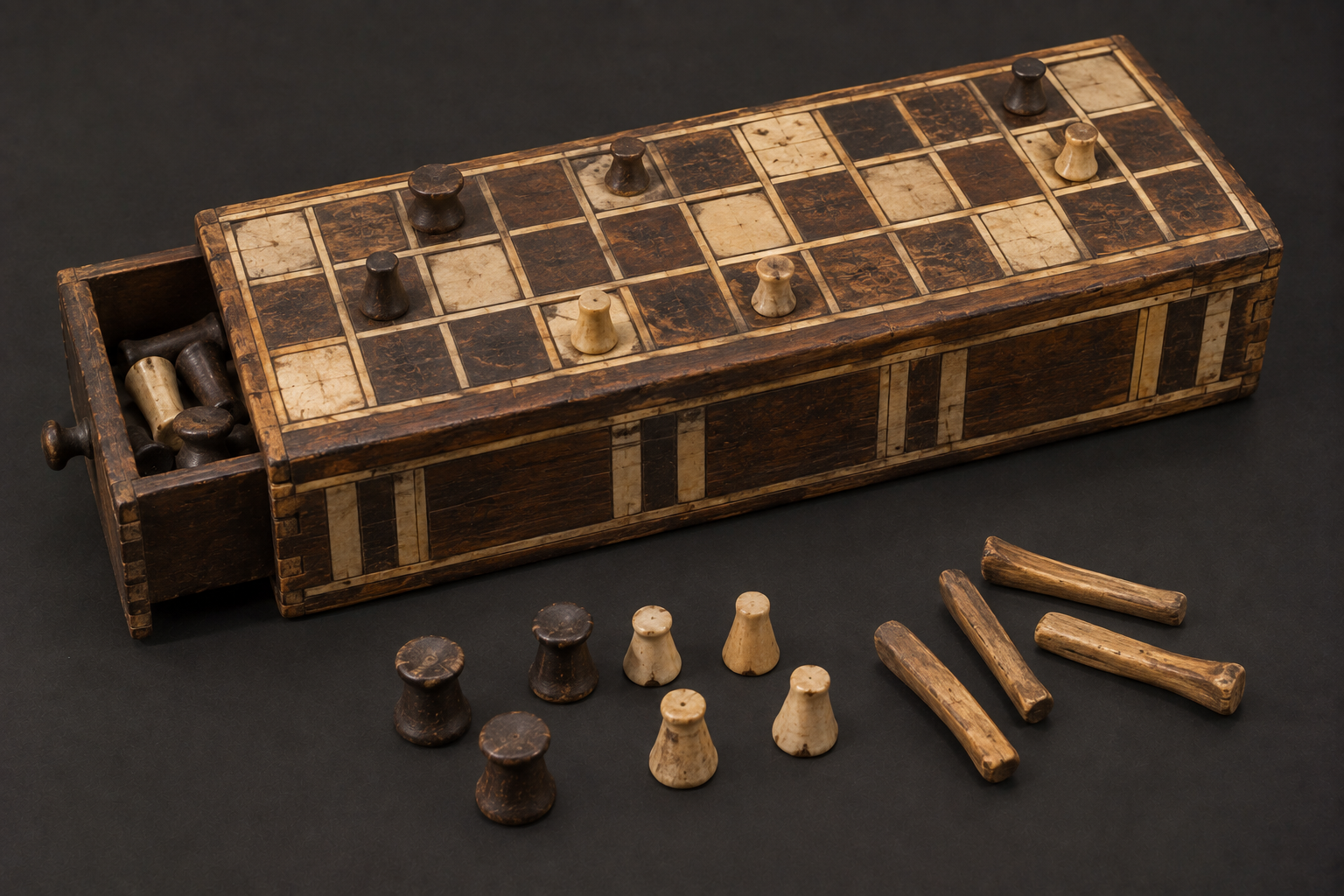

Tutankhamun was buried with gold, weapons, chariots, clothing, food, and something that feels surprisingly familiar more than three thousand years later: board games.
No fewer than five game boxes were placed in the young king’s tomb. Some were impressive pieces of craftsmanship, while others were much smaller and more portable. Gaming pieces and throwing sticks accompanied them, preserving traces of an activity that ancient Egyptians had enjoyed for centuries.
But these were not simply ancient entertainment left beside a king who enjoyed playing games. By Tutankhamun’s time, Senet, Egypt’s most famous board game, had acquired an important connection with the journey after death. The game boxes from KV62 therefore sit between two worlds. They can tell us about play and craftsmanship in life, while their presence in a royal tomb also reveals how a familiar game could take on a deeper funerary meaning.
Quick Context
- King: Tutankhamun
- Dynasty: Eighteenth Dynasty
- Period: New Kingdom
- Tomb: KV62, Valley of the Kings
- Discovery: 1922
- Age at death: Approximately 19 years
- Game boxes: At least five were included in the burial
- Best-known game: Senet
- Senet board: 30 squares arranged in three rows of ten
- Another important game: Twenty Squares
- Players: Both Senet and Twenty Squares were played by two players
- Movement: Casting sticks, bones, or similar devices determined moves
- Key caution: The presence of game boxes in the tomb does not prove that Senet was Tutankhamun’s favorite game
At Least Five Game Boxes Inside KV62
The number itself immediately tells us that gaming equipment was not a minor presence in Tutankhamun’s burial.
At least five game boxes were found among the objects from KV62.
They were not five identical copies of a single board. Carter’s description of the gaming equipment records considerable variation in size and construction, from an elaborate large example to medium-sized boards and much smaller specimens.
The largest was a substantial object mounted on a small ebony stand shaped rather like a low stool on a sledge. Gold embellished parts of the stand, while the gaming board itself combined ebony and ivory.
Other examples were much more compact.
This range matters because it shows that an ancient Egyptian board game could take different physical forms. A game did not always require a large permanent table. Smaller boxes could concentrate the playing surface, pieces, and other equipment into an object that was comparatively easy to move.
Yet quantity alone cannot tell us why Tutankhamun possessed several sets.
Multiple game boxes do not prove that gaming was his favorite pastime. Nor can we assume that he personally used every set found in the tomb.
As with the many sticks and staffs buried with Tutankhamun, archaeological quantity has to be interpreted in context.
At least five game boxes were buried with Tutankhamun, but this does not mean archaeologists can identify his favorite game or reconstruct how often he personally played.
Where Were Tutankhamun’s Games Found?
It is easy to imagine Tutankhamun’s games discovered as complete sets, neatly arranged and waiting to be opened.
The excavation was much messier.
Important gaming equipment was recovered from the Annex, the small chamber opening from the Antechamber. This room contained an extraordinary concentration of objects, many of which had been disturbed long before Howard Carter entered the tomb.
Game boxes, pieces, and related components were found scattered rather than preserved as a modern museum display.
Parts belonging to objects in the Annex had even been displaced into the Antechamber.
This ancient disturbance created a difficult archaeological puzzle.
A loose gaming piece could no longer be understood simply by looking at where it happened to lie in 1922. Carter’s team had to compare dimensions, materials, decoration, fragments, and associated objects to reconstruct which pieces belonged together.
This is one reason the detailed cataloguing of KV62 became so important.
The discovery was not only about removing spectacular treasures. It required reconstructing relationships between thousands of objects, fragments, and components whose original positions had sometimes been disrupted.
The challenge is explored in greater detail in how Howard Carter catalogued Tutankhamun’s tomb.
What Did the Game Boxes Look Like?
The basic idea would still be recognizable to a modern player.
A game box provided a marked surface on which pieces could move. Depending on its construction, it could also provide storage for gaming pieces and the small devices used to determine movement.
But Tutankhamun’s examples belonged unmistakably to the material culture of New Kingdom Egypt.
Carter described the largest gaming board as an ebony object faced with ivory and supported on an elaborate stand. A medium-sized example used ivory veneer over a wooden core and carried stained carving and gilded borders.
At the other end of the scale were much smaller examples, including plain ivory specimens.
These differences show that the same basic activity could exist at several levels of material refinement.
A board game could be a practical pastime.
It could also be a carefully crafted luxury object.
And once placed inside a royal burial, it could acquire yet another layer of meaning.
Senet: Egypt’s Most Famous Ancient Board Game
The name most closely associated with ancient Egyptian gaming is Senet.
Its history reaches back long before Tutankhamun.
The characteristic Senet board contains thirty spaces arranged in three parallel rows of ten. Players moved pieces through this grid, with several spaces near the end of the route carrying special significance.
The game’s Egyptian name is commonly translated in connection with the idea of “passing.”
That word became especially meaningful as the role of Senet changed over time.
Earlier evidence demonstrates that Senet was genuinely played as a board game. By the New Kingdom, however, its imagery had also become connected with passage through the dangers encountered after death.
This development is crucial for interpreting Tutankhamun’s game boxes.
Senet did not suddenly stop being a game when it acquired funerary meaning.
An object could belong to recreation and burial symbolism at the same time.
Tutankhamun’s game boxes belonged to two worlds at once: the familiar world of play and the symbolic world of royal burial.
How Was Senet Played?
We know the broad structure of Senet better than we know every detail of its rules.
It was a two-player game in which opposing pieces moved through a board of thirty squares.
The route progressed through the rows, while casting sticks, bones, or related devices were used to determine movement.
Players could advance their own pieces, interact with an opponent’s position, and encounter particular squares that affected progress.
The final spaces of surviving Senet boards often carry special markings.
Some appear to represent beneficial positions, while others could create hazards or setbacks.
Modern reconstructions can demonstrate plausible ways to play, but they should not be confused with a complete ancient rulebook.
No surviving document gives us one definitive set of rules covering every period in which Senet was played.
The game existed for a very long time, and its rules and symbolic associations could change.
We can reconstruct the broad mechanics of Senet, but not every rule with complete certainty. Modern playable versions inevitably fill some gaps left by the ancient evidence.
The Game of Twenty Squares
Senet was not the only important board game known in New Kingdom Egypt.
Another was the Game of Twenty Squares.
As its modern name suggests, its playing surface contained twenty spaces rather than Senet’s thirty.
It was also a two-player racing game, with players moving pieces according to results produced by casting devices.
But Twenty Squares has a different history.
Unlike Senet, which is deeply rooted in Egyptian culture, Twenty Squares belonged to a gaming tradition known much more widely across the ancient Near East. It reached Egypt from that broader eastern world and was adapted there.
This is a valuable reminder that ancient Egypt was not culturally isolated.
Objects, materials, artistic ideas, technologies, and games could move across regions through long-distance networks of contact.
The presence of a foreign-origin gaming tradition in Egypt does not tell us anything specific about Tutankhamun’s personal travels or preferences. It tells us something broader about the connected world in which New Kingdom Egypt existed.
Two Games on One Box
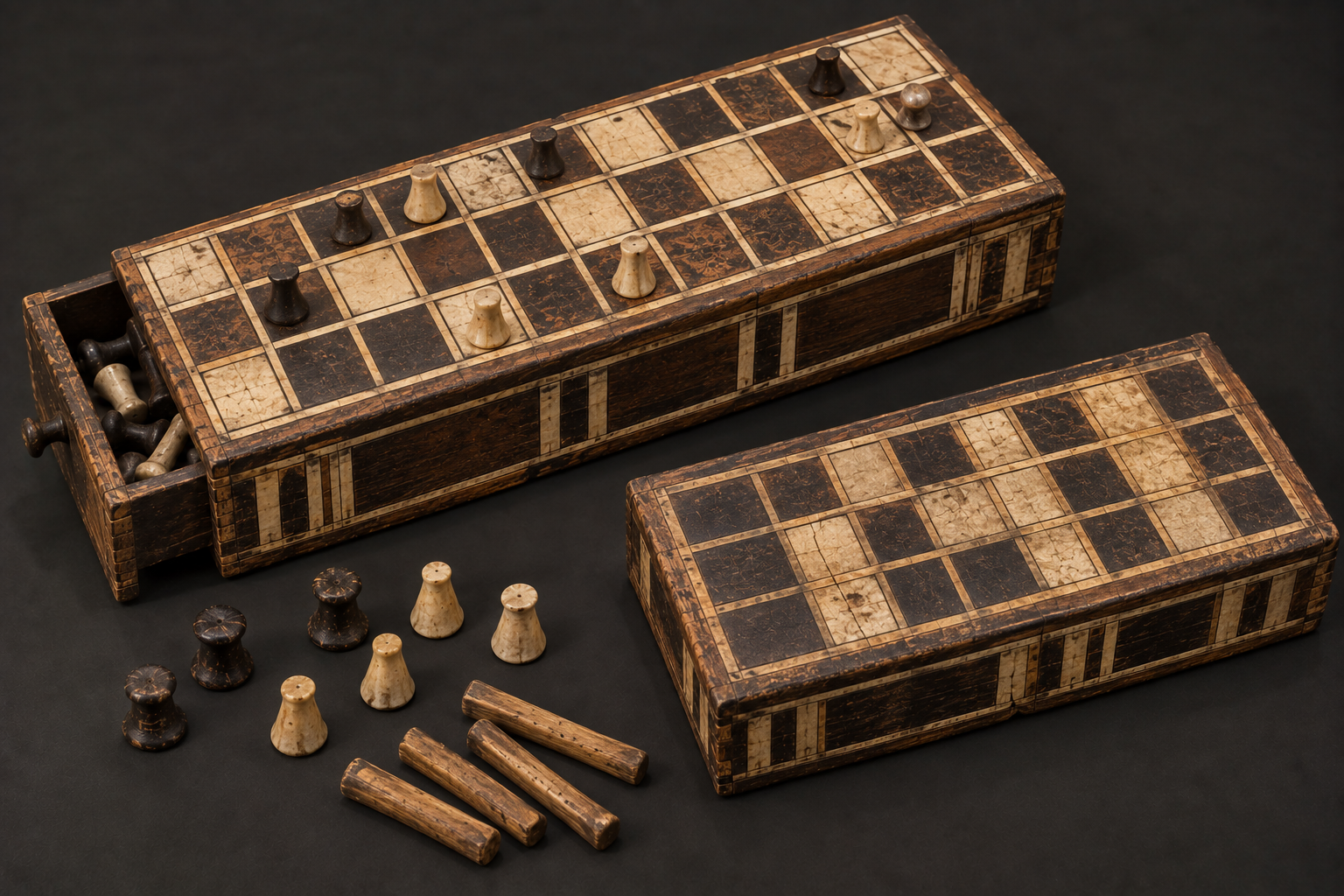
One of the cleverest features of ancient Egyptian gaming equipment was the ability to combine two different games in a single box.
Surviving New Kingdom examples show Senet on one playing surface and Twenty Squares on the opposite side.
Turn the box over and the game changed.
In well-preserved examples, a drawer could hold gaming pieces together with throw sticks or other equipment used to determine moves.
The design was compact and practical.
Instead of creating two completely separate gaming objects, a craftsperson could place two playing systems into one portable form.
The combination is important for another reason.
It places an Egyptian game beside one that had entered Egypt from the ancient Near East.
A single object could therefore preserve evidence for both a long Egyptian gaming tradition and a game adopted from a wider international world.
The Tiny Pieces That Made the Games Work
A board without pieces could not function as a game.
Ancient gaming sets therefore included small counters representing opposing players.
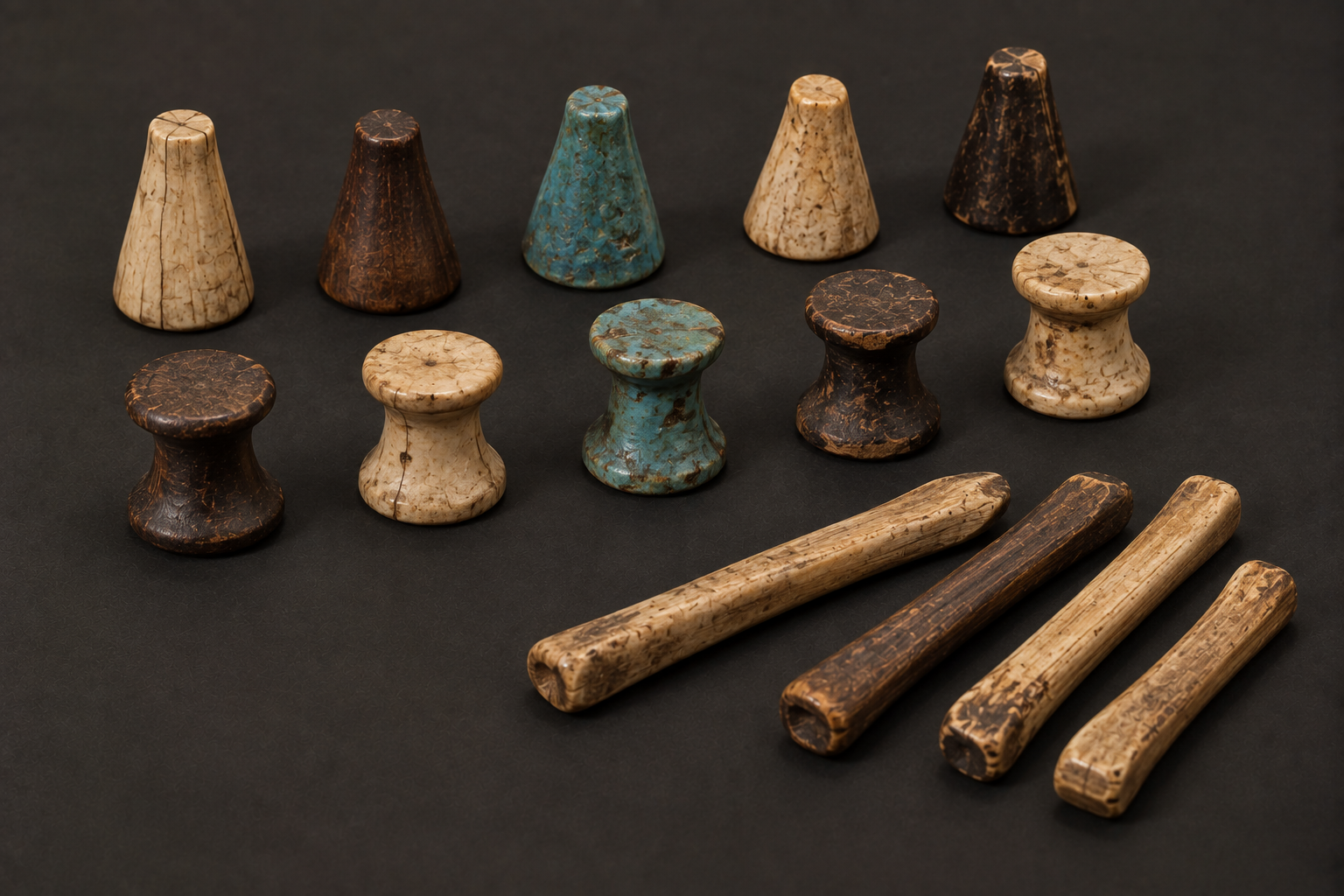
Comparable New Kingdom sets preserve simple geometric forms, especially conical and spool-shaped pieces. Different shapes allowed the two sides to be distinguished easily.
Some were made from faience and other materials, and more elaborate examples from Egyptian gaming traditions could take more complex forms.
Tutankhamun’s tomb also preserved gaming pieces associated with the boxes.
But this is an area where comparison must be handled carefully.
A beautifully preserved set from another New Kingdom tomb can help us understand how Egyptian gaming equipment worked, but its exact materials, number of pieces, or appearance should not automatically be transferred to every game box from KV62.
Each archaeological set has its own evidence.
Throwing Sticks Instead of Modern Dice
Ancient Egyptian players needed an element that determined how their pieces could move.
For Senet and related games, this could be provided by casting sticks or bones.
The principle is familiar even if the objects look different from modern dice.
A player cast the devices and interpreted the way they landed. The result then controlled movement on the board.
Gaming equipment from Tutankhamun’s tomb included small throwing sticks associated with the games, while comparable Egyptian sets preserve both throw sticks and knucklebones.
This combination of choice and chance was central to gameplay.
A player could make strategic decisions, but movement was constrained by the result of the cast.
That element of uncertainty may also help explain why Senet later lent itself so effectively to funerary symbolism. Progress across a board filled with helpful and dangerous spaces could become a powerful metaphor for a difficult passage whose outcome mattered enormously.
But we should be cautious here.
The symbolic interpretation developed within ancient Egyptian funerary culture. It should not be projected backward onto every Senet game from every period as though the game had always possessed exactly the same meaning.
Were Tutankhamun’s Games Actually Used?
This question sounds simple, but the evidence is difficult to interpret.
Signs of wear can potentially show that an object had a history before burial.
A playing surface may become abraded.
Edges can become worn.
Pieces may be damaged, lost, or replaced.
A drawer can show repeated handling.
But the same caution that applies to Tutankhamun’s sandals and walking sticks applies here too.
Damage is not automatically evidence of use.
The game boxes experienced ancient disturbance inside the tomb. Components became separated. Organic materials aged. Objects were excavated, conserved, moved, stored, and studied.
Any claim that a particular mark proves Tutankhamun personally played a game therefore requires much more than simply noticing an imperfect surface.
The distinction matters because objects from KV62 did not all share the same biography.
Some possessions may have existed before the burial.
Other objects may have been prepared or selected specifically for funerary use.
And even an object genuinely used during Tutankhamun’s lifetime cannot automatically be assigned to his own hands.
Did Tutankhamun Personally Play Senet?
It is certainly possible.
Senet was an established game in Egyptian culture, and gaming equipment formed a substantial part of Tutankhamun’s burial assemblage.
But possibility is not proof.
No surviving evidence allows us to watch Tutankhamun sitting opposite another player or to count how often he used a particular board.
The tomb therefore cannot justify statements such as “Senet was Tutankhamun’s favorite game.”
That claim may sound harmless, but it turns archaeological evidence into invented biography.
The more accurate conclusion is also more interesting.
Tutankhamun lived within a culture in which board games were familiar, and several gaming sets were important enough to be included among his burial equipment. Some may have belonged to the material world around the living king, while their placement in KV62 gave them a new funerary context.
Found in Tutankhamun’s tomb does not automatically mean personally used by Tutankhamun. The game boxes reveal the royal material environment and burial assemblage more securely than they reveal the young king’s personal hobbies.
From Entertainment to Something More
Senet is especially important because its meaning did not remain fixed.
It was a real board game with players, pieces, movement, competition, and chance.
But during the New Kingdom it also became increasingly connected with the passage after death.
The movement of pieces across a board could be understood in a new way.
Special spaces could represent obstacles or beneficial stages.
Successfully moving through the game could echo the idea of successfully passing through dangers on the way to continued existence after death.
This transformation did not erase Senet’s identity as a game.
Instead, it added another layer.
That is why the game boxes in Tutankhamun’s tomb should not be forced into a choice between “entertainment” and “funerary object.”
In New Kingdom Egypt, the same familiar object could participate in both worlds.
Why Senet Became Connected With the Afterlife
The Egyptian name of Senet is associated with the idea of passing, an especially suggestive concept in a funerary setting.
During the New Kingdom, Senet became incorporated into imagery and texts concerned with the deceased’s successful journey beyond death.
One of the most famous later images appears in the tomb of Queen Nefertari, where she is shown playing Senet in a funerary context.
The scene is important not because it gives us a literal photograph of how every Egyptian played, but because it demonstrates how deeply the game could be integrated into ideas about the next life.
By this stage, a game board could represent more than a pleasant way to spend time.
Progress across its squares could evoke passage through obstacles toward a successful outcome.
That symbolic dimension helps us understand why gaming equipment belonged naturally among funerary possessions, including those prepared for Tutankhamun.
But the relationship should not be simplified into the claim that every game box in KV62 existed only for symbolic purposes.
Carter himself noted the everyday character of some of the smaller specimens.
The most plausible picture is therefore layered: gaming was a recognizable activity of life, while Senet had also become powerful enough to carry meaning into death.
Why Put a Board Game Inside a Tomb?
To a modern visitor, a board game may seem like an unusually ordinary object to place beside a dead king.
But Egyptian burials often included objects connected with familiar activities, material comfort, status, ritual, and provision. Tutankhamun’s tomb preserved clothing, sandals, furniture, food, weapons, containers, and many other objects alongside spectacular royal treasures.
Games could fit naturally into this larger assemblage.
They belonged to the recognizable world of human activity, but Senet offered something additional. By the New Kingdom, its association with successful passage after death meant that a gaming object could carry both practical familiarity and funerary significance.
That makes it difficult to divide Tutankhamun’s game boxes neatly into two categories: objects for life and objects for death.
Some may have had histories before the burial.
Some may have been selected because gaming equipment was considered appropriate royal provision.
Some may have carried symbolic significance because of the funerary meaning Senet had acquired.
Several explanations could apply to the same object.
A game did not have to stop being a game in order to become meaningful in a tomb.
Portable Games and Royal Life
One of the most revealing details in Carter’s description is the variation in size among Tutankhamun’s game boxes.
Not every example was a large luxury object.
Some were much smaller, and their compact construction made them portable in a way that a permanent gaming table would not have been.
That tells us something useful about ancient gaming technology.
A playing surface, pieces, and casting equipment could be brought together in a relatively small object. A box or drawer could keep loose components together, while two different games could even be placed on opposite surfaces.
In practical terms, this made gaming adaptable.
It did not have to remain tied to one room.
However, portability should not be turned into an invented story about Tutankhamun carrying a favorite game everywhere he traveled.
The construction shows that such an object could be transported. It does not tell us where Tutankhamun personally took it or how often he used it.
The Craftspeople Behind Tutankhamun’s Game Boxes
A game box may have been designed for play, but making one could require sophisticated craftsmanship.
Tutankhamun’s more elaborate gaming equipment combined carefully worked wood with materials such as ebony, ivory, gilding, and decorative carving.
The board itself had to be measured and divided accurately.
Individual squares needed to remain visually distinct.
Veneers and inlays had to be cut and fitted.
Drawers or storage spaces, where present, required joinery precise enough to function.
Gaming pieces had to be made small enough to move easily while remaining distinguishable from the opponent’s pieces.
Throwing sticks needed to be simple enough to cast repeatedly and sufficiently differentiated for their results to be read.
In an elaborate royal set, these practical requirements existed alongside decoration.
This is one of the most interesting features of Tutankhamun’s everyday and personal objects. Even familiar forms could become showcases for elite craftsmanship.
A Luxury Object Could Still Be Functional
It is tempting to assume that an object made from expensive materials must have been ceremonial rather than practical.
That distinction does not always work.
Royal possessions could be functional and luxurious at the same time.
A finely veneered game box still had a board.
Its pieces could still move.
Its throwing sticks could still be cast.
Likewise, an ordinary-looking object was not necessarily unimportant. A small portable set could tell us just as much about the design of ancient games as a more spectacular example.
The important question is not simply whether an object looks expensive.
It is how its construction, archaeological context, condition, and associated equipment fit together.
What Carter Found in the Annex
The Annex was one of the most difficult rooms in KV62 to excavate.
Objects were crowded together, and the chamber had been disturbed in antiquity. The neat arrangement originally created for the burial no longer survived intact.
Gaming equipment was part of that disorder.
Carter recorded game boxes and associated pieces scattered among the contents. Components belonging to some objects had become separated, and material originating in the Annex had been displaced into the Antechamber.
For the excavation team, finding a gaming piece was therefore only the beginning.
They had to determine what it belonged to.
Dimensions could help.
So could material, color, decoration, surviving fittings, and the shape of missing areas on damaged objects.
Photography provided another layer of evidence.
Harry Burton’s systematic images preserved objects and excavation contexts at stages that could never be recreated once the tomb was cleared.
His work, explored in the photographic record of Tutankhamun’s discovery, became an essential partner to Carter’s notes, cards, plans, and drawings.
The Tomb Was Not a Museum Display
This point matters well beyond the game boxes.
Modern photographs of Tutankhamun’s treasures often show one carefully conserved object against a clean background.
That can unintentionally create the impression that Carter encountered the tomb in the same orderly condition.
He did not.
Some areas were extraordinarily crowded.
Objects overlapped one another.
Fragile materials had deteriorated.
Ancient intruders had moved items.
Pieces became detached.
Containers had been opened or disturbed.
The archaeological task was therefore partly one of reconstruction.
For the game boxes, this is especially important because loose counters and casting sticks make sense only when their relationship to a gaming set can be established.
Archaeological context can be as important as the object itself. A gaming piece separated from its board may look insignificant, but reconnecting it with the correct set can reveal how the original game functioned.
What the Game Boxes Reveal About Ancient Egyptian Design
The game boxes also demonstrate a principle that appears repeatedly in ancient Egyptian craftsmanship: compact objects could solve several practical problems at once.
The board provided the playing surface.
The box could provide storage.
A drawer could protect small pieces.
Opposite faces could carry different games.
The entire object could remain relatively portable.
This is efficient design, not decoration for its own sake.
At the same time, the surface could be transformed through fine materials and careful workmanship into something appropriate for an elite or royal environment.
Function and beauty were not opposing ideas.
They could be engineered into the same object.
Senet Was Older Than Tutankhamun
Another misconception is worth correcting.
Tutankhamun did not introduce Senet, and the game was not created specifically for his burial.
Senet had already existed in Egypt for many centuries by the time he became king in the fourteenth century BCE.
Evidence for the game reaches back into much earlier periods of Egyptian history.
Its long lifespan is part of what makes it archaeologically important.
Senet survived because it could remain recognizable while its cultural associations evolved.
An early player and a New Kingdom player belonged to different historical worlds, even if both recognized the familiar grid of the game.
By Tutankhamun’s era, the funerary dimension had become particularly significant.
This means the Senet equipment in KV62 belonged to a tradition already ancient from Tutankhamun’s own perspective.
Twenty Squares Tells a Different Story
Twenty Squares adds another dimension because its history demonstrates cultural movement rather than continuity within Egypt alone.
The game is known from the ancient Near East and was adopted in Egypt.
Its appearance alongside Senet shows that Egyptians did not limit themselves to games that originated within their own cultural tradition.
This fits a much larger picture of New Kingdom Egypt.
Egypt interacted intensively with neighboring regions through diplomacy, trade, warfare, marriage, gift exchange, migration, and the movement of craftspeople and materials.
A board game is a small object compared with those large historical processes, but it can preserve evidence of the same connected world.
Games can travel surprisingly easily.
People do not need to share a language, political system, or religion to learn the basic mechanics of moving pieces across a board.
Once adopted, a game can then acquire local forms and meanings.
Could Children Have Played These Games?
Board games were not necessarily restricted to one age group.
Egyptian evidence shows gaming as an activity embedded in social life rather than something that can be classified simply as children’s entertainment.
Adults could play.
Elite individuals could own sophisticated sets.
Games could appear in funerary imagery.
And the craftsmanship of surviving boards demonstrates that some sets were valuable possessions.
Tutankhamun’s young age sometimes encourages modern writers to describe the games as though they were toys placed in the tomb of a teenage boy.
That interpretation is too narrow.
He died young, but he was also a king, and the gaming equipment belonged to a much older cultural tradition shared across age and status.
Calling the objects simply “toys” would miss both their function as genuine games and the symbolic significance Senet could possess.
Can We Recreate Tutankhamun’s Game Today?
We can reproduce the physical appearance of a Senet board quite easily.
Thirty squares can be arranged in three rows of ten.
Two sets of pieces can be made.
Casting sticks can replace a modern numbered die.
The difficult part is the rules.
Modern scholars have reconstructed plausible systems by combining surviving boards, textual evidence, images, comparative material, and later information.
Those reconstructions can produce playable games.
But a playable modern reconstruction is not identical to possessing Tutankhamun’s rulebook.
No such complete rulebook survives.
When modern museums or game makers present a specific version of Senet, some decisions necessarily fill gaps in the ancient evidence.
That does not make reconstruction useless.
It simply means the distinction between evidence and reconstruction should remain visible.
We know what a Senet board looked like far more securely than we know every rule followed by a player in Tutankhamun’s time.
What Archaeologists Can Learn From a Board Game
A game box can preserve far more information than the rules of a game.
The wood can reveal material selection.
Veneer and inlay can reveal craft techniques.
Construction can show how drawers, boards, and compartments were engineered.
Imported gaming traditions can reveal cultural contact.
Wear can potentially reveal use.
Archaeological context can reveal how an object was prepared for burial.
Funerary imagery can reveal changes in symbolic meaning.
Even missing pieces can become evidence when old excavation photographs or catalogue cards document what once survived.
This is why objects that appear ordinary can be so valuable.
A gold mask tells us something extraordinary about royal burial.
A board game can tell us about people doing something immediately recognizable: sitting opposite one another, casting a result, making a decision, and moving a piece.
The challenge is resisting the temptation to turn that familiarity into invented personal details about Tutankhamun himself.
A Game Connects Us With Ancient People Differently
Many objects from KV62 emphasize the enormous distance between Tutankhamun’s world and ours.
Royal regalia, funerary shrines, ritual equipment, and specialized burial objects belonged to institutions and traditions that no longer exist in the same form.
A board game feels different.
The basic human situation is easy to recognize.
Two people face each other.
Each wants to move pieces successfully.
Chance changes what is possible.
One player gains an advantage.
The other tries to recover.
That familiarity can make ancient Egypt feel unusually close.
But Senet also reminds us not to make the ancient world too modern.
By the New Kingdom, the game could carry funerary associations that go well beyond a modern evening spent playing for entertainment.
The familiar and the unfamiliar exist together.
The board looks familiar because people played games. Its deeper meaning feels distant because ancient Egyptians could also turn play into a language of passage beyond death.
What the Games Cannot Tell Us
Tutankhamun’s gaming equipment is remarkably informative, but it cannot answer every question we might want to ask.
It cannot prove that Senet was his favorite game.
It cannot tell us how often he played.
It cannot identify his regular opponents.
It cannot demonstrate that he personally handled every gaming piece found in KV62.
It cannot provide a complete set of rules for every game represented in the tomb.
It cannot prove that every game box had been used before burial.
And it cannot tell us that every example was included for exactly the same reason.
These limits are not weaknesses in archaeology.
They are part of interpreting evidence responsibly.
What the tomb gives us securely is already remarkable: multiple gaming sets were considered appropriate equipment for the burial of a young New Kingdom king, and those objects belonged to traditions that combined recreation, skilled craftsmanship, cultural exchange, and funerary meaning.
Why These Objects Matter
Tutankhamun’s game boxes rarely receive the attention given to his gold mask, throne, chariots, or jewelry.
Yet they reveal something those more spectacular treasures cannot show in quite the same way.
They preserve an activity.
A game only makes sense when people interact with it.
Someone casts.
Someone moves.
Someone waits for the opponent.
Someone eventually wins.
That gives the game boxes an unusually human quality.
At the same time, Senet demonstrates how dangerous it can be to divide ancient objects into simple modern categories.
Was it entertainment?
Yes.
Could it also carry funerary meaning?
By the New Kingdom, yes.
Could a beautifully made game box also be a luxury object?
Yes.
Could it be portable?
Some examples were.
Could we therefore conclude that Tutankhamun carried his favorite Senet set everywhere?
No.
That final distinction is what separates archaeological interpretation from storytelling presented as fact.
Frequently Asked Questions
What games were found in Tutankhamun’s tomb?
Tutankhamun’s burial included game boxes associated with ancient board games including Senet and Twenty Squares. Gaming pieces and throwing or casting equipment were also recovered.
How many game boxes were found with Tutankhamun?
No fewer than five game boxes were included in Tutankhamun’s burial assemblage. They varied considerably in size and construction.
Was Senet found in Tutankhamun’s tomb?
Yes. Gaming equipment from KV62 included Senet boards, part of a tradition that had existed in Egypt for centuries before Tutankhamun.
What was Senet?
Senet was an ancient Egyptian board game played by two opponents. Its characteristic board contained thirty spaces arranged in three rows of ten. By the New Kingdom, the game had also acquired important funerary associations.
How many squares were on a Senet board?
A standard Senet board contained thirty squares arranged in three rows of ten.
How was Senet played?
Players moved opposing pieces across the board, with casting sticks, bones, or related devices determining movement. The broad mechanics can be reconstructed, but no single complete ancient rulebook survives, so some details remain uncertain.
What was the Game of Twenty Squares?
Twenty Squares was a separate two-player board game associated with a wider ancient Near Eastern gaming tradition. It was adopted in Egypt and could appear on game boxes alongside Senet.
Could one Egyptian game box contain two games?
Yes. Surviving New Kingdom examples show Senet on one playing surface and Twenty Squares on another, allowing two different games to be incorporated into a single compact object.
Did Tutankhamun personally play Senet?
It is plausible that gaming formed part of the royal environment in which Tutankhamun lived, but the tomb does not prove how often he personally played Senet or which individual boards he used.
Was Senet Tutankhamun’s favorite game?
There is no reliable evidence establishing Senet as Tutankhamun’s favorite game. Multiple game boxes were buried with him, but burial objects cannot automatically be treated as a record of personal preferences.
Why were board games placed in Egyptian tombs?
Games could belong to familiar life and funerary provision, while Senet acquired a particularly strong connection with successful passage after death. A board game could therefore function as both a recognizable possession and an object carrying symbolic meaning.
Did Senet have a meaning connected with the afterlife?
Yes. By the New Kingdom, Senet had become associated with the deceased’s passage through dangers and toward a successful existence after death, although the game had a much older history as an actual pastime.
Did ancient Egyptians use dice?
Egyptian board games could use casting sticks, knucklebones, and related devices to determine movement. These performed a role similar to randomizing devices in later games, although they should not all be described as modern numbered dice.
Were Tutankhamun’s game boxes portable?
Some of the smaller examples were compact enough to be portable. That tells us about their design, but it does not prove where or how often Tutankhamun personally carried them.
Where were Tutankhamun’s games found?
Important gaming equipment was recovered from the Annex, where objects had been disturbed in antiquity. Game boxes and pieces were not necessarily found as perfectly intact sets, and some components had become displaced.
Final Thoughts
Among the thousands of objects placed inside Tutankhamun’s tomb were at least five game boxes.
They are easy to overlook beside gold, royal furniture, weapons, chariots, and jewelry.
But they preserve something unusually recognizable.
People in ancient Egypt played games.
They moved pieces across boards, cast sticks or bones to determine what happened next, competed with another player, and created beautifully crafted equipment for the activity.
Tutankhamun’s burial preserved that world on a royal scale.
Yet the game boxes also show how much can change when a familiar object enters a different cultural setting.
Senet was entertainment, but by the New Kingdom it could also represent passage beyond death.
Twenty Squares reveals connections between Egypt and a wider ancient world.
The boxes themselves preserve sophisticated woodworking, veneers, inlays, storage solutions, and compact design.
And their scattered discovery in KV62 reminds us how much archaeological reconstruction was required before these objects could be understood again.
What they do not reveal is Tutankhamun’s favorite pastime.
We cannot know how many evenings he spent playing, who sat opposite him, or which board he preferred.
We do not need to invent those details.
The surviving evidence already tells a richer story.
A simple human activity had become part of royal material culture, international exchange, skilled craftsmanship, and the Egyptian imagination of what might lie beyond death.
More than three thousand years later, the pieces are no longer moving across the board.
But the games still reveal how closely everyday life and royal burial could meet inside Tutankhamun’s tomb.