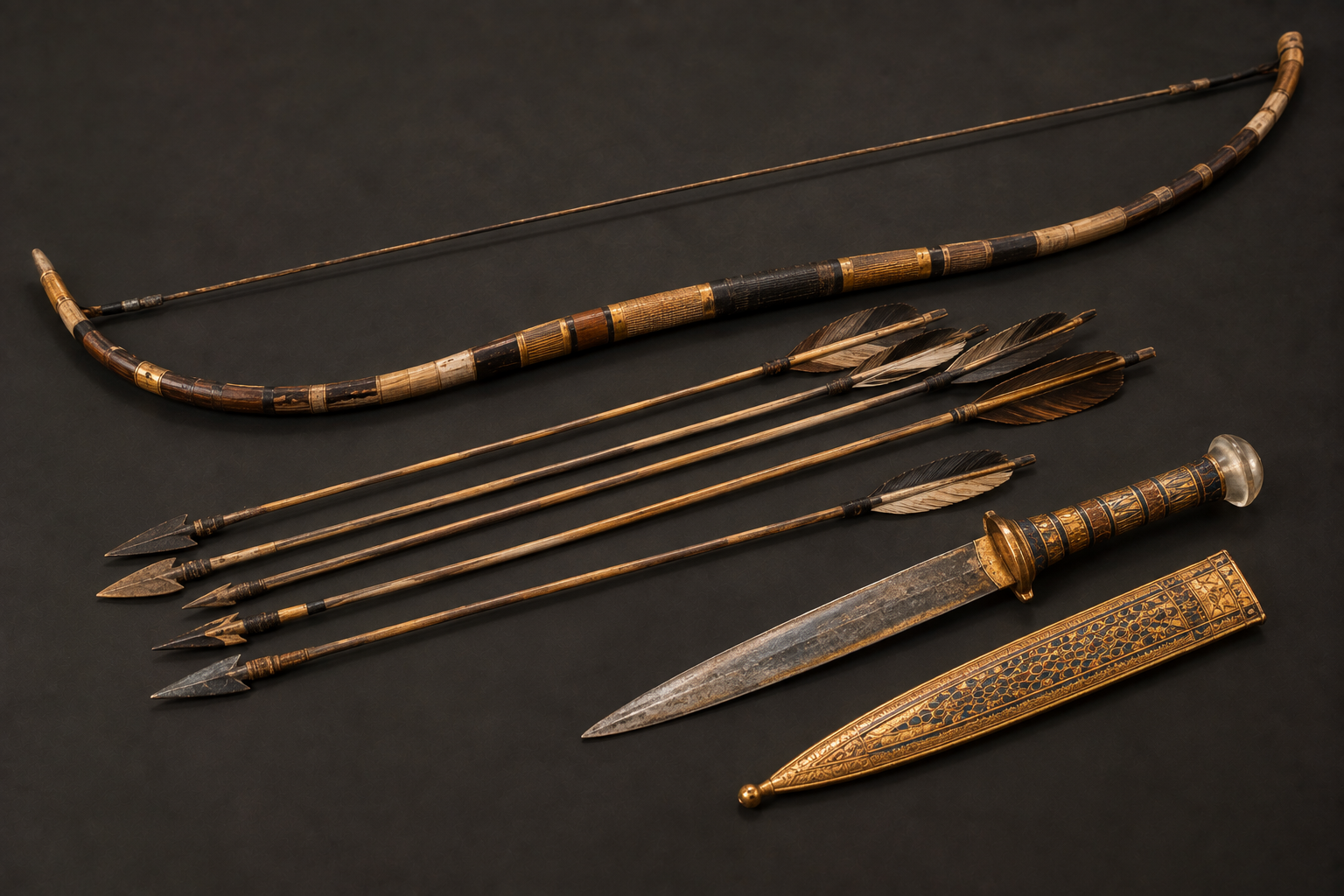

Gold is what made Tutankhamun’s tomb famous. But among its thousands of objects were items designed around very different actions: shooting, cutting, striking, throwing, and defending.
The young king was buried with an extraordinary range of weapons. Bows and arrows were especially well represented, but the collection also included daggers, shields, clubs, throw-sticks, slings, and related equipment. Some pieces were richly decorated and closely connected with royal display. Others were surprisingly plain and practical.
That contrast raises a more interesting question than simply asking what weapons were found. Do these objects prove that Tutankhamun was an experienced warrior? Or do they tell us more securely about archery, hunting, military technology, craftsmanship, royal identity, and the preparations made for a king’s burial?
Quick Context
- King: Tutankhamun
- Dynasty: Eighteenth Dynasty
- Period: New Kingdom
- Tomb: KV62, Valley of the Kings
- Discovery: 1922
- Age at death: Approximately 19 years
- Weapons represented: Bows, arrows, daggers, shields, clubs, throw-sticks, slings, and related equipment
- Archery: One of the strongest weapon groups represented in the tomb
- Famous iron dagger: Its blade was made from meteoritic iron
- Possible contexts: Hunting, warfare, royal display, ceremony, and burial
- Key caution: Weapons found in KV62 do not by themselves prove that Tutankhamun personally used them in battle
A Tomb Filled With Weapons
Tutankhamun’s weapons were not stored together in a single royal armory.
They appeared in different parts of KV62 and in different archaeological contexts. Bows and arrows were stored in boxes, other examples were positioned around the burial shrines, and weapons were also recorded among the crowded contents of the Annex.
This distribution immediately warns us against treating the collection as one uniform group.
Some objects were practical weapons.
Some were richly decorated royal possessions.
Others were ceremonial or funerary versions of weapon forms.
There were even bows and arrows placed near the king’s sarcophagus that Howard Carter identified as dummy examples rather than ordinary functional archery equipment.
That distinction is fundamental.
If every bow in the tomb were automatically described as a weapon Tutankhamun used, the archaeological evidence would be distorted before interpretation even began.
The word “weapon” describes an object’s form, but not necessarily its entire history. A bow could be practical, ceremonial, symbolic, funerary, or combine more than one of those roles.
The collection also ranged from spectacular to remarkably ordinary.
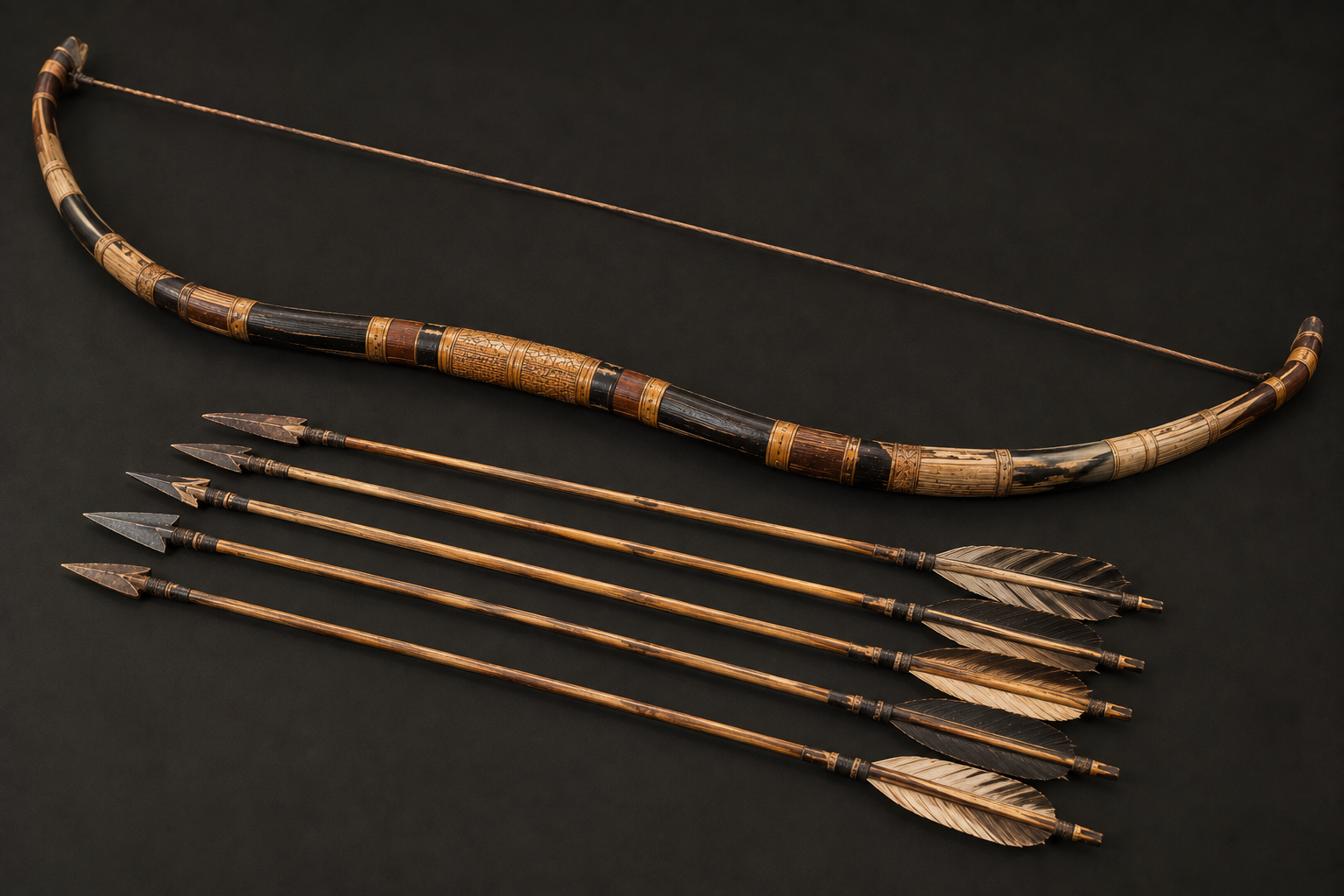
Harry Burton’s excavation photographs preserve arrows with visible shafts, tips, and feather fletching, while other photographs document simple slings that look almost modest beside Tutankhamun’s famous gold-covered treasures.
This contrast is one of the most revealing features of the burial.
The tomb did not contain only idealized royal display pieces. It also preserved objects whose construction was closely connected with the practical technologies of hunting and weaponry.
Why Were Weapons Buried With Tutankhamun?
There is no single explanation that fits every weapon in KV62.
For some objects, practical use is a serious possibility. Others clearly emphasize royal status or ceremony. Still others belonged specifically to the organization and symbolism of the burial.
Weapons also occupied several overlapping worlds in New Kingdom Egypt.
Weapons for Hunting
Archery and projectile weapons were important in hunting.
Royal imagery could show the king hunting animals from a chariot, while throw-sticks were strongly associated with hunting birds in marsh environments.
These activities were not identical to warfare, even though some of the same technologies could appear in both.
Weapons for Warfare
Bows, arrows, shields, clubs, and other weapons also belonged to the military world of New Kingdom Egypt.
Egypt’s armies used projectile and close-range weapons, while the introduction and development of technologies such as the composite bow increased the range of equipment available to warriors.
Weapons as Royal Symbols
A king’s martial image went beyond his personal experience with individual weapons.
Egyptian royal art repeatedly represented the king as powerful, victorious, and capable of overcoming disorder and foreign enemies.
A weapon could therefore communicate authority even when its archaeological context did not demonstrate battlefield use.
Weapons in Burial
Finally, the tomb itself changed the meaning of an object.
Placing weapons with the dead king made them part of his funerary equipment. Some could have existed before the burial, while others were ceremonial, symbolic, or specifically prepared for the burial environment.
This is the same interpretive problem encountered with Tutankhamun’s large collection of sticks and staffs: presence in KV62 is important evidence, but it does not automatically tell us how every object was used during the king’s lifetime.
Tutankhamun’s Bows
If one weapon technology stands out in Tutankhamun’s tomb, it is archery.
The quantity and diversity of bows, arrows, bow cases, and related equipment were substantial enough that modern scholarship has devoted specialist studies to the composite bows and self bows from KV62.
This was not a collection of one generic bow repeated many times.
Different construction methods, dimensions, materials, and purposes were represented.
Some bows were simple in technological principle.
Others were highly sophisticated composite weapons.
Some were decorated.
And some examples associated with the burial shrines were dummy bows whose role cannot be understood as ordinary hunting or battlefield equipment.
Together, they preserve an unusually rich cross-section of New Kingdom archery technology.
The Large Bow Boxes
Some of Tutankhamun’s archery equipment was kept in purpose-made containers.
Carter’s excavation records describe bow boxes holding substantial groups of bows and arrows. These containers mattered because long bows, fragile strings, arrows, and related equipment needed organization and protection.
The boxes also show that archery equipment was treated as a collection of interconnected objects rather than simply a pile of individual weapons.
A bow needed arrows.
Arrows needed suitable shafts, fletching, and points.
The equipment needed to be stored and transported without unnecessary damage.
In a royal context, the container itself could also become an elaborate object.
This makes the archery collection particularly valuable archaeologically. Instead of preserving only isolated arrowheads, KV62 retained larger parts of the complete technological system around the bow.
Composite Bows and Self Bows
The difference between a self bow and a composite bow is more than cosmetic.
A self bow is fundamentally formed from a single main piece of wood. Its performance depends heavily on the qualities, length, thickness, and shaping of that wooden stave.
A composite bow uses multiple materials engineered together.
Wood forms the core, while other organic materials can be added in carefully arranged layers to exploit different mechanical properties. The result can store considerable energy in a bow that is relatively compact compared with a long simple wooden bow.
Producing one required specialist knowledge.
The materials had to be selected, shaped, joined, and allowed to work together under repeated tension.
That complexity is one reason Tutankhamun’s archery collection matters beyond the biography of the young king.
It preserves evidence for technological expertise.
At the same time, simple bows did not become meaningless just because more complex composite technology existed. Different forms could remain useful for different circumstances.
Tutankhamun’s tomb preserves more than “bows and arrows.” It preserves evidence for different approaches to bow construction, storage, projectile design, decoration, and funerary use.
The Arrows Found in the Tomb
Arrows may look less spectacular than a gold dagger, but they are among the most informative weapons from KV62.
Harry Burton photographed groups of them in extraordinary detail.
His images record long shafts, different types of tips, and surviving feather fletching. Because arrows are composite objects made from several materials, such preservation is especially valuable.
An arrow is not simply a pointed stick.
The shaft has to be straight enough to fly predictably.
Its weight and balance matter.
Fletching helps stabilize flight.
The point or end treatment can be adapted according to the intended task.
Even small differences can change how a projectile behaves.
The arrows therefore give us a more detailed view of Egyptian archery than a decorated representation of a king shooting from a chariot ever could.
Artwork shows the idea of archery.
The surviving arrows show how the technology was physically constructed.
Why the Arrows Were Not All the Same
Carter was struck by the variety of arrows in the tomb and attempted to interpret different forms according to their likely functions.
Modern interpretation has to be somewhat more cautious than assigning every shape to one precise target.
Even so, the diversity is significant.
Different points and shaft configurations could change penetration, impact, flight behavior, and suitability for particular hunting or military situations.
Some projectiles were better suited to piercing.
Others could emphasize impact rather than deep penetration.
Different quarry in hunting also created different requirements.
The important conclusion is not that archaeologists can identify the exact animal or enemy intended for every arrow.
It is that Egyptian archery technology was specialized enough to produce multiple projectile forms rather than relying on one universal design.
Was Tutankhamun Really an Archer?
Howard Carter believed archery had been personally important to Tutankhamun.
It is easy to understand why.
The tomb contained extensive archery equipment, and images associated with the king show him using the bow in hunting and martial settings.
But Carter’s interpretation should not be transformed into a modern certainty about Tutankhamun’s personality or skill.
Royal education and elite life made familiarity with archery plausible. The large quantity of equipment also shows that archery occupied an important place within Tutankhamun’s royal environment.
What the objects cannot tell us is exactly how skilled he was.
We cannot reconstruct how often he practiced, how accurately he shot, or which surviving bow he personally preferred.
Royal images require similar caution.
A scene showing a king shooting magnificently from a chariot belongs to an artistic tradition that presents royal power in an ideal form. It should not automatically be read like a modern photograph of an individual event.
Archery was strongly represented in Tutankhamun’s possessions and royal imagery. That makes personal familiarity plausible, but it does not allow us to measure his actual skill with a bow.
Hunting or Warfare?
One reason Tutankhamun’s weapons are difficult to interpret is that modern categories do not always fit them neatly.
A bow can be a hunting weapon.
The same basic technology can be used in war.
A projectile designed for one purpose may have close relatives used for another.
Throw-sticks are strongly associated with hunting birds, while shields belong much more directly to defense and combat. Clubs and bows can occupy broader functional territory.
Royal imagery complicates the issue further because hunting itself could communicate qualities expected of a king: control, strength, precision, and dominance over dangerous forces.
We therefore should not ask only, “Is this a hunting weapon or a military weapon?”
A better question is, “What does the object’s construction and context allow us to say about its likely function?”
This object-by-object approach prevents a tomb full of varied equipment from being turned into a fictional battlefield arsenal.
The Daggers Buried With Tutankhamun
The weapons found directly with Tutankhamun’s mummy bring us closer to the king’s burial than almost any bow or arrow stored elsewhere in KV62.
Among them were daggers positioned within the elaborate layers surrounding his body.
The most famous is the iron-bladed dagger.
Its importance comes from an extraordinary combination of material, craftsmanship, preservation, and archaeological context.
Yet even here, proximity to the king’s body does not prove a history of combat.
The dagger was part of the carefully constructed burial arrangement.
To understand it, we have to separate two questions:
What was the dagger physically capable of doing?
And:
What role did this particular dagger play before and during the burial?
The first can be approached through its construction.
The second is much harder.
The Famous Iron Dagger
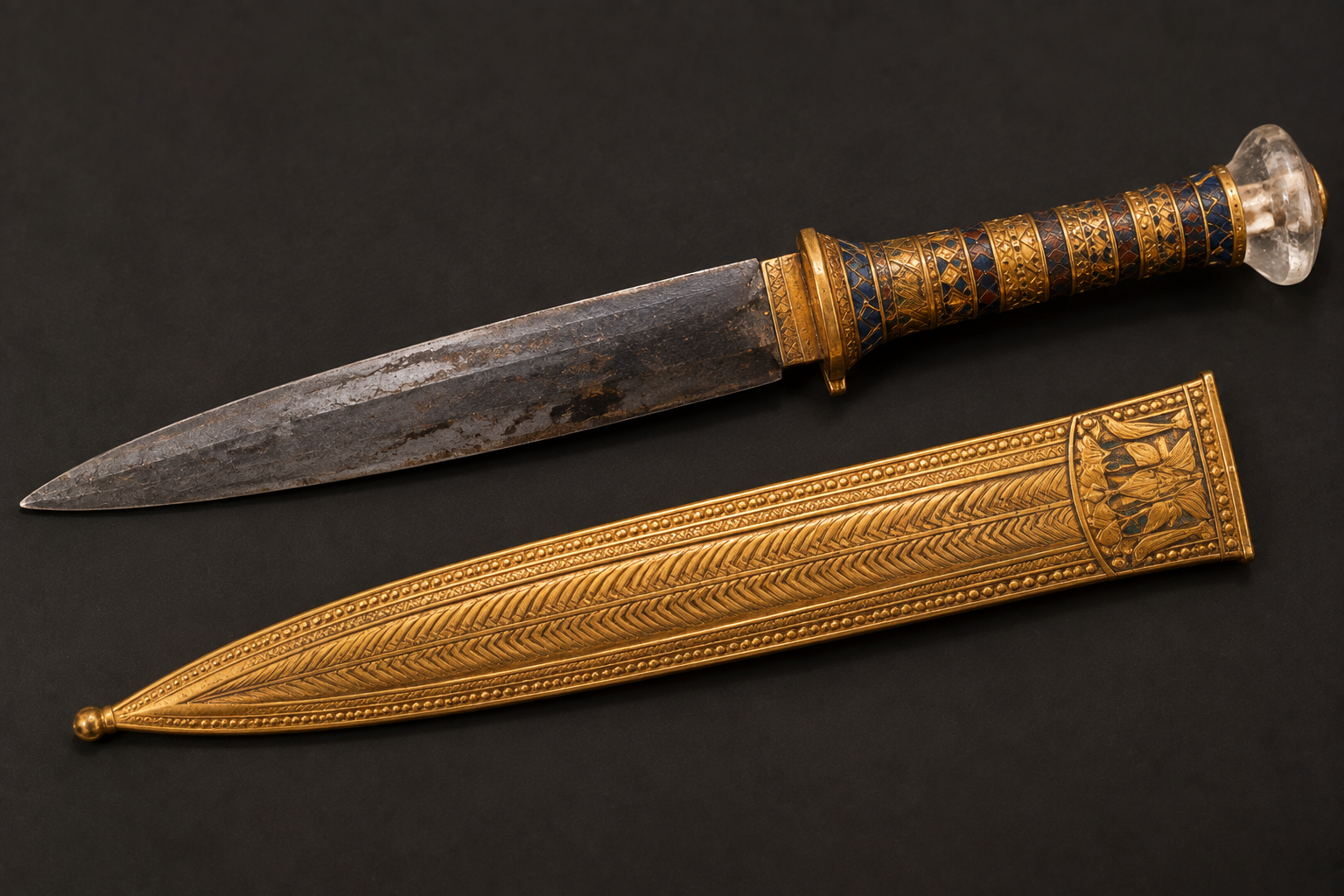
Carter’s object record places the dagger along Tutankhamun’s right thigh, with the point extending toward the area above the knee.
Its total recorded length was approximately 34.2 centimeters.
The blade itself was iron.
Carter described it as remarkably clean apart from a few rust spots and noted that its edge was very sharp.
The rest of the object was far more elaborate.
The haft combined gold work with cloisonné decoration, colored glass and stones, while the pommel was made from crystal. The accompanying sheath was fashioned from sheet gold and carried embossed decoration.
That combination creates a striking contrast.
The blade is visually restrained.
The handle and sheath proclaim extraordinary craftsmanship.
The dagger would already be exceptional if its story ended there.
It does not.
Was the Iron Really From a Meteorite?
Yes.
Modern scientific analysis has shown that the metal in Tutankhamun’s iron dagger is consistent with meteoritic iron.
Iron meteorites naturally contain substantial nickel along with characteristic trace elements. Analysis of the dagger’s composition provided the evidence needed to distinguish its metal from ordinary terrestrial iron produced through later smelting traditions.
Further research has examined the internal pattern preserved in the blade and the way the metal was worked, adding information about the type of meteorite and the manufacturing process.
The important point is often lost behind sensational descriptions of a “space dagger.”
The finished weapon did not fall from the sky.
Its raw iron ultimately came from meteoritic material, but human craftspeople had to recognize that unusual metal, work it, shape the blade, produce the elaborate handle and sheath, and turn the materials into a royal object.
The meteorite supplied the iron. Human craftsmanship created Tutankhamun’s dagger.
Why the Iron Blade Was Extraordinary
Tutankhamun lived in the Late Bronze Age, before iron became the dominant material for weapons and tools across the region.
That historical context makes the dagger particularly important.
Iron objects existed, but worked iron remained unusual compared with the much broader Bronze Age traditions of copper and copper alloys.
Meteoritic iron offered access to metallic iron without requiring the later large-scale iron-smelting technology that would transform metalworking.
This does not mean we should casually repeat the claim that iron was simply “more valuable than gold.”
Directly comparing the economic value of two materials across ancient contexts is much more complicated.
What we can say securely is that iron was rare and exceptional in Tutankhamun’s Egypt, while gold was already a deeply established material within elite Egyptian craftsmanship.
The dagger therefore brought together two very different materials.
One was visually brilliant and culturally familiar in royal luxury.
The other was technologically unusual.
That combination helps explain why the object remains one of the most discussed weapons from KV62.
Tutankhamun’s Shields
Weapons designed to attack were only part of the collection.
KV62 also preserved shields.
Surviving examples demonstrate immediately why the distinction between functional and ceremonial equipment matters.
Some shields carried elaborate heraldic decoration and belong strongly to the world of royal display. Another documented example was made from hard wood and lined with cheetah skin, showing a much more substantial defensive construction.
A shield can therefore tell several stories depending on the individual object.
Its materials can reveal how defense was engineered.
Its shape can reveal how it was carried.
Its decoration can communicate royal authority.
Its context can show whether it belonged primarily to practical equipment, ceremony, or burial.
Calling all of Tutankhamun’s shields “battle shields” would erase those differences.
Clubs, Throw-Sticks and Other Weapons
The weapon collection extended beyond bows, arrows, daggers, and shields.
Wooden clubs and other striking weapons were also present, alongside curved throw-sticks and simple projectile equipment.
The throw-sticks are particularly interesting because they connect weapon technology with hunting.
Curved wooden throwing weapons were used in Egypt for hunting birds, and examples were included among Tutankhamun’s equipment.
They are sometimes described as boomerangs, but that familiar modern word can be misleading if it encourages the assumption that every example was designed to return to the thrower in the manner associated with certain Australian weapons.
It is safer to focus on their Egyptian archaeological form and use as throw-sticks.
The tomb also contained slings.
These comparatively simple objects provide an important counterweight to the visual splendor of the royal daggers and gilded ceremonial weapons.
They remind us that Tutankhamun’s burial preserved practical technologies as well as luxury craftsmanship.
A weapon did not need gold to be effective.
Practical Weapons vs Ceremonial Weapons
The diversity of Tutankhamun’s weapons becomes clearer when we stop treating them as one category.
| Weapon Type | What It May Reveal | Main Caution |
|---|---|---|
| Bows and arrows | Archery technology, hunting, projectile design, and military equipment | Their presence does not prove that Tutankhamun personally used every example |
| Iron dagger | Rare materials, advanced craftsmanship, and royal burial equipment | Its position with the mummy does not prove battlefield use |
| Shields | Defensive technology and royal martial imagery | Some examples were ceremonial or strongly symbolic |
| Clubs | Forms of close-range striking weapon | Function must be assessed object by object |
| Throw-sticks | Projectile technology and hunting practices | Not every curved example should be interpreted as a returning boomerang |
| Slings | Simple and potentially practical projectile technology | Presence in the burial cannot establish personal use by the king |
| Dummy or ceremonial weapons | Royal symbolism, burial practice, and the importance of weapon forms | They should not be counted automatically as functional combat equipment |
The contrast is not a problem to be solved.
It is one of the most valuable things about the collection.
The tomb preserves the same weapon forms across practical, luxury, ceremonial, and funerary contexts.
That allows us to see how an object designed around violence or hunting could also become a carrier of royal meaning.
Weapons Placed Close to the King’s Body
Location inside the burial matters.
The iron dagger was placed along Tutankhamun’s right thigh, making it part of the carefully arranged equipment directly associated with the mummy.
Bows and arrows also appeared in the protected space around the sarcophagus and nested shrines.
But here the archaeological evidence gives us an especially useful warning.
Carter identified a pair of long bows and a group of arrows on the north side of the burial arrangement as dummy examples.
They looked like weapons.
They occupied an important place close to the king.
Yet their function was not equivalent to an ordinary bow ready to be strung and shot.
This single example demonstrates why the physical presence of weapons near Tutankhamun cannot be translated automatically into stories of personal combat.
The burial was an intentionally constructed environment.
Objects could be selected and positioned because of what they represented as well as what they could physically do.
Some bows and arrows placed near Tutankhamun’s sarcophagus were identified by Carter as dummy examples. Their presence shows how weapon forms could become part of burial symbolism rather than simply functioning as equipment for combat.
What the Weapons Reveal About Craftsmanship
Even when a weapon cannot tell us who used it, it can reveal a great deal about the people who made it.
The composite bows required knowledge of several materials and how they behaved under tension.
Arrow makers needed to produce straight shafts, attach fletching, balance the projectile, and prepare suitable tips.
Shield makers combined structural materials with coverings and decoration.
Metalworkers created blades and fittings.
Goldsmiths transformed weapon handles and sheaths into royal luxury objects.
The iron dagger brings several of these specialist traditions together in a single artifact.
Its meteoritic blade required one kind of knowledge.
Its goldwork required another.
The colored inlays and crystal pommel added further materials and techniques.
The result was not simply a weapon decorated after manufacture. It was a carefully integrated object in which material technology and royal craftsmanship worked together.
This is one reason the weapons belong naturally beside the everyday and personal objects found in Tutankhamun’s tomb.
They reveal not only what existed around the king, but also the extraordinary range of specialist skills available within the royal world of the late Eighteenth Dynasty.
Do the Weapons Prove Tutankhamun Fought in Battle?
No surviving weapon from KV62 can, by itself, prove that Tutankhamun personally fought in battle.
This distinction is essential because the tomb contains exactly the kind of evidence that can tempt us into building a dramatic biography around the young king.
He had bows.
He had arrows.
He was buried with daggers and shields.
Royal imagery could present him hunting or attacking enemies.
Put those facts together too quickly and it becomes easy to describe Tutankhamun as a proven battlefield warrior.
Archaeology does not take us that far.
Weapons belonged naturally to the world of New Kingdom kingship. Military power was fundamental to the Egyptian state, and the king was represented as its supreme defender and victorious leader.
That ideological role existed whether or not a particular royal image recorded a literal event.
Likewise, possession of a weapon does not establish the circumstances in which it was used.
A bow could have been used for hunting or training.
A decorated weapon could have served royal display.
A weapon form could be reproduced specifically for ceremonial or funerary purposes.
Some practical equipment may indeed have been used during Tutankhamun’s lifetime, but connecting an individual object to a specific battle requires evidence that the tomb does not provide.
Tutankhamun’s tomb preserves the weapons of a royal world. It does not preserve a record of the battles he personally fought.
Royal Images of the King as Warrior
The distinction becomes even more important when we compare the surviving weapons with images of Tutankhamun.
Royal objects from his reign show the king in dynamic scenes of hunting and domination.
One of the best-known examples is the painted chest from the tomb, which depicts Tutankhamun shooting arrows from a chariot while enemies fall before him. Other imagery presents the king hunting animals and asserting control over dangerous forces.
These scenes are valuable historical evidence.
But they are not documentary photographs.
Egyptian royal imagery followed long-established conventions. The king could be shown larger, stronger, more controlled, and more successful than everyone around him because the image communicated an ideal of kingship.
The victorious king represented power, protection, and the defeat of forces threatening Egyptian order.
That does not mean every scene was invented.
It means the image alone cannot establish that a depicted event happened exactly as shown.
The safest approach is to use the physical weapons and royal imagery together while recognizing what each type of evidence can actually demonstrate.
The objects show that archery and weapon technology belonged to Tutankhamun’s material environment.
The images show that martial and hunting ability formed part of his royal representation.
Neither source independently provides a detailed military biography.
Weapons and Chariots Belonged to the Same Royal World
The relationship between archery and chariotry is particularly important in the New Kingdom.
A chariot offered speed and mobility, while a composite bow allowed arrows to be launched from a moving platform.
Royal imagery repeatedly brought the two technologies together.
Tutankhamun’s tomb preserved both.
This makes the weapons especially useful when viewed as part of a larger technological system rather than as isolated objects.
A bow tells us about projectile technology.
An arrow tells us about aerodynamics, materials, and specialized manufacture.
A chariot tells us about mobility, woodworking, wheel construction, harnessing, and horses.
Together they reveal the technical environment associated with elite hunting, military power, and royal representation.
But once again, the survival of the equipment does not automatically prove that every scene showing Tutankhamun shooting from a chariot records an event from his personal experience.
The distinction between technology and biography has to remain clear.
Could Some Weapons Have Been Tutankhamun’s Personal Possessions?
Yes, and this possibility should not be lost in our caution.
Responsible interpretation does not require assuming that every weapon was purely symbolic.
KV62 contained objects that almost certainly had histories before the burial, alongside objects made or adapted specifically for funerary purposes.
Some weapons and hunting equipment could have belonged to Tutankhamun’s living royal environment.
Signs of use, repair, wear, construction, and storage can sometimes help archaeologists investigate those histories.
But even genuine ancient wear has limits.
A worn grip may suggest repeated handling without identifying the person who held it.
A damaged arrow may have been used without revealing who shot it.
A repaired bow may have had a practical history without proving that Tutankhamun himself performed the activity.
That is why the distinction between an object’s biography and the king’s biography matters so much.
An object can show evidence of ancient use without identifying its ancient user. Wear on a weapon is potentially valuable evidence, but it should not automatically be attributed to Tutankhamun personally.
Why Simple Weapons Matter as Much as Gold Ones
The spectacular weapons naturally attract the most attention.
A dagger with a meteoritic iron blade, gold handle, crystal pommel, and decorated sheath is difficult to ignore.
But some of the less glamorous equipment can tell us just as much about ancient technology.
A simple sling reveals how a small amount of fiber could become an effective projectile device.
A plain arrow preserves choices about shaft material, balance, fletching, and point design.
A wooden throw-stick records a hunting technology requiring none of the precious materials associated with royal luxury.
These objects help correct a distorted image of Tutankhamun’s tomb as a place made entirely of gold.
KV62 contained extraordinary luxury, but it also contained wood, fiber, leather, plant material, simple tools, clothing, food containers, board games and gaming equipment, and many other objects connected with recognizable technologies of life.
The weapons fit that wider pattern.
Some demonstrate wealth.
Others demonstrate practical engineering.
Several do both.
What the Iron Dagger Does Not Prove
The meteoritic dagger deserves one additional caution because its fame has generated several exaggerated claims.
Scientific analysis establishes the extraterrestrial origin of the iron.
It does not establish that Tutankhamun found a meteorite.
It does not tell us that he watched it fall.
It does not prove that Egyptian craftspeople themselves collected the original meteorite.
And it does not demonstrate that Tutankhamun carried the dagger in battle.
The material could have moved through networks of exchange before reaching the workshop where the dagger was produced.
Scholars have also investigated whether the finished object or its material may have had connections beyond Egypt, but questions of exact manufacturing location and transmission require evidence beyond simply identifying meteoritic iron.
The strongest conclusion remains straightforward.
The blade was manufactured from meteoritic iron and combined with exceptionally sophisticated royal craftsmanship before being placed with Tutankhamun’s mummy.
That is remarkable without adding an unsupported story.
Weapons Were Also Messages
A royal weapon did not communicate only through its ability to cut, shoot, or strike.
Decoration could transform it into a political and symbolic object.
Images of subdued enemies, royal names, precious materials, and carefully controlled compositions connected weapon forms with the authority of the king.
This principle appears elsewhere in Tutankhamun’s burial.
Some of his sticks incorporated representations of foreign captives, while certain footwear used images of traditional enemies beneath the king.
The physical relationship carried meaning.
An enemy could be placed beneath the royal foot, held within the king’s grasp, or shown defeated before him.
Weapons belonged naturally to this visual language of control.
That does not reduce them to decoration.
Instead, it shows that a royal object could operate on several levels at once.
A weapon might be functional.
It might demonstrate wealth.
It might embody specialist technology.
And its decoration might communicate the political ideals attached to kingship.
What Burial Changed About the Weapons
Whatever histories Tutankhamun’s weapons had during life, entering KV62 gave them a new context.
They became part of a carefully assembled royal burial.
Some were stored with other equipment.
Some appeared among the crowded contents of subsidiary chambers.
Some weapon forms were placed close to the sarcophagus.
The iron dagger was positioned directly with the mummy.
That arrangement matters because funerary placement was intentional even when the original practical history of an object is uncertain.
Weapons could contribute to the identity and protection of the buried king, while royal martial imagery reinforced ideas of power and victory.
At the same time, the presence of practical equipment fits the broader pattern seen throughout KV62: the burial contained an enormous range of objects drawn from the material world around royalty.
The distinction between life and burial was therefore not always absolute.
An object could have one history before Tutankhamun’s death and acquire another meaning once incorporated into the tomb.
How Ancient Disturbance Complicates the Evidence
The location of objects inside KV62 must also be interpreted in light of ancient disturbance.
The tomb had been entered and disrupted before Carter’s discovery.
The Annex in particular contained a dense and confusing mass of material.
Objects had been moved.
Components became separated.
Items originally associated with one another were not always found together.
This makes Carter’s records, object cards, plans, drawings, and Harry Burton’s photographs especially valuable.
They preserve the excavation context before the objects were completely removed and reorganized for conservation, storage, and display.
The same issue appeared with Tutankhamun’s game boxes, whose scattered components required archaeological reconstruction.
Weapons could present similar problems.
A loose arrow or detached component does not explain itself.
Its dimensions, material, decoration, condition, and discovery context have to be compared with the rest of the assemblage.
This is why Carter’s system for documenting the thousands of objects from KV62 remains so important to modern study.
Harry Burton Preserved Details That Could Have Been Lost
Weapons made from organic materials are especially vulnerable to deterioration.
Wood can split and warp.
Fibers weaken.
Adhesives fail.
Feathers are fragile.
Composite objects can separate as their different materials respond differently to environmental change.
Harry Burton’s photographs therefore preserve more than the appearance of Tutankhamun’s discoveries.
They provide archaeological evidence.
His images of arrows, slings, bows, and other objects captured details of construction and condition during the excavation period.
When an object later deteriorates, is conserved, or has components repositioned, an early photograph can become an essential record of its previous state.
This is one reason Harry Burton’s photographic record of Tutankhamun’s tomb remains scientifically valuable rather than merely visually impressive.
What the Weapons Cannot Tell Us
Tutankhamun’s weapons provide exceptional evidence, but they have limits.
They cannot prove that Tutankhamun personally fought in a specific battle.
They cannot tell us that he killed an enemy with one of the surviving weapons.
They cannot establish that every bow was personally used by him.
They cannot show that every arrow was shot during his lifetime.
They cannot turn every royal battle image into a literal historical report.
They cannot prove that every decorated shield was designed for battlefield defense.
They cannot establish that the meteoritic iron dagger was ever used in combat.
And even when an object shows genuine ancient wear, that wear does not automatically identify Tutankhamun as the person responsible for it.
These limitations do not make the collection less valuable.
They help define what the evidence can actually tell us.
| Evidence | What We Can Reasonably Say | What It Does Not Prove |
|---|---|---|
| Numerous bows and arrows | Archery was strongly represented in Tutankhamun’s royal and funerary environment | That every bow was personally used by the king |
| Different arrow forms | New Kingdom archery employed specialized projectile designs | The exact target of every surviving arrow |
| Meteoritic iron dagger | Rare meteoritic iron was worked into an exceptionally sophisticated royal blade | That Tutankhamun carried the dagger into battle |
| Shields | Defensive weapon forms and royal martial imagery were represented in the burial | That every shield was battlefield equipment |
| Throw-sticks and slings | Simple projectile and hunting technologies were included alongside luxury weapons | That Tutankhamun personally used every example |
| Royal battle imagery | Martial victory formed an important part of Tutankhamun’s royal representation | That every depicted scene records a literal historical event |
Why the Collection Matters
The weapons found inside Tutankhamun’s tomb matter because they preserve far more than an ancient arsenal.
They preserve technology.
The bows show different solutions to storing and releasing energy.
The arrows reveal careful control of shafts, fletching, balance, and points.
The shields preserve approaches to defense.
The throw-sticks and slings reveal comparatively simple projectile technologies.
The daggers bring together metalworking, luxury craftsmanship, and extraordinary materials.
The collection also preserves social meaning.
Hunting belonged to elite and royal life.
Military power belonged to kingship.
Decorated weapons could communicate authority.
Funerary versions show that the form of a weapon could remain meaningful even when practical combat was not its purpose.
Most importantly, the collection teaches us to separate evidence from assumption.
Tutankhamun’s weapons can tell us much more securely how New Kingdom weapons were made than exactly how the young king used them.
That is not a disappointing conclusion.
It is what makes the collection so useful.
Instead of forcing every object into a dramatic story about a warrior king, we can use the surviving evidence to reconstruct a much richer world of archery, hunting, craftsmanship, royal imagery, military technology, and burial practice.
Frequently Asked Questions
What weapons were found in Tutankhamun’s tomb?
The tomb contained a diverse collection including bows, arrows, daggers, shields, clubs, throw-sticks, slings, and related archery equipment. Some objects were practical in construction, while others were ceremonial, symbolic, or specifically connected with the burial.
Were bows and arrows found in Tutankhamun’s tomb?
Yes. Archery equipment was one of the strongest weapon groups represented in KV62. Different bows, numerous arrows, bow boxes, and related equipment were documented in the tomb.
What is the difference between a self bow and a composite bow?
A self bow is fundamentally made from one main piece of wood. A composite bow combines several materials engineered to work together, allowing considerable energy to be stored in a relatively compact weapon.
Did Tutankhamun personally use his bows?
Personal familiarity with archery is plausible given the royal environment, the extensive equipment, and surviving imagery. However, the tomb does not allow us to identify every bow that Tutankhamun personally used or measure his skill as an archer.
Did Tutankhamun use his weapons in battle?
There is no secure evidence demonstrating that a particular weapon from KV62 was personally used by Tutankhamun in a specific battle. The weapons reveal his royal environment and New Kingdom weapon technology more securely than his individual combat history.
Was an iron dagger found with Tutankhamun?
Yes. A famous iron-bladed dagger was found along Tutankhamun’s right thigh within the mummy’s burial arrangement. It had an elaborate gold and inlaid handle and a decorated gold sheath.
Was Tutankhamun’s dagger really made from a meteorite?
The blade was made from meteoritic iron. Scientific analysis of its composition, including its nickel content and other characteristics, supports the conclusion that the iron originated in a meteorite.
Did the entire dagger come from a meteorite?
No. The meteoritic material supplied the iron used for the blade. Craftspeople then worked that metal and combined it with an elaborate handle, goldwork, inlays, a crystal pommel, and a decorated sheath to create the finished dagger.
Why was iron unusual in Tutankhamun’s time?
Tutankhamun lived during the Late Bronze Age, before smelted iron became widely used for tools and weapons across the region. Worked iron objects were therefore comparatively rare and unusual in his period.
Were shields found in Tutankhamun’s tomb?
Yes. Several shields were found in KV62. They varied in construction and decoration, and not every example should be assumed to have been intended for practical battlefield use.
Were there simple weapons in the tomb as well as gold ones?
Yes. Tutankhamun’s burial contained comparatively plain equipment such as arrows, slings, wooden clubs, and throw-sticks alongside richly decorated royal and ceremonial weapons.
Were boomerangs found in Tutankhamun’s tomb?
Curved wooden throw-sticks were found in the tomb and have often been described as boomerangs. However, the modern term can be misleading because it should not be assumed that every Egyptian example was designed to return to the thrower. Throw-sticks were particularly associated with hunting birds.
Were all the weapons in Tutankhamun’s tomb functional?
No. The collection included practical weapon forms as well as ceremonial and funerary examples. Carter even identified dummy bows and arrows among objects placed near the burial arrangement.
Why were weapons placed in Tutankhamun’s tomb?
Different weapons may have entered the burial for different reasons. Some may have been possessions from the royal environment, while others emphasized hunting, military power, royal authority, protection, ceremony, or funerary symbolism.
Do Tutankhamun’s weapons prove he was a warrior king?
The weapons show that martial identity, archery, hunting, and military technology were important within Tutankhamun’s royal world. They do not, by themselves, provide enough evidence to reconstruct a personal battlefield career.
Final Thoughts
Tutankhamun went to his tomb surrounded by far more than gold.
His burial preserved bows engineered from different materials, carefully made arrows, shields, clubs, throw-sticks, simple slings, ceremonial weapon forms, and beautifully crafted daggers.
Among them was one of the most remarkable blades to survive from the Bronze Age: a dagger whose iron began as material from a meteorite.
But the most important lesson of the collection is not that Tutankhamun possessed extraordinary weapons.
It is that those weapons did not all mean the same thing.
A bow could be practical equipment or a funerary object.
An arrow could preserve sophisticated projectile technology without telling us who fired it.
A shield could provide defense or communicate royal power.
A throw-stick could belong to hunting rather than warfare.
A dagger could be physically capable of cutting while also serving as an extraordinary object within a royal burial.
And an image of Tutankhamun defeating enemies could express the ideal power of kingship without functioning as a literal record of a particular battle.
Separating those possibilities gives us a clearer picture of the young king’s world.
The weapons reveal a society with highly developed archery, specialist craftspeople, sophisticated knowledge of organic and metallic materials, established hunting traditions, powerful military institutions, and a visual language that connected the king with victory and control.
What they do not give us is a battlefield diary.
We do not need one to appreciate their importance.
The surviving weapons already tell a remarkable story about technology, craftsmanship, hunting, warfare, kingship, and burial in the Egypt of Tutankhamun.